


The core negotiation skills you need are clear goal-setting, BATNA development, active listening, anchoring, calibrated questions, emotional intelligence, rapport-building, value creation through MESOs, and deliberate closing. Together, they let you protect your interests, expand what’s on the table, and reach agreements that hold. The Program on Negotiation at Harvard frames skilled negotiators as value creators first: they expand options across multiple issues before claiming their share, which consistently produces better outcomes than win-lose positioning.
Negotiation is not a talent. It’s a set of learnable moves, and the gap between a mediocre outcome and a great one usually comes down to preparation and a handful of well-timed tactics. Soft skills like negotiation drive career and financial outcomes more than most people expect.
Table of Contents
- 1. The essential negotiation skills you need to master
- How to prepare before any negotiation
- Tactical techniques and when to use each one
- Managing emotions and using advanced conversational moves
- Common mistakes and how to fix them mid-negotiation
- How to build your negotiation skills through practice
- Your immediate next steps after reading this
- Strategies for cross-cultural negotiations
- Ethical considerations in negotiation
- Negotiation in virtual and remote settings
- Key Takeaways
- Why most negotiation advice misses the point
- Finblog can help you prepare for what’s next
- Useful sources
1. The essential negotiation skills you need to master
These twelve skills form a durable checklist. Each one has a clear use case and a short tactic you can try immediately.
1. Clear communication
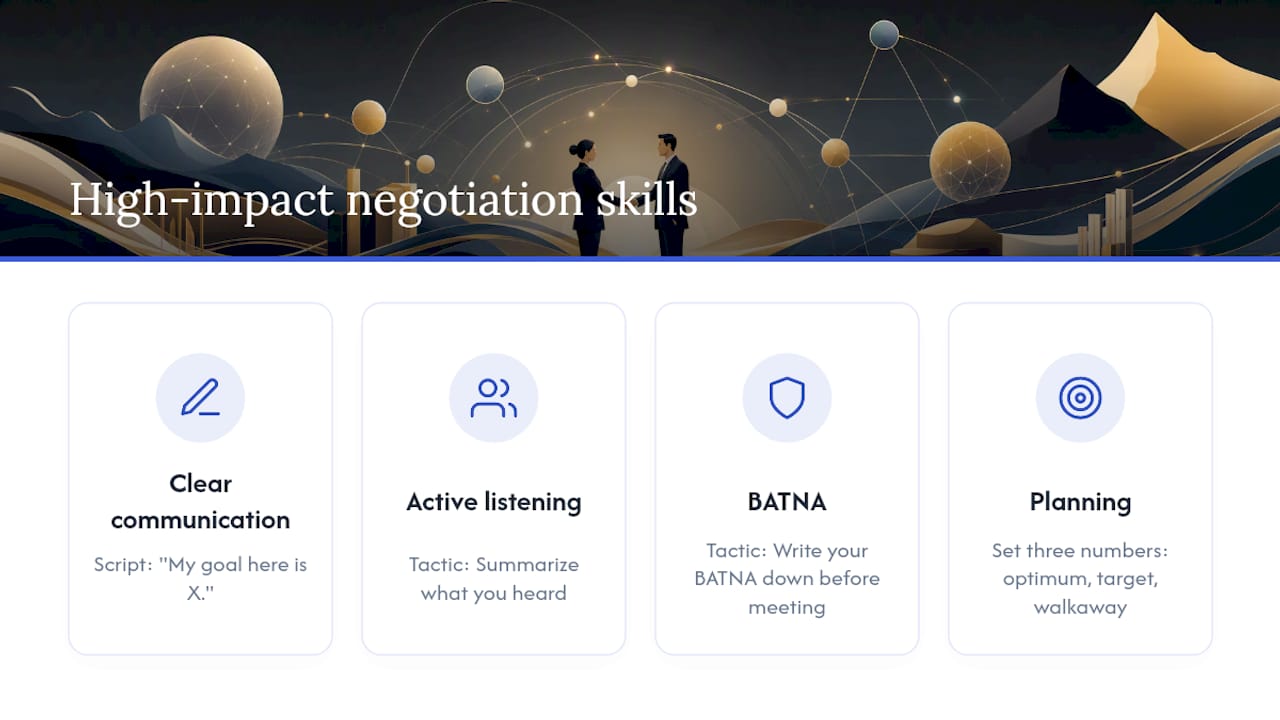
Say exactly what you want and why, without ambiguity. Vague requests invite the other party to fill the gap in their favor. Script: “My goal here is X. I’d like to understand what matters most to you so we can find something that works for both of us.”
2. Active listening
Most people listen to respond, not to understand. Real listening means tracking what the other party emphasizes, pauses on, and avoids. Tactic: Summarize what you heard before making your next point. “So if I understand correctly, your main concern is timeline, not price?”
3. Emotional intelligence
Harvard Business School Online identifies emotional intelligence as managing feelings so they don’t drive decisions. Stress and anxiety reduce effectiveness unless you actively manage them. Tactic: Before responding to a provocative offer, pause three seconds and breathe. It sounds trivial. It works.
4. BATNA (Best Alternative to a Negotiated Agreement)
Your BATNA is what you do if this deal falls apart. A strong BATNA gives you real leverage; a weak one forces concessions. Tactic: Write your BATNA down before the meeting. If you can’t name it, you’re not ready to negotiate.
5. Planning and goal-setting
Set three numbers before any negotiation: your optimum (best realistic outcome), your target (expected outcome), and your walkaway (the point below which you leave). Tactic: Anchor your opening ask to your optimum, not your target.
6. Anchoring and first offers
The first number mentioned exerts strong influence on the final outcome. PON’s research confirms that a well-supported first offer sets the frame rather than forcing you to adjust to someone else’s anchor. Script: “Based on current market data, I’m proposing $X as a starting point.”
7. Calibrated questions
Open-ended questions that start with “how” or “what” force the other party to think and reveal information. Chris Voss popularized this in high-stakes contexts. Script: “What would need to be true for this to work for your team?”
8. Rapport-building
People make concessions for people they like and trust. Small talk, mirroring language, and genuine curiosity about the other party’s situation all build rapport. Tactic: Find one genuine point of common ground before the substantive discussion starts.
9. Value creation through tradeoffs
Most negotiations have more than one issue. Trading across issues (price vs. timeline, payment terms vs. volume) creates value for both sides. Tactic: List every variable in play before the meeting. The more levers you have, the more room to trade.
10. MESOs (Multiple Equivalent Simultaneous Offers)
Present two or three offers of equal value to you but structured differently. The other party’s preference reveals what they actually care about. Script: “I can offer Option A (higher price, faster delivery) or Option B (lower price, extended timeline). Which fits you better?”
11. Contingent contracts
When parties disagree on future outcomes, a contingent contract lets each side bet on their own forecast. Script: “If revenue hits $X by Q4, we adjust the fee upward. If it doesn’t, we stay at the current rate.”
12. Closing and implementation planning
Agreements that lack clear next steps fall apart. Nail down who does what, by when, and how disputes get resolved before you leave the room. Tactic: Summarize the agreement out loud and ask for explicit confirmation before ending the meeting.
Pro Tip: In routine, low-stakes negotiations, focus on active listening and rapport. In high-stakes deals, invest the most time in BATNA development and anchoring. The skill mix shifts with the stakes.
How to prepare before any negotiation
Preparation is where most negotiations are won or lost, and it takes less time than people think. The PON Seven Elements framework gives a structured map: interests, legitimacy, options, commitments, relationships, alternatives (BATNA), and communication. Use it as your prep backbone.
Set your objectives first:
- Write your optimum, target, and walkaway numbers for every key issue.
- Separate your positions (what you’ll ask for) from your interests (why you want it). Positions are negotiable; interests usually point to creative solutions.
- Identify which issues you’d trade against each other if needed.
Research the counterpart:
- What are their likely constraints? Budget cycles, approval chains, and competitive pressures all shape what they can say yes to.
- What objective standards apply? Market rates, industry benchmarks, and published data give you legitimate anchors that are hard to argue with.
- What’s their likely BATNA? Knowing their alternatives tells you how much pressure they’re actually under.
Build and strengthen your BATNA:
- List every realistic alternative if this deal doesn’t happen.
- Actively improve at least one: get a competing offer, line up a backup supplier, or confirm a fallback option in writing.
- Rehearse walking away mentally. If you can’t picture yourself doing it calmly, your BATNA needs work.
Quick prep checklist:
- [ ] Optimum / target / walkaway set for each issue
- [ ] Counterpart’s interests and constraints mapped
- [ ] Objective standards identified (market data, benchmarks)
- [ ] BATNA named and strengthened
- [ ] Opening anchor prepared with supporting rationale
- [ ] List of variables available for tradeoffs
- [ ] Meeting logistics confirmed (time, participants, decision authority)
The financial goal-setting process maps cleanly onto negotiation prep: both require you to define success before you start, not during.
Tactical techniques and when to use each one
Knowing a tactic exists is different from knowing when to deploy it. Here’s how the main moves compare.
Anchoring and first offers
Make the first offer when you’ve done your homework. A well-researched anchor sets the frame; an uninformed one backfires by signaling weakness or ignorance. If you don’t have solid data, let the other party go first and use their number as a reference point to challenge.
Concession management
Never give a concession without getting something in return, and make your concessions smaller over time. Decreasing concession size signals you’re approaching your limit. Avoid the “split the difference” shortcut: it rewards the party who anchored more aggressively and ignores whether the midpoint is actually fair.
MESOs and contingent contracts
MESOs work best when you genuinely don’t know which package the other party prefers. Two quick examples:
- MESO script: “I’ve put together two options. Option A is $50,000 with a 60-day delivery. Option B is $45,000 with a 90-day delivery. Both work for me. Which is closer to what you need?”
- Contingent contract script: “You think the project will generate $200K in savings; I think it’ll be closer to $150K. What if we set the fee at $X base, with a bonus tied to actual savings?”
The counter-offer tactics checklist from DealFlip covers practical sequencing for structured offers that applies beyond resale contexts.
Technique comparison
| Technique | Best for | Risk | Preparation needed | Expected payoff |
|---|---|---|---|---|
| Anchoring | Setting the range early | Backfires if uninformed | High (market data required) | High when well-supported |
| Concession sequencing | Signaling limits credibly | Giving too much too fast | Medium | Medium to high |
| MESOs | Revealing counterpart priorities | Complexity in multi-issue deals | High (package design) | High (value creation) |
| Contingent contracts | Resolving forecast disagreements | Requires clear metrics | Medium | High when outcomes are measurable |
| Splitting the difference | Speed when relationship matters more than outcome | Rewards aggressive anchors | Low | Low to medium |
Pro Tip: Splitting the difference feels fair but often isn’t. Before agreeing to a midpoint, ask yourself: “Is this midpoint based on anything real, or just arithmetic?” If it’s just arithmetic, pause and look for a cross-issue trade instead.
Managing emotions and using advanced conversational moves
Negotiation jujitsu
When someone makes an aggressive demand or attacks your position, the instinct is to defend or counter-attack. Both moves escalate. PON’s negotiation jujitsu redirects that energy by asking open, clarifying questions instead.
Short dialogue example:
Counterpart: “Your price is way too high. We’ve seen this done for half that.”
You: “Could you help me understand how you arrived at that figure? I’d like to see if we’re comparing the same scope.”
That question does three things: it slows the conversation, forces the other party to justify their claim, and shifts the frame from positional combat to problem-solving.
Emotional intelligence in practice
HBS Online is direct on this: managing emotions protects decision-making. The goal isn’t to suppress what you feel but to keep feelings from driving your next move. Two techniques that work in practice:
- Label the emotion, don’t act on it. If you feel pressured, name it internally (“I’m feeling rushed”) and separate that feeling from your response.
- Reframe the stakes. Instead of “I need this deal,” try “I have a strong BATNA and I’m here to find a good fit.” The cognitive shift is small; the behavioral effect is significant.
Interests vs. positions: a short example
A buyer says they need a 30% discount (position). The seller says that’s impossible (position). Deadlock. But if the seller asks why the buyer needs that discount, the answer might be: “Our budget cycle closes in two weeks and I can only approve $X this quarter.” That’s the interest. The solution might be a phased payment across two quarters at full price, which costs the seller nothing and solves the buyer’s real problem.
Distinguishing positions from interests is the single biggest practical shift new negotiators can make. Once interests are visible, cross-issue trades become obvious.
“Skilled negotiators expand the pie before dividing it — they treat negotiation as a mix of value creation and value claiming, not a zero-sum contest.” — Program on Negotiation, Harvard Law School
Pro Tip: When you hit a wall, ask “What would make this work for you?” It’s not a concession. It’s an invitation to reveal interests, and it almost always moves the conversation forward.
Common mistakes and how to fix them mid-negotiation
Stanford GSB identifies a consistent set of errors that reduce outcomes. Most are fixable once you know what to look for.
Top mistakes:
- Poor planning. Showing up without a BATNA or a walkaway point puts you at the mercy of the other party’s preparation.
- Fixed-pie thinking. Assuming the deal is zero-sum prevents you from finding trades that make both sides better off.
- Over-relying on anchors. An anchor without supporting data is just a number. The other party will ask you to justify it, and if you can’t, you lose credibility.
- Caving too quickly. The first “no” is rarely final. Holding your position for one more exchange often produces a better outcome.
- Gloating. Celebrating a win in front of the other party damages the relationship and can unravel implementation.
Red flags from the other party and quick fixes:
- Aggressive anchor: Ask for justification. “That’s an interesting number. How did you arrive at it?”
- Silence after your offer: Don’t fill it. Silence is pressure; let it work for you.
- Guilt or emotional pressure: Use a calibrated question. “What would a fair outcome look like from your side?”
- Impasse: Call a time-out. “Let’s take 15 minutes and come back to this.” Alternatively, introduce a new variable or propose an objective standard.
Rescue script for a stalled negotiation:
“It seems like we’re stuck on [issue]. What if we set that aside for a moment and look at [different issue]? Sometimes a different angle opens things up.”
How to build your negotiation skills through practice
Reading about negotiation helps. Practicing it is what actually changes behavior. The good news: you don’t need a formal course to improve. A consistent weekly routine works.
Weekly micro-practice routine (15–60 minutes):
- Scripted roleplay (20–30 min): Pick one scenario (salary negotiation, vendor contract, client scope change). One person plays the counterpart, one negotiates. Rotate roles.
- Listening drill (10 min): Listen to a recorded conversation or podcast. Pause every two minutes and summarize what the speaker’s underlying interest is, not just what they said.
- Anchoring drill (10 min): Research a market rate for something (a service, a product, a salary band). Practice stating your anchor out loud with a one-sentence justification. Repetition builds confidence.
Structuring roleplay and feedback:
- Use an observer checklist: Did the negotiator state their interests? Did they ask calibrated questions? Did they make decreasing concessions? Did they avoid splitting the difference?
- Score progress on process, not just outcome. A negotiation where you held your anchor and gathered information is a win even if the deal didn’t close.
Metrics worth tracking:
- Outcome metrics: Closing rate, average concession size, gap between opening ask and final agreement.
- Process metrics: Number of calibrated questions asked, silence tolerance (how long you waited before speaking after an offer), number of variables introduced.
For structured negotiation training and courses, several platforms offer dedicated programs that pair theory with practice scenarios.
Your immediate next steps after reading this
You don’t need to master all twelve skills at once. Pick two, practice them this week, and build from there.
Your short action checklist:
- [ ] Identify your next negotiation (even a low-stakes one works for practice).
- [ ] Build your BATNA: name your best alternative and write it down.
- [ ] Pick two skills from the list above to focus on this week.
- [ ] Script your opening anchor with one line of supporting rationale.
- [ ] Choose one metric to track (concession size, calibrated questions asked, or silence tolerance).
- [ ] Schedule a 20-minute roleplay with a colleague or friend before your next real negotiation.
Low-stakes conversations are the best training ground. Negotiate a service fee, push back on a vendor quote, or ask for a better rate on a subscription. The mechanics are identical to high-stakes deals; the pressure is lower, which makes learning faster.
Strategies for cross-cultural negotiations
Culture shapes how people interpret silence, directness, hierarchy, and time. A tactic that signals confidence in one context can read as disrespectful in another.
A few principles that hold across most cross-cultural situations:
Do your homework on communication norms. In high-context cultures (Japan, China, many Middle Eastern countries), meaning is often conveyed indirectly. A “yes” may mean “I hear you,” not “I agree.” In low-context cultures (Germany, the Netherlands, the US), directness is expected and ambiguity reads as evasion.
Slow down on relationship-building. Many cultures expect a longer relationship-building phase before substantive negotiation begins. Pushing to the deal too quickly signals that you don’t value the relationship, which can kill trust before the numbers even come up.
Use objective standards carefully. Market data and benchmarks carry different weight depending on whether the other party views the negotiation as a problem-solving exercise or a relationship-based exchange. In relationship-oriented cultures, a rigid appeal to data can feel cold.
Watch for different attitudes toward time. Deadlines that create urgency for you may not register the same way for a counterpart from a culture with a longer time horizon. Using a deadline as leverage can backfire if the other party simply doesn’t share your sense of urgency.
The PMC practitioner review notes that timing, honesty, and pre-negotiation analysis matter in any context, but the weight each carries shifts significantly across cultures.
Ethical considerations in negotiation
Negotiation sits in a gray zone between advocacy and deception, and the line matters more than most people acknowledge.
What’s generally accepted: Stating a high opening position, withholding your walkaway point, and declining to volunteer information the other party didn’t ask for. These are standard negotiating moves.
What crosses the line: Fabricating competing offers, misrepresenting material facts, creating false urgency, or making commitments you have no intention of keeping. Beyond the ethical problem, these tactics destroy trust and often unravel deals during implementation.
The practical case for honesty: Deceptive tactics tend to work once. Honest negotiators build reputations that generate better deals over time because counterparts trust that agreements will hold. In finance and advisory contexts, where relationships span years and referrals matter, that reputation is worth more than any single deal.
The PMC review on negotiation principles and tactics is explicit: honesty and timing are core negotiation hygiene, not optional add-ons.
This article provides general educational information on negotiation. It is not legal or professional advice. For high-stakes or legally complex negotiations, consult a qualified attorney or professional advisor.
Negotiation in virtual and remote settings
Video calls and asynchronous communication change negotiation dynamics in ways that catch people off guard.
What you lose remotely: Nonverbal cues are compressed on video and disappear entirely in email. It’s harder to read discomfort, hesitation, or genuine enthusiasm. Rapport-building takes longer because the informal pre-meeting conversation that happens naturally in person rarely happens on a Zoom call.
What you can do about it:
- Build in explicit small talk at the start of video calls. It feels forced at first; it still works.
- Use the camera. Turning off video removes one of the few nonverbal channels you have left.
- Send a written summary of key points after each session. In remote negotiations, the written record carries more weight because there’s no shared physical context to fall back on.
- Be more deliberate about silence. On video, silence reads as a technical glitch. Calibrate accordingly: a brief pause is fine, but longer silences need a verbal acknowledgment (“I’m thinking about that”).
For asynchronous negotiations (email, messaging):
- Never negotiate price or major concessions in email if you can avoid it. Written offers invite anchoring without the context that makes anchors reasonable.
- Use email to confirm what was agreed verbally, not to introduce new demands.
- When you must make an offer in writing, include the rationale in the same message. A number without context invites rejection.
Key Takeaways
Preparation, BATNA development, and a handful of well-practiced tactics account for the majority of improvement most negotiators see.
| Point | Details |
|---|---|
| Build your BATNA first | Name your best alternative before any negotiation; a strong BATNA is your real source of leverage. |
| Anchor with data, not hope | Make the first offer only when you have market data to support it; unsupported anchors backfire. |
| Trade across issues | Identify every variable before the meeting so you can create value through tradeoffs, not just split the difference. |
| Practice weekly, not once | Short weekly roleplays and listening drills build negotiation instincts faster than reading alone. |
| Finblog advisory support | Finblog offers preparation guidance and financial advisory resources to help you approach high-stakes negotiations with a clear strategy. |
Why most negotiation advice misses the point
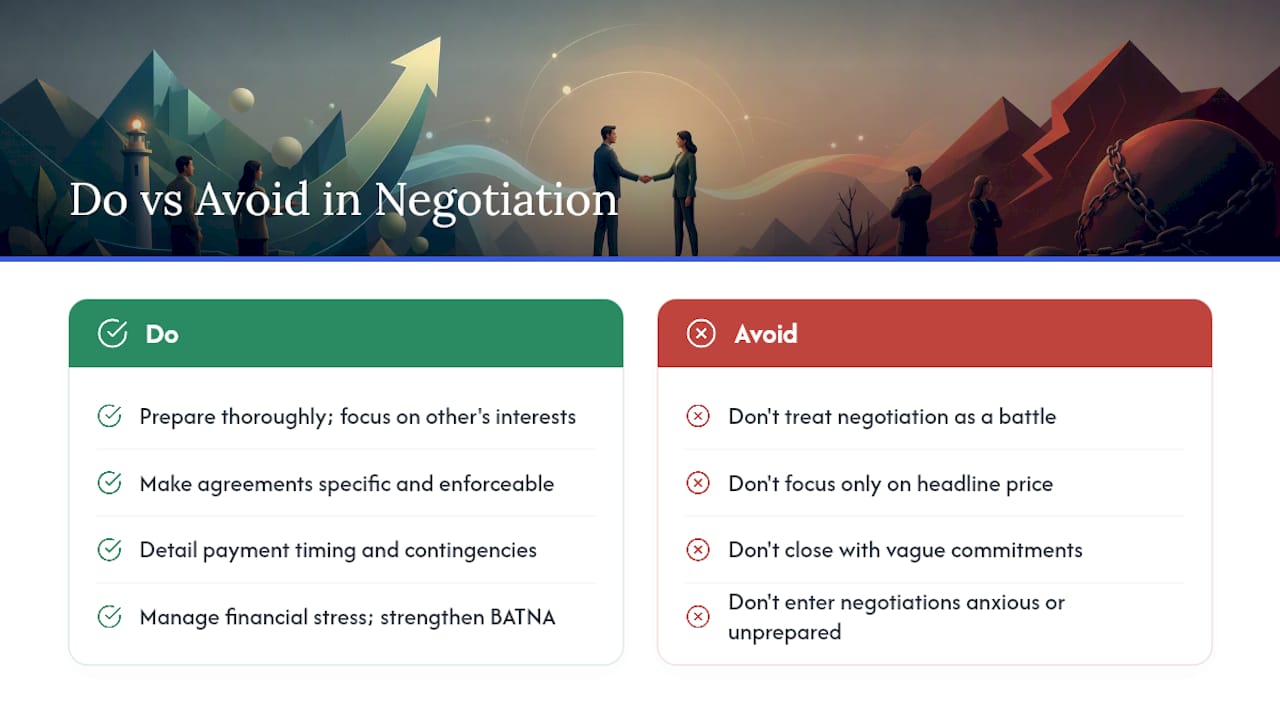
The conventional framing of negotiation as a battle of wills gets it backwards. The negotiators who consistently get the best outcomes aren’t the most aggressive ones. They’re the most prepared, and they spend more time thinking about the other party’s interests than their own opening position.
What gets overlooked in most negotiation guides is the implementation gap. You can anchor well, create value through MESOs, and close cleanly, and still end up with a bad outcome if the agreement falls apart during execution. The closing skill that actually matters isn’t getting a “yes.” It’s building an agreement specific enough that both parties know exactly what they agreed to. Vague commitments are where deals die.
The finance context makes this sharper. In advisory and investment negotiations, the numbers are often secondary to the structure: payment timing, contingencies, revision rights, and exit clauses. A negotiator who focuses only on the headline figure and ignores the terms is leaving real value on the table. That’s where the DealFlip counter-offer guide is useful even outside resale contexts: it forces you to think about the full structure of an offer, not just the price.
The other thing most guides underweight: managing your own financial stress before a high-stakes negotiation. Anxiety narrows thinking. A negotiator who walks in worried about the outcome of this specific deal will make worse decisions than one who genuinely believes their BATNA is solid. That’s not a soft observation. It’s the mechanism behind why BATNA preparation matters so much.
Finblog can help you prepare for what’s next
Knowing the tactics is one thing. Applying them under pressure, in a real financial or professional negotiation, is where most people want support. Finblog’s advisory resources are built for exactly that: helping you walk into a high-stakes conversation with a clear preparation framework, a defensible anchor, and a BATNA you’ve actually thought through.
Whether you’re negotiating a contract, a compensation package, or an investment term sheet, the preparation process is the same. Finblog provides financial education and advisory guidance that covers the analytical side of preparation, from benchmarking and goal-setting to structuring contingent terms. No hard sell, no generic templates. Just practical support tied to your specific situation.
Start with the Finblog resources to find the preparation tools and advisory content that fit your next negotiation.
Useful sources
The claims in this article draw on the following authoritative sources. Each is worth reading directly for deeper frameworks.
- Top 10 Negotiation Skills You Must Learn to Succeed (PON) — The primary framework for BATNA, MESOs, contingent contracts, and anchoring. Start here for a structured overview.
- Six Guidelines for Getting to Yes (PON) — The source for negotiation jujitsu and redirecting positional moves. Useful for handling aggressive counterparts.
- What Is Negotiation? The Seven Elements (PON) — The Seven Elements framework for preparation planning. Use it as a pre-negotiation checklist.
- Principled Negotiation: Focus on Interests (PON) — The clearest explanation of positions vs. interests and why the distinction drives value creation.
- 6 Negotiation Skills All Professionals Can Benefit From (HBS Online) — HBS’s take on emotional intelligence in negotiation and why managing stress protects decision quality.
- Negotiation Strategy: Seven Common Pitfalls to Avoid (Stanford GSB) — Stanford’s list of the most common negotiation errors, with corrective suggestions for each.
- Principles and Tactics of Negotiation (PMC) — A practitioner-oriented academic review covering timing, honesty, and pre-negotiation analysis. Particularly useful for ethical considerations.