


TL;DR:
- Currency hedge funds use FX derivatives to reduce portfolio currency volatility or generate returns from exchange-rate movements. Their suitability depends on an investor’s policy, exposure size, and risk preferences, with strategies ranging from passive hedging to active alpha-seeking approaches. Proper exposure measurement, transparency, and alignment with investment objectives are essential for effective currency risk management.
Currency hedge funds use FX derivatives — forwards, futures, swaps, and options — to either reduce currency-driven volatility in a portfolio or actively pursue returns from exchange-rate movements. The bottom line for any investor: whether you need one depends entirely on your Investment Policy Statement (IPS). If your IPS prioritizes volatility reduction on international holdings, a passive or overlay approach fits. If it permits alpha-seeking, an active currency mandate may be appropriate. According to Finblog’s internal data, many investors use hedging strategies to reduce portfolio risk, and the CFA Institute frames currency management as a spectrum from rules-based full hedging to aggressive alpha-seeking overlays.
Key signals that a currency hedge fund belongs in your portfolio:
- You hold significant non-USD assets and currency swings are materially affecting total returns
- Your IPS explicitly permits derivatives or alternative strategies
- You want to separate currency risk from underlying asset performance for cleaner attribution
- You are prepared to absorb hedging costs, including carry and transaction spreads
Table of Contents
- How do currency hedge funds work?
- What types of currency exposure do funds measure?
- When should you use a currency hedge fund?
- How do you measure currency fund performance?
- What are your implementation options?
- What does hedging actually do to your returns?
- Key Takeaways
- The case for treating currency as its own portfolio decision
- How Finblog helps you evaluate currency risk management
- Useful sources and further reading
How do currency hedge funds work?
Currency hedge funds operate by taking positions in FX markets through a defined set of instruments, each suited to a different objective.
FX forwards lock in an exchange rate for a future date. They are the most common instrument: OTC currency forwards represent over 50% of all foreign exchange derivatives used by U.S. firms, largely because of their liquidity and customizable settlement dates. A fund holding European equities might sell euros forward against the dollar to neutralize the currency return entirely.
Futures are exchange-traded equivalents of forwards, standardized in contract size and settlement. A minority of U.S. firms prefer them over OTC instruments, but they offer transparent pricing and no counterparty credit risk.
Swaps involve exchanging cash flows in two currencies over a set period. They are useful for managing longer-dated exposures or rolling short-term hedges without repeated transaction costs.
Options give the holder the right, not the obligation, to exchange currency at a set rate. They cap downside while preserving upside, making them the preferred tool for volatility trading and for situations where the direction of currency movement is uncertain.
Strategy types across the spectrum
The CFA Institute describes currency management as a spectrum: passive (rules-based full hedging), discretionary, active management, and currency overlay programs. Passive strategies apply a fixed hedge ratio — say, 100% of foreign exposure — mechanically, with no view on direction. Discretionary managers adjust ratios based on macro signals. Active overlays are the most aggressive form, explicitly seeking alpha from currency positions independent of the underlying assets.
Treating currencies as a separate asset class enables clearer alpha measurement and more deliberate diversification — currency returns are driven by dynamics entirely distinct from equity or bond market trends.
Pro Tip: Before selecting a manager, ask for a breakdown of their instrument mix by strategy type. A manager who uses options heavily for a passive mandate is adding cost and complexity you may not need; one who relies solely on forwards for an alpha program may be leaving return potential on the table.
What types of currency exposure do funds measure?
Best practice begins with formally identifying and measuring exposures before choosing instruments or hedge ratios. There are three distinct types.
Transactional exposure arises from known future cash flows in a foreign currency — a U.S. company expecting a euro payment in 90 days, for example. It is the most straightforward to hedge and the most common target for FX forwards.

Translational (reporting) exposure affects the balance sheet when foreign-currency assets and liabilities are converted to USD for financial reporting. A U.S. investor holding a European equity fund sees this every quarter when NAV is restated in dollars.
Economic exposure is the subtlest of the three. It reflects how exchange-rate shifts affect the present value of future cash flows — competitive position, pricing power, and long-run profitability. It is difficult to quantify and often hedged as a residual.
| Exposure type | Typical instrument | Common measurement metric |
|---|---|---|
| Transactional | FX forwards, futures | Notional exposure, hedge ratio |
| Translational | Forwards, swaps | Balance sheet FX sensitivity, VaR |
| Economic | Options, natural hedges | Scenario analysis, stress testing |
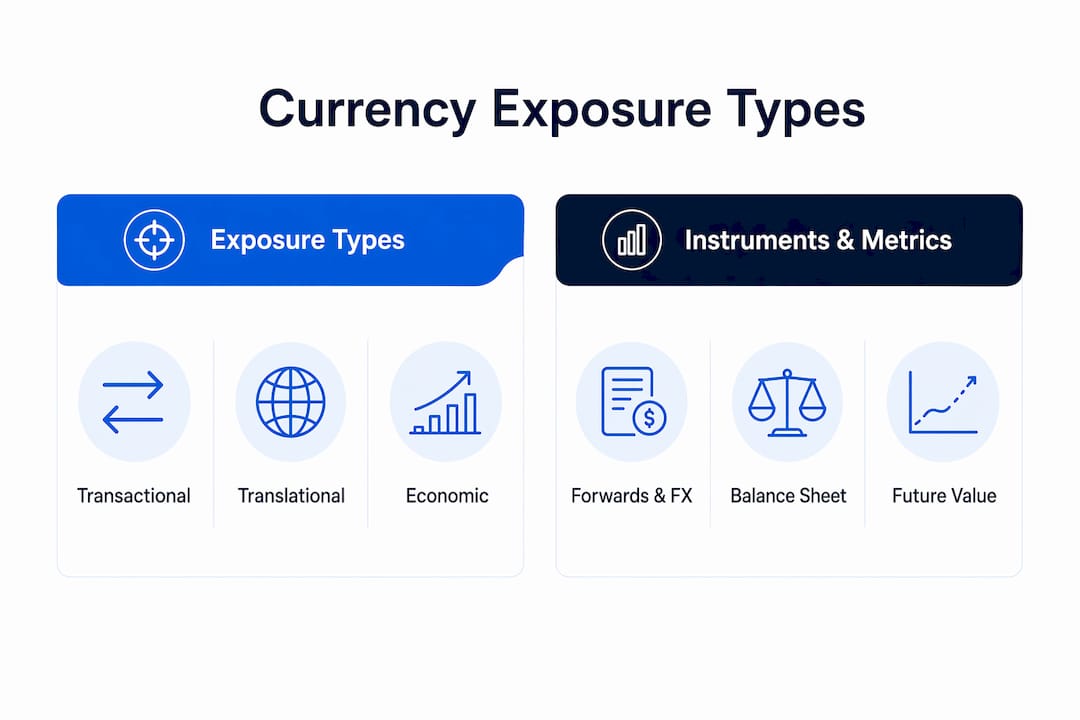
Measurement tools funds use include exposure mapping (cataloging all foreign-currency positions), hedge ratios (percentage of exposure covered), Value-at-Risk (VaR) at defined confidence levels, and scenario stress tests that model specific rate shocks. Minimum-variance hedging goes further, optimizing the hedge ratio to minimize portfolio volatility rather than targeting a fixed percentage.
When should you use a currency hedge fund?
Start with your IPS. It should specify your base currency (USD for most U.S. investors), your stated objective (volatility reduction vs. return enhancement), your time horizon, and any constraints on derivatives use or tax treatment. A currency hedge fund is appropriate when the IPS permits it and when currency exposure is large enough to materially affect outcomes.
IPS alignment checklist:
- Stated objective permits derivatives and alternative strategies
- Base currency is USD and significant foreign-currency exposure exists
- Time horizon is long enough to absorb hedging costs through multiple rate cycles
- Tax and accounting treatment of FX gains/losses is addressed
Manager due-diligence checklist:
- Track record: review risk-adjusted returns, not just gross performance, over at least one full rate cycle
- Reporting transparency: monthly hedge-ratio history, P&L attribution by strategy (carry, value, trend), and scenario P&L — managers who provide this level of detail enable far better investor monitoring
- Instrument and counterparty practices: who are the prime brokers, how is collateral managed, what are the credit limits?
- Fee structure: management fee, performance fee, and high-water mark provisions
- Governance: independent risk oversight, valuation policy, and redemption terms
Questions to ask any manager:
- How do you set and adjust hedge ratios, and what triggers a change?
- What instruments do you use, and why that mix for this mandate?
- How do you report carry and roll costs separately from alpha?
- What is your drawdown limit, and how have you managed it historically?
Pro Tip: If you need full control over hedge ratios and want positions reported on your own balance sheet, a segregated overlay mandate is almost always preferable to a pooled fund. Pooled funds are simpler to access but offer less transparency and no customization for your specific tax or accounting situation.
How do you measure currency fund performance?
Performance evaluation for currency funds requires metrics beyond simple return. The relevant measures are:
- Currency alpha: excess return versus a hedged benchmark, isolating the manager’s contribution from pure currency exposure
- Contribution to total portfolio return: how much of the portfolio’s overall return or volatility reduction came from the currency sleeve
- Sharpe ratio and volatility: risk-adjusted return relative to the volatility of the currency positions themselves
- Hit rate: percentage of periods where the strategy added value, which matters more for discretionary managers than systematic ones
Hedging is not free. The CFA Institute is explicit: hedging incurs direct transaction costs and opportunity costs from forgone favorable outcomes. In a high-rate environment, carry costs can meaningfully reduce net returns — a USD investor hedging EUR exposure pays the interest-rate differential between the two currencies. That cost should be modeled explicitly before committing to a fully hedged mandate.
Reporting you should expect from any manager:
- Monthly hedge-ratio history showing how positions changed over time
- Attribution report separating carry, value (mean-reversion), and trend contributions
- Scenario P&L showing how the portfolio would have performed under defined rate shocks
- Stress-test results against historical episodes (2015 CNY devaluation, 2022 USD surge)
What are your implementation options?
Three paths exist, each with a different profile on control, cost, and complexity.
| Option | Control | Transparency | Cost | Complexity | Speed to implement |
|---|---|---|---|---|---|
| Pooled currency hedge fund | Low | Moderate | Lower entry | Low | 2 weeks |
| Segregated overlay mandate | High | Full | Higher minimum | Moderate | — |
| In-house hedging | Full | Full | Operational overhead | High | 3 months |
Onboarding sequence for each:
- Pooled fund: Due diligence → subscription documents → AML/KYC → initial investment → ongoing monitoring
- Overlay mandate: IPS review → manager selection → ISDA/CSA negotiation → benchmark and reporting setup → initial hedge implementation → quarterly governance
- In-house: Policy drafting → system and data infrastructure → staff or consultant hiring → counterparty agreements → phased rollout
Dynamic hedging approaches that adjust ratios to macro indicators tend to outperform static ratios in institutional implementations. For most U.S. investors without a dedicated FX desk, an overlay mandate or pooled fund is the practical starting point.
What does hedging actually do to your returns?
Two scenarios illustrate the practical effect for a U.S.-based investor.
Scenario A: U.S. investor in European equities, full hedge vs. no hedge. When the dollar strengthens sharply against the euro — as it did in 2022 — an unhedged position in European equities loses both on the equity return and on the currency conversion. A fully hedged position isolates the equity return, removing the FX drag. The cost is the forward premium (the interest-rate differential), which in a high-USD-rate environment is not trivial. For context on how emerging market currency swings can amplify this effect, the dynamic is even more pronounced outside developed markets.
Scenario B: Active carry/trend strategy. A manager systematically buys high-yielding currencies and sells low-yielding ones (carry), while also following momentum signals (trend). This can generate positive returns uncorrelated with equities, but carry strategies suffer sharp drawdowns during risk-off episodes when high-yield currencies sell off suddenly.
| Scenario | Approach | Return effect | Volatility effect |
|---|---|---|---|
| European equities, USD strengthens | Full hedge | Removes FX drag | Reduces total volatility |
| European equities, USD weakens | Full hedge | Removes FX tailwind | Reduces total volatility |
| Active carry/trend | Alpha-seeking overlay | Potential positive alpha | Adds strategy-specific risk |
Key Takeaways
Currency hedge funds are most effective when the implementation path — pooled fund, overlay, or in-house — is matched to the investor’s IPS, exposure size, and reporting requirements.
| Point | Details |
|---|---|
| Start with your IPS | Confirm your IPS permits derivatives and defines the objective before selecting any currency strategy. |
| Measure exposures first | Map transactional, translational, and economic exposures before choosing instruments or hedge ratios. |
| Hedging has a real cost | Carry and transaction costs reduce net returns; model them explicitly, especially in high-rate environments. |
| Demand reporting transparency | Require monthly hedge-ratio history, attribution by strategy, and scenario P&L from any manager. |
| Finblog’s guidance | Finblog recommends treating currencies as a distinct portfolio component and aligning the implementation path to your IPS before committing to a manager. |
The case for treating currency as its own portfolio decision
Most investors treat currency as an afterthought — a side effect of holding international assets. That framing is a mistake, and it costs real money.
The practitioners who get this right think about currency the way they think about duration or sector allocation: a deliberate position with its own risk budget, its own benchmark, and its own performance attribution. When you collapse currency into the equity or fixed-income sleeve, you lose visibility into what is actually driving returns. A great year in European equities can look mediocre in USD terms, and you will never know whether the drag came from the manager or the euro.
The 2026 environment adds a specific wrinkle. With U.S. rates still elevated relative to many developed-market peers, the carry cost of hedging foreign exposure back to USD is meaningful. A blanket 100% hedge ratio that made sense in a near-zero-rate world now needs to be stress-tested against that cost. Dynamic approaches that adjust ratios based on rate differentials and valuation signals are worth the additional complexity for any investor with more than modest foreign-currency exposure.
The other thing most guides understate: manager selection in this space is harder than in equity or fixed income because the track records are shorter, the strategies are less standardized, and the reporting varies enormously. Insist on full attribution. If a manager cannot tell you how much of their return came from carry versus trend versus value, you cannot evaluate them properly.
How Finblog helps you evaluate currency risk management
Finblog’s advisory and educational resources are built for investors who want to move from understanding currency risk to acting on it. Whether you are assessing whether a currency overlay fits your portfolio or working through the due-diligence questions for a specific manager, Finblog’s financial consulting services give you a structured framework rather than a generic checklist. The platform covers IPS alignment, exposure measurement, and manager evaluation criteria drawn from CFA Institute guidance and current market practice. If you are ready to assess your currency exposure and decide on the right implementation path, start with a consultation at Finblog.
Useful sources and further reading
The sources below are organized by use case.
For technical implementation and instrument mechanics:
- CFA Institute — Currency Management: An Introduction: the authoritative reference for strategy types, instrument selection, and IPS alignment
- IMF Working Paper on Exchange Rate Risk Management: covers VaR measurement, hedging benchmarks, and U.S. firm hedging practices in depth
For IPS alignment and exposure identification:
- Ripple Treasury — What is Currency Risk Management?: practical framework for identifying transactional, translational, and economic exposures
- Finblog — Financial Risk Management Guide: covers reporting standards and risk governance frameworks
For manager due diligence and portfolio construction:
- Finblog — Hedge Fund Portfolio Strategies: A 2026 Guide: portfolio-level context for integrating currency mandates
- Finblog — Portfolio Risk Explained: background on risk metrics relevant to currency fund evaluation
Investors who want to go deeper on the active vs. passive currency management debate should read the CFA Institute refresher alongside Finblog’s active vs. passive investing guide — the frameworks translate directly to the currency management decision.
This article is general financial information, not professional investment advice. Confirm current regulations, tax treatment, and suitability with a qualified financial advisor for your specific situation.