



TL;DR:
- Personal money management involves simple, repeatable steps like budgeting, saving, and debt tracking to reach financial goals. Following a 30/90-day plan can help establish a system of automated savings, clear debt payoff strategies, and regular reviews for long-term growth. Including discretionary spending allowances significantly improves budget adherence and reduces the risk of abandonment.
Personal money management is the set of simple, repeatable steps you use to cover bills, build savings, pay down debt, and reach goals. Start today by creating a one-month budget and automating one savings transfer before the week is out.
The 30/90-day promise: Follow the steps in this guide and you will have a working budget, an automated savings habit, and a clear debt-payoff plan within 30 days. By day 90, you will have increased your savings rate, started basic investing, and built the weekly review habit that keeps everything on track.
Three things to do right now, before reading further:
- Gather your last two pay stubs and your three most recent bank statements
- List every fixed monthly bill (rent, utilities, subscriptions, loan payments)
- Schedule an automatic transfer to savings for the day after your next payday
That is the whole game in three lines. Everything below shows you how to do it well.
Table of Contents
- What is personal money management and why does it matter?
- How to manage your money in 7 practical steps
- Which budgeting method fits your personality?
- How do you track spending and net worth effectively?
- How saving, investing, and retirement connect to your budget
- How to manage debt and protect your credit score
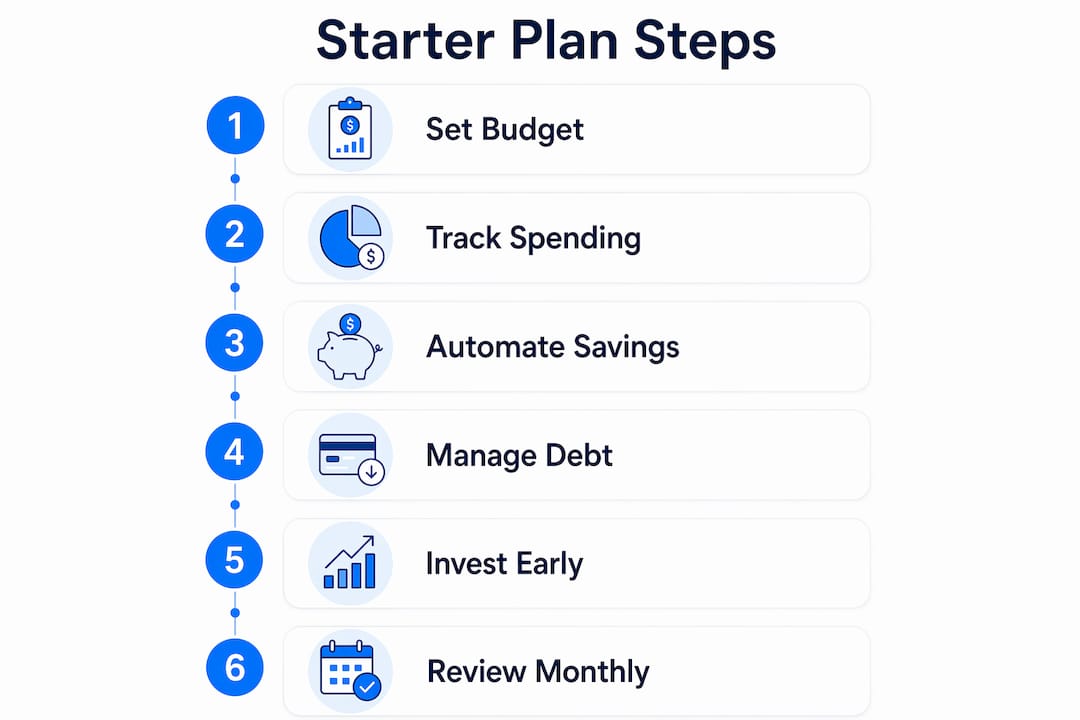
- Your 30/90-day starter plan, week by week
- Why most people quit budgets and how to avoid it
- What to do this week: your action checklist
- Key Takeaways
- The number that surprised me most
- Further reading and trusted sources
What is personal money management and why does it matter?
Personal finance covers budgeting, saving, investing, debt management, retirement planning, and tracking net worth as a single, connected picture of your financial life. Miss one piece and the others get harder. Ignore all of it and you are one unexpected bill away from a real problem.
The risks of skipping this are concrete. A job loss, a medical bill, or a car repair can spiral into credit card debt and missed rent when there is no buffer. The emotional cost compounds the financial one.
Here is what solid money habits actually deliver:
- Less anxiety. 43% of Americans worry about money several times a week. A written budget does not fix income, but it removes the fog that makes stress worse.
- Better decisions. When you know your numbers, you stop guessing whether you can afford something.
- Compounding progress. Small, automated habits build wealth over years without requiring willpower every day.
Key stat: Budgeting and planning measurably reduce financial anxiety. The Penny Hoarder found that 43% of Americans worry about their finances several times a week — a number that drops sharply for people who track their spending consistently.
How to manage your money in 7 practical steps
This is the core framework. Work through it in order, and you will have a functioning system within a week.
-
Take a full financial inventory. Pull every account balance, every debt balance, and every income source. In the first 30 minutes: log into every bank and credit card account and write the balances on one sheet of paper.
-
Set goals at three time horizons. Short-term (under one year): build a $1,000 starter emergency fund. Medium-term (1–5 years): pay off a specific debt or save for a down payment. Long-term (5+ years): fund retirement. Write one goal per horizon and attach a dollar amount.
-
Choose a budgeting method. Pick one from the four covered in the next section. Do not overthink it. The best method is the one you will actually use next month.
-
Automate savings on payday. Pay yourself first — set a recurring transfer to savings for the day your paycheck lands. Saving what is left over rarely works; automating it does.
-
Set up sinking funds. A sinking fund is a small monthly set-aside for predictable but irregular costs: car maintenance, annual insurance, holiday gifts. Name each fund and assign a monthly target. A $600 car repair hurts a lot less when you have been saving $50 a month for it.
-
Build a debt-payoff plan. List every balance and its interest rate. Choose snowball or avalanche (covered in the debt section). Automate a fixed extra payment to your target debt each month.
-
Schedule weekly and monthly reviews. Fifteen minutes every Sunday to check spending against the budget. One longer session at month-end to adjust categories, confirm savings transfers landed, and update your net worth snapshot.
Pro Tip: Set a recurring calendar event called “Money Sunday” for 15 minutes each week. Treat it like a bill — non-negotiable. Consistency here matters more than perfection in any single category.
Which budgeting method fits your personality?

Four methods cover almost every personality type and income pattern. Each one works. The question is which one you will stick with.
| Method | How it works | Best for | Monthly effort |
|---|---|---|---|
| 50/30/20 | 50% needs, 30% wants, 20% savings/debt | Beginners who want simple guardrails | Low |
| Zero-based | Every dollar gets a job; income minus expenses = $0 | Detail-oriented people who want full control | High |
| Cash envelopes | Physical cash divided into labeled envelopes by category | Overspenders who need a hard stop on discretionary spending | Medium |
| Pay-yourself-first | Savings come out first; spend the rest freely | People who hate tracking but want to build wealth | Very low |
How each method handles $3,000/month take-home pay:
- 50/30/20: $1,500 to rent, groceries, utilities; $900 to dining, entertainment, clothing; $600 to savings and debt payments.
- Zero-based: Every dollar assigned — $1,200 rent, $400 groceries, $200 utilities, $300 dining, $200 savings, $150 debt, $550 everything else — until the total hits $3,000.
- Cash envelopes: Withdraw $300 cash for groceries, $200 for dining, $150 for gas. When the envelope is empty, spending in that category stops.
- Pay-yourself-first: Transfer $450 to savings immediately on payday. Spend the remaining $2,550 without tracking every line.
Three questions to pick your method:
- Do you enjoy tracking details? If yes, zero-based. If no, 50/30/20 or pay-yourself-first.
- Do you overspend on specific categories like dining or shopping? Cash envelopes add a physical brake.
- Is your income irregular? Pay-yourself-first with a percentage (say, 15%) scales automatically with what you earn.
For more on choosing and sticking to a method, Finblog’s guide to good budgeting techniques walks through real-world examples.
How do you track spending and net worth effectively?
Tracking is where most budgets die. People set up a beautiful spreadsheet in January and abandon it by February. The fix is to make tracking as frictionless as possible.
Three approaches, from simplest to most powerful:
- Transaction review: Once a week, scroll through your bank and credit card transactions. Categorize them mentally or in a notes app. Takes five minutes and catches surprises fast.
- Category tracking: Use a spreadsheet or app to assign every transaction to a category (groceries, rent, dining, etc.). Consumer.gov’s free budget worksheet is a solid starting point — it walks through a four-step sequence: gather bills, total income, track spending, build the plan.
- Net worth snapshot: Once a month, add up all assets (checking, savings, investments, property value) and subtract all debts. The result is your net worth, and watching it grow is one of the most motivating numbers in personal finance.
Setting up a basic spreadsheet in three steps:
- Create columns for Date, Description, Category, and Amount.
- Import or manually enter transactions every Sunday during your Money Sunday review.
- Add a summary tab that totals each category and compares it to your budget target.
Using an app: Mint is one of the most widely used transaction-tracking tools in the U.S. Connect your bank and credit card accounts, and it automatically categorizes spending. Start by reviewing the auto-categorized transactions for accuracy in the first two weeks — Mint’s categories are close but not always right, and correcting them early trains the system.
Pro Tip: Track net worth in a separate tab from your monthly budget. Seeing a single number grow month over month gives you a long-term anchor when a bad spending week feels discouraging.

How saving, investing, and retirement connect to your budget
Saving and investing are not separate from budgeting. They are line items in it, and they need to be funded before discretionary spending, not after.
Emergency fund first. The standard target is 3–6 months of essential expenses. Start with a $1,000 starter fund if that feels more achievable, then build to the full target. Keep it in a high-yield savings account, separate from your checking account so it is not tempting to spend.
Priority order for your money:
- Fund the emergency fund to at least $1,000
- Contribute enough to your 401(k) to capture the full employer match (that is a 50–100% instant return)
- Pay down high-interest debt (anything above roughly 7% interest)
- Max out a Roth IRA or traditional IRA ($7,000 annual limit for 2026 if you are under 50)
- Then invest in taxable brokerage accounts
Basic investment principles for beginners:
- Diversification: Spread money across asset classes (stocks, bonds) and geographies. A single low-cost index fund like a total market fund does this automatically.
- Low-cost funds: Expense ratios matter over decades. A fund charging 0.03% annually costs far less than one charging 1%, and the difference compounds.
- Time horizon: Money you will not touch for 10+ years can tolerate more stock exposure. Money you need in three years should stay conservative.
- Automation: Set contributions to increase by 1% each year. You will barely notice the difference in take-home pay, but the long-term impact is significant.
For readers ready to align investing with tax strategy, strategic tax planning can amplify returns by reducing what you owe each year.
How to manage debt and protect your credit score
Debt management comes down to two decisions: which debt to attack first, and how to protect your credit while you do it.
Snowball vs. avalanche — pick one:
- Snowball: Pay minimums on everything, throw extra money at the smallest balance first. When it is gone, roll that payment to the next smallest. The psychological win of eliminating accounts keeps motivation high.
- Avalanche: Pay minimums on everything, throw extra money at the highest-interest debt first. Mathematically cheaper — you pay less interest overall.
The decision rule is simple. If you have struggled to stick with a debt plan before, use snowball. If you are disciplined and the interest rate difference between your debts is large, use avalanche. Finblog’s debt repayment strategies guide covers both in detail.
Practical steps to start this week:
- List every debt: balance, minimum payment, and interest rate
- Automate the minimum payment on every account to avoid late fees
- Set one extra payment to your target debt, even if it is only $25
- Consider consolidation only after comparing the new interest rate to your current weighted average — consolidation is not always cheaper
Protecting and improving your credit score:
- Pull your free credit reports from AnnualCreditReport.com (all three bureaus, once a year)
- Dispute any errors in writing — errors are more common than most people expect
- Keep credit utilization below 30% on each card
- Never miss a minimum payment; payment history is the single largest factor in your score
- Avoid opening multiple new accounts in a short window, which triggers hard inquiries
Your 30/90-day starter plan, week by week
This is the plan made concrete. Follow it in order.
30-day sprint:
| Week | Tasks | How to measure success |
|---|---|---|
| Week 1 | Gather statements, list all income and fixed bills, calculate take-home pay | One-page financial snapshot complete |
| Week 2 | Choose a budgeting method, build your first monthly budget, set up tracking (spreadsheet or app) | Budget covers all income and all categories |
| Week 3 | Automate savings transfer, open sinking funds for 2–3 irregular expenses, name each fund | Transfers confirmed in bank account |
| Week 4 | Record first net worth snapshot, review Week 1–3 spending vs. budget, adjust one category | Net worth number written down; one category corrected |
90-day scaling plan:
- Month 2: Increase your automated savings by $25–$50. Start contributing to a 401(k) if you have not already, even at 1%.
- Month 2: Begin the debt-payoff plan. Make your first extra payment to the target debt.
- Month 3: Open a Roth IRA if eligible. Set a recurring monthly contribution, even $50.
- Month 3: Review all three sinking funds. Adjust monthly targets based on actual spending from the first two months.
- Month 3: Run a full 90-day review — compare net worth snapshot from Week 4 to current. Celebrate any positive movement.
For a deeper walkthrough of the budgeting setup steps, Finblog’s how to budget effectively guide includes a worksheet you can use alongside this plan.
Why most people quit budgets and how to avoid it
The most common reason people abandon a budget is not lack of discipline. It is that they cut every enjoyable expense at once and then feel deprived within two weeks.
Common mistakes and the one-line fix:
- Cutting all discretionary spending: Build in a “fun allowance” — a fixed amount you can spend on anything, guilt-free. Even $50/month prevents the all-or-nothing collapse.
- Ignoring small leaks: $8 here, $12 there adds up fast. A weekly five-minute transaction scan catches these before they become a pattern.
- Setting vague goals: “Save more money” fails. “Save $200 by March 31 for a car repair fund” works.
- Skipping the review: A budget you set and forget is just a wish list. The weekly check-in is what turns it into a system.
- Treating one bad week as failure: One overspent week does not ruin a budget. Reset the next Monday and move on.
Behavioral tactics that actually work:
- Automation: Remove the decision entirely. If the transfer happens automatically, you never have to choose between saving and spending.
- Default rules: “I always pack lunch on weekdays” is easier to follow than “I will try to spend less on food.”
- Friction for bad habits: Delete saved credit card numbers from shopping sites. The extra 30 seconds to re-enter them kills impulse purchases.
- Small rewards: After four consecutive Money Sunday check-ins, do something you enjoy. Positive reinforcement is not childish — it is how habits form.
The YNAB philosophy frames this well: money is a tool to live by your values, not a scoreboard. When you connect each budget category to something you actually care about, the motivation to track it shifts from obligation to intention. That reframe alone keeps more people on track than any spreadsheet feature.
For a deeper look at the mindset side of this, Finblog’s piece on financial literacy’s real purpose is worth reading once you have the mechanics in place.
What to do this week: your action checklist
Do these in order. Each one takes under 30 minutes.
- Gather your statements. Pull the last two pay stubs and three months of bank and credit card statements. This is your raw material.
- Set up automation. Log into your bank and schedule a recurring transfer to savings for the day after your next payday. Even $25 counts.
- Open sinking funds. Create two or three labeled savings buckets (most online banks allow this for free) for car maintenance, medical costs, and annual subscriptions.
- Schedule your weekly review. Put “Money Sunday — 15 min” on your calendar as a recurring event. Do not skip the first one.
- Record your net worth. Add up every account balance and subtract every debt. Write the number down. This is your baseline.
- Verify at week’s end. On Sunday, confirm the savings transfer landed, check that your budget categories are populated, and note one thing you would adjust next week.
For a broader foundation, Finblog’s financial literacy guide explains why these habits compound into long-term financial security.
Key Takeaways
Solid personal money management comes down to five habits: budget every dollar, automate savings before you can spend them, protect against shocks with an emergency fund, attack high-interest debt with a clear method, and review your numbers weekly.
| Point | Details |
|---|---|
| Budget first, always | Choose one method (50/30/20, zero-based, envelopes, or pay-yourself-first) and build a monthly budget before spending. |
| Automate savings on payday | Transfer to savings the day your paycheck lands — saving what is left over rarely works. |
| Emergency fund is non-optional | Target 3–6 months of essential expenses; start with $1,000 if the full amount feels out of reach. |
| Attack debt with a clear method | Snowball for motivation, avalanche for math — pick one and automate an extra payment each month. |
| Weekly reviews keep it alive | A 15-minute weekly check-in turns a budget from a wish list into a working system. |
The number that surprised me most
Most personal finance advice focuses on the mechanics: the right method, the right app, the right savings rate. Those things matter. But the single biggest predictor of whether someone actually sticks with a money plan is not the method they chose — it is whether they built in permission to spend on something they enjoy.
The research on this is consistent. Budgets that include a discretionary allowance, however small, outlast restrictive ones by a wide margin. People do not fail at budgeting because they lack discipline. They fail because they designed a system that treats every dollar of enjoyment as a problem to eliminate. That is not a financial plan. It is a punishment.
The 30/90-day plan in this guide is built around that reality. Automate the savings so discipline is not required. Name the sinking funds so irregular expenses stop feeling like emergencies. Keep the weekly review short so it never becomes a chore. And give yourself a fun allowance, because a budget you can live with for a decade beats a perfect budget you abandon in March.
If you follow the week-by-week plan above and return to adjust it after 30 days, you will have built something most people never do: a financial system that fits your actual life. That is worth more than any single tactic in this article.
Further reading and trusted sources
These are the sources worth bookmarking for deeper detail on specific topics.
- Consumer.gov — Making a Budget: Free, government-backed budget worksheet with a four-step setup sequence. Start here if you want a printable template.
- Investopedia — Personal Finance Complete Guide: Covers every component of personal finance in depth, including net worth tracking and retirement account types.
- Capital One — Budgeting Tips for Beginners: Practical guidance on emergency fund sizing and aligning your budget with bill due dates.
- The Penny Hoarder — Budgeting for Beginners: Covers all four major budgeting methods, sinking funds, and pay-yourself-first automation in plain language.
- YNAB: The app and the philosophy behind giving every dollar a job; useful for anyone who wants a values-driven approach to tracking.
- Investor.gov Compound Interest Calculator: Run the numbers on how much a small monthly investment grows over 10, 20, or 30 years.
- Finblog — Personal Finance Management Guide: Finblog’s comprehensive internal guide covering budgeting, debt, saving, and investing in one place.
- Finblog — Emergency Fund Planning: Step-by-step guidance for building a 3–6 month emergency fund, including account selection and monthly targets.
This article is general financial information, not professional advice. Confirm current rules, contribution limits, and tax implications with a qualified financial advisor or the relevant government source for your specific situation.