



TL;DR:
- Increasing income, reducing expenses, and eliminating high-interest debt are essential for building net worth. Consistent investing capitalizes on compound growth over time, especially with early contributions. Balancing homeownership, asset diversification, and disciplined saving accelerates long-term wealth accumulation.
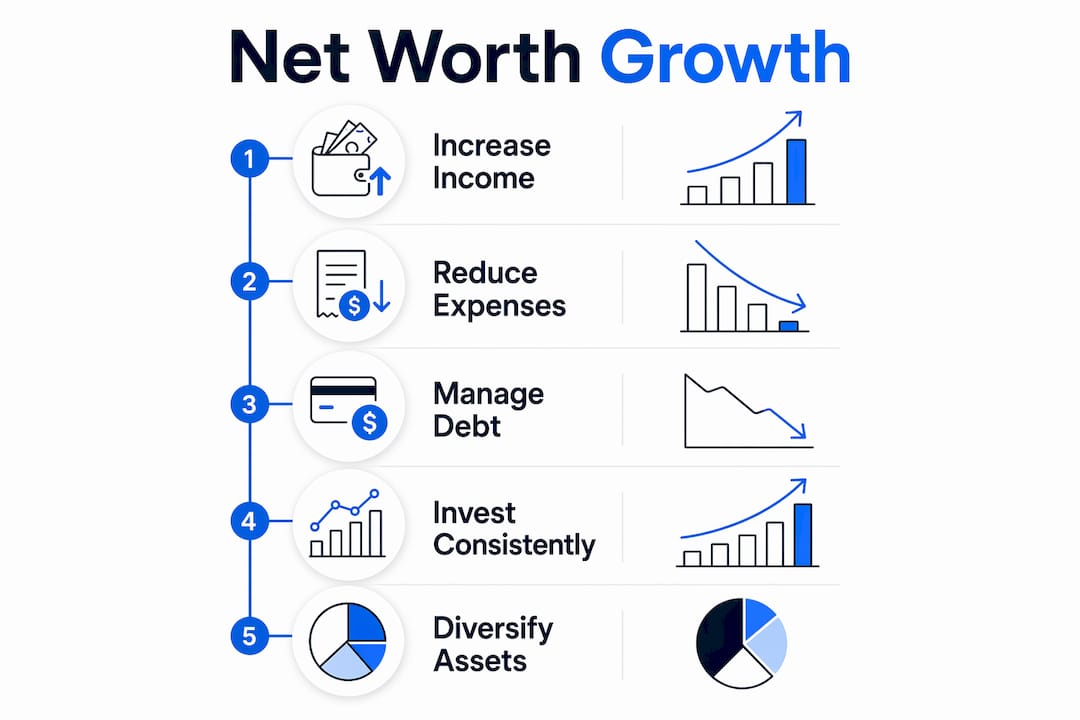
Net worth is defined as the total value of everything you own minus everything you owe. The median American household net worth sits at approximately $192,900, which means most people have real room to grow. Knowing how to increase net worth comes down to four levers: raising income, cutting expenses, eliminating high-interest debt, and investing consistently. Pull all four at once and the results compound faster than any single strategy alone. This guide gives you the exact methods to do that, in plain language, with numbers that hold up.
How can increasing income impact your net worth growth?
Income growth is the single fastest way to widen the gap between your assets and your liabilities. More money coming in creates more money available to save, invest, and deploy. The catch is that a raise means nothing if your spending rises to match it. That pattern, known as lifestyle inflation, is the most common reason high earners still finish the month with nothing left over.
The most reliable ways to grow income fall into two categories: career advancement and side income.
- Career advancement: Negotiating a raise, earning a certification, or switching to a higher-paying employer are all proven paths. The Bureau of Labor Statistics consistently shows that job switchers earn more than those who stay put.
- Side hustles: Freelancing, consulting, tutoring, or selling products online can add meaningful income without requiring a full career change.
- Passive income streams: Dividend-paying stocks, rental income, or royalties from digital products generate money without ongoing active effort.
- Skill-based income: Learning high-demand skills in areas like data analysis, coding, or financial modeling raises your market value and earning ceiling.
The key is where that extra money goes. Combining income growth with expense reduction can accelerate net worth by $10,000–$30,000 annually, depending on your income level. That is not a small number. It represents the difference between a decade of slow progress and real wealth accumulation.
Pro Tip: Automate a transfer of any raise or bonus directly to a savings or investment account before you ever see it in your checking balance. What you never touch, you never spend.

The financial habits of wealthy people consistently show one pattern: they treat income growth as fuel, not as permission to spend more. That discipline is what separates earners from wealth builders.
What are practical strategies to reduce expenses and manage debt effectively?
Cutting expenses is not about deprivation. It is about directing money toward assets instead of consumption. The 50/30/20 budgeting rule gives you a clear framework: 50% of after-tax income covers needs, 30% covers wants, and 20% goes to savings and debt repayment. That 20% is where net worth grows.
Debt management deserves its own focus because high-interest debt destroys wealth faster than almost anything else. Paying off credit card debt at rates often exceeding 20% APR delivers a guaranteed, tax-free return that beats most investment gains. Eliminating that debt is not just a financial move. It is one of the highest-yield decisions you can make.
Two popular methods for paying down multiple debts:
- Debt avalanche: Pay minimum balances on all debts, then direct every extra dollar to the highest-interest debt first. This method saves the most money over time.
- Debt snowball: Pay off the smallest balance first, regardless of interest rate. This method builds psychological momentum and keeps people on track.
- Balance transfer strategy: Move high-interest credit card balances to a 0% APR promotional card and pay aggressively during the interest-free window.
- Debt consolidation loan: Replace multiple high-rate debts with a single lower-rate personal loan to reduce total interest paid.
An emergency fund is not optional. Keeping 3–6 months of expenses in a liquid savings account prevents a car repair or medical bill from forcing you onto a credit card. That cycle of emergency spending on credit is one of the most common ways people erode net worth without realizing it.
Pro Tip: Review your subscriptions every quarter. Most people carry $50–$150 per month in forgotten recurring charges. Canceling three unused subscriptions and redirecting that money to debt repayment adds up to real progress over a year.
Lifestyle creep is the quiet killer of expense management. Every time income rises, the temptation to upgrade your car, apartment, or wardrobe follows. Resisting that pull and keeping fixed costs stable is one of the most powerful smart money habits you can build.
How does consistent investing accelerate net worth through compound growth?
Saving money preserves wealth. Investing grows it. The difference matters because inflation erodes the purchasing power of cash sitting in a low-yield account. Investing puts your money to work so it generates returns that outpace inflation over time.
The math behind compound growth is the most persuasive argument for starting early. Investing $500 monthly at a 7% average annual return compounds to over $500,000 in 25 years. That figure assumes no windfalls, no inheritance, and no salary explosion. Just consistency. The rule of 70 offers a quick way to visualize this: divide 70 by your expected annual return rate to find how many years it takes to double your money.
Key investment vehicles to know:
- 401(k): Employer-sponsored retirement account with pre-tax contributions. Saving 15–20% of gross income is the benchmark, and capturing the full employer match is non-negotiable. Missing that match is equivalent to turning down a 50–100% immediate return on your contribution.
- IRA (Individual Retirement Account): Traditional IRAs offer tax-deferred growth; Roth IRAs offer tax-free withdrawals in retirement. Both are powerful tools for long-term wealth.
- Index funds: Broad market index funds like those tracking the S&P 500 give you diversified exposure at low cost. They outperform most actively managed funds over long periods.
- Dollar-cost averaging: Investing a fixed amount on a regular schedule, regardless of market conditions, removes the temptation to time the market and reduces the impact of volatility.
| Investment vehicle | Tax advantage | Best for |
|---|---|---|
| 401(k) | Pre-tax contributions, tax-deferred growth | Employees with employer match |
| Roth IRA | Tax-free withdrawals in retirement | Younger earners in lower tax brackets |
| Traditional IRA | Tax-deductible contributions | Higher earners seeking current deductions |
| Index funds (taxable) | Long-term capital gains rates | Flexible, non-retirement investing |
Consistency and time in the market matter more than picking the right individual stock. The investor who starts at 25 with modest contributions will almost always outperform the investor who waits until 40 to begin. Starting early is the single most valuable decision you can make for long-term wealth. Finblog’s guide on why to invest for retirement breaks down the mechanics of tax-advantaged accounts in detail.
What role does homeownership and asset diversification play in building net worth?
Homeownership is the most common wealth-building method in America. A 2025 survey found that 36% of Americans cite homeownership as their primary wealth-building strategy, ahead of retirement savings, online savings accounts, and stock market investing. The reason is straightforward: every mortgage payment builds equity, and home values historically appreciate over time.
Equity is the portion of your home’s value you actually own. As you pay down the principal on your mortgage, your equity grows. If your home also appreciates in value, your net worth benefits from both directions at once. That dual effect is why real estate remains a cornerstone of personal wealth for most American households.
The risk is overextending. Spending too much on housing leaves too little for investing and emergency savings. A common guideline is to keep total housing costs, including mortgage, taxes, and insurance, below 28% of gross monthly income. Stretching beyond that threshold forces trade-offs that slow net worth growth elsewhere.
Diversifying beyond real estate protects you from concentration risk. A portfolio that includes stocks, bonds, real estate, and cash reserves is far more resilient than one that depends on a single asset class. The table below compares asset types by their primary role in a net worth strategy.
| Asset class | Primary role | Liquidity |
|---|---|---|
| Primary residence | Equity building, appreciation | Low |
| Stocks and index funds | Long-term growth | High |
| Bonds | Stability, income | Medium |
| Cash and savings | Emergency buffer, short-term needs | Very high |
| Rental property | Income and appreciation | Low |
Balancing debt repayment and investing is a real tension. Paying off a 4% mortgage early feels safe, but investing those same dollars in a diversified portfolio historically earns more over time. High-interest debt always gets paid first. Low-interest debt, like a standard mortgage, can coexist with an active investment strategy. The long-term vs. short-term investing framework at Finblog helps clarify when to prioritize each.
Key Takeaways
Increasing net worth requires combining income growth, expense discipline, debt elimination, and consistent investing because no single lever works as well in isolation.
| Point | Details |
|---|---|
| Income growth alone is not enough | Direct every raise and bonus to savings or investments before spending it. |
| High-interest debt is a wealth killer | Paying off credit cards above 20% APR delivers returns that beat most investments. |
| Compound growth rewards early starters | $500 per month at 7% grows to over $500,000 in 25 years. |
| Employer 401(k) match is free money | Missing the full match is equivalent to losing a 50–100% immediate return. |
| Diversify assets beyond your home | Stocks, bonds, and cash reserves protect against concentration risk. |
The wealth gap no one talks about
After years of watching people work through financial plans, the pattern that surprises most readers is this: income level predicts almost nothing about net worth growth. The people who build real wealth fastest are rarely the highest earners. They are the ones who treat every dollar of income growth as an investment opportunity rather than a spending budget increase.
The most underrated move I have seen is treating debt repayment as a high-yield investment. When someone eliminates a credit card charging 22% interest, they have just earned a guaranteed 22% return on that money. No index fund promises that. No savings account comes close. Yet most people mentally separate debt payoff from investing, as if they are unrelated activities.
The psychological side matters too. Investors who automate contributions and stop checking their balances daily consistently outperform those who react to market news. Consistency beats cleverness every time. The readers who build lasting wealth are not the ones with the best stock picks. They are the ones who never stop contributing, never panic sell, and never let a raise become an excuse to spend more.
— Povilas
How Finblog supports your net worth growth
Finblog brings together the financial education and planning tools that make these strategies practical, not just theoretical. Whether you are mapping out a debt payoff plan, calculating how much to contribute to your 401(k), or figuring out the right savings rate for your income level, Finblog’s guides cover each step in plain language. The step-by-step wealth building guide at Finblog walks you through saving, investing, and financial planning in a single, structured resource. If you are ready to put a real number on your net worth goal and build a plan to reach it, Finblog is the place to start.
FAQ
What is net worth and how is it calculated?
Net worth equals total assets minus total liabilities. Add up everything you own, including savings, investments, and property, then subtract everything you owe, including loans and credit card balances.
How much should I save to grow my net worth?
Saving 15–20% of gross income is the standard benchmark for steady wealth accumulation. Capturing the full employer 401(k) match is the first priority before directing savings elsewhere.
Is paying off debt or investing the better move?
High-interest debt above roughly 7–8% APR should be paid off first, since the guaranteed return exceeds typical investment gains. Low-interest debt can coexist with an active investment strategy.
How does homeownership help build net worth?
Homeownership builds equity through mortgage principal payments and benefits from property appreciation over time. It is the most common wealth-building strategy among American households, cited by 36% of Americans in a 2025 survey.
How long does it take to significantly increase net worth?
Meaningful net worth growth typically takes 5–10 years of consistent saving and investing. Starting early and maintaining discipline through market cycles matters more than the size of any individual contribution.