
TL;DR:
- Universal basic income is a government program that provides unconditional cash payments to all citizens. Its high cost and uncertain impact on workforce participation make full-scale implementation politically and economically challenging. Technology-driven automation fears have reignited debate about UBI’s role in addressing economic shifts.
Universal basic income (UBI) is defined as a government program providing unconditional, regular cash payments to every citizen regardless of employment status, income level, or work history. The universal basic income debate sits at the intersection of fiscal policy, social justice, and technological change. Proponents like Andrew Yang made UBI a centerpiece of the 2020 presidential race, while critics at institutions like the Cato Institute argue the costs are fiscally catastrophic. Automation fears have pushed the debate back into the spotlight, making it one of the most consequential policy discussions of the decade.
What are the main economic arguments for and against universal basic income?
The fiscal math of UBI is the first obstacle any serious proposal must clear. A national UBI at $1,000 per month costs roughly $3.7 trillion annually, which equals approximately 50% of the entire 2026 federal budget. That figure alone explains why most economists treat full-scale UBI as a generational fiscal commitment, not a budget line item.
Supporters argue UBI solves a structural flaw in the current welfare system known as the poverty trap. Under means-tested programs, earning more income causes benefit phase-outs that can push effective marginal tax rates above 70%. UBI eliminates that cliff by providing a flat, unconditional floor. The incentive to work is never penalized by losing benefits.
The evidence from actual trials, however, complicates that argument. Modest pilot programs show recipients tend to work less, with no clear gains in entrepreneurship or measurable mental health improvement. Pilots are also structurally different from a national program, so their results cannot be extrapolated cleanly. Small-scale guaranteed income tests cannot conclusively predict the effects of a true national UBI.
Funding is the third major fault line in the economic debate. Most extensive UBI proposals require either large tax increases or cuts to existing welfare programs. Both options carry serious political costs. Replacing current programs risks stripping targeted protections from the most vulnerable, while raising taxes to fund UBI alongside existing programs is historically unprecedented in scale.
- Poverty trap elimination: UBI removes benefit phase-outs that punish low-income earners for working more.
- Labor supply risk: Trial data shows recipients work fewer hours, raising questions about workforce participation at scale.
- Fiscal scale: $3.7 trillion annually requires either historic tax increases or a full restructuring of the welfare system.
- Funding trade-offs: Cutting existing programs to fund UBI could harm recipients who need more than a flat cash payment.
Pro Tip: When evaluating UBI cost estimates, always check whether the figure assumes UBI replaces existing programs or supplements them. The difference can shift the net cost by trillions of dollars.
How does universal basic income relate to social justice and equity debates?
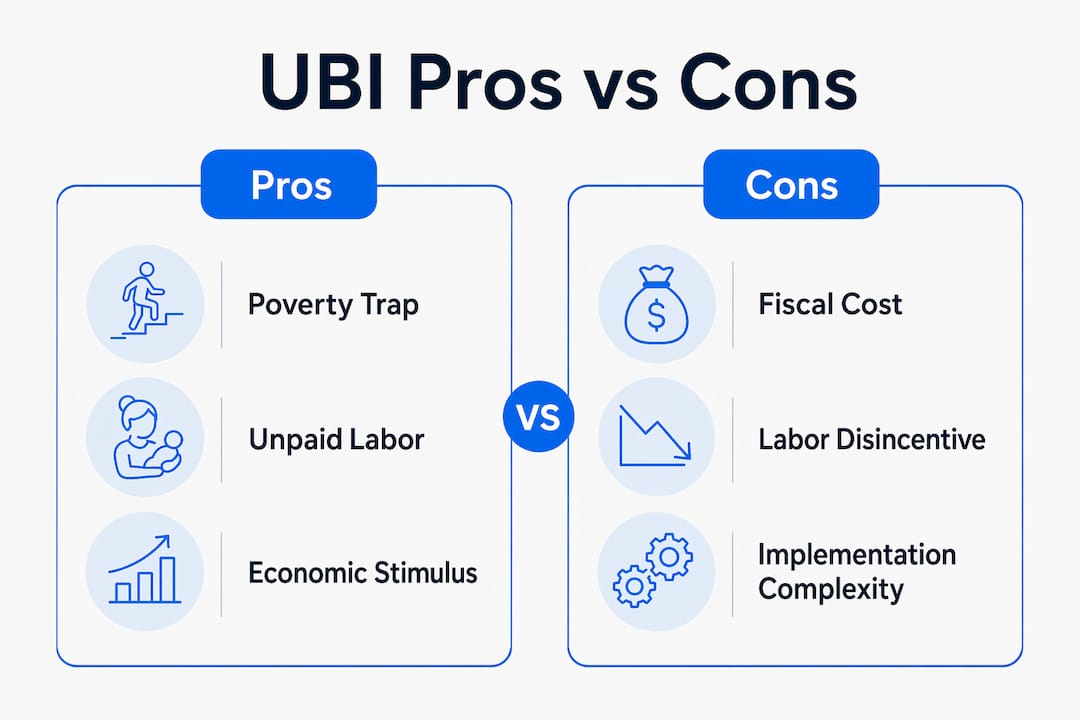
The social justice dimension of the UBI debate centers on a concept called the reciprocity worry. The reciprocity worry holds that public benefits should require labor market participation in return. Critics argue that paying people unconditionally undermines the social contract. Proponents counter that caregiving, community work, and other unpaid contributions are genuine societal labor that current systems simply do not recognize or compensate.
The redistribution question is where the “giving money to the wealthy” objection loses most of its force. If funded through progressive taxation, high-income individuals effectively pay more into the system than they receive back. The net transfer flows from rich to poor, making UBI redistributive in practice even if it appears universal on the surface. The financing mechanism determines whether UBI is a wealth transfer or a wealth giveaway.
Gender equity is an underappreciated angle in this debate. Women perform the majority of unpaid caregiving labor in the United States. A universal cash payment would partially compensate that contribution without requiring a bureaucratic classification of what counts as “real” work. That recognition matters both economically and symbolically.
- Reciprocity concern: Critics argue unconditional payments violate the expectation that benefits require contribution.
- Caregiver recognition: UBI implicitly values unpaid labor like childcare and elder care that current programs ignore.
- Progressive financing: Tax-funded UBI redistributes wealth downward, countering the argument that it wastes money on the rich.
- Inclusion risk: A flat payment may not address the specific needs of disabled individuals or those requiring targeted support.
Pro Tip: When making social justice arguments for or against UBI, specify the financing model. A UBI funded by a flat consumption tax has very different equity implications than one funded by a wealth tax.
What are the practical challenges of implementing universal basic income?
The administrative complexity of the current U.S. welfare system is a major barrier to UBI adoption. The federal government currently operates more than 80 welfare programs with administrative overhead running between 15% and 30%. Consolidating or replacing those programs with a single cash transfer sounds efficient in theory. In practice, each program has its own congressional constituency, agency bureaucracy, and recipient population with specific needs.

Political resistance follows directly from that complexity. Agencies, advocacy groups, and program beneficiaries all have reasons to defend existing structures. UBI can be more cost-effective than the current fragmented system, but political resistance from dismantling existing structures is a documented barrier that has stalled reform efforts repeatedly.
A job guarantee is the most frequently cited complement to UBI in policy circles. Research from the Economic Policy Institute and academic economists affiliated with econfip.org shows that UBI and job guarantees serve complementary roles. UBI raises individual autonomy. Job guarantees provide social inclusion and structured participation for long-term unemployed groups who benefit from more than cash.
| Feature | Universal Basic Income | Job Guarantee |
|---|---|---|
| Primary benefit | Financial autonomy for all | Employment and social inclusion |
| Target group | Universal | Long-term unemployed |
| Labor market effect | May reduce work hours | Maintains workforce participation |
| Administrative complexity | Lower (single transfer) | Higher (program management) |
| Political feasibility | Contested | Broadly supported |
- Audit existing programs. Identify which of the 80+ current welfare programs overlap with what a UBI payment would cover.
- Define the financing model. Decide whether UBI supplements or replaces existing benefits before calculating net cost.
- Run targeted pilots. Use guaranteed income programs in specific cities or counties as evidence-gathering tools, not proof of concept for national UBI.
- Pair with job guarantees. Design UBI alongside employment programs to address both income security and social inclusion.
- Build political coalitions. Engage program administrators and advocacy groups early to reduce bureaucratic resistance.
How does automation and AI shape the debate on basic income?
Automation anxiety is the primary reason UBI has returned to mainstream policy discussion. The fear is straightforward: AI and robotics will eliminate enough jobs to require a new income floor for displaced workers. Tech layoffs reshaping Silicon Valley have amplified that narrative, giving UBI advocates a concrete, visible example of technology disrupting labor markets.
The labor market data tells a more complicated story. AI has displaced some tasks and affected hiring patterns, particularly for younger workers, but overall U.S. unemployment held steady at 4.3% as of early 2026. That figure does not support the mass displacement scenario that UBI proponents cite as the urgent justification for immediate adoption.
The more accurate framing is that automation shifts human jobs rather than replaces all employment. New industries and tasks emerge as technology advances. The pattern has held through every major technological transition from mechanized agriculture to the internet economy. Whether AI represents a genuine break from that historical pattern remains an open empirical question, not a settled fact.
Policy analysts at the White House level have taken the position that AI growth will generate more economic activity than it destroys. That optimism may prove correct. It also may reflect motivated reasoning from an administration invested in the tech sector. Policymakers should treat current labor market stability as a reason for careful planning, not complacency.
Pro Tip: Separate the automation argument for UBI into two distinct claims: the short-term disruption claim (some workers need support now) and the long-term displacement claim (most jobs will disappear). The evidence supports the first claim far more than the second.
Key Takeaways
The strongest case for UBI rests on eliminating the poverty trap and recognizing unpaid labor, but fiscal cost and labor supply risks make a full national program politically and economically difficult without a clear financing plan.
| Point | Details |
|---|---|
| Fiscal scale is the core barrier | A $1,000/month UBI costs $3.7 trillion annually, requiring historic tax increases or welfare cuts. |
| Poverty trap elimination is real | Removing benefit phase-outs reduces effective marginal tax rates that currently punish low-income earners. |
| Progressive financing matters | UBI funded by progressive taxation redistributes wealth downward, countering the “waste on the wealthy” critique. |
| Pilots cannot replace national data | Small-scale guaranteed income tests cannot predict the full effects of a universal national program. |
| UBI and job guarantees complement each other | UBI builds autonomy; job guarantees provide inclusion and structure for long-term unemployed groups. |
Where I stand on the UBI debate after years of policy analysis
The UBI debate attracts two types of advocates: those who have done the fiscal math and those who have not. After years of tracking economic policy, I find the strongest honest case for UBI is not the automation apocalypse argument. It is the administrative efficiency argument. The current U.S. welfare system runs 80+ programs with 15–30% overhead. A single, unconditional transfer is structurally cleaner. That efficiency case deserves more attention than it gets.
What concerns me is the tendency to treat pilot programs as proof. A city-funded guaranteed income program for 500 households tells you almost nothing about what happens when you remove the novelty effect, scale to 330 million people, and fund it through real tax changes. The evidence gap between pilots and national policy is enormous, and advocates on both sides routinely ignore it.
My honest read is that targeted guaranteed income programs, paired with job guarantees, are the right near-term path. They generate real evidence. They build political coalitions. They do not require dismantling a welfare system that, for all its inefficiency, keeps millions of people housed and fed right now. A full UBI may eventually be the right answer. Rushing to it without a credible financing plan and real behavioral evidence would be a policy mistake with consequences measured in trillions of dollars.
— Povilas
Finblog covers the economic forces driving the UBI debate
The UBI debate does not exist in isolation. It connects directly to AI adoption rates, labor market shifts, and fiscal policy decisions that affect every investor and policymaker. Finblog tracks all of it. From AI’s role in economic growth to the tech CEO narratives around job cuts, Finblog provides the financial context that turns policy headlines into decisions you can act on. If you are a policymaker, investor, or informed reader who wants analysis grounded in data rather than ideology, Finblog’s policy coverage gives you the depth the debate requires. Understanding how UBI financing intersects with tax policy for businesses is part of that picture too.
FAQ
What is universal basic income?
Universal basic income is an unconditional cash payment made by a government to all citizens, regardless of employment status or income level. It requires no means test and no work requirement.
How much would a national UBI cost in the United States?
A $1,000 per month UBI for all Americans would cost approximately $3.7 trillion annually, which equals roughly 50% of the 2026 federal budget.
Does UBI reduce the incentive to work?
Trial data shows recipients in modest pilot programs tend to work fewer hours. However, pilots differ significantly from a national program, so the long-term labor supply effect at scale remains uncertain.
Is UBI the same as a guaranteed income program?
No. A true UBI is universal and unconditional with no time limit. Guaranteed income pilots are typically means-tested, time-limited, and targeted at specific populations, which makes direct comparisons unreliable.
Does AI and automation justify implementing UBI now?
Current U.S. unemployment sits at 4.3%, and labor market data does not yet show the mass displacement that would make urgent UBI adoption necessary. Automation shifts job types more than it eliminates employment overall.