

TL;DR:
- Residual income encompasses different concepts in personal, corporate, and creative finance, often leading to confusion. Building residual income requires significant initial effort, diversification, and patience over 12 to 36 months to generate sustainable cash flow. Its benefits include financial independence, compounding growth, and increased resilience, but it demands ongoing effort and risk management.
Most people hear “residual income” and picture money rolling in while they sleep. That image is half right and half dangerous. Residual income explained properly covers at least three distinct concepts: leftover personal income after debts, ongoing earnings from creative or investment assets, and a corporate profit metric. The confusion between these definitions leads people to either dismiss the concept entirely or chase it with unrealistic expectations. This guide breaks down what residual income actually means, how it differs from passive income, and exactly what it takes to build income streams that hold up over time.
Table of Contents
- Key takeaways
- What residual income actually means
- How residual income actually works
- The real benefits of building residual income
- Practical strategies to generate residual income
- Calculating residual income and common misconceptions
- My honest take on residual income
- Start building your residual income knowledge with Finblog
- FAQ
Key takeaways
| Point | Details |
|---|---|
| Multiple definitions exist | Residual income means different things in personal finance, corporate finance, and creative royalties. |
| Upfront work is required | Building residual income streams demands significant initial effort before income becomes sustainable. |
| Diversification reduces risk | Spreading across multiple streams protects against volatility in any single asset or income source. |
| Lenders use it too | Mortgage lenders assess residual income to determine how much you can actually afford to borrow. |
| It is not the same as passive income | Residual and passive income overlap but carry distinct definitions depending on the financial context. |
What residual income actually means
The word “residual” means leftover. That single idea branches into three genuinely different financial concepts, and mixing them up creates real confusion.
In personal finance, residual income is leftover funds after you pay all financial obligations, including rent, mortgage payments, car loans, and credit card minimums. Think of it as disposable purchasing power. If you earn $6,000 a month and your total debt payments come to $2,200, your residual income is $3,800. Lenders look at this number closely. It is not your gross salary or your net pay, it is what genuinely remains.
In creative and investment contexts, residual income refers to ongoing earnings from intellectual property, licensing deals, or investment assets after the initial work or capital has been deployed. A novelist who receives royalty checks years after a book’s release is earning residual income. So is a landlord collecting rent from a property purchased a decade ago.
In corporate finance, residual income is an economic profit metric. The formula measures how much profit a company generates above and beyond the cost of its equity capital. Residual income is calculated as (ROE minus cost of equity) multiplied by book value. A positive result signals value creation. A negative result means the business is technically destroying shareholder value even if accounting profits look fine.
Residual income vs. passive income
These two terms are often used interchangeably, but they have a meaningful distinction. Residual income often emphasizes leftover funds after obligations, while passive income specifically describes earnings generated with minimal active effort. A rental property generates passive income. Your salary minus your mortgage payment is residual income. The overlap happens when residual income from investments also happens to be passive. Understanding which definition applies in a given conversation prevents costly misreads.
| Context | Definition | Example |
|---|---|---|
| Personal finance | Income remaining after debts/expenses | $3,800 left after monthly obligations |
| Creative/investment | Ongoing earnings from assets or IP | Book royalties, rental income |
| Corporate finance | Profit above equity cost | (ROE − cost of equity) × book value |
How residual income actually works
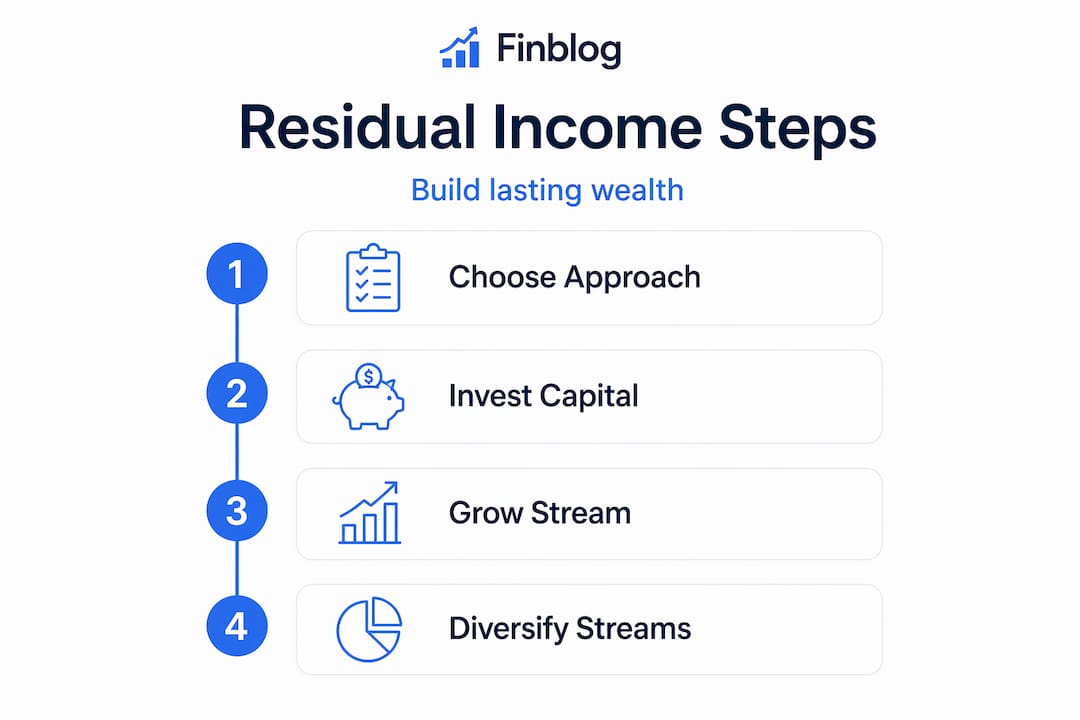
Residual income does not appear out of nowhere. Building it follows a three-stage pattern: create or acquire the income-generating asset, go through a ramp-up period where income builds gradually, and then reach a maintenance phase where ongoing involvement stays minimal. Skipping the first two stages is exactly why so many people get frustrated.
The three stages look like this in practice:
- Initial effort or investment. You write the course, buy the rental property, invest the capital, or create the digital product. This phase is anything but passive. It demands time, money, research, and often both.
- Ramp-up and income growth. Revenue builds as the asset gains traction. A rental property may sit vacant for the first few weeks. A new dividend portfolio takes years of reinvestment to generate meaningful cash flow. An online course needs an audience before it earns.
- Sustained earnings with low active involvement. Once the asset matures, your time input drops while income continues. This is the stage most people imagine when they hear “residual income.” It is real, but it is earned.
Common examples across these stages include dividend-paying stocks, rental real estate, self-published books and courses, software subscriptions, and affiliate content sites. Each follows the same arc.
Pro Tip: Set a realistic timeline before you start. Most residual income streams take 12 to 36 months before they contribute meaningfully to your monthly cash flow. Planning for this gap prevents you from abandoning a legitimate strategy too early.
One overlooked reality: residual income streams are not guaranteed. A tenant can leave. A platform can change its algorithm. A stock can cut its dividend. Treating any single stream as permanent income is a mistake. The goal is to build several streams so that the failure of one does not derail your finances.
The real benefits of building residual income
The appeal of residual income goes well beyond convenience. When structured properly, it fundamentally changes your financial position.

The most direct benefit is income that exists independent of your time. Active income stops the moment you stop working. Residual income continues during illness, vacations, career transitions, or even retirement. For anyone who has ever been laid off and watched their income disappear overnight, this distinction matters enormously.
Residual income also enables compounding. When you reinvest dividends, rental profits, or royalty earnings back into additional income-generating assets, your total output accelerates over time. This is not theoretical. A dividend investor who consistently reinvests payouts for 20 years accumulates a substantially larger position than one who spends them.
“The goal of building residual income is not to stop working. It is to make working optional.”
Diversifying across multiple income streams adds a layer of protection that a single salary simply cannot provide. If your rental income dips, dividend income may stay steady. If royalties slow, a side business may pick up. This is the same principle as portfolio diversification applied to your overall income structure.
There are legitimate limitations to acknowledge. Residual income streams often require upfront capital, specialized skills, or extended time before they pay off. They carry market risk, occupancy risk, and platform dependency risk. The benefits are real, but so are the constraints.
Practical strategies to generate residual income
No two people will build residual income the same way. Your starting capital, skills, and risk tolerance determine which approaches make sense. Here is how to think across the main categories.
Investment-based income is the most accessible starting point for many people. Dividend stocks, index funds with dividend components, and bonds generate regular cash distributions without requiring you to manage a business. Building a dividend investing strategy early and reinvesting consistently is one of the most reliable long-term approaches available. You do not need a large sum to start, but you do need patience.
Real estate rental income is historically one of the strongest residual income sources. A properly managed rental property generates monthly cash flow above mortgage and maintenance costs. The challenges are real, including vacancies, repairs, and tenant issues, but the income potential justifies the complexity for many investors.
Digital and business income covers online courses, software as a service, affiliate marketing, and content monetization. The startup costs are low, but the time investment is substantial. A well-researched affiliate content site can generate consistent monthly income years after the initial articles were written. The same applies to a self-published book or a niche software tool.
Intellectual property royalties apply to authors, musicians, photographers, and inventors. Once the work is created and licensed or sold, royalties flow in based on usage. Patent holders earn fees every time a manufacturer uses their design. This category rewards creativity and specialization.
Pro Tip: Do not try to build every stream at once. Pick one category that matches your current resources, build it to a point where it generates consistent income, and then add a second stream. Parallel-building too early spreads your attention too thin and slows everything down.
Diversifying across multiple income types is the strategy that separates people who build lasting financial resilience from those who end up dependent on a single asset class. Concentration risk is the biggest threat to residual income reliability.
Calculating residual income and common misconceptions
Getting the math right matters whether you are assessing your own finances or evaluating a business investment.
For personal finance, the calculation is straightforward:
Residual Income = Total Monthly Income − Total Monthly Debt Obligations
If you earn $7,500 per month and carry $2,100 in debt payments, your residual income is $5,400. Mortgage lenders pay close attention to this number. Lenders use residual income to verify that borrowers have enough left over after debts to handle living expenses, and some programs require residual income to reach at least 120% of a defined threshold to qualify.
For corporate finance, the formula is more nuanced. Residual income equals net income minus a charge for equity capital used. If a company earns $500,000 in net income but its equity capital requires a $600,000 return, its residual income is negative $100,000. This is a critical insight. Corporate residual income can be negative even when accounting profits are positive, which signals that the business is not truly creating value for shareholders.
| Calculation type | Formula | Purpose |
|---|---|---|
| Personal finance | Income − debt obligations | Creditworthiness, affordability |
| Investment valuation | (ROE − cost of equity) × book value | Measure economic profit |
Several misconceptions trip people up regularly:
- Residual income is not always passive. Writing a book takes months of active work before it earns a single royalty.
- Residual income is not always positive. In corporate contexts, poor performance makes it negative.
- Residual income is not the same as disposable income. Disposable income is post-tax earnings. Residual income subtracts debt obligations on top of that.
- Building residual income requires patience and sustained effort before any meaningful return materializes.
My honest take on residual income
I have spent years watching people get burned not by bad strategies but by misaligned expectations. The biggest mistake I see is treating residual income as a shortcut. Someone reads about dividend investing or online courses, spends a few weeks setting things up, and then wonders why they are not earning $3,000 a month two months later.
In my experience, the people who build genuine residual income do three things differently. They treat the initial phase like a second job, not a hobby. They reinvest every dollar earned in the early stages instead of spending it. And they stay consistent through long stretches where nothing seems to be happening.
What I have learned is that the ramp-up period is where most people quit. It is the hardest part because you are putting in real work for minimal reward. But that period is not wasted. It is the foundation. The people who push through it end up with income streams that genuinely require little attention years later.
My practical advice: start with one stream that matches your existing skills or capital, build it deliberately, and resist the urge to chase the next shiny method. The boring approach compounds. The scattered approach rarely does.
— Povilas
Start building your residual income knowledge with Finblog
Understanding residual income is the first step. Knowing how to apply it to your own financial picture is where the real progress happens. Finblog covers the specific strategies that turn these concepts into actual income, from passive income ideas for investors at every level to diversification strategies that protect what you build. Whether you are just starting to think about income beyond your salary or actively managing multiple streams, the guides on Finblog give you the depth and clarity to make better decisions. Explore the full library and find the approach that fits where you are right now.
FAQ
What is residual income in simple terms?
Residual income is the money left over after you pay all your regular financial obligations, or in an investment context, the ongoing earnings generated by an asset after the initial work or capital has been deployed.
How is residual income different from passive income?
Residual income often refers to leftover funds after debts and expenses, while passive income specifically describes earnings generated with minimal ongoing effort. All passive income can be considered residual, but not all residual income is passive.
How do I start generating residual income?
Pick one approach that matches your current skills and capital, such as dividend investing, rental real estate, or a digital product, and commit to the build phase for at least 12 to 24 months before expecting meaningful returns.
Can residual income be negative?
Yes. In corporate finance, residual income is negative when a company’s return on equity falls below its cost of equity, meaning the business is consuming more value than it creates despite showing accounting profit.
Why do lenders care about residual income?
Mortgage lenders use residual income to confirm that borrowers retain enough cash after debt payments to cover living expenses. Some loan programs require residual income to meet a specific threshold before approving a mortgage application.