



TL;DR:
- Cash flow measures actual money moving in and out, providing a better indicator of financial health than profit.
- Effective cash flow management enhances resilience, decision-making, investment opportunities, and personal security.
- Regular tracking, forecasting, and disciplined habits are essential to overcoming cash flow challenges and maintaining stability.
Understanding the importance of cash flow for financial success
Many professionals and investors assume that a strong profit figure is proof of financial health. It isn’t. A business can report impressive earnings on paper while struggling to pay its employees on Friday. Individuals can earn six figures and still face overdrafts by month’s end. The real measure of financial stability sits in your cash flow, the actual movement of money into and out of your accounts. This article will show you exactly what cash flow is, why it matters more than you might think, and how you can take control of it to protect and grow your financial future.
Table of Contents
- What is cash flow and why does it matter?
- Key benefits of effective cash flow management
- Common cash flow challenges and how to overcome them
- Practical tips to improve cash flow for professionals and investors
- The difference cash flow focus makes: Our perspective
- Take your cash flow knowledge to the next level
- Frequently asked questions
Key Takeaways
| Point | Details |
|---|---|
| Cash flow vs. profit | Cash flow measures real money movement, while profit is accounting-based. |
| Importance for stability | Strong cash flow protects against crises and supports short and long term goals. |
| Manage and monitor | Regularly tracking and adjusting cash flow leads to better financial decisions. |
| Predict and prevent risk | Monitoring cash flow ratios can prevent financial distress before it starts. |
What is cash flow and why does it matter?
Cash flow, at its simplest, is the net amount of money moving in and out of your finances over a set period. When more money flows in than goes out, you have positive cash flow. When more exits than enters, you’re in negative territory. This sounds straightforward, but the real-world mechanics are often anything but simple.
The key distinction most people miss is the difference between cash flow and profit. Profit is an accounting concept. It records revenue when a sale is made, even if you haven’t received the payment yet. Cash flow management tracks actual inflows and outflows of money, distinct from profit which is accrual-based. That gap between profit on paper and cash in hand is exactly where financial trouble hides.
Consider a consulting firm that closes a $500,000 contract in January. Accounting records the revenue, and the profit looks fantastic. But if the client has 90-day payment terms, that cash won’t arrive until April. Meanwhile, salaries, office rent, software subscriptions, and other expenses continue rolling out every single month. The business is profitable but potentially cash-starved.
For individual investors, the dynamic is similar. You might hold a diversified portfolio with strong returns on paper, but if your actual monthly income doesn’t cover your living expenses and investment contributions comfortably, you’re riding a financial tightrope.
Here’s a breakdown of the three main types of cash flow:
| Type | What it tracks | Who it matters most to |
|---|---|---|
| Operating cash flow | Day-to-day business transactions | Business owners, self-employed |
| Investing cash flow | Asset purchases, sales, investments | Investors, growing businesses |
| Financing cash flow | Loans, equity, dividends | Both professionals and investors |
Understanding all three types gives you a complete picture of where money is really going. Most people only focus on operating cash flow, but ignoring investing and financing movements can leave dangerous blind spots in your financial planning.
Some red flags that signal poor cash flow management include:
- Consistently relying on credit lines to cover routine expenses
- Repeatedly paying bills late despite having strong revenues
- Inability to take advantage of investment opportunities because funds are tied up
- Stress around payroll or tax deadlines every quarter
“Your profit and loss statement tells you what you earned. Your cash flow statement tells you whether you can survive.”
For a deeper look at how to structure your tracking system, the cash flow management guide at finblog.com offers a practical framework tailored to working professionals. And if you’re building a broader financial foundation, the personal finance management guide is an excellent companion resource.
Key benefits of effective cash flow management
Once you understand what cash flow is, the case for managing it carefully becomes obvious. But the benefits go well beyond just “not running out of money.”
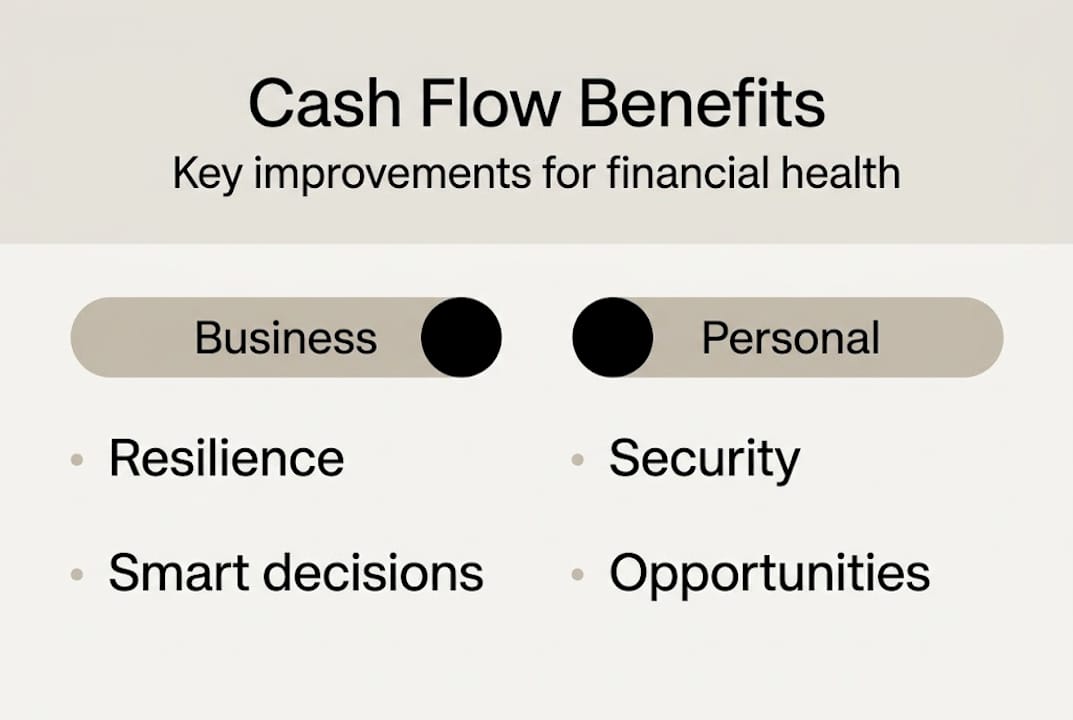
Effective cash flow management builds resilience, optimizes capital use, enhances decisions, and prevents insolvency. Let’s unpack what each of these actually looks like in practice.
Resilience during downturns. When a market correction hits, or when a major client cancels a contract unexpectedly, the businesses and individuals with healthy cash reserves weather the storm. Those without adequate cash flow typically scramble for emergency credit at unfavorable terms, or worse, liquidate investments at the worst possible time.
Better day-to-day decisions. Knowing your exact cash position allows you to make smarter choices. Should you hire a contractor this month? Can you negotiate a bulk discount by paying a supplier upfront? Is it smart to reinvest profits right now, or should you hold cash for an upcoming obligation? These decisions become much clearer when you know your cash flow in real time.

Seizing investment opportunities. The best deals in real estate, equities, or business acquisitions rarely come with long lead times. Investors with strong cash flow can move quickly. Those who are perpetually cash-tight watch opportunities pass them by while they wait for funds to free up.
Personal lifestyle security. For individuals, positive cash flow creates a buffer that makes life less stressful. It means you can handle a surprise car repair or a medical bill without derailing your savings plan. It also means you can make deliberate choices about spending and saving, rather than reactive ones.
Here’s a quick comparison between reactive and proactive cash flow management:
| Approach | Decision style | Financial outcomes |
|---|---|---|
| Reactive | Respond to crises as they occur | Higher costs, more debt, missed opportunities |
| Proactive | Anticipate needs and surpluses | Lower stress, better investments, stronger stability |
The numbers speak clearly. Professionals who plan their cash flow are far better positioned to meet their financial milestones planning targets, from buying a home to funding retirement, without constant financial disruption.
Some of the most powerful benefits of strong cash flow management include:
- Reduced dependency on high-interest debt
- Ability to invest consistently rather than sporadically
- Greater confidence in financial negotiations
- Improved credit profiles over time
Pro Tip: Build a cash reserve equal to at least three months of your essential expenses or operating costs. Keep it in a liquid, easily accessible account separate from your regular checking account. This single habit can prevent the most common cash flow crises.
Common cash flow challenges and how to overcome them
Knowing the benefits of cash flow management is powerful. But the real skill lies in navigating the obstacles that constantly push against it.
The most common cash flow challenges fall into three categories: irregular income, delayed payments, and uncontrolled expenses. Each one can erode financial stability quickly if left unaddressed.
Irregular income is a challenge for freelancers, consultants, seasonal business owners, and commission-based sales professionals. When income arrives in unpredictable lumps, it’s easy to overspend during good months and scramble during slow ones. The fix is to calculate your average monthly income across 12 months and budget based on that lower, normalized figure.
Delayed payments plague businesses that extend credit to clients. A client sitting on a 60-day invoice isn’t just an inconvenience; it actively disrupts your ability to pay your own bills. Invoice promptly, set clear payment terms upfront, and consider offering small discounts for early payment. Many businesses that struggle with cash flow would solve most of their problems just by tightening their invoicing process.
Overspending on non-essentials is surprisingly common even among high earners. Subscriptions, premium services, and lifestyle inflation all nibble away at cash reserves without triggering any obvious alarm. A quarterly audit of all recurring expenses often reveals hundreds of dollars that can be redirected to reserves or investments.
One powerful but underused tool is the cash flow ratio. This metric compares your actual cash from operations to specific financial obligations like debt or current liabilities. Cash flow ratios outperform traditional ratios in predicting distress, making them one of the most reliable early warning systems available to business owners and investors.
Here’s a step-by-step approach to getting ahead of cash flow problems:
- Track everything. Use accounting software, apps, or even a well-structured spreadsheet to record every inflow and outflow, not just monthly, but weekly.
- Invoice immediately. Send invoices the same day you deliver goods or services. Every day of delay is a day your cash is sitting in someone else’s account.
- Forecast 90 days ahead. Build a rolling 90-day cash flow projection. This helps you spot potential shortfalls before they become emergencies.
- Control discretionary spending. Separate your spending into essential and discretionary categories. When cash flow tightens, the discretionary column gets cut first.
- Set payment term expectations early. Negotiate payment terms with both clients and suppliers before work begins. Align them so money comes in before it needs to go out.
For deeper strategies on handling financial pressure, the financial stress management guide covers psychological and practical approaches. You can also compare software options with this best financial planning tools breakdown.
Pro Tip: Set a recurring calendar reminder every week to review your current bank balance against your projected outflows for the next 30 days. This five-minute habit catches problems weeks before they become crises.
Practical tips to improve cash flow for professionals and investors
Understanding the challenges is half the battle. The other half is building habits and systems that keep your cash flow consistently healthy, even when markets shift or unexpected expenses appear.
Automate where you can. Set up automatic transfers to your savings and investment accounts on the day you receive income. This pays your future self first and removes the temptation to spend funds before they’re allocated. Automation also works in reverse: schedule automatic bill payments to avoid late fees that drain cash unnecessarily.
Negotiate smarter payment terms. If you’re a business owner, push for shorter receivables terms with clients while negotiating longer payment windows with your suppliers. Even a 15-day improvement on each side can create meaningful breathing room in your monthly cash position. If you’re an individual professional, consider asking employers or clients for milestone-based payments rather than lump sums at project completion.
Use technology to your advantage. Modern financial tools go far beyond basic bookkeeping. Cash flow forecasting software can model multiple scenarios simultaneously, showing you what happens to your position if revenue drops by 20% or a major expense hits unexpectedly. Cash flow management tracks actual inflows and outflows of money, and today’s tools automate most of that tracking in real time.
Key habits that consistently improve cash flow:
- Review your cash flow statement monthly, not just your profit and loss report
- Maintain a 13-week rolling cash flow forecast for business finances
- Segment income and expenses by category to spot trends quickly
- Renegotiate contracts and service agreements annually to ensure terms still serve you
- Pay estimated taxes quarterly to avoid surprise tax bills that gut your reserves
“Cash flow management isn’t a task you do once a year during tax season. It’s a discipline you practice weekly, like physical fitness. The results compound quietly until they become impossible to ignore.”
For individuals building personal financial discipline, a strong budget is the foundation. The budget creation guide at finblog.com walks through a structured process that integrates naturally with cash flow tracking.
Pro Tip: Create two budgets: one based on your average monthly income and one based on your minimum expected income. Use the minimum budget as your operating standard and treat any excess as bonus cash to direct toward reserves or investments.
A monthly cash flow review doesn’t need to be a lengthy process. Thirty minutes with your bank statements, your tracking software, and a simple spreadsheet is enough. The goal is to confirm that your actual position matches your projection, and to update the forecast if it doesn’t.
The difference cash flow focus makes: Our perspective
Here’s a view that most financial advice glosses over: chasing profit without managing cash flow is one of the most common ways smart, talented professionals destroy financial security.
We’ve seen it repeatedly. A business generates record revenue for three consecutive quarters. The owner reinvests heavily, expands operations, and takes on new obligations based on that profit trajectory. Then one quarter goes soft, receivables slow down, and suddenly there’s no cash to cover payroll. The business wasn’t failing. Its cash timing was.
For individual investors, the same trap shows up differently. A high earner accumulates impressive assets but keeps nearly all of it illiquid, tied up in real estate equity or retirement accounts they can’t touch without penalties. When a real opportunity appears or a crisis hits, they’re stuck. Asset-rich, cash-poor is a real and painful place to be.
The mindset shift we advocate is simple but powerful: measure financial health by cash availability first, then by profit or asset value. This shift changes how you negotiate, how you invest, and how you plan. It’s also one of the core principles behind every financial risk management strategies framework worth following.
Cash flow focus doesn’t mean hoarding cash. It means knowing exactly what you have, what’s coming, and what’s going out, so every financial decision you make is grounded in reality rather than optimistic accounting.
Take your cash flow knowledge to the next level
You’ve worked through the fundamentals and some advanced insights around cash flow. Now the real gains come from putting these strategies into a consistent system tailored to your situation. At finblog.com, we’ve built a library of practical, professional-grade resources designed for people who take their financial outcomes seriously. Start with our comprehensive cash flow guide, which pairs perfectly with the concepts covered here and includes tools, checklists, and expert-recommended frameworks. Whether you’re managing business finances, building personal wealth, or both, our guides give you the clarity to act with confidence.
Frequently asked questions
How does cash flow differ from profit?
Profit measures overall earnings after expenses, while cash flow tracks real money moving in and out, making it a more accurate indicator of whether you can meet immediate financial obligations.
What tools are effective for managing cash flow?
Budgeting apps, dedicated accounting software like QuickBooks or Xero, and financial dashboards all help you track and forecast cash flow accurately and efficiently.
Why do businesses with profit still face cash flow problems?
Profitable businesses can still run short on cash because revenues tied to unpaid invoices or inventory don’t translate into spendable money until those obligations are settled.
Can cash flow ratios predict financial trouble?
Yes. Cash flow ratios are consistently more reliable than traditional financial ratios when it comes to identifying early signs of financial distress in both businesses and personal finances.
How often should I review my cash flow?
A monthly review is the minimum recommended cadence, but weekly check-ins are more effective for catching trends early and adjusting before small gaps become serious problems.