

TL;DR:
- Conducting an annual financial review provides clarity on progress and helps identify issues early.
- Preparing with key documents like account statements and tax returns ensures a productive review process.
- Major life events should trigger immediate reviews to adjust your financial plan promptly.
Most investors feel a quiet unease when they try to answer one simple question: am I actually on track? Not just saving something, but saving enough, investing wisely, and moving toward real goals. That uncertainty is more common than you think, and it costs people real money every year. A structured annual financial review replaces that guesswork with clarity. It gives you a repeatable system to measure progress, catch problems early, and make confident decisions. This guide walks you through exactly how to do it, from gathering documents to avoiding the mistakes that quietly derail even disciplined savers.
Table of Contents
- Preparation: What to gather before your review
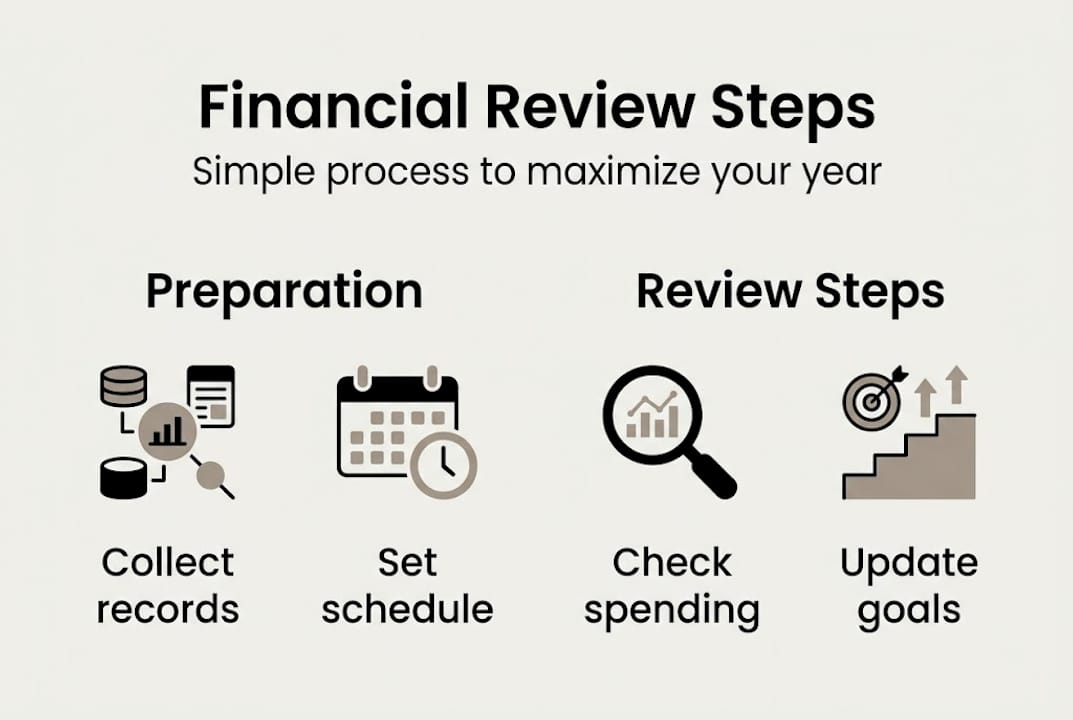
- The core steps of an annual financial review
- Special considerations for major life changes
- Maximizing results: Avoiding common mistakes and optimizing
- Our take: Why annual reviews matter more than ever in 2026
- Next steps: Make your best financial year yet
- Frequently asked questions
Key Takeaways
| Point | Details |
|---|---|
| Gather key documents | Having all your financial records ready streamlines the review and prevents missed steps. |
| Follow a proven process | Breaking your review into defined steps ensures thorough evaluation and clarity. |
| Adjust for life changes | Major events require prompt financial updates to stay on track. |
| Automate where you can | Use technology and scheduling to keep your finances aligned all year. |
| Avoid common pitfalls | Sidestep frequent errors like emotional investing and skipped rebalancing for better results. |
Preparation: What to gather before your review
Once you understand the value of an annual review, it’s crucial to prepare by collecting everything you’ll need for a smooth process. Showing up to your review without the right documents is like trying to fix a car without the keys. You’ll waste time, miss things, and end up with an incomplete picture.
Annual financial reviews typically involve 8-12 core steps including net worth calculation and budget review, so having everything ready upfront makes the difference between a productive session and a frustrating one.
Here’s what to pull together before you start:
- Bank and investment account statements (all accounts, past 12 months)
- Debt balances: mortgage, car loans, student loans, credit cards
- Insurance policy summaries: life, health, disability, property
- Last year’s tax return plus any estimated tax payments made
- Retirement account statements: 401(k), IRA, Roth IRA
- A list of your current financial goals and any notes from last year’s review
For tracking, a simple spreadsheet works well. Tools like Google Sheets or Excel let you build a net worth tracker and budget summary in one place. If you prefer apps, platforms like Mint or Personal Capital pull accounts automatically. Pair your documents with a quarterly financial planning habit to stay organized between annual reviews.
| Document type | Where to find it |
|---|---|
| Bank statements | Online banking portal |
| Investment statements | Brokerage account dashboard |
| Tax return | IRS account or tax software |
| Insurance summaries | Insurer’s online portal or email |
| Debt balances | Lender websites or credit report |
The best time to run your review is either in late December or early January, when year-end data is fresh. Tax season (February to April) works too, since you’re already gathering financial documents.
Pro Tip: Set a recurring digital calendar reminder every November 15th to start collecting documents. Treat it like a bill due date so it never slips.
The core steps of an annual financial review
With your materials ready, you can now dive into the key steps that make an annual financial review effective. Think of this as a structured checklist, not a free-form exercise. Each step builds on the last.
Annual reviews cover steps such as net worth calculation, portfolio rebalancing, retirement review, debt assessment, and goal progress evaluation. Here’s how to work through them:
- Calculate your net worth. Add up all assets (savings, investments, property) and subtract all debts. This single number tells you more than any monthly budget snapshot.
- Review your budget. Compare what you planned to spend versus what you actually spent. Identify categories that drifted and decide whether to adjust or correct.
- Check retirement contributions. Fidelity recommends saving 15% of pre-tax income for retirement, including any employer match. If you’re behind, look for ways to optimize retirement savings before year-end.
- Rebalance your investment portfolio. Market gains and losses shift your asset allocation over time. Rebalancing restores your target mix and keeps risk in check.
- Review insurance coverage. Check that your life, disability, and property coverage still fits your current situation. Gaps here can be financially devastating.
- Assess your debt. List every balance, interest rate, and minimum payment. Prioritize high-interest debt and track payoff progress.
- Evaluate goal progress. Did you hit last year’s targets? Set specific, measurable goals for the coming year.
For emergency funds, most people should hold 3-6 months of essential expenses. If you’re self-employed, aim for 6-12 months. A quarterly budgeting approach helps you monitor this between annual reviews.

| Review step | Traditional method | Automated method |
|---|---|---|
| Budget tracking | Manual spreadsheet | App like Mint or YNAB |
| Investment rebalancing | Manual trade orders | Robo-advisor auto-rebalance |
| Savings contributions | Manual transfers | Scheduled auto-transfers |
| Net worth tracking | Spreadsheet update | Aggregator like Personal Capital |
Pro Tip: Automate your savings and investment contributions so they happen before you can spend the money. Automation removes emotion from the equation entirely.
Special considerations for major life changes
While the standard review flow covers your day-to-day reality, certain events require extra care and adjustments. Life rarely follows a neat annual schedule, and your financial plan shouldn’t pretend otherwise.
Major life events like a job change, divorce, or inheritance are key triggers for an immediate review, outside of your normal yearly cycle. Self-employed individuals also need to account for larger emergency funds and quarterly estimated tax payments.
Here are the most common triggers and what each one requires:
- New job or income change: Update your 401(k) contribution rate, review new benefits, and adjust your budget for the new income level.
- Marriage: Combine or coordinate financial accounts, update beneficiaries, and revisit insurance coverage for both partners.
- Divorce: Separate accounts immediately, update all beneficiary designations, and rebuild your emergency fund. Strong debt management strategies become especially important here.
- Inheritance or windfall: Resist the urge to act fast. Park the funds temporarily, then plan deliberately with tax implications in mind.
- Starting a business: Your income becomes variable, so your emergency fund needs to grow. You’ll also need to set up quarterly estimated tax payments and separate business finances from personal ones. If you’re carrying student debt into self-employment, revisiting your repayment plan through managing student loan debt resources can help.
“Financial reviews aren’t just annual. They’re essential after major life changes.”
The key across all of these scenarios is speed. Waiting until your scheduled year-end review after a major life event can mean months of misaligned coverage, wrong beneficiaries, or missed tax deadlines. Treat any significant change as a trigger for an immediate mini-review.
Maximizing results: Avoiding common mistakes and optimizing
Even the best plans can go off-track without attention to common pitfalls and smart upgrades. Most people who do an annual review still leave money on the table because of a handful of repeatable errors.
Here are the mistakes that show up most often:
- Missing documentation: Forgetting one account or debt balance skews your entire net worth calculation.
- Emotional investing: Reacting to market swings during your review leads to selling low and buying high. Stick to your target allocation.
- Skipping rebalancing: A portfolio left alone for a year can drift significantly from your intended risk level.
- Ignoring insurance gaps: People update investments but forget to check whether their life or disability coverage still matches their income and dependents.
- Not updating for life changes: Getting married, having a child, or changing jobs and not adjusting your plan is one of the most expensive mistakes you can make.
For optimization, calendar scheduling and automation are the two highest-impact moves. The 50/30/20 budget rule (50% needs, 30% wants, 20% savings and debt) gives you a simple framework to evaluate whether your spending is balanced.
The gap between average behavior and best practice is significant. The U.S. personal saving rate sits around 4.5%, well below the 15% benchmark most experts recommend. That gap compounds painfully over a career.
Use tax optimization strategies to reduce your tax burden during the review. Explore planning for tax deductions before year-end, and if credit card balances are a recurring problem, tackle managing credit card debt as part of your debt step.
Pro Tip: Schedule a 30-minute quarterly mini-checkup in addition to your annual deep dive. It keeps small problems from becoming big ones.
Our take: Why annual reviews matter more than ever in 2026
With the main review framework covered, it’s worth taking a step back to consider why this process works so well and why it’s especially vital right now.
Markets in 2026 are moving faster than ever. Interest rates, inflation expectations, and tax policy are all in flux. In that environment, the temptation is to react constantly, checking your portfolio weekly and shifting strategy with every headline. That behavior destroys returns. Study after study shows that frequent trading and emotional decisions cost investors more than market downturns themselves.
The annual review works precisely because it creates a structured pause. It forces you to look at the full picture rather than the noise of any given week. When you know you have a scheduled review coming, you’re less likely to make impulsive moves in between.
We’ve seen this pattern repeatedly: investors who stay consistent with retirement planning outperform those who chase trends, even when the trend-chasers pick winners occasionally. The compounding effect of disciplined, annual course-corrections beats sporadic bursts of activity every time.
The real edge isn’t a hot stock pick or a clever tax move. It’s showing up every year, doing the work, and adjusting calmly. That habit, more than any single financial decision, is what separates people who build real wealth from those who stay stuck.
Next steps: Make your best financial year yet
Having understood the steps and the logic behind annual reviews, here’s how you can put this guidance into action with the help of Finblog.
You now have a clear, repeatable framework: gather your documents, work through each review step, adjust for life changes, and avoid the common traps that slow most people down. The next move is yours. Start by bookmarking Finblog’s resources as your go-to hub for financial guidance, tools, and expert perspectives. Then set up your first quarterly check-in using the quarterly planning guide to build momentum between now and your next annual review. Consistency is the strategy. The investors who do this every year, without exception, are the ones who look back a decade from now and feel genuinely proud of where they landed.
Frequently asked questions
How long should an annual financial review take?
A thorough annual financial review usually takes 2-3 hours if you’re organized, but your first review may take longer since you’re building the process from scratch. With preparation, 8-12 core steps can be completed efficiently in a single focused session.
What is the ideal savings rate I should target each year?
Experts recommend saving 10-20% of income annually, with 15% pre-tax for retirement being the strongest benchmark, including any employer match contributions.
What should trigger an extra financial review besides year-end?
Major life changes like a new job, divorce, inheritance, or business launch should all prompt an immediate review. Key life event triggers include job changes, divorce, and windfalls, all of which affect your coverage, taxes, and goals.
How do I know if my emergency fund is large enough?
Most people should hold 3-6 months of essential expenses in an accessible account. If you’re self-employed, the recommended range is 6-12 months to account for income variability and irregular cash flow.
Recommended
- Quarterly financial planning: optimize your finances in 2026 – Finblog
- Planning financial milestones: step-by-step guide to stability – Finblog
- Master the financial goal setting process in 5 steps – Finblog
- Top financial goal setting tips for lasting success – Finblog
- Financial management for SME profitability: 5 key steps