

Managing investment portfolios can feel increasingly complex as market, credit, and operational uncertainties threaten financial stability. For finance professionals in risk management, the ability to thoroughly measure and adapt to evolving risk exposures is essential for protecting client assets and achieving performance targets. This article offers actionable strategies for mastering investment risk management by pinpointing vulnerabilities, distinguishing major risk types, and leveraging advanced mitigation frameworks.
Table of Contents
- Defining Risk Exposure In Investment Management
- Major Types Of Risk And Key Distinctions
- Core Principles Of Effective Risk Mitigation
- Strategic Tools For Assessing Liability And Exposure
- Legal, Regulatory, And Compliance Impacts
- Critical Mistakes And Enhancing Resilience
Key Takeaways
| Point | Details |
|---|---|
| Understanding Risk Exposure | Investors should analyze various risk dimensions to navigate potential financial vulnerabilities effectively. |
| Regular Portfolio Monitoring | Consistently reviewing and rebalancing portfolios helps manage risk exposure in changing market conditions. |
| Comprehensive Risk Mitigation | Employing diverse strategies, such as diversification and active hedging, enhances portfolio resilience. |
| Proactive Compliance Measures | Establish ongoing compliance processes to address legal and regulatory changes, safeguarding investor interests. |
Defining Risk Exposure in Investment Management
Risk exposure represents the potential financial vulnerability an investment portfolio faces from various market uncertainties. In investment management, understanding risk exposure means comprehensively analyzing the different ways your investments could experience potential losses or performance volatility. Investment risk management involves systematically identifying, measuring, and mitigating these potential financial threats.
Professional investors categorize risk exposure into several critical dimensions:
- Market Risk: Potential losses from overall market fluctuations
- Credit Risk: Potential losses from borrower default or credit deterioration
- Liquidity Risk: Potential losses from inability to quickly convert assets to cash
- Operational Risk: Potential losses from internal system failures or external events
- Systematic Risk: Broad economic factors affecting entire market segments
Understanding risk exposure requires a nuanced approach to portfolio construction. Investors must recognize that risk is not inherently negative – it represents the potential variability of returns. By measuring investment portfolio risks strategically, professionals can create balanced investment strategies that optimize potential returns while maintaining acceptable risk levels.
Quantitative risk assessment involves calculating specific metrics like standard deviation, beta coefficients, and value-at-risk (VaR) to provide precise measurements of potential portfolio vulnerabilities. These mathematical models help investors understand the probabilistic range of potential investment outcomes, enabling more informed decision-making.
Pro tip: Regularly review and rebalance your investment portfolio to manage risk exposure dynamically and adapt to changing market conditions.
Major Types of Risk and Key Distinctions
Investment risk management requires a comprehensive understanding of the various risk types that can impact portfolio performance. Financial risk management strategies help investors navigate the complex landscape of potential financial vulnerabilities across multiple dimensions. Recognizing the distinct characteristics of each risk type is crucial for developing targeted mitigation approaches.
Professional investors typically categorize risks into several fundamental types:
- Market Risk: Systematic risk affecting entire market segments
- Credit Risk: Potential for losses from borrower defaults
- Liquidity Risk: Challenges in converting assets to cash
- Operational Risk: Losses from internal system failures
- Country Risk: Geopolitical and economic uncertainties in specific regions
- Inflation Risk: Potential erosion of investment value due to rising prices
- Behavioral Risk: Psychological factors influencing investment decisions
- Governance Risk: Risks associated with organizational management and control
Each risk type presents unique challenges and requires specialized assessment techniques. Market risk, for instance, involves broader economic fluctuations that can impact entire investment portfolios, while credit risk focuses on the specific probability of default by individual borrowers or counterparties. Balancing risk and return becomes a nuanced process of understanding these intricate risk interactions.
Quantitative risk analysis involves sophisticated mathematical models that help investors measure and predict potential vulnerabilities. These models incorporate statistical techniques like standard deviation, correlation analysis, and value-at-risk calculations to provide a more precise understanding of potential portfolio performance under various scenarios.
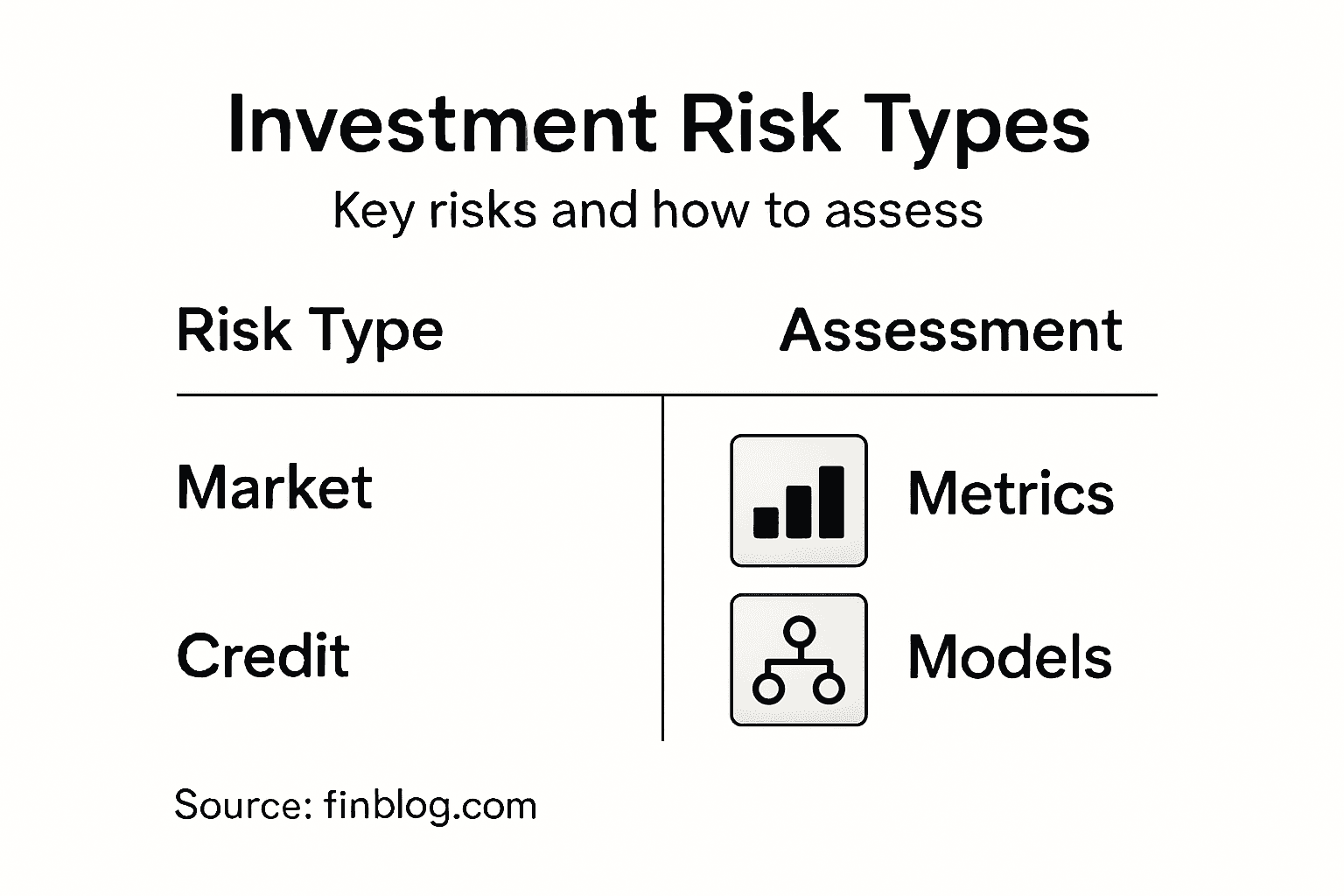
Here’s a comparison of common risk types and how they typically affect investment portfolios:
| Risk Type | Typical Impact on Portfolio | Common Assessment Approach |
|---|---|---|
| Market Risk | Portfolio value fluctuates | Standard deviation, beta analysis |
| Credit Risk | Potential loan default losses | Credit ratings, spread analysis |
| Liquidity Risk | Difficulty selling assets fast | Bid-ask spread, turnover ratio |
| Operational Risk | Disrupts operations and returns | Scenario analysis, audits |
| Country/Political Risk | Unpredictable market disruptions | Economic indicators, news tracking |
Pro tip: Develop a comprehensive risk management framework that dynamically assesses and adapts to multiple risk dimensions, ensuring a holistic approach to portfolio protection.
Core Principles of Effective Risk Mitigation
Risk mitigation represents a strategic approach to protecting investment portfolios from potential financial vulnerabilities. Risk management strategies provide investors with comprehensive frameworks to identify, assess, and proactively manage potential threats to portfolio performance.
Key principles of effective risk mitigation include:
- Systematic Risk Assessment: Continuously evaluate potential vulnerabilities
- Diversification: Spread investments across multiple asset classes and sectors
- Active Hedging: Implement targeted strategies to minimize potential losses
- Quantitative Modeling: Use advanced statistical techniques for risk measurement
- Adaptive Frameworks: Develop flexible risk management approaches
- Regular Monitoring: Consistently track and reassess portfolio risk exposure
Professional investors recognize that risk management is not about eliminating risk entirely, but about creating a balanced approach that optimizes potential returns while maintaining acceptable risk levels. Financial stress management becomes crucial in developing a resilient investment strategy that can withstand market fluctuations.

The most sophisticated risk mitigation approaches combine multiple strategies, utilizing advanced quantitative models that analyze correlation, volatility, and potential scenario outcomes. These techniques help investors understand the probabilistic range of potential portfolio performance and develop targeted risk reduction strategies.
The following table summarizes key differences among essential risk mitigation strategies:
| Mitigation Principle | Main Purpose | Key Investor Benefit |
|---|---|---|
| Diversification | Reduce impact of single asset losses | Smoother overall portfolio returns |
| Active Hedging | Limit downside from market swings | Protects value in downturns |
| Quantitative Modeling | Identify hidden risks | Data-driven decision support |
| Regular Monitoring | Spot issues early | Enables quick tactical adjustments |
Pro tip: Create a dynamic risk management dashboard that provides real-time insights into your portfolio’s risk exposure, allowing for immediate and strategic adjustments.
Strategic Tools for Assessing Liability and Exposure
Investment professionals rely on sophisticated analytical tools to comprehensively assess potential liability and risk exposure across complex financial landscapes. Safe investment options provide critical insights into measuring and managing potential financial vulnerabilities through advanced quantitative and qualitative assessment techniques.
Key strategic tools for assessing liability and exposure include:
- Probabilistic Risk Models: Simulate potential portfolio performance scenarios
- Sensitivity Analysis: Evaluate portfolio response to market changes
- Correlation Matrix: Analyze interdependencies between different investment assets
- Value-at-Risk (VaR) Calculations: Quantify potential maximum portfolio losses
- Stress Testing: Simulate extreme market conditions and potential impacts
- Monte Carlo Simulations: Generate multiple potential investment outcome scenarios
- Regression Analysis: Identify statistical relationships between risk factors
Successful liability assessment requires a multidimensional approach that combines mathematical modeling with nuanced understanding of market dynamics. Professional investors develop comprehensive frameworks that integrate quantitative metrics with qualitative market intelligence, creating a holistic view of potential risks and opportunities.
Advanced technological platforms now enable real-time risk monitoring, allowing investors to track potential exposures with unprecedented precision. These tools provide dynamic dashboards that offer instantaneous insights into portfolio vulnerabilities, enabling rapid strategic adjustments in response to emerging market conditions.
Pro tip: Implement a quarterly comprehensive risk assessment protocol that systematically reviews and recalibrates your portfolio’s exposure metrics and mitigation strategies.
Legal, Regulatory, and Compliance Impacts
Investment professionals must navigate a complex landscape of legal and regulatory requirements that significantly impact portfolio management strategies. Legal and regulatory risks represent critical considerations that can fundamentally alter investment approaches and potential financial outcomes.
Key legal and regulatory compliance considerations include:
- Jurisdictional Variations: Understanding diverse legal frameworks
- Reporting Requirements: Meeting disclosure and transparency standards
- Risk Management Protocols: Implementing comprehensive compliance systems
- International Regulatory Alignment: Adapting to global financial regulations
- Documentation Standards: Maintaining rigorous record-keeping practices
- Ethical Investment Guidelines: Adhering to professional conduct standards
- Securities Compliance: Following strict trading and investment regulations
Professional investors recognize that regulatory compliance is not merely about avoiding penalties, but about creating a robust framework that protects both investor interests and institutional integrity. Sophisticated investment strategies must continuously evolve to address emerging legal landscapes and regulatory shifts.
The most effective approach involves developing proactive compliance mechanisms that anticipate potential regulatory changes. This requires maintaining deep connections with legal experts, staying informed about global regulatory trends, and implementing flexible risk management systems that can quickly adapt to new requirements.
Pro tip: Establish a dedicated compliance review process that conducts quarterly assessments of your investment strategies against current regulatory standards.
Critical Mistakes and Enhancing Resilience
Investment portfolios face numerous potential vulnerabilities that can significantly undermine long-term financial performance. Enhancing portfolio resilience requires a strategic approach that identifies and mitigates common critical mistakes in investment management.
Most frequent portfolio resilience mistakes include:
- Concentration Risk: Overexposure to single asset classes or sectors
- Emotional Decision-Making: Reacting impulsively to market fluctuations
- Inadequate Diversification: Failing to spread investments across multiple risk categories
- Neglecting Alternative Assets: Overlooking non-traditional investment opportunities
- Poor Risk Monitoring: Inconsistent assessment of portfolio vulnerabilities
- Ignoring Inflation Impact: Underestimating long-term purchasing power erosion
- Lack of Hedging Strategies: Failing to protect against potential market downturns
Successful investors understand that resilience is not about eliminating risk entirely, but about creating adaptive strategies that can withstand market uncertainties. This requires a comprehensive approach that combines sophisticated risk assessment, flexible investment frameworks, and continuous portfolio optimization.
Advanced risk management involves developing sophisticated hedging techniques, integrating alternative assets, and maintaining a dynamic approach to portfolio construction. By implementing robust monitoring systems and maintaining flexibility, investors can create portfolios that not only survive market volatility but potentially capitalize on emerging opportunities.
Pro tip: Develop a systematic quarterly portfolio review process that critically evaluates each investment’s performance, risk profile, and alignment with your long-term financial objectives.
Take Control of Your Risk Exposure and Strengthen Your Portfolio Today
Managing risk exposure is one of the most critical challenges for any serious investor aiming to build lasting portfolio resilience. This article clearly shows how understanding market risk, credit risk, and liquidity risk can protect your assets from unforeseen fluctuations. If you have ever felt overwhelmed by the complexity of risk factors or uncertain about how to balance potential returns with risk mitigation strategies, you are not alone.
At finblog.com, we provide expert insight and practical tools to help you systematically assess and manage your investment risk exposure. Explore our comprehensive guides on investment risk management and learn how to implement effective financial risk management strategies tailored to your unique portfolio goals. Don’t wait for market volatility to catch you off guard. Start building a more resilient investment plan with trusted advice from finblog.com and take the next step toward financial confidence and control.
Frequently Asked Questions
What is risk exposure in investment management?
Risk exposure refers to the potential financial vulnerability that an investment portfolio faces due to various market uncertainties. It involves analyzing the different ways investments could experience losses or performance volatility.
How can I manage risk exposure in my investment portfolio?
To manage risk exposure, consider implementing strategies such as diversification across asset classes, active hedging, regular monitoring of portfolio performance, and using quantitative modeling for precise risk measurement.
What are the major types of risks to be aware of in investment management?
Key risk types include market risk, credit risk, liquidity risk, operational risk, country risk, inflation risk, behavioral risk, and governance risk. Each type has unique characteristics and requires specific assessment techniques.
How often should I review my investment portfolio to manage risk?
It’s recommended to conduct a systematic quarterly review of your investment portfolio. This allows for critical evaluation of each investment’s performance and alignment with long-term financial objectives, enabling timely adjustments to manage risk exposure.
Recommended
- Portfolio Risk Explained: Why It Matters for Investors – Finblog
- Balancing Risk and Reward: Smarter Portfolio Decisions – Finblog
- Master Building an Investment Portfolio for Profits – Finblog
- Risk Tolerance Definition: Shaping Smart Investment Decisions – Finblog
- Inights | Credit Impact in Debt Relief – Why It Matters