

Every serious investor knows that misunderstanding capital gains tax can lead to costly surprises at year-end. For high-net-worth individuals, these taxes impact everything from asset moves in the United Kingdom to strategic investment sales across the United States and other major markets. This guide brings clarity to the most common myths and complex rules of capital gains tax, empowering you to make informed decisions that help protect your wealth and support smarter long-term financial strategies.
Table of Contents
- Capital Gains Tax Explained and Common Myths
- Short-Term vs. Long-Term Gains Distinctions
- Global Capital Gains Tax Rates and Regulations
- Key Strategies for Reducing Tax Liabilities
- Risks, Traps, and Costly Mistakes to Avoid
Key Takeaways
| Point | Details |
|---|---|
| Understanding Capital Gains Tax | Capital gains tax applies to profits from asset sales that have appreciated in value, with tax rates influenced by holding periods and income levels. |
| Myths about Tax Rates | Misconceptions lead investors to assume all gains are taxed equally; understanding short-term and long-term distinctions is crucial. |
| Global Variability | Capital gains tax rates vary significantly by country, impacting investment planning for high-net-worth individuals. |
| Importance of Strategic Tax Planning | Sophisticated investors should utilize tax-efficient strategies and consult professionals to minimize liabilities and avoid costly mistakes. |
Capital Gains Tax Explained and Common Myths
Capital gains tax represents a critical financial mechanism that impacts high-net-worth investors’ wealth strategies. At its core, the tax applies to profits generated from selling assets that have appreciated in value, targeting the financial gain rather than the total transaction amount. Capital gains occur when an investment is sold for more than its original purchase price, creating a taxable event.
Understanding the nuanced landscape of capital gains taxation requires examining several key principles. Most OECD countries tax capital gains upon realization, often implementing strategic approaches that balance revenue generation with investor incentives. The tax system typically considers multiple factors:
- Assets subject to capital gains tax (stocks, real estate, collectibles)
- Holding period of the investment
- Individual’s income tax bracket
- Type of asset being sold
Common myths about capital gains tax can lead investors to make uninformed decisions. One prevalent misconception is that all investment gains are taxed equally. In reality, tax rates vary significantly based on several factors:
- Short-term capital gains (assets held less than one year) are typically taxed at ordinary income rates
- Long-term capital gains often receive preferential tax treatment
- Certain assets may qualify for specific exemptions or reduced rates
Capital gains taxation is not a one-size-fits-all system, but a nuanced approach designed to balance revenue generation and investment incentives.
Capital gains tax systems can create complex implications for investors. While the tax aims to generate government revenue, it also potentially influences investment behaviors and economic dynamics. Sophisticated investors must understand these intricate mechanisms to optimize their financial strategies.
Pro tip: Consult with a tax professional to develop personalized strategies for managing capital gains and minimizing tax liability through strategic investment planning.
Short-Term vs. Long-Term Gains Distinctions
Navigating the complex world of capital gains taxation requires a deep understanding of how different investment holding periods impact tax liabilities. Capital gains tax rules create critical distinctions between short-term and long-term investment gains that can significantly influence an investor’s financial strategy.
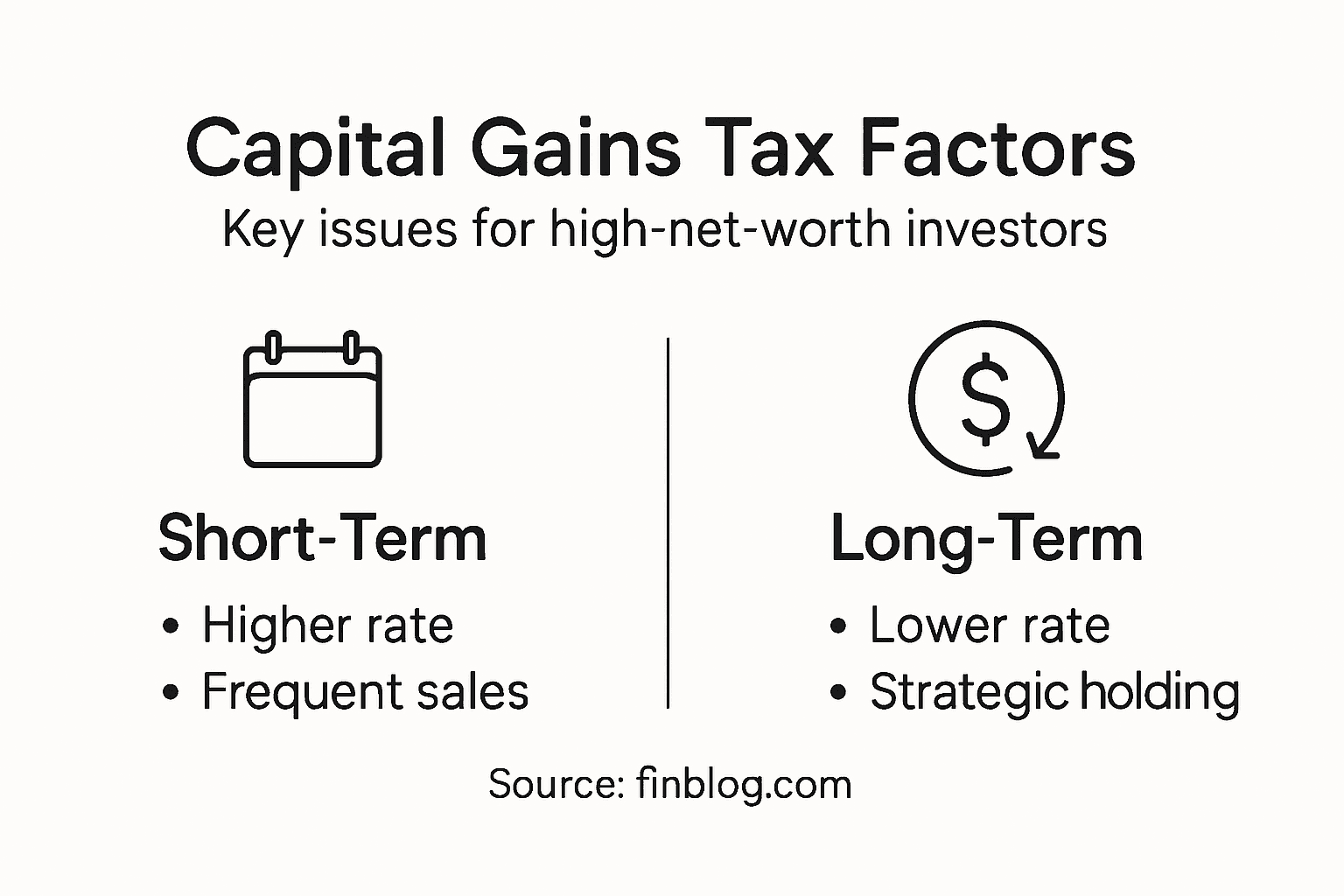
Short-term capital gains are defined as profits from assets held for one year or less, which are taxed at the same rate as an investor’s ordinary income. This means these gains are typically subject to higher tax rates compared to long-term investments. The tax brackets for short-term gains directly align with an individual’s standard income tax rate, which can range from 10% to 37% depending on the investor’s total annual income.

In contrast, long-term capital gains offer more favorable tax treatment for investors who demonstrate patience and strategic holding periods. Key characteristics include:
To help clarify key differences, here’s a comparison of short-term and long-term capital gains for investors:
| Feature | Short-Term Capital Gains | Long-Term Capital Gains |
|---|---|---|
| Holding Period | 1 year or less | More than 1 year |
| Typical Tax Rate Range | 10% – 37% (ordinary income rates) | 0% – 20% (favorable rates) |
| Tax Planning Benefit | Limited flexibility | Significant tax savings |
| Impact on Strategy | May discourage quick asset sales | Encourages patient investing |
- Assets held for more than one year qualify for long-term status
- Lower tax rates ranging from 0% to 20%, depending on income level
- Potential for significant tax savings compared to short-term gains
- Encourages longer-term investment strategies
The tax implications of these different gain types can be substantial for high-net-worth investors. Sophisticated investors often employ strategies to optimize their tax positioning:
- Strategically time asset sales to minimize tax liability
- Balance short-term and long-term investments
- Consider holding periods when making investment decisions
- Utilize tax-advantaged accounts to manage gains
Intelligent investment planning requires understanding the nuanced tax consequences of short-term versus long-term capital gains.
Tax planning becomes particularly complex when dealing with diverse asset types. Stocks, real estate, cryptocurrencies, and other investments may have unique tax treatment, making it crucial to develop a comprehensive understanding of how different assets are taxed based on their holding period.
Pro tip: Consult with a certified tax professional to develop a personalized investment strategy that maximizes tax efficiency and aligns with your long-term financial goals.
Global Capital Gains Tax Rates and Regulations
Navigating the intricate landscape of global capital gains taxation requires a sophisticated understanding of diverse international regulatory frameworks. Capital gains tax revenues represent a critical component of national fiscal strategies, with significant variations across different jurisdictions that directly impact high-net-worth investors’ financial planning.
In the United Kingdom, the capital gains tax system demonstrates remarkable complexity and nuance. Taxation thresholds and rates fluctuate periodically, creating a dynamic environment for investors. Capital gains tax regulations typically include annual exempt amounts that provide a fundamental baseline for tax liability, with current provisions offering specific protections for individual taxpayers.
Global capital gains tax frameworks typically encompass several key characteristics:
- Varying tax rates based on income levels
- Different treatment for short-term versus long-term investments
- Specific exemptions for certain asset types
- Provisions for non-resident investors
- Potential relief for specific economic activities
The international taxation landscape presents multiple strategic considerations for sophisticated investors:
- Understand jurisdiction-specific tax rates
- Evaluate potential tax treaty implications
- Consider investment holding periods
- Explore tax-efficient investment structures
- Monitor regulatory changes across jurisdictions
Successful global investment strategies require comprehensive understanding of diverse capital gains tax regulations and proactive tax planning.
Tax policy continues to evolve, with ongoing discussions about potential reforms aimed at improving fairness and reducing economic distortions. Policymakers are increasingly examining approaches such as aligning capital gains tax rates with income tax rates and addressing challenges related to unrealized gains and international mobility.
Pro tip: Engage a cross-border tax specialist to develop a nuanced investment strategy that optimizes tax efficiency across multiple international jurisdictions.
Key Strategies for Reducing Tax Liabilities
Sophisticated high-net-worth investors recognize that strategic tax planning is crucial for preserving and growing wealth. Capital gains tax allowances provide sophisticated mechanisms for minimizing tax burdens through careful financial maneuvering. Understanding these nuanced strategies can significantly reduce overall tax liabilities.
Tax-efficient investment strategies represent a critical approach to managing capital gains tax exposure. Investors can leverage multiple techniques to optimize their tax positioning, including strategic asset allocation, timing of asset sales, and utilizing specific tax exemptions and reliefs available within their jurisdiction.
Key strategies for reducing capital gains tax liabilities include:
Here’s a summary of popular strategies used by sophisticated investors to reduce capital gains tax liabilities:
| Tax Reduction Strategy | How It Works | Typical Benefit |
|---|---|---|
| Tax-exempt allowances | Use annual exemptions | Lower taxable gains |
| Tax-loss harvesting | Sell losing assets to offset gains | Reduce tax owed on profits |
| Timing of sales | Spread disposals across years | Minimize annual tax liability |
| Asset transfer between spouses | Reallocate assets for tax benefits | Access more exemptions |
- Maximize annual tax-exempt allowances
- Strategically time asset sales across multiple tax years
- Utilize tax-loss harvesting techniques
- Transfer assets between spouses to optimize tax treatment
- Invest through tax-advantaged accounts
- Explore business asset disposal relief options
Sophisticated tax management requires a comprehensive approach to investment planning:
- Conduct thorough annual tax reviews
- Diversify investment holdings
- Understand specific reliefs and exemptions
- Coordinate investment strategies with overall financial goals
- Consider long-term holding periods for more favorable tax treatment
Intelligent tax planning is not about avoiding taxes, but strategically managing tax liabilities to optimize overall financial performance.
The complexity of capital gains tax regulations demands a proactive and informed approach. Investors must continuously educate themselves about changing tax landscapes, potential legislative updates, and innovative strategies for minimizing tax burdens while maintaining compliance with existing regulations.
Pro tip: Develop a comprehensive tax planning strategy with a certified tax professional who specializes in high-net-worth investment management and can provide personalized guidance.
Risks, Traps, and Costly Mistakes to Avoid
Navigating the complex landscape of capital gains taxation requires a vigilant approach to avoiding potential financial pitfalls. Capital gains tax traps can significantly erode investment returns if investors fail to understand the intricate regulatory nuances and potential compliance challenges.
Misunderstanding tax regulations represents one of the most critical risks for high-net-worth investors. The complexity of capital gains tax systems creates numerous opportunities for costly mistakes that can result in unexpected tax liabilities, penalties, and potential legal complications.
Key risks and common mistakes to avoid include:
- Overlooking annual exempt amount limitations
- Incorrectly timing asset disposals
- Failing to offset capital losses strategically
- Misinterpreting tax exemption qualifications
- Neglecting to track comprehensive investment records
- Underestimating complex trust and business asset disposal rules
Sophisticated investors must develop a comprehensive approach to mitigating potential tax risks:
- Maintain meticulous financial documentation
- Conduct regular tax planning reviews
- Understand jurisdiction-specific regulations
- Consult with specialized tax professionals
- Stay informed about legislative changes
Proactive tax management is not about avoiding obligations, but strategically navigating complex regulatory landscapes.
The potential financial consequences of capital gains tax mistakes extend beyond immediate tax liabilities. Investors may face significant retrospective assessments, interest charges, and potential legal complications that can dramatically impact long-term wealth preservation strategies.
Pro tip: Implement a robust record-keeping system and schedule quarterly reviews with a tax professional to identify and mitigate potential capital gains tax risks before they become costly problems.
Take Control of Your Capital Gains Tax Strategy Today
Navigating the complexities of capital gains tax can feel overwhelming, especially for high-net-worth investors striving to protect their hard-earned wealth. This article highlights the challenges of managing short-term versus long-term gains, understanding global tax regulations, and avoiding costly mistakes. If you have struggled with timing asset sales, maximizing tax allowances, or parsing through evolving tax laws you are not alone.
At finblog.com, we specialize in turning confusion into clarity. Our expert insights and personalized strategies help you minimize your tax liability while aligning with your unique financial goals. Whether you want to strategically plan asset disposals or learn advanced tax-loss harvesting techniques we have the guidance you need. Your path to smarter capital gains tax planning starts here.
Explore valuable resources and unlock precise advice with our Capital Gains Tax Explained and Common Myths. Don’t wait for tax challenges to impact your wealth. Visit finblog.com now to start optimizing your investment strategy with expert support.
Frequently Asked Questions
What is capital gains tax and how does it affect investors?
Capital gains tax is a tax on the profit made from selling assets that have appreciated in value, impacting investors by taxing their financial gains rather than the total sale amount.
What are the main differences between short-term and long-term capital gains?
Short-term capital gains apply to assets held for one year or less and are taxed at ordinary income rates. Long-term capital gains apply to assets held for over one year and benefit from lower tax rates, usually ranging from 0% to 20%.
How can high-net-worth investors reduce their capital gains tax liabilities?
High-net-worth investors can reduce capital gains tax liabilities by utilizing strategies like tax-loss harvesting, timing asset sales across multiple years, maximizing annual tax exemptions, and considering asset transfers between spouses.
What common mistakes should investors avoid regarding capital gains tax?
Investors should avoid mistakes such as overlooking annual exempt amounts, incorrectly timing asset sales, failing to offset capital losses, and misinterpreting tax exemption qualifications.
Recommended
- Understanding the Tax Implications of Investing – Finblog
- Understanding Tax Efficient Investing: How It Works – Finblog
- Tax Loss Harvesting Explained: Boosting Investment Returns – Finblog
- Generational Wealth Planning: Securing Your Legacy – Finblog
- Nigeria Financial News | UK to Nigeria Money Transfer | SabiSend
- Building Passive Income Streams: Complete Guide | siift
- Don’t Leave Money on the Table: Maximizing Tax Incentives with End-of-Year Marketing Spend – Case Quota