


Every finance professional knows the pressure of making investment decisions when market headlines dominate daily conversations. The challenge is real: do you try to anticipate the next downturn, or trust in time in the market as your path to growth? Your deep market knowledge can lead to overconfidence, making the distinction between staying invested and timing trades even more crucial for long-term wealth. This article clarifies these opposing strategies—highlighting how consistency and discipline fuel lasting financial success.
Table of Contents
- Defining Time In The Market Vs Timing
- How Compounding Favors Consistent Investing
- Market Timing Strategies And Their Challenges
- Risk, Volatility, And Investor Behavior
- Long-Term Performance: Data And Misconceptions
Key Takeaways
| Point | Details |
|---|---|
| Time in the Market vs Timing the Market | Staying invested over time generally yields better results than attempting to predict market movements. |
| Compounding Benefits | Consistent investing allows compounding to work in your favor, significantly increasing wealth over time. |
| Behavioral Challenges | Understanding common psychological biases can help investors make more rational decisions rather than reacting impulsively to market volatility. |
| Long-Term Performance | Historical data shows that long-term investing typically outperforms market timing due to reduced sequence-of-returns risk and better compounding outcomes. |
Defining Time in the Market vs Timing
Investing comes down to two distinct approaches: staying invested or trying to predict market movements. These aren’t interchangeable strategies, and understanding the difference shapes your entire investment philosophy.
Time in the market means holding positions consistently over extended periods, regardless of market conditions. You invest money and stay committed through both gains and losses. This approach assumes markets move upward over time and that attempting to exit and reenter creates unnecessary friction.
Timing the market involves buying before prices rise and selling before they fall. You’re trying to predict market movements with precision. This requires accurate forecasts about when peaks and valleys occur.
The fundamental difference comes down to your assumptions about what you can control:
- Time in the market assumes you cannot reliably predict short-term price movements
- Market timing assumes you can identify inflection points and act faster than others
- Time in the market focuses on consistent participation in overall market gains
- Market timing focuses on capturing specific profitable periods while avoiding losses
For mid-career finance professionals, this distinction matters because your career trajectory often overlaps with your investment timeline. You might have 20-30 years until retirement, yet you’re exposed to daily market noise through your industry knowledge.
The core tension: knowing more about markets can paradoxically make you worse at investing by encouraging overconfidence in your timing predictions.
Consider how market trends develop over time. Market timing assumes you’ll spot these trends early and act decisively. Time in the market assumes you’ll capture gains by remaining invested throughout the entire trend, including the volatile early phases.
One common misconception: time in the market doesn’t mean being passive about your portfolio. You can rebalance, adjust allocations, and make strategic shifts without trying to time market peaks and valleys. Rebalancing is discipline-based. Timing is prediction-based.
The stakes feel different when you work in finance. You hear market analysis daily. You understand economic indicators. Yet this knowledge creates a false sense of predictive power. Research consistently shows that even professional investors struggle to time markets successfully.
Pro tip: Define your investment horizon first, then select the approach that matches that timeline rather than letting daily market movements dictate your strategy.
Here’s a comparison of investing approaches and their suitability for different investor types:
| Approach | Ideal Investor | Core Benefit | Main Challenge |
|---|---|---|---|
| Time in the Market | Long-term planner | Maximizes compounding | Emotional discipline needed |
| Market Timing | Active trader | Potential quick gains | High risk of mistimed trades |
| Dollar-Cost Averaging | Busy professionals | Reduces impact of volatility | Requires consistency |
| Trend Following | Technical analyst | Takes advantage of momentum | Prone to false signals |
How Compounding Favors Consistent Investing
Compounding is mathematics working in your favor. When you invest consistently, your earnings generate their own earnings, creating exponential growth over time. This process accelerates dramatically the longer you stay invested.
Compounding requires two non-negotiable elements: time and consistency. Missing either one significantly reduces the final outcome. A finance professional who invests $500 monthly for 30 years accumulates wealth differently than someone who invests sporadically for 20 years, even if total amounts contributed are similar.
The math becomes striking when you examine real timelines:
- Year 5: Modest growth, mostly from your contributions
- Year 10: Earnings on earnings start becoming visible
- Year 15: Compounding begins pulling ahead of contributions
- Year 20: Exponential growth accelerates noticeably
- Year 30: Compounding has often generated more wealth than your actual contributions
Consistent investing amplifies compounding because you’re buying at different price points. When markets drop, your regular contributions purchase more shares at lower prices. When markets rise, you own more shares benefiting from the increase. This mechanical process removes emotion from the equation.
Compounding turns small, consistent actions into substantial wealth—but only if you stay invested long enough to let the mathematics work.
Market timing disrupts compounding at its core. When you exit during downturns, you miss the recovery when compounding accelerates fastest. Research shows the majority of market gains happen in concentrated bursts, often immediately following significant declines. Missing just a few of these days compounds into millions in lost gains over decades.
The benefits of early investing become apparent through compounding calculations. A 30-year-old who invests $10,000 annually until age 65 often accumulates more than someone who waits until 40 and invests the same amount. The 10-year head start generates substantial additional growth through compounding alone.

For mid-career professionals, you’ve already sacrificed some compounding time. This makes consistency even more critical now. You can’t recover lost years, but you can maximize remaining years through disciplined, continuous investment.
The real power emerges when you combine consistent contributions with long holding periods. Your portfolio becomes a wealth-building machine that operates largely independent of your market predictions or daily decisions.
Pro tip: Automate your investments through systematic monthly transfers so compounding operates without requiring willpower or perfect timing decisions.
The impact of compounding over time becomes clear in this simplified timeline:
| Year | Contribution Growth | Compounding Growth | Portfolio Characteristics |
|---|---|---|---|
| 5 | Mostly contributions | Modest | Regular savings dominate |
| 10 | Steady increase | Noticeable | Earnings-on-earnings visible |
| 20 | Significant | Accelerates | Compounding outpaces contributions |
| 30 | Substantial | Exponential | Compounding is primary growth driver |
Market Timing Strategies and Their Challenges
Market timing sounds logical in theory. Buy low, sell high. Execute perfectly, and you eliminate losses while capturing all gains. The reality diverges sharply from this appealing narrative.
Professional traders and hedge fund managers employ sophisticated timing strategies daily. They use technical analysis, momentum indicators, macroeconomic forecasts, and algorithmic models. Yet academic research consistently shows that even these professionals fail to outperform buy-and-hold strategies after accounting for fees and trading costs.
Common market timing approaches include:
- Trend following: Buying when prices rise, selling when they fall
- Momentum trading: Identifying accelerating price movements and riding them
- Economic cycle timing: Shifting allocations based on predicted economic phases
- Technical analysis: Using price charts and patterns to forecast future movements
- Macro timing: Rotating between asset classes based on economic outlooks
Each strategy demands precise execution. You must identify the inflection point, act decisively, and exit at the right moment. Miss any step, and gains evaporate.
The timing challenges mount quickly:
- Emotional interference: Fear during declines prevents buying; greed during rallies prevents selling
- Information lag: By the time you identify a trend, it’s often partially priced in
- Transaction costs: Frequent trading erodes returns through commissions and spreads
- Tax consequences: Selling winners triggers capital gains taxes, reducing net returns
- Opportunity cost: Cash held waiting for better entry points misses compounding
Timing markets requires being right twice: identifying when to exit AND when to reenter. Most investors succeed at neither.
The cost of being wrong extends beyond the immediate trade. When you exit during market stress, you’ve crystallized losses and now face a second decision: when to reinvest. The psychological burden of missing the recovery often prevents proper reentry.
Managing investment risks during market volatility requires discipline that transcends trying to predict peaks and valleys. Volatility creates the illusion that timing is possible because price swings feel predictable in retrospect. They’re not.
For finance professionals, your industry knowledge can actually work against you. Deeper market understanding can breed overconfidence in timing ability. You hear earnings forecasts, economic projections, and market commentary that create false conviction about your predictions.
The compounding effect of repeated timing errors multiplies over years. Missing the ten best market days in a 20-year period can cut your returns by half. Most attempts to time markets cause investors to miss exactly these concentrated periods of recovery.
Pro tip: If you feel compelled to time markets, confine it to a small “speculation” allocation separate from your core long-term portfolio, so poor timing decisions don’t derail your primary wealth-building strategy.
Risk, Volatility, and Investor Behavior
Volatility triggers the behaviors that destroy wealth. Market swings expose psychological vulnerabilities that logic can’t overcome. Understanding this connection reveals why time in the market outperforms timing.
Volatility is the price of market participation. Higher returns require accepting price fluctuations. Markets don’t deliver steady upward progress; they deliver overall gains through a path filled with temporary declines. Your brain rebels against this reality.
Human psychology operates against sound investing:
- Loss aversion: You feel losses twice as intensely as equivalent gains
- Recency bias: Recent market performance seems predictive of future performance
- Herding instinct: Seeing others sell creates urgency to sell yourself
- Overconfidence: Believing you can predict downturns others miss
- Regret aversion: Selling to avoid potential losses you fear more than gains you hope for
These aren’t character flaws. They’re survival mechanisms developed over millennia. In ancestral environments, loss aversion kept you alive. In markets, it costs you millions.
Volatility creates false urgency. A 15% market decline feels catastrophic in real-time. Historically, these declines lasted months, not years, followed by recoveries that rewarded those who stayed invested. The investors who sold during downturns locked in losses and then faced the psychological barrier of reinvesting after recovery began.
Your biggest investment risk isn’t market volatility. It’s your behavioral response to volatility.
Risk tolerance fluctuates with market conditions, not with your actual financial situation. During bull markets, investors feel risk-tolerant and increase equity exposure. During bear markets, fear dominates and they shift to bonds. This backwards pattern locks in losses and misses recoveries.
Understanding behavioral finance concepts and investment biases reveals how widespread these patterns are. Professional investors experience identical psychological pressures. The difference is structural discipline and predetermined decision-making.
For finance professionals, your knowledge paradoxically increases behavioral risk. You understand market mechanics thoroughly enough to construct convincing narratives for why you should act. You hear institutional perspectives that create false confidence in predictions. Your expertise makes poor decisions feel defensible.
Time in the market succeeds because it sidesteps these behavioral challenges. You remove the timing decision entirely. No need to predict volatility because you’re never attempting to. Volatility becomes irrelevant to your strategy; you’re simply participating through market cycles.
Consistent investing during volatility actually uses psychology in your favor. Dollar-cost averaging means you buy more shares when prices drop. Volatility becomes an opportunity rather than a threat.
Pro tip: When volatility spikes and fear escalates, review your investment policy statement and verify your allocations haven’t drifted from your predetermined targets rather than making reactive changes.
Long-Term Performance: Data and Misconceptions
The data overwhelmingly favors staying invested. Yet misconceptions persist about what long-term performance actually reveals. Understanding the real numbers changes how you approach your strategy.
Historical stock market returns show consistent patterns across decades. The S&P 500 has delivered approximately 10% annualized returns over the past 90 years, despite numerous crashes, recessions, wars, and crises. This figure matters because it shows recovery always followed disruption.
Common misconceptions about long-term performance include:
- Misconception: Past returns guarantee future results
- Reality: Historical averages guide expectations, not predictions
- Misconception: Time eliminates all losses
- Reality: Time increases probability of recovery, not certainty
- Misconception: Longer holding periods require less diversification
- Reality: Asset allocation matters regardless of timeframe
- Misconception: Long-term investing means ignoring your portfolio
- Reality: Periodic rebalancing optimizes long-term outcomes
The critical distinction: time reduces sequence-of-returns risk but doesn’t eliminate market risk entirely. A portfolio that drops 40% still requires years to recover. The investor who maintains allocations through the downturn and benefits from recovery fares vastly better than one who sells during panic.
Long-term investing wins not because time heals all wounds, but because you compound gains across complete market cycles.
Data shows that long-term versus short-term investing approaches produce dramatically different outcomes. An investor holding stocks for 20 years faced negative returns in only 5% of historical rolling periods. An investor holding for one year faced negative returns roughly 25% of the time. Time genuinely transforms the risk-return profile.
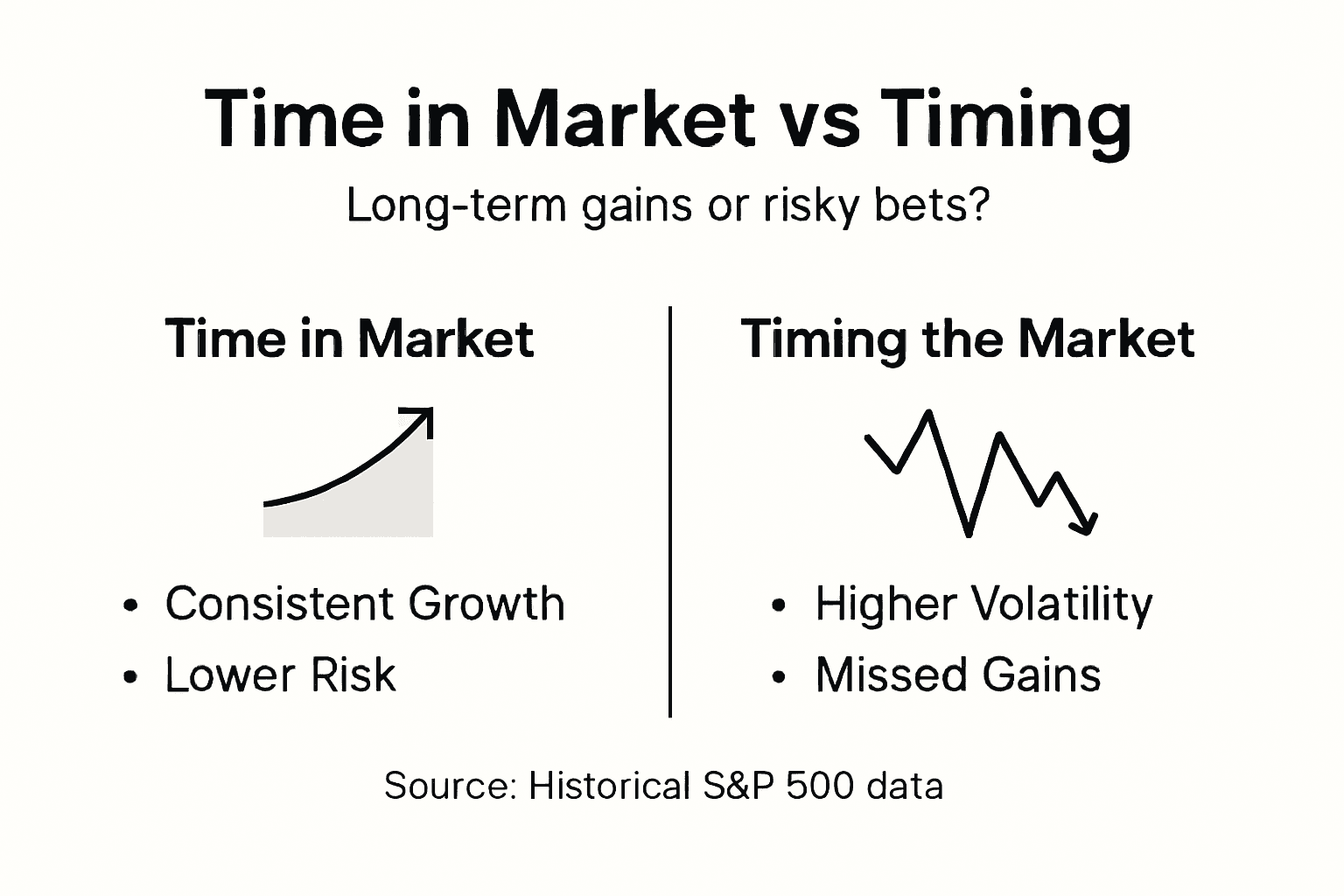
Another misconception: market timing could match long-term returns if executed perfectly. The math doesn’t support this. Missing the 10 best market days in a 20-year period cuts your returns approximately in half. Those best days often occur during market stress when panic incentivizes selling.
For finance professionals evaluating performance, avoid anchoring to recent results. A 5-year underperformance period doesn’t validate timing strategies. Markets move in cycles. Positioning yourself outside markets during downturns may feel protective but costs recovery gains.
Performance data also reveals the impact of fees and taxes. Active management fees of 1% annually reduce 10% returns to 9%. Over 30 years, that 1% difference compounds into 30-40% lower wealth. Long-term strategies should minimize costs, not maximize trading activity.
The most important data point: consistent investors outperform talented market-timers. This isn’t because markets are unpredictable. It’s because behavioral discipline compounds more reliably than predictive accuracy.
Pro tip: Measure your portfolio against a suitable benchmark over rolling 5-year periods rather than annual results to avoid overreacting to normal market cycles.
Secure Your Investment Success by Mastering Time in the Market
Understanding the challenge of resisting market timing urges while maximizing the power of compounding can transform your financial future. This article clearly highlights how emotional discipline and consistent investing through market volatility are key to building lasting wealth. If you struggle with overconfidence in timing or fear missing critical recovery days, you are not alone. Many finance professionals face these exact pain points while navigating daily market noise.
At finblog.com, we specialize in guiding investors like you to develop strategies grounded in time-tested principles rather than fleeting market predictions. Explore how to effectively manage investment risks during market volatility and overcome behavioral challenges through expert advice tailored for serious investors. Don’t let missed timing opportunities cost you millions. Start automating your wealth-building journey today and benefit from insights on how to spot market trends.
Take control of your investment strategy with trusted guidance and proven methods at finblog.com. Act now to turn knowledge into consistent success by visiting our site to get started.
Frequently Asked Questions
What is the difference between ‘time in the market’ and ‘timing the market’?
‘Time in the market’ involves consistently holding investment positions over the long term, whereas ‘timing the market’ involves trying to predict short-term market movements for buying low and selling high.
How does compounding benefit long-term investors?
Compounding allows your investment earnings to generate their own earnings over time, leading to exponential growth. The longer you stay invested and consistently contribute, the more you can amplify your wealth through compounding.
Why is market timing often considered a risky strategy?
Market timing is risky because it requires accurately predicting both when to enter and exit the market. Many investors, including professionals, often fail to time their trades correctly, which may lead to missed opportunities and reduced returns.
How can I manage my investments during periods of market volatility?
Instead of trying to time the market, maintain a consistent investment strategy that aligns with your long-term goals. Techniques like dollar-cost averaging can help you buy more shares when prices are low, mitigating the effects of volatility on your investments.
Recommended
- Master Investing During Market Volatility for Lasting Results – Finblog
- Two Stock Market Trends Investors Should Know
- Evaluating Investment Opportunities for Confident Decisions – Finblog
- Long Term vs Short Term Investing: Key Decisions for Growth – Finblog
- The Essential Guide to Importance of Time Management – team I