
TL;DR:
- The stock market is a marketplace where investors buy and sell ownership shares in publicly traded companies. Long-term, disciplined investing in diversified low-cost funds like ETFs typically yields better results than active trading or trying to time the market.
The stock market is defined as a marketplace where investors buy and sell ownership stakes in publicly traded companies. Learning the stock market for dummies means grasping one core truth: patient, informed investors who stay in the market consistently build wealth over time. The stock market has risen in 70 of the past 96 years, which translates to an upward trend roughly 73% of the time. That single fact makes the case for long-term investing better than any trading strategy ever could. This guide covers account setup, investment types, proven strategies, and the mistakes that cost beginners the most.
How do you start learning the stock market for dummies?
Opening a brokerage account is the first concrete step every beginner must take. The process is faster than most people expect. Setting up an account typically takes 10–15 minutes online, and you need only a few standard documents to get started.
You will need:
- Your Social Security number
- A government-issued photo ID (driver’s license or passport)
- Basic employment information
- A linked bank account to transfer funds
Once your account is open and funded, you can place your first trade the same day. The cost barrier has also dropped significantly. Most U.S. brokerages now charge zero commissions on stocks and ETFs, meaning the price of the share itself is your only real cost. Many platforms also have no minimum deposit requirement, so you do not need thousands of dollars to begin.
Pro Tip: Start with a paper trading account if your brokerage offers one. You practice buying and selling with simulated money before risking a single real dollar.
Choosing a brokerage comes down to three factors: the platform’s ease of use, the educational resources it offers, and whether it supports fractional shares. For a complete walkthrough of account setup basics, Finblog’s beginner guide covers each step in plain language.
What are stocks and investment options for beginners?
A stock is a share of ownership in a company. When you buy one share of Apple or Ford, you own a small piece of that business and have a claim on its future earnings. Each company’s stock trades under a unique ticker symbol, such as AAPL for Apple or F for Ford. Understanding basic stock market terms like ticker symbols, market capitalization, and dividends gives you the vocabulary to read financial news without confusion.

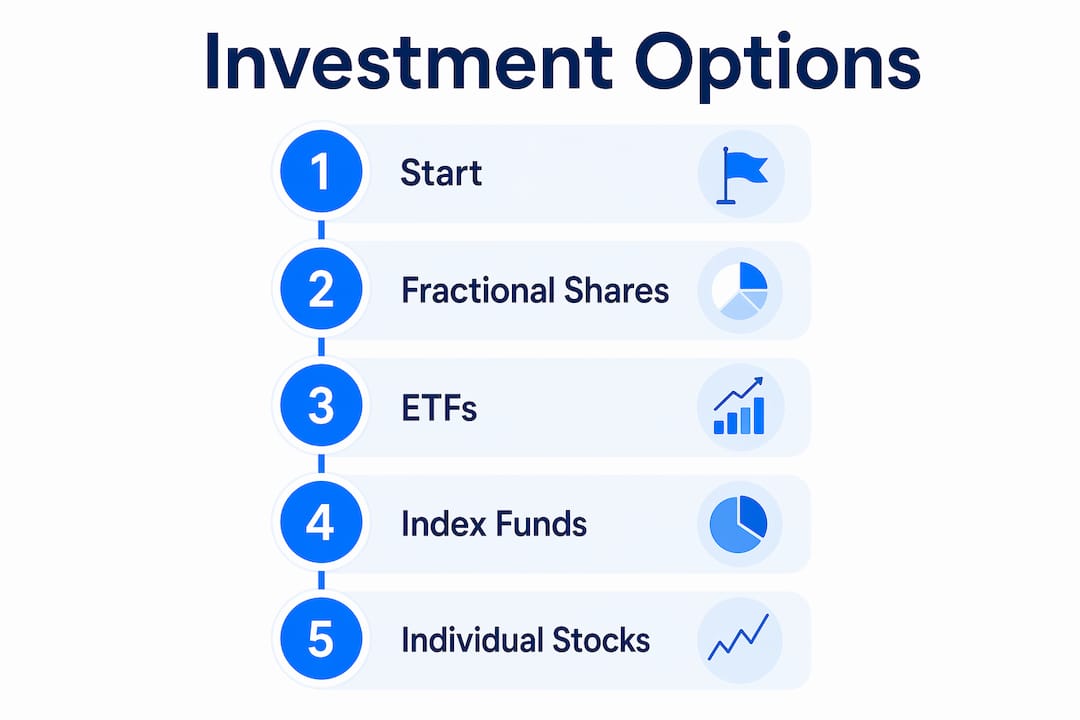
Beginners often assume they need hundreds of dollars to buy a single share. Fractional shares solve that problem. Fractional shares let you invest with as little as $1 to $5, so you can own a slice of an expensive stock like Amazon without buying a full share. This makes building a diversified portfolio possible on almost any budget.
Beyond individual stocks, beginners have two other strong options: index funds and ETFs (exchange-traded funds).
| Investment type | Minimum investment | Diversification | Best for |
|---|---|---|---|
| Individual stocks | $1+ with fractional shares | Low (single company) | Hands-on learners |
| ETFs | Often under $100 per share | High (many companies) | Budget-conscious beginners |
| Mutual funds | Typically $500–$3,000 | High (many companies) | Set-and-forget investors |
ETFs often require lower minimum investments than mutual funds, making them the more accessible choice for beginners with limited capital. An S&P 500 ETF, for example, gives you exposure to 500 of the largest U.S. companies in a single purchase.
Index funds and ETFs that track broad indexes like the S&P 500 offer low-cost, diversified exposure that even experienced investors rely on. Warren Buffett has publicly recommended low-cost index funds for most individual investors, citing lower risk and less time commitment compared to picking individual stocks.
What investing strategies should beginners focus on?
The single most effective strategy for beginners is the buy-and-hold approach. You buy shares in solid companies or broad index funds and hold them for years, letting compounding do the work. Short-term trading requires skill, time, and emotional discipline that most beginners underestimate.
Three strategies form the foundation of a sound beginner portfolio:
- Long-term buy-and-hold. The market’s historical upward trend rewards investors who stay invested through downturns rather than selling in panic.
- Diversification. Spreading investments across companies and industries reduces the damage any single bad investment can do to your overall portfolio.
- Dollar-cost averaging. Investing a fixed amount regularly, such as $50 every month, means you buy more shares when prices are low and fewer when prices are high. Over time, this smooths out the effect of market swings.
Avoid penny stocks and highly speculative investments in your first year. These assets promise fast gains but carry extreme volatility that wipes out beginner accounts regularly. The index funds advantages page on Finblog explains why broad-market funds outperform most active stock-picking strategies over a 10-year horizon.
Pro Tip: Automate your monthly contribution. Set a recurring transfer from your bank to your brokerage so you invest consistently without relying on willpower or memory.
What common mistakes do beginners make when learning stocks?
Most beginner losses come from a handful of predictable errors. Recognizing them before you make them is the fastest shortcut to better results.
- Treating the market like a casino. Industry veterans consistently warn that viewing the stock market as gambling leads to impulsive decisions. Daily price swings are normal market behavior, not signals to buy or sell immediately.
- Trying to time the market. Waiting for the “perfect” moment to invest means sitting on the sidelines while the market rises. Time in the market beats timing the market, every time.
- Chasing hot stocks. A stock that doubled last month is already priced for that growth. Buying it now often means buying at the peak.
- Ignoring order types and trading hours. Market orders placed outside trading hours execute at the next day’s opening price, which can differ significantly from what you intended to pay. Use limit orders when price precision matters.
- Skipping portfolio reviews. Investing is not a one-time event. Review your holdings every three to six months to confirm your allocation still matches your goals. Avoid reacting emotionally to short-term drops, but do rebalance when one asset class grows disproportionately large.
Reading through Finblog’s guide on common investing myths can save you from the most expensive misconceptions before they cost you real money.
Key Takeaways
The most effective approach to stock market investing for beginners is consistent, long-term participation in diversified, low-cost funds rather than active trading or stock picking.
| Point | Details |
|---|---|
| Open an account fast | Brokerage setup takes 10–15 minutes with a Social Security number and government-issued ID. |
| Start small with fractional shares | You can begin investing with as little as $1–$5 using fractional shares at most major brokerages. |
| Use ETFs for diversification | ETFs tracking the S&P 500 give beginners broad exposure with lower minimums than mutual funds. |
| Invest consistently | Dollar-cost averaging reduces the impact of market volatility and removes the pressure to time the market. |
| Avoid speculative traps | Penny stocks, market timing, and chasing hot stocks are the three fastest ways to lose money as a beginner. |
The one thing I wish someone had told me first
Most beginner guides focus on what to buy. The harder lesson is learning to do nothing when the market drops 15% in a week. I have watched beginners with solid portfolios sell everything in a panic during a correction, lock in their losses, and then watch the market recover without them. That pattern destroys more wealth than bad stock picks ever do.
The market’s long-term upward trend is not a guarantee for any single year or any single stock. It is a pattern that only rewards you if you stay invested long enough to see it play out. Starting with fractional shares in a broad ETF removes most of the pressure. You are not betting on one company. You are betting on the broader economy, which has a much stronger track record.
My honest advice: set up automatic monthly contributions, pick a low-cost S&P 500 ETF, and stop checking your account every day. Investing is not exciting in the short term. The results show up years later, and they are worth the patience. Review your portfolio twice a year, rebalance if needed, and resist the urge to react to headlines. Consistency beats brilliance in this game, every single time.
— Povilas
Finblog’s resources for beginner investors
Building confidence as a new investor takes the right information at the right time. Finblog offers a library of plain-language guides covering everything from stock market basics to account setup, key terminology, and portfolio strategy. Whether you are figuring out what a ticker symbol means or deciding between an ETF and a mutual fund, the resources at Finblog are built for investors who are just getting started. The goal is to give you enough knowledge to make your first investment with confidence, not confusion.
FAQ
What is the stock market in simple terms?
The stock market is a marketplace where investors buy and sell ownership shares in publicly traded companies. When a company’s value grows, the shares you own become worth more.
How much money do I need to start investing?
You can start with as little as $1–$5 using fractional shares at most major brokerages. Many platforms also have no minimum deposit requirement for opening an account.
What is the safest investment for a beginner?
Index funds and ETFs that track broad indexes like the S&P 500 are widely recommended for beginners. They offer built-in diversification and lower costs compared to actively managed funds or individual stock picking.
How long does it take to open a brokerage account?
Opening an online brokerage account typically takes 10–15 minutes. You need a Social Security number, a government-issued ID, and basic employment information to complete the process.
What is dollar-cost averaging?
Dollar-cost averaging means investing a fixed dollar amount at regular intervals, regardless of market conditions. This approach reduces the risk of investing a large sum at the wrong time and builds consistent investing habits.