Most American investors now choose index funds for their simplicity and steady performance. If you are a working professional aiming for long-term wealth, this approach offers reliable growth without demanding constant attention. With over 80 percent of actively managed funds underperforming their benchmark, index funds stand out for efficiency and peace of mind. This guide uncovers how American and global investors can use index funds to build wealth with less stress and lower costs.
Table of Contents
- What Are Index Funds And How They Work
- Types Of Index Funds And Key Features
- Major Benefits: Diversification And Low Costs
- Index Funds Versus Actively Managed Funds
- Potential Risks And What To Watch For
Key Takeaways
| Point | Details |
|---|---|
| Index Funds Ensure Diversification | Index funds automatically distribute investments across various securities, significantly reducing individual stock risk. |
| Cost Efficiency is Key | With expense ratios typically below 0.20%, index funds help investors retain more of their gains compared to actively managed funds. |
| Lower Risk Through Passive Management | Index funds aim to match market performance, generally leading to more predictable returns and lower risk compared to actively managed funds. |
| Monitor Tracking Error and Liquidity Risks | Be aware of tracking error and liquidity risks that can affect an index fund’s performance and strategy effectiveness. |
What Are Index Funds And How They Work
Index funds represent a powerful investment strategy designed to provide broad market exposure with minimal complexity. These financial instruments are essentially mutual funds or exchange traded funds (ETFs) constructed to mirror the performance of a specific market index, such as the S&P 500. By tracking predetermined market indices, these funds offer investors a passive approach to investing that minimizes transaction costs and maximizes long-term returns.
At their core, index funds work by purchasing shares proportionally to match the exact composition of a chosen market index. This means if a particular index contains 500 stocks, the fund will own those same stocks in nearly identical percentages. The primary goal is not to outperform the market, but to match its performance precisely. Passive management is key – fund managers make minimal trading adjustments, which significantly reduces administrative expenses and helps maintain lower expense ratios compared to actively managed funds.
Investors are drawn to index funds for several compelling reasons. They provide instant diversification by spreading investments across multiple companies and sectors, reducing individual stock risk. Transaction costs remain extremely low due to minimal trading activity, and investors benefit from transparency since the fund’s holdings closely reflect the underlying index. Most importantly, historical data consistently shows that index funds often outperform actively managed funds over extended periods, making them an attractive option for long-term wealth building strategies.
Pro tip: When selecting an index fund, focus on tracking error and expense ratio – lower numbers indicate a fund more precisely mirrors its benchmark index.
Types Of Index Funds And Key Features
Index funds have evolved to offer investors a diverse range of options for market participation. Global market indices provide multiple strategies for tracking different segments of the financial landscape. The most common types include broad market index funds, sector-specific funds, international funds, and bond index funds, each designed to meet specific investment objectives and risk preferences.
Broad Market Index Funds represent the most traditional approach, tracking comprehensive market indices like the S&P 500 or total stock market indexes. These funds provide extensive diversification by capturing the performance of hundreds of companies across various industries. Sector-Specific Index Funds, in contrast, focus on particular economic sectors such as technology, healthcare, or energy, allowing investors to target specific market segments with potentially higher growth potential.
International and specialized index funds offer additional investment opportunities. Bond Index Funds track fixed-income securities, providing stable income streams and lower volatility. Meanwhile, International Index Funds enable investors to gain exposure to global markets, including emerging economies and developed international regions. Some advanced index funds utilize unique weighting methodologies like equal weighting or fundamental indexing, which deviate from traditional market capitalization approaches to potentially enhance returns.
This table summarizes the different types of index funds and their investment focus:
| Fund Type | Market Focus | Key Benefit |
|---|---|---|
| Broad Market | Entire market index | Maximum diversification |
| Sector-Specific | One market sector | Targeted growth exposure |
| International | Global companies | Geographical diversity |
| Bond Index | Fixed-income assets | Lower volatility |
Pro tip: Diversify your index fund investments across different types and regions to balance risk and maximize potential market opportunities.
Major Benefits: Diversification And Low Costs
Index funds offer investors two primary advantages that make them a compelling investment strategy: exceptional diversification and remarkably low costs. Investment strategies focused on diversification help mitigate risk by spreading investments across multiple securities and market sectors. Unlike individual stock selections, these funds automatically distribute investment capital across hundreds of companies, dramatically reducing the potential for significant losses from any single company’s poor performance.

Cost efficiency stands as another critical benefit of index funds. Traditional actively managed funds often charge management fees between 1% to 2% annually, which can substantially erode investment returns over time. In contrast, index funds typically maintain expense ratios below 0.20%, allowing investors to keep more of their investment gains. Academic research consistently demonstrates that most actively managed funds fail to consistently outperform their benchmark indexes, making the low-cost index fund approach increasingly attractive for strategic investors.
The comprehensive diversification provided by index funds goes beyond simple risk reduction. By tracking broad market indexes, these funds offer exposure to entire economic sectors, geographic regions, and market capitalization ranges. This approach enables investors to build robust portfolios that capture overall market growth while minimizing the volatility associated with individual stock selections. Investors gain the advantage of professional-level asset allocation without requiring extensive personal research or continuous portfolio management.
Pro tip: Compare expense ratios across different index funds and prioritize those with the lowest fees while maintaining broad market coverage.
Index Funds Versus Actively Managed Funds
The investment world presents a fundamental choice between index funds and actively managed funds, each with distinct characteristics and performance implications. Comparative research on investment strategies reveals significant differences in approach, cost, and potential returns. Actively managed funds rely on professional fund managers who attempt to outperform market benchmarks through strategic stock selection and frequent trading, while index funds take a more passive approach by tracking a specific market index with minimal intervention.
Cost structures represent one of the most compelling distinctions between these investment approaches. Actively managed funds typically charge higher fees ranging from 1% to 2% annually, reflecting the expenses associated with research teams, frequent trading, and management expertise. Index funds, in contrast, maintain dramatically lower expense ratios, often below 0.20%, which directly translates to higher potential returns for investors. Academic and financial research consistently demonstrates that most actively managed funds fail to consistently outperform their benchmark indexes after accounting for these higher management fees.
Performance metrics further highlight the advantages of index funds. While actively managed funds promise the potential for exceptional returns, empirical evidence suggests that most fail to deliver consistent outperformance. Peer-reviewed research indicates that index funds not only provide more predictable returns but also offer lower risk through broad market diversification. Professional investors increasingly recognize that the simplicity and cost-efficiency of index funds often make them a superior long-term investment strategy compared to the more complex and expensive actively managed alternatives.
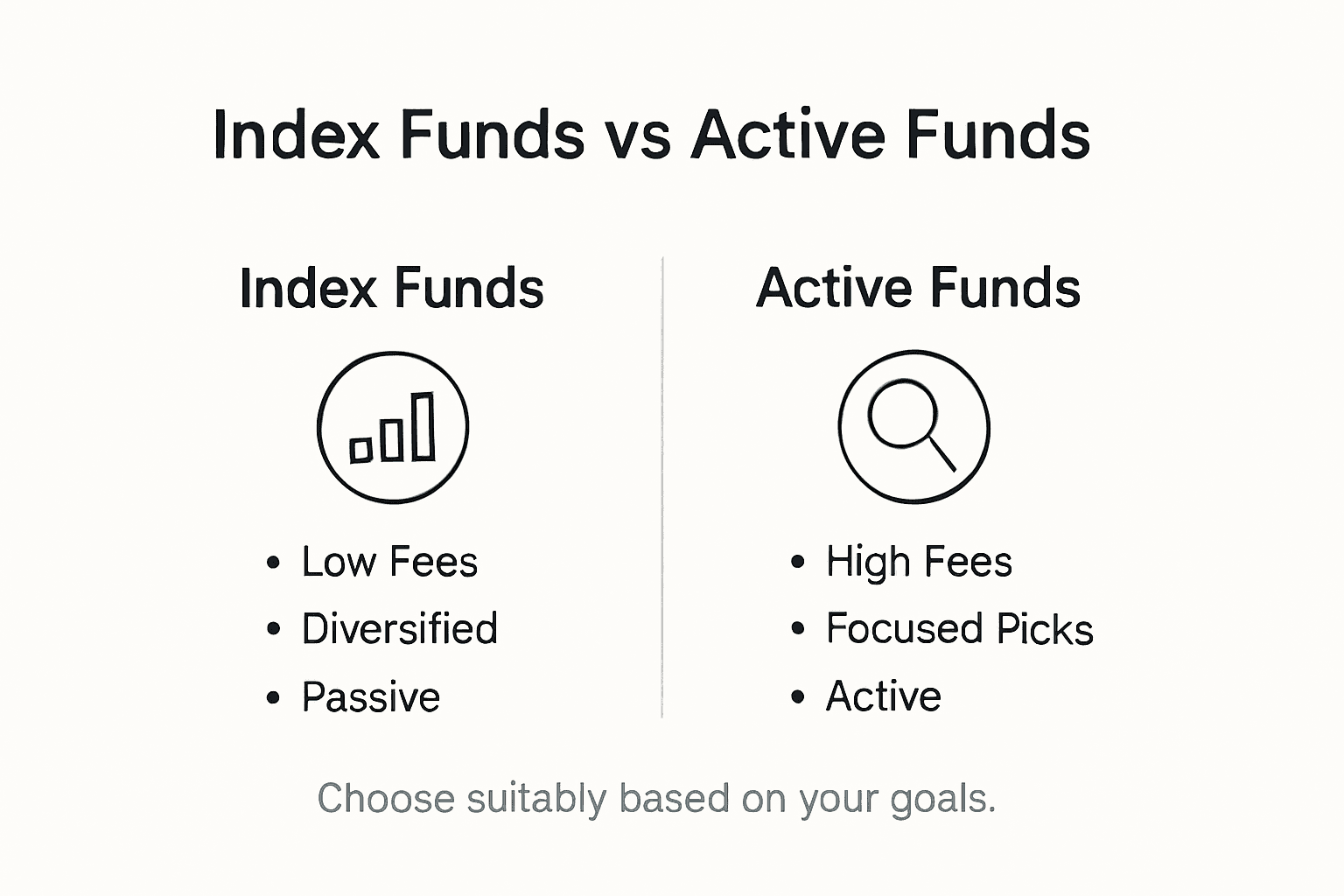
Here’s a summary comparison between index funds and actively managed funds to clarify their main differences:
| Aspect | Index Funds | Actively Managed Funds |
|---|---|---|
| Management Style | Passive tracking | Professional selection |
| Expense Ratio | Typically below 0.20% | 1% to 2% annually |
| Goal | Match market performance | Outperform the market |
| Diversification | Broad market exposure | Varies by manager |
| Trading Activity | Minimal rebalancing | Frequent trading |
| Consistency | Predictable returns | Returns vary widely |
| Risk Level | Generally lower | Can be higher or lower |
| Transparency | Holdings mirror index | Less frequent updates |
Pro tip: Request a complete fee breakdown from any fund manager and calculate the total annual cost, including both explicit fees and potential hidden transaction expenses.
Potential Risks And What To Watch For
Index funds, while offering numerous advantages, are not immune to investment risks. Understanding potential investment risks is crucial for making informed financial decisions. Index funds inherently carry market risks equivalent to the underlying securities they track, which means investors remain exposed to broader economic fluctuations and potential downturns that impact the entire market index.
Tracking error represents a critical risk investors should carefully monitor. This occurs when an index fund’s performance deviates from its benchmark index due to factors like management fees, trading costs, and sampling techniques. Some funds might not perfectly replicate their target index, potentially resulting in slight performance variations. Additionally, certain index funds engage in complex strategies like securities lending or derivative usage, which can introduce additional layers of financial complexity and potential risk beyond simple market exposure.
Liquidity risks demand particular attention from sophisticated investors. Market liquidity challenges can emerge during periods of significant market stress, especially for funds holding less liquid assets. Open-end index funds that allow daily redemptions while maintaining investments in less-tradable securities might face challenges during market turbulence. In extreme scenarios, large-scale redemption requests could force funds to sell assets at unfavorable prices, potentially amplifying market volatility and negatively impacting investor returns.
Pro tip: Always review a fund’s prospectus carefully, paying special attention to its liquidity provisions, tracking methodology, and potential hidden transaction costs.
Unlock the Full Potential of Index Funds for Your Wealth Journey
Investing in index funds offers a smart pathway to build diversified wealth while keeping costs low and minimizing risks. This article highlights key challenges such as managing tracking error, understanding expense ratios, and balancing global exposure — essential factors for crafting a resilient portfolio that mirrors market performance precisely. If you are seeking clarity on these concepts and want to avoid the pitfalls of actively managed funds, gaining expert insight is critical.
At finblog.com, we specialize in helping investors like you harness the advantages of index funds through strategic guidance tailored to your financial goals. Learn how to spot fund nuances, optimize your asset allocation with diversification, and monitor performance effectively. Don’t wait for market volatility to dictate your outcomes. Visit finblog.com now and take the first step towards smarter, cost-efficient investing. Secure your future today with confidence by tapping into proven wealth-building strategies aligned with your aspirations.
Frequently Asked Questions
What are the main advantages of investing in index funds?
Investing in index funds offers exceptional diversification and low costs. These funds spread investments across a wide range of securities, reducing individual stock risk, and typically have much lower expense ratios compared to actively managed funds.
How do index funds differ from actively managed funds?
Index funds are passively managed and aim to match the performance of a specific market index, resulting in lower fees and consistency in returns. Actively managed funds, on the other hand, involve professional fund managers attempting to outperform the market through frequent trading, which often leads to higher costs.
What types of index funds are available for investors?
Investors can choose from various types of index funds, including broad market index funds, sector-specific funds, international funds, and bond index funds. Each type targets specific investment objectives and offers varying levels of diversification and risk.
How can I measure the performance and efficiency of an index fund?
When evaluating an index fund, consider its tracking error and expense ratio. A lower tracking error indicates the fund closely follows its benchmark index, while a lower expense ratio means more of your investment returns are retained rather than lost to fees.