
TL;DR:
- Continuous learning enhances career resilience, earning potential, and cognitive health through active skill development.
- Organizational cultures that promote ongoing education foster innovation, higher productivity, and competitive advantage.
Continuous learning is defined as the ongoing, self-directed acquisition of skills and knowledge beyond formal education, and it is the single most reliable driver of career resilience in a fast-moving professional world. For working professionals, the advantages of lifelong learning extend well past resume padding. They include measurable gains in earnings, cognitive health, job satisfaction, and the kind of adaptability that keeps careers relevant through industry shifts. Platforms like LinkedIn Learning, Coursera, and micro-credential programs from universities have made ongoing education more accessible than at any point in history. The evidence from cognitive science and organizational research is clear: professionals who commit to continuous development outperform those who rely on static credentials alone.
What are the key benefits of continuous learning for working professionals?
Continuous learning benefits fall into four distinct categories: career mobility, earning potential, job satisfaction, and cognitive health. Each one compounds the others, meaning that investing in one area tends to accelerate progress across all four.

Career mobility and earnings. Earning new credentials improves upward mobility, income potential, and job competitiveness in measurable ways. This matters because the labor market increasingly rewards demonstrated skill acquisition over tenure alone. Professionals who hold micro-credentials in areas like data analysis, project management, or financial modeling signal to employers that they adapt rather than stagnate. Micro-credentials and industry certifications also open hidden job market opportunities that traditional degrees rarely surface, particularly through the peer networks built inside those programs.
Job satisfaction and engagement. Active continuous learning leads to higher job satisfaction, stronger engagement, and better team-level adaptability. The mechanism is straightforward: when professionals feel they are growing, they invest more in their work. This creates a reinforcing cycle where learning fuels performance and performance motivates further learning.
Cognitive health. Lifelong learning enhances cognitive reserve, slowing age-related cognitive decline by building neural connections that protect brain function over time. For professionals in their 30s, 40s, and beyond, this is not a distant concern. It is a present-day advantage. People who regularly challenge their minds with new material maintain sharper focus, faster recall, and greater mental flexibility than those who do not.
“Continuous learning signals adaptability and initiative to employers, often outweighing static credentials in competitive job markets.” — University of Cincinnati
Pro Tip: When selecting learning activities, prioritize skills that sit at the intersection of your current role and where your industry is heading. That overlap is where the highest career return on learning investment lives.
How does cognitive science explain the impact of continuous learning?
The brain’s capacity for neuroplasticity persists throughout life, meaning new neural pathways form whenever you acquire a skill or process new information. This is not a metaphor. It is a documented biological process that underpins every benefit associated with ongoing education. The practical implication is that you are never too old or too experienced to build new competencies.
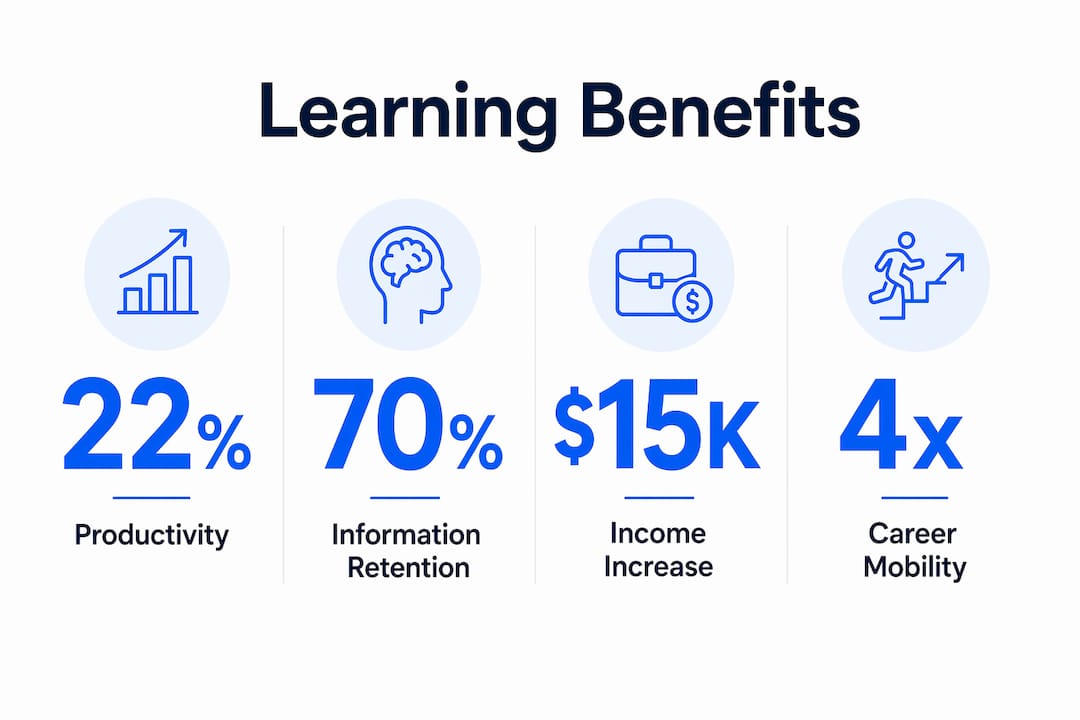
The central obstacle to realizing these benefits is the forgetting curve. Without active recall, up to 70% of new information disappears within 24 hours. That statistic reframes how most professionals approach learning. Reading an article, watching a video, or attending a webinar without any follow-up retrieval practice delivers almost no lasting knowledge. The information feels absorbed in the moment but evaporates before it can be applied.
The solution is a shift from passive consumption to active learning. Two techniques stand out in the research.
| Technique | Mechanism | Outcome |
|---|---|---|
| Active retrieval | Testing yourself on material rather than re-reading it | Stronger long-term memory encoding |
| Spaced repetition | Reviewing material at increasing intervals over time | Dramatically reduced forgetting rate |
| Real-world application | Applying new knowledge to actual work problems | Transfers learning from theory to durable skill |
Active retrieval and spaced repetition produce far better knowledge retention than passive study. Tools like Anki, Readwise, and Obsidian are built specifically around these principles and are widely used by professionals in finance, law, and medicine for exactly this reason.
Continuous learning also builds what neuroscientists call a neural safety net. The neuroplasticity benefits of sustained learning support faster adaptation and cognitive resilience as you age, which translates directly into sharper problem-solving and greater creative output in your professional life.
Pro Tip: Habit research shows that consistent learning habits solidify over approximately 66 days of fixed daily practice. Pick a 20-minute window each morning or evening and protect it like a meeting. The schedule matters more than the duration.
What practical strategies maximize the benefits of continuous learning?
Knowing why continuous learning matters is only half the equation. The other half is building a system that actually works inside a demanding professional schedule. These strategies are ordered by impact.
-
Apply active recall immediately. After any learning session, close the material and write down everything you remember. This single habit, practiced consistently, can cut knowledge loss from 70% to under 20% within a week. Use tools like Anki for flashcard-based spaced repetition or simply keep a learning journal where you reconstruct key ideas from memory.
-
Pursue micro-credentials strategically. Programs from Google, Coursera, edX, and professional associations like the CFA Institute or PMI deliver targeted skills in weeks rather than years. Choose credentials that your industry actively recognizes. A Google Data Analytics certificate carries real weight in finance and operations roles where data literacy is increasingly expected.
-
Set fixed daily learning blocks. Fixed daily time blocks outperform irregular study schedules for building lasting habits. Thirty minutes at the same time each day beats three hours on a random Saturday. Treat this block as non-negotiable. Pair it with a trigger, such as your morning coffee or your commute, to automate the habit.
-
Diversify your learning formats. Rotate between online courses on platforms like LinkedIn Learning or Udemy, live workshops, peer study groups, and hands-on projects. Each format activates different cognitive processes. Peer collaboration in particular accelerates learning because explaining concepts to others forces the kind of active retrieval that cements knowledge.
-
Prioritize depth over volume. Learning depth and quality of practice matter more than the volume of content consumed. Finishing one course deeply, with application and reflection, beats skimming five courses passively. The professional who can apply one framework fluently is more valuable than the one who has watched 50 hours of content they cannot use.
Pro Tip: Link every learning goal to a specific career outcome. “I want to learn Python” is weak motivation. “I want to automate my monthly reporting by Q3” creates urgency and a clear application target that sustains effort through the 66-day habit formation window.
How does continuous learning influence workplace productivity and innovation?
The organizational case for ongoing education is as strong as the individual case. Organizations with strong continuous learning cultures are 92% more likely to develop novel products and 56% more likely to be first to market. Those are not marginal advantages. They represent the difference between leading an industry and reacting to it.
The productivity data reinforces this. Companies with high learning engagement show a 22% increase in productivity. That gain comes from employees who solve problems faster, adapt to new tools more readily, and require less supervision when facing unfamiliar challenges.
| Factor | Organizations with learning culture | Organizations without |
|---|---|---|
| Product innovation | 92% more likely to develop novel products | Slower, reactive development cycles |
| Time to market | 56% faster to market | Lag behind industry leaders |
| Productivity | 22% higher output | Average or declining performance |
| Employee retention | Higher engagement reduces turnover | Higher replacement and training costs |
The innovation advantage comes from skill combinations. A financial analyst who also understands behavioral economics and data visualization produces insights that a purely technical analyst cannot. Continuous learning is the mechanism that creates these hybrid professionals. Teams built from people with overlapping but distinct skill sets consistently outperform homogeneous groups on complex problem-solving tasks.
Lifelong learning also functions as a tool for economic equity. The ILO has identified ongoing education as a vital mechanism for reducing labor market inequalities, particularly for professionals from disadvantaged backgrounds who cannot rely on elite institutional credentials to open doors.
What are common challenges and misconceptions about continuous learning?
The biggest misconception about the benefits of ongoing education is that more content equals more development. It does not. Passive consumption is highly inefficient, and most knowledge consumed without active retrieval is forgotten within days. Professionals who pride themselves on reading 50 books a year or completing dozens of courses often retain far less than someone who deeply engages with five.
The real barriers to sustained learning are more practical.
- Time scarcity. Most professionals cite lack of time as the primary obstacle. The fix is not finding more time but protecting existing time. A 20-minute daily block, defended consistently, outperforms sporadic multi-hour sessions. Finblog’s guide on time management tactics offers specific frameworks for carving out learning time within a full professional schedule.
- Information overload. The abundance of learning content creates decision paralysis. Solve this by committing to one learning track at a time and finishing it before starting another.
- Lack of access. Cost and availability remain real barriers for some professionals. Free resources from MIT OpenCourseWare, Khan Academy, and YouTube channels run by industry practitioners have largely eliminated this barrier for anyone with internet access.
- Motivation decay. Initial enthusiasm fades without a clear connection between learning and career outcomes. Tying each learning goal to a specific professional milestone sustains motivation through the plateau phases that every learner encounters.
Pro Tip: Review your learning goals quarterly against your career development plan. If a learning activity cannot be connected to a skill your role requires or a role you want within 18 months, deprioritize it. Relevance is the most powerful motivator.
Key takeaways
Continuous learning delivers compounding career and cognitive returns only when paired with active retrieval, strategic goal-setting, and consistent daily practice rather than passive content consumption.
| Point | Details |
|---|---|
| Active recall is non-negotiable | Up to 70% of new information is lost within 24 hours without retrieval practice. |
| Credentials accelerate mobility | Micro-credentials and certifications improve earning potential and open hidden job market networks. |
| Habit formation takes 66 days | Fixed daily learning blocks, not irregular sessions, build lasting professional development habits. |
| Learning cultures drive innovation | Organizations with strong learning cultures are 92% more likely to develop novel products. |
| Depth beats volume | Focused, applied learning outperforms high-volume passive consumption for real skill development. |
Why I think most professionals are learning the wrong way
I have watched hundreds of finance professionals invest serious time in courses, books, and certifications and still feel stuck. The pattern is almost always the same: they consume content without ever applying it, and they measure progress by hours spent rather than skills gained. That is not continuous learning. That is expensive procrastination dressed up as self-improvement.
The research backs this up, but so does direct observation. The professionals who advance fastest are not the ones with the longest reading lists. They are the ones who take one concept from a course and immediately use it in a real project, then reflect on what worked and what did not. That cycle of learn, apply, reflect is where the actual neuroplasticity happens. It is where the career gains accumulate.
I also think the 66-day habit formation principle is underused. Most professionals try to build learning habits through willpower alone, which fails within two weeks. Attaching learning to an existing daily anchor, like a morning routine or a lunch break, removes the decision entirely. You do not decide whether to learn today. You just follow the trigger.
The professionals I respect most treat their skill development the way serious investors treat their portfolios. They are deliberate about what they add, they review performance regularly, and they cut what is not delivering returns. That mindset shift, from passive consumption to active portfolio management of your own knowledge, is what separates people who talk about lifelong learning from those who actually benefit from it. Finblog’s resources on soft skills development and learning platforms reflect exactly that philosophy.
— Povilas
Build your continuous learning practice with Finblog
Finblog is built for finance professionals and serious investors who want practical, evidence-based guidance on career development and skill building. The resources on Finblog cover the tools, platforms, and strategies that working professionals actually use to grow, from selecting the right online learning platforms to managing the time demands of ongoing education alongside a full career. If you are ready to move from passive content consumption to a structured development practice, Finblog’s curated guides on learning platforms, time management, and professional growth give you a concrete starting point. Explore the blog to find resources matched to where you are in your career right now.
FAQ
What are the main continuous learning benefits for professionals?
Continuous learning benefits include career advancement, higher earning potential, improved job satisfaction, and stronger cognitive health. Research shows that professionals who actively develop skills are more competitive in the job market and more resilient to industry disruption.
How much time do I need to commit to continuous learning daily?
Twenty to thirty minutes of focused, active learning each day is sufficient to build lasting habits. Fixed daily time blocks outperform irregular longer sessions because consistency drives the habit formation process, which research places at approximately 66 days.
Does continuous learning actually improve workplace performance?
Yes. Companies with high learning engagement show a 22% increase in productivity, and organizations with strong learning cultures are 92% more likely to develop novel products. Individual performance gains come from faster problem-solving and greater adaptability to new tools and processes.
What is the difference between active and passive learning?
Passive learning involves consuming content without retrieval practice, such as watching videos or reading without follow-up. Active learning uses techniques like self-testing, spaced repetition, and real-world application. Without active recall, up to 70% of new information is forgotten within 24 hours.
Are micro-credentials worth pursuing for career growth?
Micro-credentials from recognized providers like Google, Coursera, or professional associations deliver targeted skills faster than traditional degrees and open peer networks that surface hidden job opportunities. They are particularly effective when chosen to match skills your industry actively values.