

TL;DR:
- Building generational wealth requires establishing a stable financial foundation by eliminating high-interest debt and creating savings.
- Early investing, diversification, and legal protections like trusts and beneficiary designations are essential for preserving and transferring wealth.
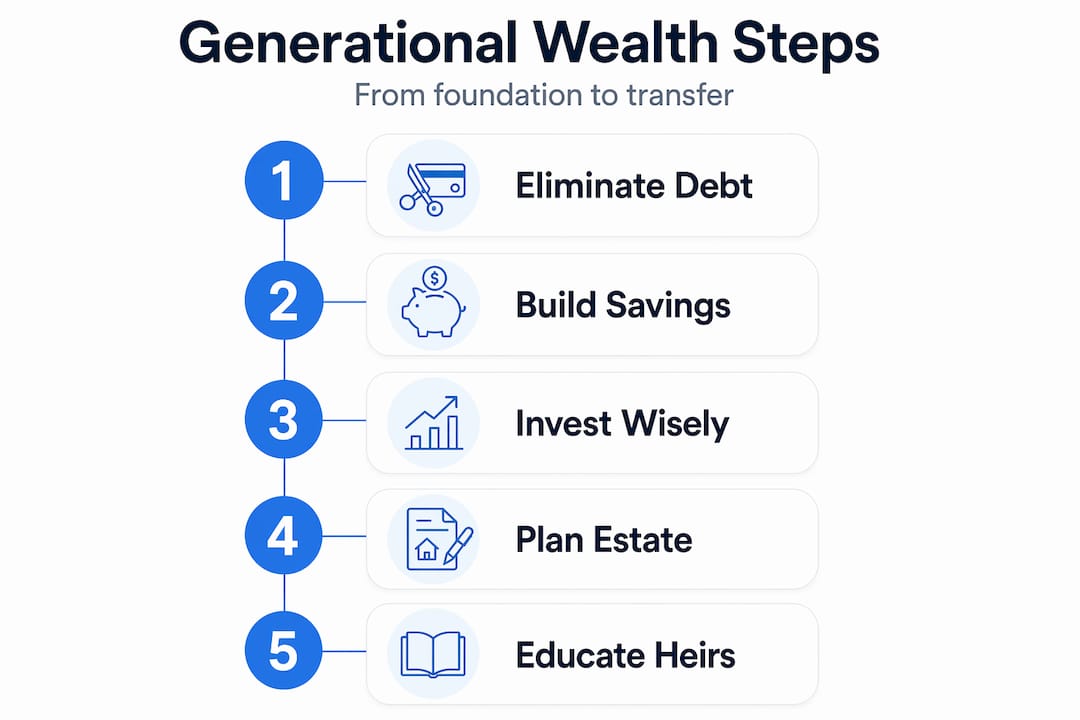
Most people earn a lifetime of income and have little to show for the next generation. Building generational wealth is not just about accumulating money. It is about creating a financial system your family can live inside, grow from, and pass forward, intact. The Great Wealth Transfer involves over $80 trillion moving from Baby Boomers to younger generations, yet most families are structurally unprepared to receive it, let alone create their own. This guide walks you through every layer: the foundation, the investment strategy, the legal protection, and the family education that keeps wealth alive past one generation.
Table of Contents
- Key takeaways
- Building generational wealth: starting with a solid foundation
- Core wealth building strategies: investing and income diversification
- Preserving wealth: estate planning and legal structures
- Educating heirs and creating family governance
- My take on what most families get wrong
- Start building your financial legacy with Finblog
- FAQ
Key takeaways
| Point | Details |
|---|---|
| Start with the foundation | Clear high-interest debt and build an emergency fund before deploying capital into investments. |
| Invest early and diversify | Compound growth rewards early starters more than large, late contributions by a wide margin. |
| Use legal structures to protect wealth | Wills, trusts, and beneficiary designations are not optional; they are how wealth survives transfer. |
| Educate heirs intentionally | Financial values and literacy, taught young, prevent the generational erosion most families never see coming. |
| Governance prevents collapse | Formal family decision rules reduce the conflict and poor choices that erase wealth by the third generation. |
Building generational wealth: starting with a solid foundation
Before you place a single dollar into an investment account, the financial ground beneath you has to be stable. This step gets skipped constantly. People rush to invest while carrying 24% APR credit card debt, no emergency savings, and a budget they have never written down. That is not wealth building. That is gambling with borrowed money.
Start by separating debt into two categories. Strategic debt is borrowing at a low rate to acquire something that produces income or appreciates. A mortgage on a rental property qualifies. A 0% business loan that expands capacity qualifies. Consumer debt, the kind tied to cars, vacations, and retail purchases, destroys wealth silently. Pay it off aggressively and stop adding to it.
The next move is living below your means, not as a punishment, but as a philosophy. Think of your income as raw material. You do not spend raw material. You deploy it. Every dollar you do not spend is a dollar available to compound over decades. Families who build lasting wealth across generations treat income this way without exception.
Here is how to build the foundation in practical terms:
- Pay off all high-interest debt (anything above 7% APR) before investing outside of employer-matched retirement accounts
- Build three to six months of living expenses in a high-yield savings account, not a standard checking account
- Write a monthly budget that reflects your actual spending, not an aspirational version of it
- Automate bill payments and savings transfers so the right behavior happens without relying on willpower
- Track your net worth quarterly so you can see whether you are moving forward or drifting
Pro Tip: Open a separate high-yield savings account labeled “emergency fund” and treat it as untouchable. Keeping it at a different bank from your checking account reduces the temptation to pull from it for non-emergencies.
Once your foundation is solid, you have real leverage. You can invest without fear of having to sell at the worst time, because you have cash reserves covering life’s interruptions.
Core wealth building strategies: investing and income diversification
The most powerful force in creating lasting wealth is time. Not income level. Not intelligence. Time. Investing $300 per month starting at 25 produces more wealth by age 65 than investing $1,000 per month starting at 45. The math is that dramatic, and it is entirely due to compound growth rewarding early starters.
Here is a prioritized order for executing your investment strategy:
- Maximize employer retirement matches. A 401(k) match is a 50% to 100% instant return on your contribution. Start here without exception.
- Fund a Roth IRA. Tax-optimized accounts like Roth IRAs grow tax-free, and withdrawals in retirement are also tax-free. This can add hundreds of thousands to your net worth over decades compared to taxable investing.
- Invest in a diversified portfolio. Low-cost index funds covering U.S. stocks, international stocks, and bonds give you broad exposure without excessive fees eroding returns.
- Add real estate when ready. Real estate builds equity, generates rental income, and appreciates over time. It is one of the most reliable wealth-building assets families hold across generations.
- Build a business or side income. A small business or scalable side income creates an asset you own outright, and ownership is where most generational wealth originates.
Dollar-cost averaging, investing a fixed amount on a regular schedule regardless of market conditions, removes the emotional element from investing. You buy more shares when prices are low and fewer when prices are high. Over decades, this smooths out volatility and keeps you in the market during the dips that scare most people out.
Strategic debt is a tool the wealthy use quietly. Borrowing at 5% to acquire assets that return 10% accelerates wealth building. This is leverage, and when applied to real estate or a productive business, it multiplies your results. The key word is strategic. It only works when the asset produces more than the cost of the debt.

| Income Stream | Risk Level | Time to Build | Wealth Transfer Value |
|---|---|---|---|
| Index fund portfolio | Low to medium | 10 to 40 years | High (easily transferable) |
| Rental real estate | Medium | 3 to 10 years | Very high (income-producing asset) |
| Business ownership | Medium to high | 2 to 15 years | Very high (sellable or inheritable) |
| Dividend stocks | Low to medium | 5 to 30 years | High (passive income stream) |
| Roth IRA / 401(k) | Low to medium | 20 to 40 years | Medium (tax advantages, some restrictions) |
Pro Tip: Automate your investment contributions the same day your paycheck arrives. Money you never see in your checking account is money you never convince yourself to spend.
Preserving wealth: estate planning and legal structures
Accumulating wealth is only half the work. The part most families skip is protecting it from taxes, legal disputes, and poor distribution. Without proper estate planning, wealth built over decades can be cut significantly or lost entirely before it reaches the next generation.
These are the core legal tools you need to understand:
- A will is the minimum. It directs where your assets go after death and names guardians for minor children. Without one, the state decides for you.
- Revocable living trusts let your assets transfer to heirs without going through probate, which can be expensive, slow, and public record.
- Multi-generational trusts minimize estate and transfer taxes while preserving wealth across multiple generations. They allow structured distributions to heirs, preventing a lump-sum inheritance from being depleted immediately.
- Beneficiary designations on retirement accounts, life insurance policies, and bank accounts override your will. Keeping them updated is non-negotiable, especially after marriage, divorce, or death of a named beneficiary.
- 529 education plans and life insurance preserve estate value while providing tax-free growth and liquidity for heirs, two overlooked tools that reduce the tax burden on an estate.
The generation-skipping transfer (GST) tax exemption allows you to transfer wealth directly to grandchildren or future generations without incurring estate tax at each generational step. It is a powerful tool that requires a skilled estate planning attorney to execute correctly.
| Estate Planning Tool | Primary Benefit | Probate Avoided | Tax Advantage |
|---|---|---|---|
| Will | Directs asset distribution | No | None |
| Revocable living trust | Smooth transfer, privacy | Yes | Limited |
| Irrevocable trust | Asset protection, tax reduction | Yes | Significant |
| Multi-generational trust | Multi-generation preservation | Yes | Significant |
| 529 plan | Education funding | N/A | Tax-free growth |
Life insurance, specifically permanent life insurance, also plays a role in estate liquidity strategies when structured properly. Selecting the right trustee matters too. A professional or institutional trustee is often preferable to a family member for high-value estates, since they bring neutrality and legal accountability.
Educating heirs and creating family governance
Wealth without education is an inheritance waiting to be depleted. You can structure the perfect trust and diversify across five asset classes, but if your children and grandchildren do not understand money, do not share your values around it, and have no framework for making financial decisions together, the wealth will not survive. This is not a harsh prediction. It is a well-documented pattern.
90% of families lose wealth by the third generation, primarily because of missing governance structures, poor communication, and heirs who were never taught the stewardship mindset. The fix is intentional and starts early.
Practical steps for educating heirs and building family governance:
- Teach children about earning, saving, and giving from a young age. Allowances with savings requirements, small investment accounts, and open conversations about family finances build early literacy.
- Discuss delayed gratification explicitly. Children who learn to wait for larger rewards develop the financial discipline that sustains wealth across decades.
- Create a family financial mission statement. Write down what the family’s wealth is for, what values guide its use, and what behaviors are expected of those who inherit it.
- Hold annual family meetings where finances, goals, and major decisions are discussed openly. Structure and frequency matter here. Informal talks do not produce the same results as a formal, recurring process.
- Involve younger generations in small investment decisions before they inherit large ones. Let them manage a portion of a custodial account. Let them attend a meeting with your financial advisor. Real experience beats any lesson.
Pro Tip: Consider a family charter: a written document that outlines how wealth decisions are made, what requires consensus, and what the family’s shared financial values are. It does not need to be complicated. One page is enough to prevent years of conflict.
My take on what most families get wrong
I have watched people execute nearly perfect financial plans and still fail to pass meaningful wealth forward. In my experience, the common thread is not bad investments or poor estate planning. It is underestimating the human side of this equation.
The families who retain wealth across generations are not necessarily the ones who earned the most or picked the best stocks. They are the ones who talked openly about money, made deliberate choices about how wealth would be used, and built a culture around stewardship rather than spending. That culture does not happen automatically. You have to build it the same way you build a portfolio: consistently, intentionally, over time.
What I have also learned is that building wealth quietly and steadily through ownership, multiple income streams, and tax literacy consistently outperforms flashy high-risk attempts. Most people drawn to overnight wealth strategies end up losing time, not gaining it.
The third generation problem is real, but it is not inevitable. The families who break that cycle are the ones who treated financial education as seriously as financial accumulation. That is a choice anyone can make, regardless of current net worth. Generational wealth is not reserved for the ultra-rich. It starts with the next decision you make about your money.
— Povilas
Start building your financial legacy with Finblog
Finblog has put together a library of guides designed specifically for people serious about generational financial planning and long-term wealth preservation. Whether you are just laying the groundwork or already managing assets across accounts and structures, the resources available cover every stage of the process.
Explore detailed guides on wealth transfer strategies, retirement account comparisons, and the financial habits that actually move the needle over decades. If you want to go deeper on the legal side of protecting what you have built, Finblog’s wealth preservation guide walks through every major tool with clear, practical explanations. The right information, applied consistently, is what separates families who sustain wealth from those who start over every generation.
FAQ
What is generational wealth?
Generational wealth refers to financial assets, property, investments, and other resources passed from one generation to the next. It goes beyond a single inheritance and includes the financial systems, habits, and education that allow wealth to grow rather than be depleted.
How do I start building generational wealth with a modest income?
Start by eliminating high-interest debt, automating savings, and opening a Roth IRA or low-cost index fund account. Investing $300 per month beginning at age 25 produces more long-term wealth than $1,000 per month starting at 45, so starting early matters far more than starting large.
What legal tools protect generational wealth?
Wills, revocable living trusts, multi-generational trusts, and updated beneficiary designations are the core tools. Multi-generational trusts in particular minimize estate taxes, avoid probate, and structure distributions to prevent heirs from depleting assets all at once.
Why do most families lose wealth by the third generation?
Research shows that 90% of families lose wealth by the third generation due to the absence of formal governance structures, lack of financial education among heirs, and poor communication about shared values and expectations around money.
How important is financial education for sustaining generational wealth?
It is one of the most critical factors. Without financial literacy and values alignment, heirs often deplete inherited wealth quickly. Teaching children about money management, delayed gratification, and stewardship from an early age is a direct investment in the longevity of your family’s financial legacy.