
An alternative stock exchange is a regulated trading venue that matches buy and sell orders without holding the privileges or regulatory structure of a national securities exchange. In U.S. market terminology, these venues are formally called Alternative Trading Systems (ATSs). An ATS matches buyers and sellers through electronic systems without listing securities or regulating subscriber conduct beyond the mechanics of trading on the platform itself. That last point is the crux of the distinction: a traditional exchange like the NYSE or Nasdaq operates as a self-regulatory organization (SRO) with authority to discipline members and set listing standards. An ATS does neither.
Key defining traits of an alternative trading system:
- Operated by a registered broker-dealer, not as a national securities exchange
- Cannot list securities or impose conduct rules on subscribers outside of trading activity
- Regulated under SEC Regulation ATS and overseen by FINRA
- Includes Electronic Communication Networks (ECNs), dark pools, crossing networks, and call markets
- Must file Form ATS with the SEC and maintain an audit trail of transactions
Table of Contents
- What types of alternative trading venues operate in the US?
- How does the SEC regulate alternative trading systems?
- What is the Alternative Investment Market (AIM)?
- How institutional investors actually use ATS venues
- Risks and benefits of trading on alternative stock exchanges
- How alternative trading systems evolved in the US
- Key Takeaways
What types of alternative trading venues operate in the US?
The ATS category covers several distinct venue types, each built around a different matching logic and serving a different slice of the market.
- Electronic Communication Networks (ECNs): Fully electronic order books that match buy and sell orders automatically, often displaying quotes publicly. ECNs were the first wave of ATS adoption in the 1990s and brought real competition to traditional exchanges by offering faster execution and lower spreads.
- Dark Pools: Non-displayed venues where orders are invisible to the broader market until after execution. Dark pools are legal and regulated under Regulation ATS, and their primary appeal is anonymity. A pension fund selling a large block of shares can do so without telegraphing the trade to the rest of the market.
- Crossing Networks: Match buy and sell orders at a reference price, typically the midpoint of the national best bid and offer (NBBO), without price discovery happening on the venue itself. Trades cross internally; no public quote is generated.
- Call Markets: Less common than the other types, call markets batch orders and execute them at a single clearing price at scheduled intervals rather than continuously. They can reduce volatility around specific events but sacrifice the immediacy most institutional traders expect.
The practical difference between these venues comes down to two variables: how much pre-trade information is visible, and how orders are prioritized. ECNs show their order books; dark pools and crossing networks do not. That transparency gap shapes how each venue affects price discovery across the broader market.
How does the SEC regulate alternative trading systems?
The regulatory architecture governing ATSs was built in 1998, when the SEC adopted Regulation ATS to address the rapid growth of electronic trading venues that were operating outside the exchange framework. The core mechanism is Rule 3a1-1, which exempts ATSs from the statutory definition of “exchange” under Section 3(a)(1) of the Exchange Act, provided they comply with Regulation ATS and do not exercise self-regulatory powers.
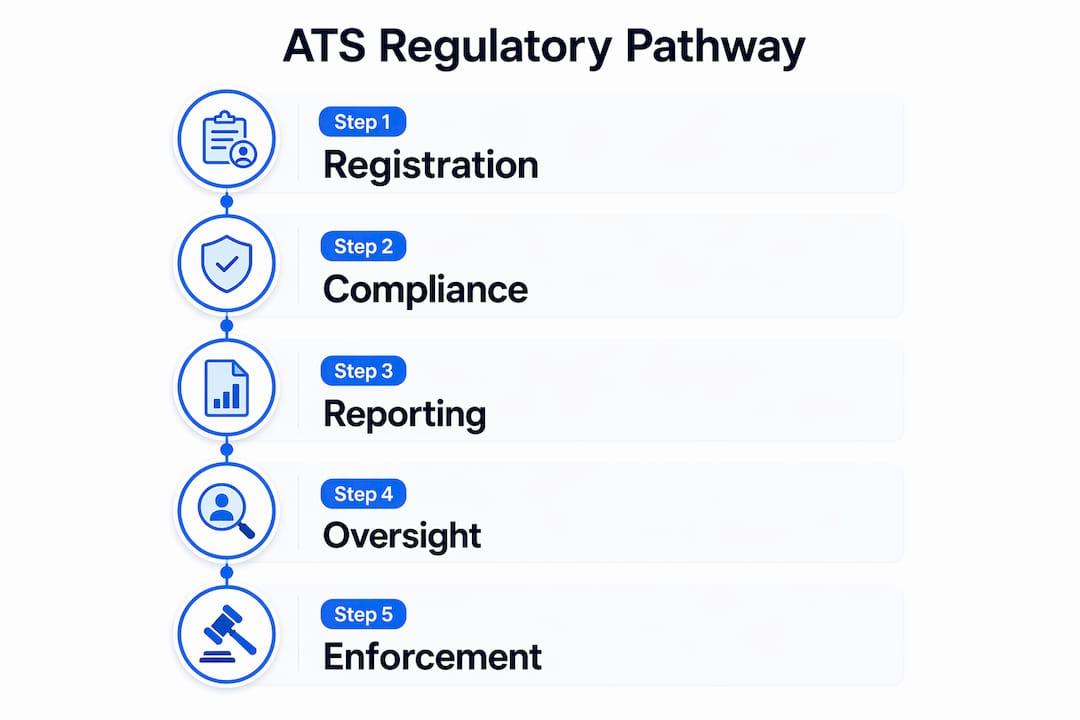
National securities exchanges register under Section 6 of the Exchange Act as SROs with listing authority. ATSs operate under the Regulation ATS exemption and can do neither. That separation is intentional. The SEC enforces a strict separation between ATSs and registered exchanges to preserve market integrity and ensure proper regulatory accountability.
Key regulatory obligations under Regulation ATS:
- All ATSs: File Form ATS with the SEC, maintain transaction records and an audit trail, and avoid using terms like “exchange” or “stock market” in their name
- ATSs exceeding 5% of national market system volume: Must meet fair access and linking obligations, including disseminating their best-priced orders into the public quote stream
- ATSs exceeding 20% of volume in a single security: Must grant or deny access based on objective, non-discriminatory standards and maintain adequate systems capacity
- Oversight: ATS operators do not self-regulate subscribers; FINRA and the SEC carry that responsibility
The tiered structure is deliberate. A small ATS launching with limited volume faces minimal compliance burden. As its market share grows, its obligations scale up to match the systemic role it plays.
Pro Tip: If you are evaluating an ATS for order routing, check its Form ATS-N filing on the SEC’s EDGAR database. These filings disclose matching logic, fee structures, and subscriber priority rules in detail that is rarely available through marketing materials.
What is the Alternative Investment Market (AIM)?
The Alternative Investment Market, known as AIM, is a sub-market of the London Stock Exchange designed for smaller, growing companies that cannot or choose not to meet the listing requirements of the main LSE market. It launched in 1995 and has since become one of the most referenced international examples of a non-traditional exchange structure.
AIM is not an ATS. The distinction matters. Where a U.S. ATS is a broker-dealer-operated matching venue with no listing authority, AIM is a formal exchange platform with actual listing standards, just lighter ones than the main market. Governance on AIM runs through Nominated Advisers, known as Nomads, which are approved firms that guide companies through the admission process and maintain ongoing compliance obligations.
Key AIM characteristics for comparison with U.S. venues:
- Formal exchange structure with listing standards, not a broker-dealer exemption
- Self-regulatory model via Nomad advisers rather than a government SRO
- Designed for smaller-cap and growth companies, not institutional block trading
- Operates under UK Financial Conduct Authority oversight, not the SEC
- No minimum market capitalization requirement at admission
For U.S. investors, AIM is most useful as a reference point showing that “alternative” in market structure can mean very different things depending on jurisdiction. An AIM-listed company has gone through a real admission process. An ATS subscriber is simply routing orders through a different matching engine.
How institutional investors actually use ATS venues
Institutions are the primary users of ATS platforms, and their motivation is straightforward: executing large orders on a lit exchange moves prices against you. A fund manager selling 500,000 shares of a mid-cap stock on a public order book signals the trade to every algorithm watching the tape. Dark pools and crossing networks exist precisely to avoid that problem.
ATS platforms account for approximately 15–18% of U.S. equity volume, including dark pools and ECNs combined.
That share is significant enough to affect price discovery on lit exchanges. When a substantial portion of trading happens off-exchange, the public quote stream reflects less of the actual supply and demand in a security. This is the core tension in the split-market environment between lit venues and dark pools: institutions get better execution on large orders, but the broader market gets noisier price signals.
The matching engines powering these venues are not simple. ATS matching algorithms often use machine learning to optimize order matching speed, reduce adverse selection risk, and calibrate match event intervals on a per-security basis. Some systems run match events every 150–900 microseconds, adjusting dynamically based on market conditions. That level of sophistication means the execution quality gap between a well-designed ATS and a poorly designed one can be substantial, even when both are technically compliant with Regulation ATS.
The split-market complexity also creates real operational challenges. Investors must manage liquidity across both public and off-exchange venues simultaneously, which requires smart order routing technology and a clear understanding of how each venue prioritizes orders. Routing everything to a dark pool to minimize market impact can backfire if the pool has thin liquidity in the security you need to trade.

Risks and benefits of trading on alternative stock exchanges
Trading through an ATS carries genuine advantages, but the tradeoffs are real and worth understanding before routing orders off-exchange.
Benefits:
- Reduced market impact: Large orders execute without moving the public quote, which is the primary reason institutions use dark pools
- Lower transaction costs: Many ATSs charge lower fees than traditional exchanges, particularly for high-volume traders
- Anonymity: Pre-trade intentions stay hidden, reducing the risk of being front-run by faster participants
- Flexibility: ATSs can offer order types and matching logic not available on registered exchanges
Risks:
- Reduced transparency: Non-displayed venues make it harder to assess whether you received a fair execution price
- Fragmented liquidity: With trading split across dozens of ATSs and exchanges, finding the best price requires sophisticated routing infrastructure
- Regulatory complexity: Compliance requirements vary by venue and volume threshold, creating operational overhead for firms using multiple platforms
- Potential conflicts of interest: Some ATSs are operated by broker-dealers who also trade on the platform, raising questions about order priority
The transparency concern is not hypothetical. Regulators have brought enforcement actions against ATS operators for misrepresenting how orders were handled, which is part of why the SEC’s Form ATS-N disclosure requirements have become more detailed over time. Checking those filings before committing order flow to a venue is standard practice for any serious institutional trading desk. For context on how SEC regulatory oversight shapes market access decisions, the broader regulatory environment matters as much as the specific venue rules.
How alternative trading systems evolved in the US
The history of U.S. alternative trading venues tracks almost perfectly with the history of electronic trading. Before the 1990s, the concept barely existed in its current form. Trading happened on exchange floors or through dealer networks, and the regulatory framework reflected that reality.
The first wave of change came with ECNs in the mid-1990s. Instinet, one of the earliest, began matching institutional orders electronically in the 1970s but gained significant traction as technology improved. By the late 1990s, ECNs were handling a meaningful share of Nasdaq volume, and the SEC recognized that the existing regulatory framework, designed decades earlier, no longer fit the market it was supposed to govern.
The SEC’s adoption of Regulation ATS in 1998 was the formal response. It created the broker-dealer registration pathway that most ATSs use today and established the tiered compliance structure that scales with trading volume. At the time of adoption, alternative trading systems handled more than 20% of orders in Nasdaq-listed securities, a figure that made the regulatory gap impossible to ignore.
Dark pools grew substantially in the 2000s as algorithmic trading accelerated and institutions sought ways to execute large orders without signaling to the market. The 2010s brought increased regulatory scrutiny, with the SEC and FINRA both stepping up examinations of ATS operators. The SEC’s 2022 proposed amendments to Rule 3b-16 signaled continued evolution, proposing to bring communication protocol systems within the exchange definition and tighten the regulatory perimeter further. Separately, the question of extended trading hours has pushed ATS operators to consider around-the-clock matching capabilities that traditional exchanges are only beginning to explore.

The trajectory is clear: ATSs started as niche electronic workarounds and have become a structural feature of U.S. equity markets, handling a share of volume large enough to influence how prices form across the entire system.
Key Takeaways
Alternative Trading Systems are regulated broker-dealer venues that match securities orders without exchange registration, SRO authority, or listing power, and they collectively handle 15–18% of U.S. equity volume.
| Point | Details |
|---|---|
| ATS vs. exchange distinction | ATSs cannot list securities or discipline members; those powers belong only to registered national securities exchanges. |
| Regulation ATS tiers | ATSs below 5% volume face minimal obligations; those above 5% must link to public markets and meet fair access standards. |
| ATS market share | ATSs, including dark pools and ECNs, account for approximately 15–18% of U.S. equity trading volume. |
| AIM is not an ATS | The UK’s Alternative Investment Market is a formal exchange with listing standards, not a broker-dealer matching venue. |
| Institutional use case | Institutions route large orders through dark pools and crossing networks to reduce market impact and preserve anonymity. |