
War is disrupting Gulf economies, but the region’s sovereign investors remain on course for one of their busiest dealmaking years, with investments projected to reach $136 billion in 2026.
That would make this their second-most active year on record, according to Global SWF data reported by Semafor. Nearly half of Gulf sovereign fund investment has gone to the United States, underscoring the continued importance of American assets to the region’s investment strategies.
Mubadala leads while Saudi Arabia slows
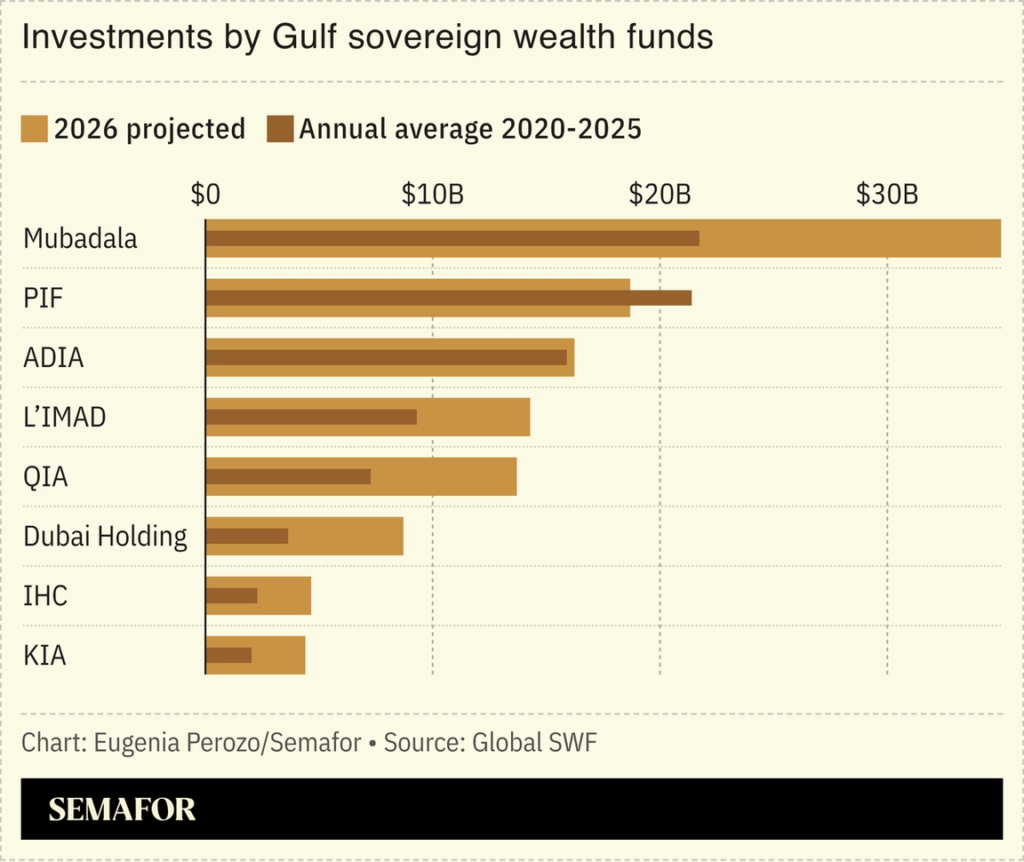
Abu Dhabi’s Mubadala invested $26.2 billion in the first nine months, leading the regional spending table.
Across the wider Middle East and North Africa, sovereign investors deployed $102 billion during that period, representing 39% of global sovereign investor dealmaking, according to Global SWF’s public report summary.
The accompanying chart shows a clear difference between funds. Saudi Arabia’s Public Investment Fund is the only investor shown with projected 2026 spending below its 2020–2025 annual average. Mubadala, Qatar Investment Authority and several other regional investors are running above that benchmark.
Gulf funds are also major backers of the $110 billion Warner Bros. takeover, illustrating their ability to support some of the world’s largest corporate transactions.
Government budgets could compete for the money
Strong dealmaking does not mean the region has escaped the financial consequences of war.
Disrupted exports through the Strait of Hormuz have squeezed government revenues. Kuwait’s and Qatar’s sovereign funds could face requests to transfer money into state budgets, potentially competing with capital available for investments.
Related: Why Trump’s War Hasn’t Broken Iran’s Economy.
For companies seeking funding, the continued activity is encouraging. But the $136 billion figure remains a projection, and prolonged export disruptions could change how much money governments leave available for overseas deals.
Gulf capital is still flowing into global markets, but domestic funding needs could increasingly shape where the next dollar goes.
Disclosure: This article does not represent investment advice. The content is for informational and educational purposes only.