



The best companies to invest in right now are high-quality businesses with durable competitive moats, strong free cash flow, and share prices that haven’t outrun their fair value. That means looking at sectors like enterprise software, healthcare, AI infrastructure, and defensive energy, then verifying every pick against tools like Morningstar’s fair value framework, FINRA’s broker-check database, and SIPC protections. This is editorial research from Finblog, not personalized financial advice.
TL;DR:
- Focus on companies with durable moats, strong free cash flow, and valuations below fair value, especially in sectors like healthcare, enterprise software, and energy.
- Verify selection criteria such as revenue and margin stability, cash flow health, management track record, and sector-specific risks before investing.
- Use a disciplined screening process to build a diversified portfolio, adjusting position sizes based on business quality and valuation rather than sector trends.
- Split initial investments into core funds and smaller stock allocations, aligning risk with your time horizon and financial objectives.
- Continually monitor market cycles, sector conditions, and company fundamentals to maintain a current and effective watchlist for long-term investing.
Table of Contents
- Six Company Themes Worth Researching in 2026
- How Do You Choose the Best Companies for Your Portfolio?
- A Step-by-Step Plan to Invest $1,000
- Why These Picks and Frameworks Hold Up
- How Market Cycles Should Shape Your Stock Picks
- The Real Problem With Most “Best Stocks” Lists
- Get Finblog’s Ongoing Stock Coverage in Your Inbox
- Verify Before You Invest: Regulator and Research Resources
- Sources
- FAQ
Six Company Themes Worth Researching in 2026
Nobody needs another list of ticker symbols copied from a screener. What you need is a framework for identifying the type of business worth owning, then applying that framework to whatever names are trading at reasonable prices when you actually sit down to invest. Below are six themes that show up repeatedly in quality-focused research, each with the metrics you should check before committing money and the investor profile it tends to suit.
1. Quality consumer staples with pricing power
Large branded consumer companies that sell things people buy regardless of the economy tend to hold up when growth stocks wobble. Their moat comes from brand loyalty and distribution scale, not novelty, which is exactly why they compound slowly and predictably rather than spiking. Watch free cash flow yield relative to the sector average, gross margin stability over the last five years, and whether pricing increases have outpaced input cost inflation. This theme fits conservative investors and anyone building a core holding they don’t want to babysit.
2. Subscription-based enterprise software
Recurring revenue businesses that sell mission-critical software to other companies tend to have extraordinarily high switching costs. Once a business runs its operations on a platform, ripping it out is expensive and risky, so retention rates for the category leaders often run above 90%. Check net revenue retention, operating margin trends as the company scales, and valuation multiples against historical ranges since this group can get expensive fast. This theme fits growth-oriented investors comfortable with higher valuations in exchange for compounding revenue.
3. Healthcare companies with predictable cash flows
Diversified healthcare businesses, particularly those with diagnostics, medical devices, or essential pharmaceutical portfolios, generate demand that doesn’t disappear in a downturn. People need insulin and hip replacements whether the market is up or down. Look at R&D spending as a percentage of revenue, patent cliff exposure over the next three to five years, and debt levels relative to EBITDA. This theme suits investors who want growth without the full volatility of a pure-play biotech bet.
4. Large-cap AI infrastructure leaders
The buildout of data center capacity, chips, and networking equipment tied to artificial intelligence has become one of the biggest capital expenditure cycles in recent corporate history. Companies supplying the physical and computational backbone for this shift benefit from multi-year order visibility, but that same visibility makes valuations sensitive to any hint of a spending slowdown. Track backlog growth, capital expenditure guidance from major customers, and price-to-earnings ratios relative to five-year averages. This theme fits growth investors with a tolerance for sharp pullbacks when sentiment shifts.

5. Defensive infrastructure and energy for income
Utilities, pipelines, and regulated energy infrastructure companies offer something growth stocks don’t: contractual or regulated cash flows that support steady dividends. These businesses typically carry more debt than the average company, so the trade-off is stability in exchange for slower capital appreciation. Watch dividend payout ratios, debt-to-EBITDA, and regulatory environment changes in the states or regions where they operate. This theme fits income-focused and conservative investors who want ballast for a broader portfolio.
6. Industrials with pricing power and reshoring tailwinds
Manufacturers tied to infrastructure spending, defense budgets, or the reshoring of supply chains back toward domestic production have picked up structural tailwinds that go beyond a normal economic cycle, as detailed by top international trading companies for global growth. Companies with the scale to raise prices without losing volume tend to protect margins even when raw material costs climb. Check order backlogs, operating margin trends over the past eight quarters, and exposure to any single customer or government contract. This theme fits balanced investors looking for cyclical exposure without pure commodity risk.
None of these themes tells you to buy a specific ticker today. What they do is narrow your research to businesses where quality and durability are structurally more likely, which is a far better starting point than scrolling a trending-stocks list. Morningstar’s approach to identifying companies worth owning combines exactly this kind of qualitative moat analysis with a valuation discount to fair value, and it’s worth applying that same two-step process to any name that surfaces from these six themes.
How Do You Choose the Best Companies for Your Portfolio?
Six themes narrow the field. What actually separates a good pick from a mediocre one is a repeatable checklist you run on every candidate before money changes hands.
Business moat. Does the company have something competitors can’t easily copy, whether that’s brand strength, switching costs, network effects, or a cost advantage from scale? Morningstar’s screening methodology treats a wide economic moat as the single strongest predictor of a company staying profitable for the next decade, not just the next earnings report.
Revenue and margin trends. A company growing revenue while margins compress is often buying growth at the expense of profitability. Look for at least three consecutive years of stable or expanding operating margins alongside revenue growth, not just top-line acceleration.
Free cash flow and balance-sheet health. Earnings can be adjusted; cash flow is harder to fake. A business generating consistent free cash flow with debt-to-EBITDA under roughly 3x has real flexibility to invest, buy back shares, or pay dividends without stress.
Valuation versus fair value. Even an excellent business is a bad investment at the wrong price. Compare the current price-to-earnings or price-to-free-cash-flow ratio against the company’s own five-year average and against a reasonable fair value estimate, not just against sector peers that might all be overpriced together.
Management and capital allocation. Read the last two shareholder letters. Has management delivered on prior promises, and does the balance between buybacks, dividends, and reinvestment make sense given the company’s growth stage?
Sector-specific risks. Regulatory exposure, customer concentration, and cyclicality vary wildly by industry, so the red flags for a bank look nothing like the red flags for a biotech.
Here are quick screening thresholds worth flagging as warning signs:
- Debt-to-EBITDA above 4x without a clear deleveraging plan
- Free cash flow declining for two or more consecutive quarters while revenue grows
- A fair value uncertainty rating described as “very high” or “extreme” by independent research
- Insider selling that accelerates sharply relative to historical patterns
- Customer concentration where one client represents more than 20% of revenue
Trade-offs matter more than absolutes here. A high-quality company at a stretched valuation might warrant a smaller position size, while a slightly lower-quality business trading at a real discount might justify a bigger bet. Conviction should scale position size, not just conviction about the story.
Pro Tip: Run the quantitative screen first to build your shortlist, then do a 15-minute qualitative check on management’s track record and recent conference call tone. Numbers tell you what happened; management commentary often tells you what’s about to.
A Step-by-Step Plan to Invest $1,000
Putting $1,000 to work doesn’t require picking six perfect stocks on day one. It requires a structure you can actually stick with.
- Set your objective and time horizon. Money you need within two years belongs in cash or short-term bonds, not stocks. Money you won’t touch for five-plus years can absorb the volatility that comes with equity ownership.
- Split core and satellite. Put the majority of your $1,000 into a low-cost diversified fund as your core holding, then use a smaller satellite allocation for individual stock picks tied to the themes above.
- Pick a starting allocation that matches your risk tolerance.
- Choose a brokerage and place the order. Compare commission structures, since some brokerages still charge per-trade fees on smaller accounts. Use limit orders rather than market orders on individual stocks to control your entry price.
- Decide between dollar-cost averaging and a lump sum. Investing the full $1,000 at once has historically outperformed spreading it out in most market conditions, but dollar-cost averaging over three or four months reduces the risk of buying right before a pullback.
- Pick the right account type. A Roth or traditional IRA shelters gains from taxes but restricts withdrawals; a taxable brokerage account offers full flexibility but taxes dividends and realized gains each year.
Whatever split you choose, running your candidates through a step-by-step analysis process before buying beats reacting to a headline or a friend’s tip. Keep a simple spreadsheet of what you bought, why, and at what price. That record becomes invaluable the first time a stock drops 20% and you need to remember whether the original thesis actually broke.
Why These Picks and Frameworks Hold Up
The themes and checklist above aren’t pulled from a trending-stocks widget. They’re built on the same principles serious research shops use to separate durable businesses from short-term momentum plays.
- Finblog’s editorial coverage tracks company fundamentals and valuation continuously, including running lists like the buy-hold-sell breakdown of stocks worth owning, updated as new financial data and price action shift the picture.
- The moat-and-valuation framework mirrors Morningstar’s own methodology for identifying companies worth long-term ownership, which weights capital-allocation quality and fair-value uncertainty alongside competitive strength.
- Composite screening tools that rank stocks on earnings growth, revenue growth, and profitability are useful for surfacing candidate lists, but they should feed your research process, not replace it.
Editorial picks are updated as earnings seasons, interest rate shifts, and sector rotations change the calculus, and readers can expect that coverage to evolve rather than stay static. Everything here is editorial perspective built on public research and standard evaluation frameworks. It is not a substitute for advice tailored to your specific finances, tax situation, or risk tolerance.
How Market Cycles Should Shape Your Stock Picks
Where the broader market sits in its cycle changes which of the six themes deserves more weight, not whether you should invest at all. Trying to time an exact bottom or top is a losing game for almost everyone, including professionals with far more data than a retail investor will ever see.
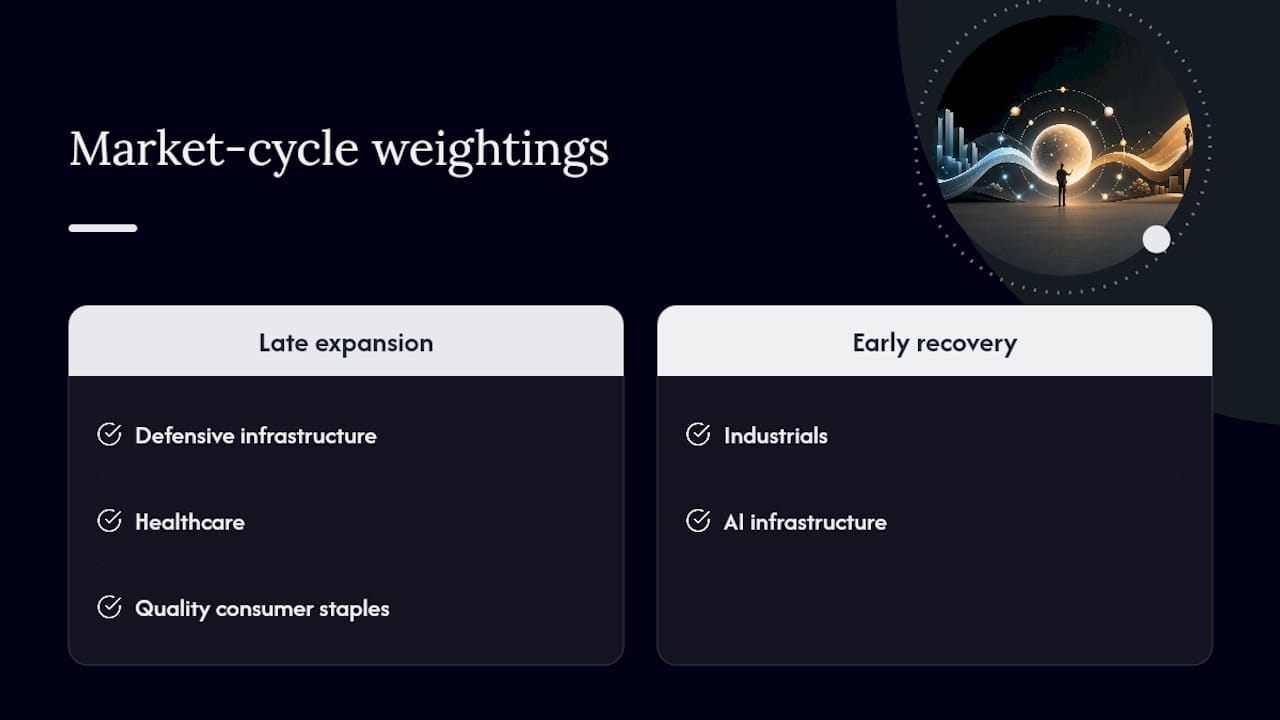
Late in an economic expansion, when interest rates are elevated and growth is slowing, defensive infrastructure, healthcare, and quality consumer staples tend to hold up better because their cash flows don’t depend on continued expansion. Early in a recovery, industrials and AI infrastructure names often lead because capital spending picks up and order backlogs start rebuilding. The mistake most investors make isn’t choosing the wrong theme. It’s abandoning a sound thesis the first time a macro headline spooks the market, then buying back in after the recovery has already happened.
A more durable approach is to size positions so that no single macro surprise wrecks your plan, then let time horizon do the heavy lifting. If your money isn’t needed for five years, a rate hike this quarter or a earnings miss next quarter matters far less than whether the underlying business still has its moat intact three years from now.
The Real Problem With Most “Best Stocks” Lists
Most stock-picking content treats the shortlist as the finish line. It isn’t. The research above supports a different conclusion: the six themes matter less than the discipline you apply after finding a candidate that fits one of them.
Conventional advice tends to oversell timing and undersell position sizing. Readers get told when to buy but rarely told how much of their portfolio a single conviction bet should occupy relative to their overall risk tolerance. That’s backwards. A mediocre stock at a 3% position size is a rounding error if you’re wrong. A great stock at 25% can wreck a portfolio if the thesis breaks.
Prioritize the checklist over the theme. Any of the six categories can contain both excellent and mediocre businesses, and the difference shows up in free cash flow trends and valuation discipline, not the sector label. Start there, size positions modestly while you build conviction, and let the framework do more work than any single ticker recommendation ever could.
— Povilas
Get Finblog’s Ongoing Stock Coverage in Your Inbox
Building a shortlist is one afternoon of work. Keeping it current as earnings, rate decisions, and sector rotations shift the picture is a full-time habit most individual investors don’t have time for. That’s where Finblog fits: ongoing coverage of company fundamentals, research tool comparisons, and beginner-friendly breakdowns that turn a six-theme framework into an actual watchlist you can act on.
Sign up on Finblog’s homepage for updated picks and deeper company reports as market conditions change through 2026. This is a recommended resource for research and education, not personalized investment advice, and any decision to buy or sell should account for your own financial situation and risk tolerance.
Verify Before You Invest: Regulator and Research Resources
Before wiring money to any brokerage or adviser, confirm the firm is properly registered. FINRA’s BrokerCheck lets you verify broker and firm registration in seconds, while adviser registration summaries disclose fee structures and conflicts of interest. SIPC explains what happens to your assets if a brokerage firm fails, and MoneySmart offers free budgeting and investment calculators to check that any purchase actually fits your goals. For firms outside standard broker-dealer registration, NMLS Consumer Access is a useful public licensing lookup.
Sources
- MoneySmart (Australian Government)
- FINRA
- SIPC
- Morningstar — The Best Companies to Own (2026 edition)
FAQ
What Is the Best Company to Invest in Right Now?
There’s no single universal answer since the right pick depends on your risk tolerance and time horizon, but quality companies with wide moats and reasonable valuations across themes like enterprise software, healthcare, and infrastructure tend to hold up best across market cycles. Finblog’s editorial coverage tracks these themes as conditions shift through 2026.
Which Company Is Best to Invest in Right Now?
Instead of chasing one name, evaluate candidates against a moat, cash flow, and valuation checklist within a theme that fits your goals, whether that’s defensive income or growth exposure to AI infrastructure. Verify any specific firm’s registration through FINRA before committing money.
Where Should I Invest $1,000 Right Now?
A common approach is splitting the $1,000 between a diversified core fund and a smaller satellite allocation in individual stocks tied to durable themes, with the exact split depending on whether you’re conservative, balanced, or aggressive. The step-by-step plan above lays out three sample allocations to start from.
How Long Does It Take to Research and Buy a Stock?
A basic screen against the checklist above, covering moat, margins, cash flow, and valuation, takes most investors around half an hour to complete per candidate once they know what to look for. Placing the actual order takes minutes through any standard online brokerage.
What Fees Should I Expect When Buying Stocks?
Most major brokerages now offer commission-free trades on stocks and ETFs, though some charge fees on smaller accounts or for certain order types. Taxable accounts also owe capital gains tax on profits when you sell, while IRAs defer or eliminate that tax depending on the account type.