

The most effective networking approach is selective, give-first networking that prioritizes depth over volume. It combines eight moves: upfront research, leading with contribution, a story-driven pitch, targeted communities, a sharpened online presence, bounded informational interviews, a light follow-up cadence, and a bias toward fewer, deeper relationships. This article includes scripts, a one-week plan, and the systems to sustain it.
TL;DR:
- Focusing on fewer, deeper relationships and targeted communities yields better career momentum than broad contact volume.
- Contribution, story-driven pitches, and a tailored online presence increase your memorability and trustworthiness in networking efforts.
- Consistent, brief follow-ups within 48 hours, backed by a simple tracking system, sustain meaningful relationships over time.
- Smaller, curated in-person or virtual settings and platforms like niche forums or Twitter promote substance over polish, enhancing trust and visibility.
- Industry and career stage shape the optimal approach, with early-career professionals benefiting from volume learning, while experienced individuals focus on strategic connections.
Table of Contents
- Networking Strategies That Actually Build Career Momentum
- Scripts and Templates You Can Use Today
- Networking Online Without Sounding Like a Sales Pitch
- Building a Follow-Up System That Doesn’t Feel Like Homework
- Networking When You’re Introverted or Anxious About It
- Your Week 1 Action Plan
- Twitter, Forums, and the Networks Beyond LinkedIn
- Networking Etiquette, In Person and On Screen
- Working a Conference or Large Event Without Wasting the Trip
- Adjusting Your Approach by Industry and Career Stage
- How to Tell If Your Networking Effort Is Actually Working
- Why Finblog Backs the Give-First Approach
- Get the Templates and Tracking System
- Where to Read More
- Sources
Networking Strategies That Actually Build Career Momentum
Most advice about networking strategies tells you to meet more people. The better advice, backed by career research from institutions like Harvard Business School Online, is to audit who you already know before chasing new contacts. A crowded contact list with no real relationships is worse than a short list of people who’d actually take your call.
Here’s the ordered playbook:
- Prepare ahead. Before any event or outreach, spend 15 minutes researching the person or group: recent posts, shared connections, a specific project they’re working on.
- Lead with contribution. Offer something (an article, an intro, a piece of feedback) before you ask for anything. This single habit, as Forbes contributor Kathy Caprino argues, makes networking feel less like a transaction and more like a genuine exchange.
- Build a short, story-driven pitch. Skip the resume recitation. One sentence on your role, one on the value you create, one small story that makes it memorable.
- Join targeted communities, not broad ones. A small Slack group in your niche beats a much larger LinkedIn group every time.
- Optimize your online presence so people can vet you before you even ask for a meeting.
- Use informational interviews for focused learning, kept short and specific.
- Set a follow-up cadence. Relationships die from neglect, not conflict.
- Choose depth over immediate asks. The person who wants your help right away is rarely the one worth cultivating.
Skip steps 2 and 3 and the rest of the list stops working. Contribution and story are what make someone remember you after the event ends.
Scripts and Templates You Can Use Today
Blank message boxes kill more networking attempts than shyness does. Use these as starting points, then edit in specifics.
LinkedIn connection request:
“Hi [Name], I saw your post on [specific topic] and it changed how I think about [specific detail]. I work on [your role/project] and would love to stay connected.”
48-hour follow-up after meeting someone:
“Great talking with you about [specific topic] at [event]. Here’s the [article/contact/resource] I mentioned. Would love to keep in touch.”
Informational interview ask (bounded):
“I’m exploring [specific career path] and admire your work at [company]. Would you have 20 minutes in the next two weeks for a few questions? Happy to work around your schedule.”
That 20-minute cap matters. Career services at the University of Michigan recommend keeping informational interview requests brief and following up with a thank-you note immediately, which keeps the ask low-friction for busy people.
Elevator pitch formula: Role + value + one story line + ask. Example: “I manage risk models at a mid-size fund. Last quarter I caught a data error that saved the desk six figures. I’m always looking to swap notes with other quants on model validation. Anyone doing interesting work there?”
For micro-actions, share a resource within an hour of a conversation, or offer a specific introduction by name rather than a vague “let me know if I can help.”
Pro Tip: Record yourself delivering your 30-second pitch on your phone. Listen once for content, once for tone. Most people are surprised how much filler language they cut on the second pass.

Networking Online Without Sounding Like a Sales Pitch
LinkedIn works when your profile does the pre-selling before a conversation even starts.
- Headline: Signal who you serve and one achievement, not just a job title.
- Photo: A clear, professional headshot, no group photos or logos.
- About section: Three lines. What you do, who you help, one proof point.
- Featured section: Pin one piece of real work, a report, a talk, a published article.
Engagement matters more than posting frequency. Comment with a specific point, not “Great post!” Share short original takes with a concrete example attached. Answer questions in niche forums with real numbers or real experience, not generalities.
Niche communities (industry Slack groups, alumni networks, subreddit-style forums for your field) tend to have higher signal than open platforms. A strong LinkedIn profile plus visible skill development makes people more willing to move a conversation offline. The signal to escalate: a shared project, overlapping interests, or a mutual connection who vouches for both of you.
Building a Follow-Up System That Doesn’t Feel Like Homework
Most networking effort dies at step two: the follow-up. A simple cadence fixes this without turning your life into a CRM sales job.
Send a thank-you with a specific reference within 48 hours. Check in briefly around the two-week mark. Send one ambient value touch, an article, a congratulations, a relevant intro, around the eight-week mark. After that, let the relationship breathe until there’s a real reason to reach out again.
A minimal tracking table keeps this from living only in your head:
| Field | Purpose |
|---|---|
| Name | Who you met |
| Where we met | Context for your next message |
| What they work on | Anchors future conversation |
| Last touchpoint | Prevents awkward silence or over-messaging |
| Next action | Keeps the relationship moving |
A free Notion template covers this for most people. Paid CRM-style tools add enrichment (job change alerts, birthday reminders) for a monthly fee, useful once your network passes a few hundred contacts, unnecessary before that.
Block 30 minutes a week to send two or three messages and update next actions. Pair it with your existing time management routine so it doesn’t compete with deadline work.
Networking When You’re Introverted or Anxious About It
Anxiety around networking usually comes from framing it as performance. Reframe it as curiosity: you’re not there to impress anyone, you’re there to learn something specific about one person.
- Prepare two conversation starters and one genuinely personalized question before you walk in.
- Choose smaller formats. Dinners of eight to fourteen people, curated meetups, or one-on-one informational interviews beat large mixers for people who drain fast in crowds.
- Lean into listening. Introverts who ask sharp follow-up questions often get remembered more than the loudest person in the room.
- Follow up in writing, where you can be more precise and less rushed than in live conversation.
Pro Tip: If a room feels like too much, commit to three good conversations instead of thirty shallow ones. Leave once you’ve had them. Nobody tracks your exit time; they remember whether the conversation mattered.
Your Week 1 Action Plan
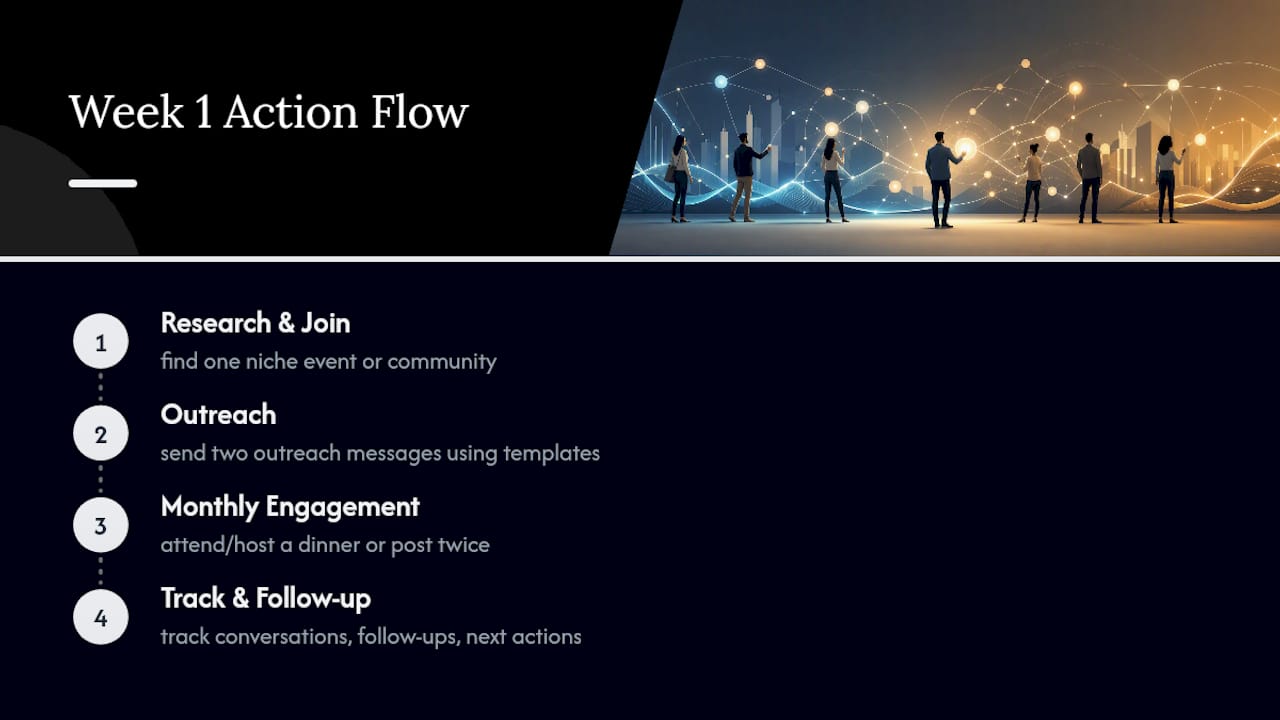
This week: research one niche event or community worth joining, send two outreach messages using the templates above, and set up your tracking table.
This month: attend or host one small dinner or join a niche community and post twice with real substance.
Track three numbers: conversations started, follow-ups sent, and next actions scheduled. According to CoreTopics, selectivity and consistent light follow-up outperform sheer contact volume, so a short list with real follow-through beats a packed inbox of dead threads.
Twitter, Forums, and the Networks Beyond LinkedIn
LinkedIn gets the attention, but plenty of real professional relationships start on platforms most people underuse for networking. Twitter (X) still functions as a live water cooler for finance, tech, and policy circles, where replying to a well-known voice in your field with a sharp, specific point can put you in front of people LinkedIn’s algorithm would never surface.
Industry-specific forums, whether that’s a subreddit for actuaries, a private Discord for portfolio managers, or a niche Slack for compliance officers, tend to reward substance over polish. Nobody there cares about your headline; they care whether your answer to a technical question actually helps.
The rule that carries across every platform: participate before you pitch. Answer three questions before you ask one. Share a resource before you request a favor. On forums with reputation systems (upvotes, karma, badges), consistent useful contributions do more for your visibility than any single introduction post ever will.
One caution: tone shifts by platform. What reads as confident on Twitter can read as self-promotional on a technical forum. Match the house style before you post, and lurk for a week or two on any new community before contributing, so your first post doesn’t misread the room.
Networking Etiquette, In Person and On Screen
Etiquette is where good networking intentions quietly fall apart. In person, the basics still hold: arrive on time, put your phone away during conversations, and exit a conversation gracefully instead of just walking off mid-sentence. A simple “I want to let you get back to the room, but I’d love to continue this over email” works every time.
Virtual settings need their own rules. Keep your camera on for one-on-one calls unless connectivity forces otherwise. Mute when you’re not speaking in group calls. Don’t multitask visibly, people notice when your eyes drift to a second screen.
A few etiquette points get overlooked constantly:
- Don’t ask for a job or a favor in the first message, ever.
- Don’t add someone to an email chain or group thread without asking first.
- Respect the stated time limit on any call you requested, even if the conversation is going well.
- Send a thank-you note after any meeting someone granted you, not just interviews.
The common thread: treat other people’s time and attention as a limited resource you’re borrowing, not one you’re entitled to.
Working a Conference or Large Event Without Wasting the Trip
Large events fail people who show up without a plan and succeed for people who treat them as a series of small, deliberate conversations rather than one big blur.
Before the event, review the attendee list or speaker lineup and pick five to eight people worth a real conversation. Message two or three of them beforehand to suggest meeting at a specific session or during a break. That single move puts you ahead of most attendees, who show up hoping for serendipity.
During the event, work the edges, not just the main hall. Hallway conversations right after a session, when everyone’s still processing what they heard, tend to be more substantive than anything at the open bar. Ask the speaker one specific, well-formed question rather than a general one; it’s the fastest way to become memorable to a room full of strangers.
Cap your day at a handful of quality conversations rather than a stack of business cards. Send your 48-hour follow-up messages while the event is still fresh in everyone’s memory, ideally the same night or the next morning, referencing the exact thing you discussed.
Adjusting Your Approach by Industry and Career Stage
A finance analyst two years out of school and a managing director fifteen years in need different networking strategies, even inside the same firm.
Early-career professionals and students benefit most from volume of learning conversations, informational interviews, alumni outreach, and entry-level community groups, because the goal is building a map of the field, not landing a specific deal. Mid-career professionals should shift toward fewer, more targeted relationships: peers who can make introductions, and people one level up who’ve solved the exact problem you’re facing now.
Industry changes the format too. In fast-moving fields like tech or venture capital, public visibility (posting, speaking, writing) does real networking work on its own. In more conservative fields like law, accounting, or traditional finance, direct introductions and small in-person gatherings still outperform public content. Match the format to how your industry actually builds trust, not to whatever tactic is trending.
How to Tell If Your Networking Effort Is Actually Working
Networking ROI is hard to measure because the payoff often lags the effort by months or years. That doesn’t mean it’s unmeasurable, it means you need leading indicators, not just outcomes like “got a job offer.”
Track three things monthly: conversations started, follow-ups actually sent (not just planned), and instances where a contact proactively reached out to you. That last metric, being remembered without prompting, is the clearest sign a relationship has real depth.
A rougher but useful check: once a quarter, look at your tracking table and count how many contacts you could call today and get a same-day reply. If that number is shrinking, your outreach volume might be up while your relationship quality is down, a common trap for people who mistake message count for progress.
The honest long-term measure is opportunity flow, how often your network surfaces information, introductions, or chances you wouldn’t have found alone. That’s slower to show up than a spreadsheet metric, but it’s the number that actually matters.
Why Finblog Backs the Give-First Approach
Networking pays off on the same timeline as good investing: slow, compounding, and easy to underestimate in year one. Finblog recommends depth-first networking because it builds the kind of professional capital, referrals, mentors, deal flow, that shows up in career outcomes for years after the initial conversation. This piece was put together by Povilas with that long horizon in mind.
— Povilas
Get the Templates and Tracking System
Building your own outreach scripts and contact tracker from scratch eats a weekend most professionals don’t have to spare. Finblog’s landing page offers the templates covered here, the LinkedIn message, the 48-hour follow-up, the informational interview ask, plus a Notion tracking starter, as a free download. None of it is required to use the strategies in this article; it just saves you the setup time. Grab the templates and tracking starter and put your Week 1 plan into motion today.
Where to Read More
- Forbes on reframing networking as contribution and storytelling techniques
- Harvard Business School Online on quality-first networking
- University of Michigan on informational interviewing
- CoreTopics on selective, modern networking
Sources
- The Real Key To Productive Networking—Why It’s Easier Than You Think
- Energize Your Networking Skills With 3 Proven Storytelling Tips
- Simple networking tips to support your career growth
- Networking (University of Michigan School of Social Work career services)
- Networking Strategies That Actually Work in 2026 – CoreTopics