
Intel delivered its strongest quarterly revenue growth in more than 15 years, beating Wall Street expectations as demand for AI infrastructure and data centre chips continued to accelerate.
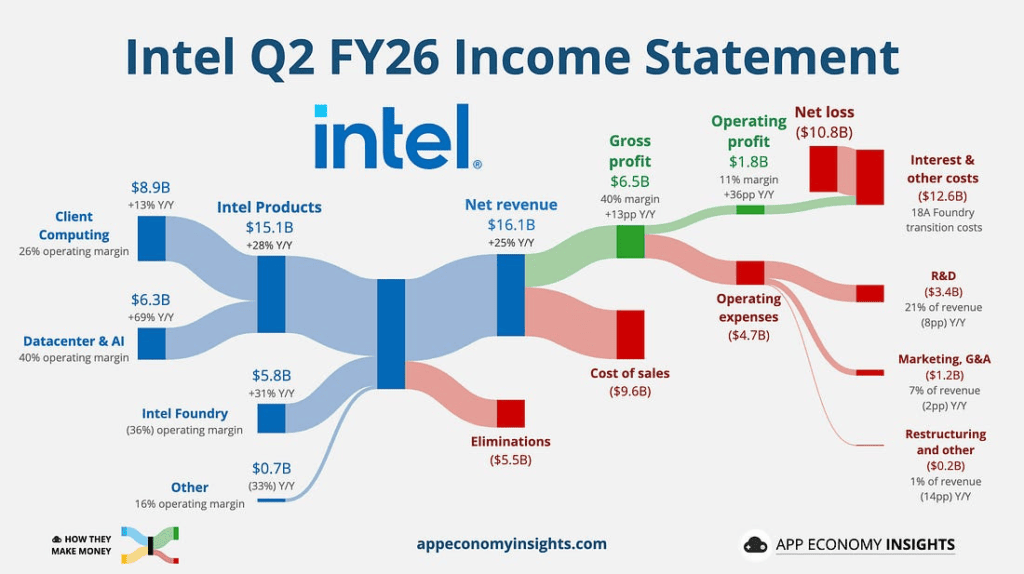
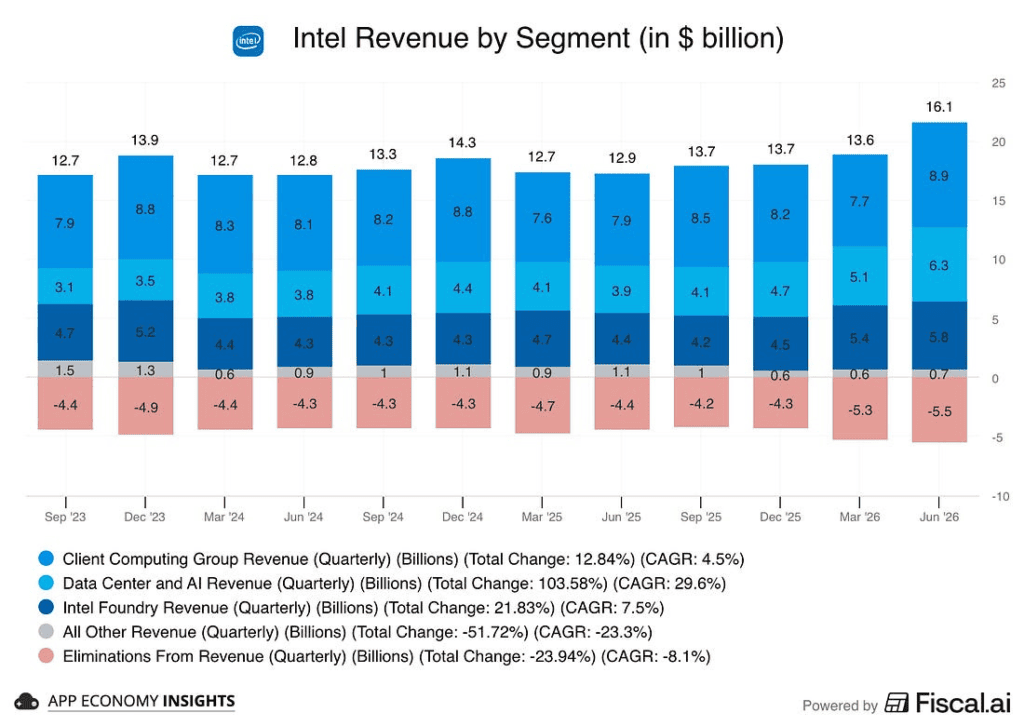
The chipmaker reported second-quarter revenue of $16.1 billion, up 25% year-over-year and well above analysts’ forecasts. Adjusted earnings came in at $0.42 per share, compared with a loss a year ago, marking another sign of Intel’s turnaround under CEO Lip-Bu Tan.
“We delivered the strongest revenue growth in more than fifteen years,” Tan said.
The biggest driver was Intel’s Data Center and AI business, where revenue jumped 59% from a year earlier to $6.3 billion. The company said growing demand for AI workloads is increasing the need for high-performance CPUs alongside AI accelerators.
Other parts of the business also outperformed:
- Client Computing revenue rose 13% to $8.9 billion, helped by growing demand for AI PCs, which now account for roughly two-thirds of Intel’s PC portfolio.
- Foundry revenue climbed 31% to $5.8 billion, while adjusted gross margin reached 41.8%, exceeding the company’s own guidance.
Looking ahead, Intel issued a stronger-than-expected forecast for the current quarter. The company expects:
- Revenue of $15.8 billion to $16.8 billion.
- Adjusted EPS of $0.38, above Wall Street estimates.
- Gross margin of around 42%.
Management also said it is increasing investment despite a challenging industry backdrop. Intel now expects to spend more than $20 billion on capital expenditures in 2026, up from its previous $18 billion forecast, with spending expected to increase further in 2027.
Still, the company acknowledged some challenges. CFO Dave Zinsner warned that rising memory chip prices are likely to pressure the PC business in the second half of the year, while management expects consumer PC demand to remain softer than usual.
Intel’s shares have nearly tripled this year, although they remain around 30% below their June 22 high after a broader pullback in semiconductor stocks. Investors have become more cautious as questions grow over whether the pace of AI hardware spending can be sustained.
For investors, Intel’s results suggest the company’s turnaround is gaining momentum, particularly in AI and data centres. The next key test will be whether it can maintain that growth while navigating higher component costs and proving it can attract major external customers to its foundry business.
Disclosure: This article does not represent investment advice. The content and materials featured on this page are for educational purposes only.