
TL;DR:
- Stock trading risk management involves controlling potential losses through rules that preserve capital and enable long-term growth. Key techniques include using the 1% or 2% risk rules, setting minimum risk-to-reward ratios, and managing position size based on volatility with the ATR method. Professional traders also limit daily losses, manage portfolio heat, and align risk with their financial capacity to ensure sustainability.
Stock trading risk management is the practice of systematically controlling potential losses through defined rules that preserve capital and enable long-term profitability. Most traders focus on finding winning trades. The ones who survive long term focus on how much they lose when they are wrong. The 1% Rule, Average True Range (ATR) position sizing, and tiered daily loss limits are the professional standards that separate disciplined traders from those who blow up their accounts. This guide covers each technique with the math and reasoning behind it, so you can build a system that protects your capital first and grows it second.
What are essential position sizing and risk-to-reward strategies in stock trading?
Position sizing is the single most important variable in stock trading risk management. It determines how much of your account you put at risk on any one trade, and it controls whether a losing streak wipes you out or leaves you with capital to recover.

The 1% Rule and 2% Rule
The 1% Rule states that you risk no more than 1% of your total account equity on a single trade. On a $50,000 account, that means a maximum loss of $500 per trade. Risking 1% per trade requires 22 consecutive losses to drop total account equity by 20%, making account ruin virtually impossible. The probability of 22 consecutive losses with a 45% win rate is roughly 1 in 137 million. That math alone makes the 1% Rule the foundation of any serious risk framework.
The 2% Rule is the upper boundary most professionals accept. Risking more than 2% per trade compresses your margin for error significantly. New traders should start at 0.5% to 1% until their win rate and process are proven.
Risk-to-reward ratios
A minimum 1:2 risk-to-reward ratio, preferably 1:3, enables profitability even with win rates as low as 40%. At a 1:3 ratio, you can be wrong 6 out of 10 trades and still grow your account over time. That is the counterintuitive truth most new traders miss: you do not need to be right most of the time. You need your winners to be larger than your losers.
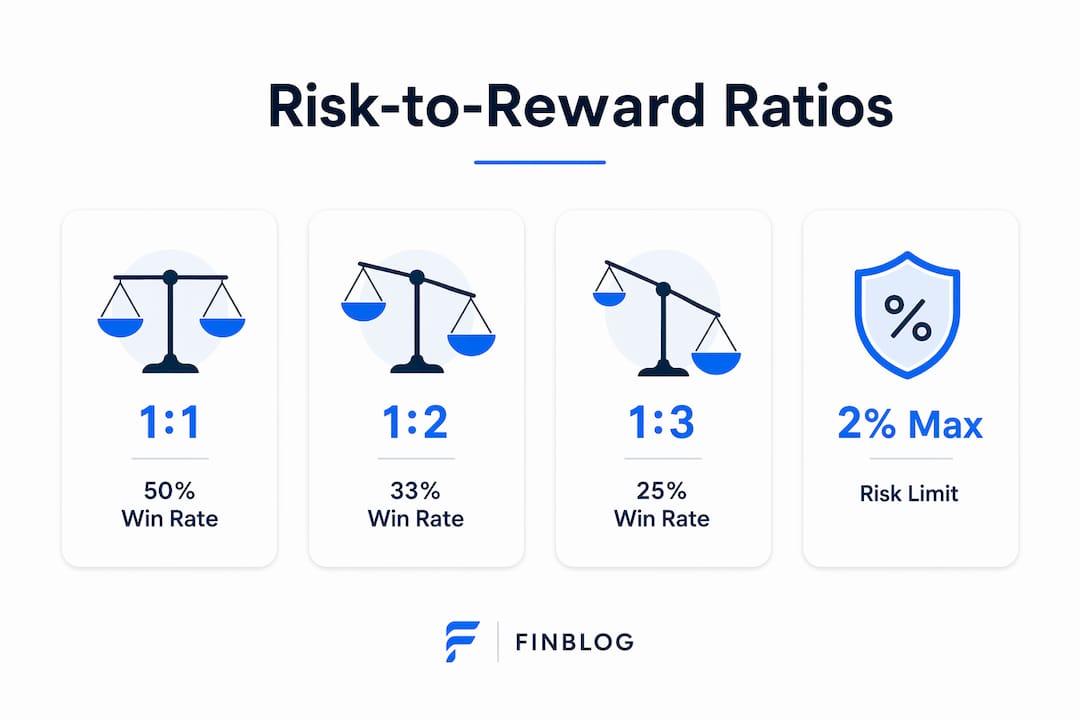
Here is how the math plays out across three ratio scenarios:
| Risk-to-reward ratio | Win rate needed to break even | Notes |
|---|---|---|
| 1:1 | 50% | Requires high accuracy |
| 1:2 | 34% | Achievable for most traders |
| 1:3 | 25% | Allows frequent losses and still profits |
ATR-based position sizing
The Average True Range method is the professional standard for adjusting position size based on volatility. ATR measures how much a stock typically moves in a day. You set your stop-loss at a multiple of ATR (commonly 1.5x or 2x), then calculate how many shares to buy so that if the stop is hit, your dollar loss equals your predetermined risk amount. This keeps your risk consistent regardless of whether you are trading a $20 stock or a $400 stock.
Pro Tip: During a drawdown, cut your standard risk per trade in half. If you normally risk 1%, drop to 0.5% until you string together three to five winning trades. This graduated approach stops a bad week from becoming a catastrophic month.
How do professional traders manage daily loss limits and prevent emotional bias?
Daily loss limits are the circuit breakers of professional trading. Without them, a bad morning can spiral into a ruined account by afternoon.
Professional day trading frameworks recommend capping total daily losses at 3% of account equity or three full-size losing trades, then stopping trading for the day. On a $50,000 account, that means you stop after a $1,500 loss. The rule sounds simple. Following it when you feel certain the next trade will recover your losses is where discipline is actually tested.
The 3-Loss Rule is a behavioral safeguard that works alongside the dollar limit. After three consecutive losing trades, you stop trading for the day, regardless of how much you have lost. The reasoning is psychological: three consecutive losses signal that either the market conditions have shifted or your judgment is compromised. Both situations call for stepping away.
Revenge trading is the most destructive pattern in stock market risk analysis. It occurs when a trader increases position size or takes low-quality setups to recover losses quickly. Enforced stop-trading rules after a set number of losses are the only reliable defense against this behavior. Willpower alone does not work under financial stress.
“Losing small, structured, and repeatable is the core edge. Risk management is about survival to profitability.” — Kunal Desai, veteran trader
Pro Tip: Write your daily loss limit on a sticky note and place it next to your monitor. Physical reminders interrupt the emotional loop that leads to revenge trading before it starts.
Key behavioral rules to enforce daily:
- Stop trading after hitting 3% account loss for the day.
- Stop trading after three consecutive losing trades.
- Take a 15-minute break after any single loss exceeding your planned risk amount.
- Do not increase position size to recover losses.
- Review your trade log before placing any trade after a losing streak.
Why is portfolio heat and correlation risk critical beyond individual trade risk?
Portfolio heat is the total percentage of your account at risk across all open positions at one time. Most traders manage individual trade risk carefully and then ignore the combined exposure. That oversight causes large drawdowns even when every single trade follows the 1% Rule.
The problem is correlation. Same-sector positions can be 70–90% correlated, meaning they tend to move together. If you hold five technology stocks, each risking 1%, your real exposure is not 5%. A sector-wide selloff can hit all five simultaneously, creating an effective 5% loss in a single session.
How to calculate and limit portfolio heat
The practical fix is to treat correlated positions as a single combined position for risk purposes. If two stocks are in the same sector, cap their combined risk at 2% rather than allowing 1% each. Across an entire portfolio, most professional frameworks cap total heat at 5–6% of account equity at any one time.
| Correlation level | Adjustment approach | Example |
|---|---|---|
| Low (different sectors) | Standard 1% per trade | Tech + Energy + Healthcare |
| Medium (related sectors) | Cap combined risk at 1.5% | Financials + Insurance |
| High (same sector) | Cap combined risk at 2% | Two semiconductor stocks |
Proper asset allocation across sectors is the structural solution to correlation risk. Spreading positions across uncorrelated asset classes reduces the chance that a single market event damages your entire portfolio at once.
Pro Tip: Before entering a new position, list every open trade and its sector. If the new trade shares a sector with an existing position, reduce both to half your normal size or wait for one to close first.
What role does risk capacity and emotional tolerance play in managing trading risk?
Risk capacity and emotional risk tolerance are two different things, and confusing them is one of the most common investing mistakes traders make. Risk capacity is your objective financial ability to absorb losses without damaging your life outside of trading. Emotional risk tolerance is how much loss you can handle psychologically before your judgment breaks down.
Risk capacity must be calculated objectively, not estimated by how confident you feel. A trader might feel comfortable risking 5% per trade but cannot actually afford to lose that money. Aligning your trade sizing to capacity rather than emotion prevents the kind of ruin that forces traders to quit permanently.
Practical rules for aligning risk to capacity:
- Never trade with money you cannot afford to lose entirely.
- If a loss would affect your rent, groceries, or emergency fund, your position size is too large.
- After a 5% equity drawdown, reduce your risk per trade by 25%.
- After a 10% equity drawdown, cut risk per trade in half and review your strategy before continuing.
- Return to normal sizing only after recovering half the drawdown.
Tiered drawdown protocols prevent bad months from compounding into wipeouts. Reducing risk per trade after 5% or 10% equity drops is not a sign of weakness. It is the mechanism that keeps you in the game long enough to recover. Traders who maintain full position sizes through deep drawdowns rarely come back.
Process discipline outperforms market timing every time. Consistent application of evidence-based rules produces better outcomes than reacting to each market move with a new strategy. The traders who last decades are not the ones who predicted the most market turns. They are the ones who lost the least when they were wrong.
How can investors apply stop-loss, diversification, and hedging techniques practically?
Stop-loss orders are the most direct tool for limiting downside risk. Stop-loss orders automatically exit positions at predetermined prices, protecting capital and enforcing discipline in volatile markets. Setting a stop-loss before entering a trade removes the emotional decision of when to exit a losing position.
Practical stop-loss approaches include:
- Fixed percentage stops: exit if the stock drops a set percentage from your entry.
- ATR-based stops: place the stop at 1.5x to 2x the stock’s Average True Range below entry.
- Support-level stops: place the stop just below a key technical support level.
- Time-based stops: exit any position that has not moved in your favor within a defined period.
Diversification spreads investments across asset classes and sectors, reducing exposure to any single failure. Diversification cannot eliminate market-wide risk, but it reliably reduces the damage from individual stock or sector collapses. A portfolio concentrated in one sector is not diversified, regardless of how many individual stocks it holds.
Hedging adds another layer of protection. Options strategies, such as buying put options on positions you want to protect, can limit downside without requiring you to sell. Hedging carries its own costs and complexity, so beginners should study hedging strategies carefully before applying them. The goal is risk reduction, not adding new risks you do not understand.
“Risk management means choosing which risks to take. Even cash carries inflation risk, so balancing exposure rather than avoiding it entirely is the real skill.” — Investing.com Academy
Key Takeaways
Effective stock trading risk management requires combining mathematical position sizing, behavioral rules, and portfolio-level controls to protect capital and sustain long-term profitability.
| Point | Details |
|---|---|
| Use the 1% Rule | Risk no more than 1% of account equity per trade to make account ruin statistically near-impossible. |
| Apply a 1:2 minimum reward ratio | A 1:2 or 1:3 risk-to-reward ratio lets you profit even with a win rate below 50%. |
| Set daily loss limits | Stop trading after a 3% daily loss or three consecutive losing trades to prevent revenge trading. |
| Manage portfolio heat | Cap total correlated exposure at 2% per sector and total portfolio heat at 5–6% of equity. |
| Align risk to capacity | Base position sizing on your financial ability to absorb losses, not on how confident you feel. |
Why losing correctly is the real edge in trading
Most traders spend years searching for better entries, better indicators, and better market timing. I spent years doing the same thing. The shift that actually changed my results was not finding better setups. It was building a system around how I lose.
The traders I have watched fail consistently share one trait: they treat losses as problems to fix immediately. They double down, they revenge trade, and they abandon their rules the moment the market challenges them. The traders who last treat losses as a cost of doing business. They size them correctly, they stop when limits are hit, and they come back the next day with their capital intact.
The 3-Loss Rule and the 3% daily cap feel arbitrary until you have lived through a day where you ignored them. I have. The damage from one undisciplined session can take weeks to recover. The damage to your confidence takes longer. Building ways to minimize investment risk into your process before you need them is the only approach that works under pressure.
Risk management is not a constraint on your trading. It is what makes trading sustainable. The market will always offer another opportunity tomorrow. Your job is to make sure you still have capital to take it.
— Povilas
Finblog’s resources for building your risk management system
Finblog publishes in-depth guides on the strategies covered in this article, from hedging techniques to the behavioral errors that cost traders the most. If you want to go deeper on any of these topics, the Finblog library covers common investing mistakes that undermine even well-planned risk systems, along with detailed breakdowns of hedging and diversification methods. Every guide is built around evidence-based principles, not generic advice. Visit Finblog to access the full range of investing and risk management content designed for serious individual investors.
FAQ
What is the 1% Rule in stock trading?
The 1% Rule means risking no more than 1% of your total account equity on a single trade. At this level, you would need 22 consecutive losses to lose 20% of your account.
What is a good risk-to-reward ratio for traders?
A minimum ratio of 1:2 is the professional standard, with 1:3 preferred. At 1:3, you can lose 6 out of 10 trades and still grow your account over time.
What is portfolio heat in trading?
Portfolio heat is the total percentage of your account at risk across all open positions simultaneously. Most professional frameworks cap total heat at 5–6% of account equity to prevent large drawdowns.
How does emotional bias affect trading risk?
Emotional bias, particularly after losses, leads to revenge trading and oversized positions. The 3-Loss Rule, which stops trading after three consecutive losses, is the most effective behavioral safeguard against this pattern.
What is the difference between risk capacity and risk tolerance?
Risk capacity is your objective financial ability to absorb losses. Risk tolerance is your emotional comfort with loss. Effective risk management aligns position sizing to capacity, not to how confident you feel in the moment.