



TL;DR:
- A financial planning service provides a customized evaluation of your entire finances to build a strategy for your money goals. It involves a four-phase process: auditing your financial profile, analyzing goals and emotions, creating a written plan, and regularly reviewing progress. The cost varies based on the fee structure, with fiduciary planners offering the most aligned and transparent guidance.
A financial planning service is a professional, customized consultation process that evaluates your entire financial situation and builds a strategy to help you reach specific money goals. This is the industry’s recognized term for what many people loosely call personal finance consulting or financial advisory services. The process covers everything from investment management advice and tax planning services to retirement strategies and estate planning. Credentialing bodies like the CFP Board and the National Financial Educators Council (NFEC) set the standards that define what qualified planners must deliver. If you want financial stability and not just a savings account, this is where to start.
What does a financial planning service actually involve?
A financial planning service follows a defined process with four clear phases: audit, analysis, plan creation, and ongoing review. Each phase builds on the last, and skipping one weakens the whole structure.
Phase 1: The financial audit
Financial planners begin by auditing your complete financial profile, including income, assets, liabilities, and insurance coverage. You typically need to gather 3–5 key documents: recent tax returns, pay stubs, bank statements, investment account summaries, and insurance policy details. This audit phase usually wraps up within 2–4 weeks, depending on how complex your finances are. The goal is a clear, honest baseline with no gaps.
Phase 2: Analysis and goal setting
Once the audit is complete, your planner analyzes the data to identify where you stand and where you want to go. This is where short-term goals like paying off debt and long-term goals like funding retirement get mapped against your actual numbers. A good planner does not just look at the math. Effective financial planning also requires exploring your emotional relationship with money, including fears, habits, and blind spots, because those factors shape every financial decision you make.

Phase 3: The written financial plan
Your planner produces a written financial plan report that outlines specific strategies for investments, savings, taxes, and retirement. This document is not a generic template. It reflects your income, your risk tolerance, and your timeline. Think of it as a financial blueprint that you can revisit and measure against.
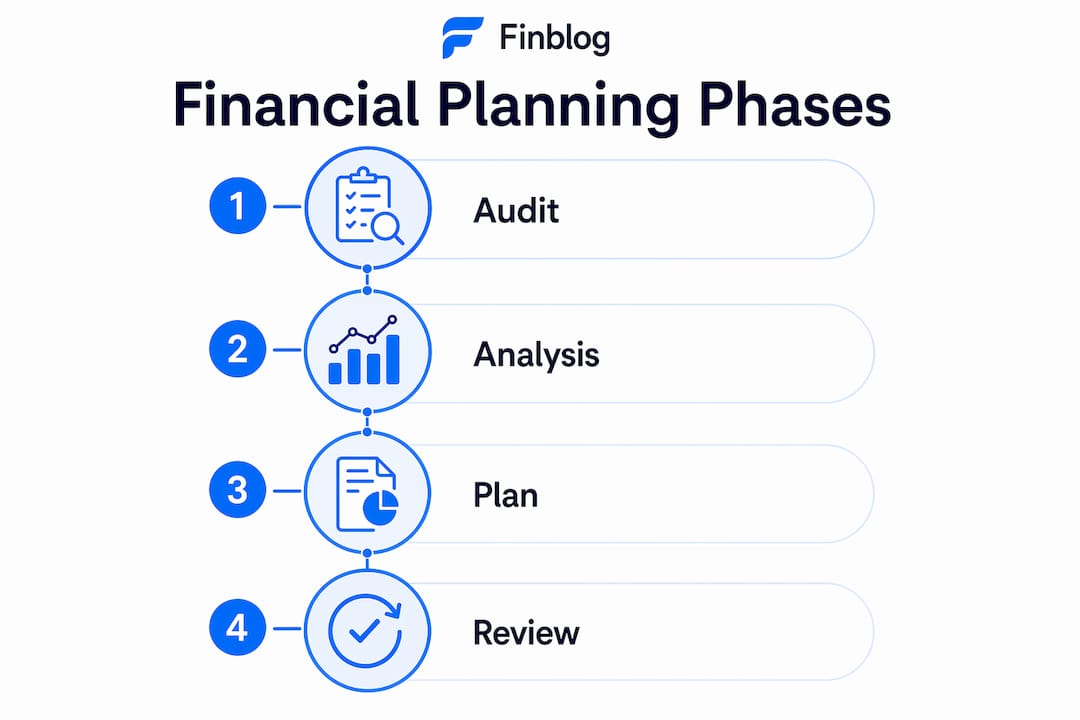
Phase 4: Ongoing reviews and updates
Financial consultants conduct continuing assessments and provide written progress reports, updating your plan as your life changes. A job promotion, a new child, or a market shift can all require plan adjustments. Regular review meetings, typically quarterly or annually, keep your strategy current and your progress on track.
Pro Tip: Before your first meeting with a planner, pull together your last two years of tax returns, your most recent pay stubs, and a list of every account you hold. Arriving prepared cuts the audit phase in half and gets you to your actual plan faster.
What services do financial planners provide?
Financial planners deliver a broader range of services than most people expect. The core offerings go well beyond picking stocks or opening a retirement account.
Common services include:
- Investment management advice: Building and rebalancing a portfolio aligned with your risk tolerance and time horizon
- Retirement planning: Working with a retirement planning expert to project income needs, Social Security timing, and withdrawal strategies
- Tax planning services: Structuring income, deductions, and investments to reduce your annual tax burden legally
- Estate planning: Drafting strategies for transferring assets to heirs with minimal tax impact
- Insurance review: Assessing whether your current coverage protects against the risks that matter most to you
- Business financial strategy: For self-employed individuals or small business owners managing personal and business finances together
Financial planning services often include estate planning, tax strategy, retirement planning, business strategy, and customized investment advice. Some planners hold additional certifications that allow them to specialize further. A Certified Financial Planner (CFP) credential, for example, signals that the advisor has passed rigorous exams and meets ongoing education requirements set by the CFP Board.
One distinction that surprises many people: financial planning is not the same as accounting. Accountants focus on past financial data while financial planners focus on future strategy. You need both perspectives for complete financial health, but they serve different functions. Your accountant tells you what happened last year. Your financial planner tells you what to do next year.
Pro Tip: Always ask a prospective planner whether they are a fiduciary. Fiduciary financial planners are legally bound to act in your best interest and do not earn commissions on the products they recommend. That one question eliminates a major conflict of interest before it costs you money.
When should you seek a financial planning service?
The best time to engage a financial planner is before a major financial transition, not after. Most people wait until something goes wrong. The planners who deliver the most value are the ones you bring in before the change hits.
Critical life transitions like marriage, inheritance, job changes, or preparing for retirement are the moments when cash flow, taxes, and risk exposure shift most dramatically. Each of these events creates a window where a well-timed plan can save you significant money and stress.
Specific situations that call for professional guidance:
- Getting married or divorced: Both events restructure income, taxes, and asset ownership in ways that require a fresh financial plan
- Receiving an inheritance: A sudden influx of assets needs a clear investment and tax strategy, not a quick decision
- Changing jobs or starting a business: New income structures, benefits gaps, and retirement account rollovers all need attention
- Having children: Education savings, life insurance, and updated estate documents become priorities immediately
- Approaching retirement: The 5–10 years before retirement are the most critical for retirement planning, including Social Security timing and withdrawal sequencing
- Hitting a financial milestone: If you have reached a savings goal or paid off a major debt, a planner helps you decide what to do with the freed-up cash flow
Early planning compounds over time. A 35-year-old who builds a financial plan today has decades for that strategy to work. A 55-year-old starting from scratch has far less room for error. The step-by-step guide to financial milestones on Finblog breaks down exactly when each type of planning becomes most valuable.
What does a financial planning service cost?
Cost is the question most people are afraid to ask. The answer depends on the fee structure your planner uses and the complexity of your financial situation.
Typical financial advisor fees vary widely across four main models:
| Fee structure | Typical cost | Best for |
|---|---|---|
| Flat annual retainer | $2,000–$7,500 per year | Ongoing, full-service planning |
| Hourly rate | $200–$400 per hour | Specific questions or one-time reviews |
| Per-plan fee | $1,000–$3,000 per plan | One-time comprehensive financial plan |
| Commission-based | 3%–6% of investment transactions | Clients who prefer no upfront fees |
These figures represent market averages as of recent years. Your actual cost depends on your advisor’s credentials, the scope of services, and how complex your finances are.
The commission-based model deserves a closer look. It sounds appealing because you pay nothing upfront. The risk is that commission-based advisors earn money when you buy certain products, which creates an incentive to recommend those products whether or not they are the best fit for you. A fiduciary advisor, by contrast, charges a flat or hourly fee and has no financial reason to steer you toward any specific product.
Paying $3,000 for a comprehensive financial plan sounds like a lot until you consider that a single tax planning error or a poorly timed retirement withdrawal can cost far more. The value of good money management solutions is measured in avoided mistakes as much as in gains. For a deeper look at how quarterly financial reviews can protect that investment over time, Finblog covers the process in detail.
Key Takeaways
A financial planning service delivers the most value when it combines a thorough financial audit, forward-looking strategy, fiduciary accountability, and regular plan updates tied to your real life.
| Point | Details |
|---|---|
| Start with a full audit | Gather 3–5 documents covering income, assets, liabilities, and insurance before your first meeting. |
| Choose a fiduciary advisor | Fiduciaries are legally required to act in your interest and do not earn product commissions. |
| Plan before life changes | Engage a planner before major transitions like marriage, inheritance, or retirement, not after. |
| Understand fee structures | Flat and hourly fees align advisor incentives with your goals better than commission-based models. |
| Review plans regularly | Ongoing assessments and written progress reports keep your strategy current as your life evolves. |
What I have learned from watching people navigate financial planning
by Povilas
The single biggest mistake I see people make is treating financial planning as a one-time event. They get a plan, feel good about it, and then ignore it for five years. Life does not stay still, and neither should your financial strategy.
The second thing I have noticed is how much anxiety people carry into their first meeting with a planner. They are embarrassed about debt, ashamed of not saving sooner, or afraid of being judged. That anxiety is real, and it matters. Effective planning requires open dialogue about your fears and goals, not just your account balances. The best planners I have seen create space for that conversation before they ever open a spreadsheet.
My honest advice: vet credentials before you trust anyone with your financial future. Ask specifically whether they hold a CFP designation and whether they operate as a fiduciary. Those two questions filter out most of the advisors who are more interested in their commission than your retirement. A credential from the CFP Board or recognition from the NFEC signals that someone has met a real professional standard, not just passed a sales training course.
Finally, do not wait for the “right time” to start. The right time was five years ago. The second best time is now.
— Povilas
How Finblog supports your financial planning goals
Finblog publishes practical, research-backed content for people who want to take their finances seriously without wading through jargon. Whether you are building your first financial plan, preparing for retirement, or trying to make sense of investment management advice, Finblog covers the topics that matter most to real people managing real money. The site connects readers with expert guidance on personal finance consulting, tax planning, and long-term wealth building. If you are ready to take the next step, explore Finblog’s financial resources and find the guidance that fits where you are right now.
FAQ
What is a financial planning service?
A financial planning service is a professional consultation process that audits your full financial situation and creates a customized strategy covering investments, retirement, taxes, and savings goals.
How do I choose a financial advisor I can trust?
Look for a fiduciary advisor with a CFP designation. Fiduciaries are legally required to act in your best interest and do not earn commissions on the products they recommend.
How much does a financial planner typically cost?
Fees range from $200–$400 per hour for hourly advisors, $1,000–$3,000 for a one-time plan, and $2,000–$7,500 annually for ongoing retainer-based services.
When is the best time to hire a financial planner?
The best time is before a major life transition such as marriage, a job change, an inheritance, or retirement, when cash flow, taxes, and risk exposure shift most significantly.
Is financial planning the same as accounting?
No. Accountants analyze past financial data for record-keeping and tax filing. Financial planners focus on future strategy, including investment growth, retirement income, and long-term wealth goals.