
TL;DR:
- Dollar cost averaging involves investing fixed amounts regularly, regardless of market conditions.
- It helps investors stay in the market, reducing emotional decision-making and poor timing risks.
- While it may yield lower returns in rising markets, DCA effectively manages volatility and encourages disciplined investing.
Most investors believe that beating the market requires perfect timing. Buy low, sell high, repeat. But most investors fail to beat the market by trying to time their purchases. The truth is, consistent investing beats brilliant but unpredictable timing more often than people expect. Dollar cost averaging (DCA) is the strategy that makes consistency your greatest asset. In this guide, you’ll learn exactly what DCA is, how it works with real numbers, what the benefits and risks look like side by side, and how to start using it in your own portfolio today.
Table of Contents
- What is dollar cost averaging?
- How dollar cost averaging works in practice
- Benefits and risks of dollar cost averaging
- How to start using dollar cost averaging
- The overlooked truth about dollar cost averaging
- Take the next step with your investing
- Frequently asked questions
Key Takeaways
| Point | Details |
|---|---|
| Reduces market timing risk | Dollar cost averaging spreads out investments, minimizing the risk of poor market timing. |
| Encourages consistency | Regular investing helps build lasting wealth by fostering disciplined habits. |
| Works in volatile markets | DCA is especially effective in uncertain markets, buying more when prices are low. |
| Easy to automate | Most platforms and retirement plans let you set up DCA automatically. |
| Not always highest returns | DCA may underperform lump sums in strong rising markets, but offers greater risk management. |
What is dollar cost averaging?
Dollar cost averaging is the practice of investing a fixed amount of money at regular intervals, no matter what the market is doing. You don’t wait for prices to drop. You don’t pause when markets feel uncertain. You invest the same amount, on the same schedule, every time.
Think of it like buying groceries. When chicken is on sale, you naturally buy more of it. When prices are high, you buy less. DCA works the same way with investment shares. When prices fall, your fixed dollar amount buys more shares. When prices rise, it buys fewer. Over time, this naturally lowers your average cost per share.
Here’s a simple example. Suppose you invest $100 every month into a mutual fund. Some months the share price is $20, so you get 5 shares. Other months it drops to $10, so you get 10 shares. Your average cost ends up lower than if you had tried to guess the best moment to invest a large amount all at once.
Dollar cost averaging reduces the impact of volatility by spreading out investment purchases over time. This approach removes two of the biggest threats to a personal portfolio: emotional decision-making and poor timing.
Key features of DCA:
- Fixed investment amount at each interval
- Regular schedule (weekly, monthly, quarterly)
- Works regardless of current market price
- Builds investing discipline automatically
- Reduces the risk of buying in at the worst possible moment
Pro Tip: Set up an automatic transfer to your investment account on payday. This way, you never have to think about it, and the habit builds itself.
How dollar cost averaging works in practice
With the core concept clear, let’s see exactly how dollar cost averaging plays out in a real investing scenario with actual numbers.
Imagine you commit to investing $100 every month for six months into an index fund. Here’s what that looks like as prices move up and down:
| Month | Amount invested | Share price | Shares bought | Cumulative shares | Avg cost per share |
|---|---|---|---|---|---|
| 1 | $100 | $20.00 | 5.00 | 5.00 | $20.00 |
| 2 | $100 | $15.00 | 6.67 | 11.67 | $17.14 |
| 3 | $100 | $10.00 | 10.00 | 21.67 | $13.85 |
| 4 | $100 | $12.00 | 8.33 | 30.00 | $13.33 |
| 5 | $100 | $18.00 | 5.56 | 35.56 | $16.88 |
| 6 | $100 | $20.00 | 5.00 | 40.56 | $14.79 |
You invested $600 total. Your average cost per share is $14.79, even though the share price started and ended at $20. That’s the power of buying more shares when prices dipped.

DCA can lower the average cost per share during market declines, which is exactly what this example shows.
Compare that to a lump sum approach. If you had invested all $600 in month one at $20 per share, you would have bought exactly 30 shares. With DCA, you ended up with over 40 shares for the same total investment.
How to set up a basic DCA plan:
- Choose your investment amount (start with what you can sustain, even $50/month)
- Pick your interval (monthly is most common and manageable)
- Select your investment vehicle (index fund, ETF, or mutual fund)
- Automate the purchase through your brokerage or employer plan
- Let it run without adjusting based on short-term news
The numbers do the work when you stay consistent. That’s the entire strategy.
Benefits and risks of dollar cost averaging
With a practical example in mind, let’s explore why dollar cost averaging is valued by so many investors and what to watch out for.
DCA’s benefits go beyond just the math. The real power is behavioral. Studies show most investors underperform market benchmarks when attempting to time the market, largely because fear and greed drive their decisions at exactly the wrong moments.
Core advantages of DCA:
- Reduces the risk of investing a large amount right before a market drop
- Encourages consistent participation in the market over time
- Removes emotional pressure from individual investment decisions
- Works well in volatile markets where prices swing widely
- Lowers the barrier to entry for new investors with limited capital
DCA is especially effective when you’re investing during market volatility, because falling prices become an opportunity to accumulate more shares rather than a reason to stop investing.
| Factor | Dollar cost averaging | Lump sum investing |
|---|---|---|
| Market risk | Lower (spread over time) | Higher (full exposure at once) |
| Potential returns | Moderate | Higher in rising markets |
| Emotional ease | High | Low (harder to commit) |
| Best for | Volatile markets, beginners | Sustained bull markets |
| Flexibility | High | Requires large capital upfront |
“The investor’s chief problem, and even his worst enemy, is likely to be himself.” — Benjamin Graham
The main drawback of DCA is straightforward: in a consistently rising market, investing everything upfront often generates higher total returns. If you had invested $600 all at once when prices were at their lowest in month three above, your returns would be bigger. But here’s the catch: nobody knows when that lowest point will come.
Pro Tip: DCA works best when paired with a long time horizon. The longer you stay consistent, the more volatility becomes your ally rather than your enemy.
How to start using dollar cost averaging
Understanding the pros and cons makes it easier to put dollar cost averaging into action. Here’s how to get started and make it work for you.
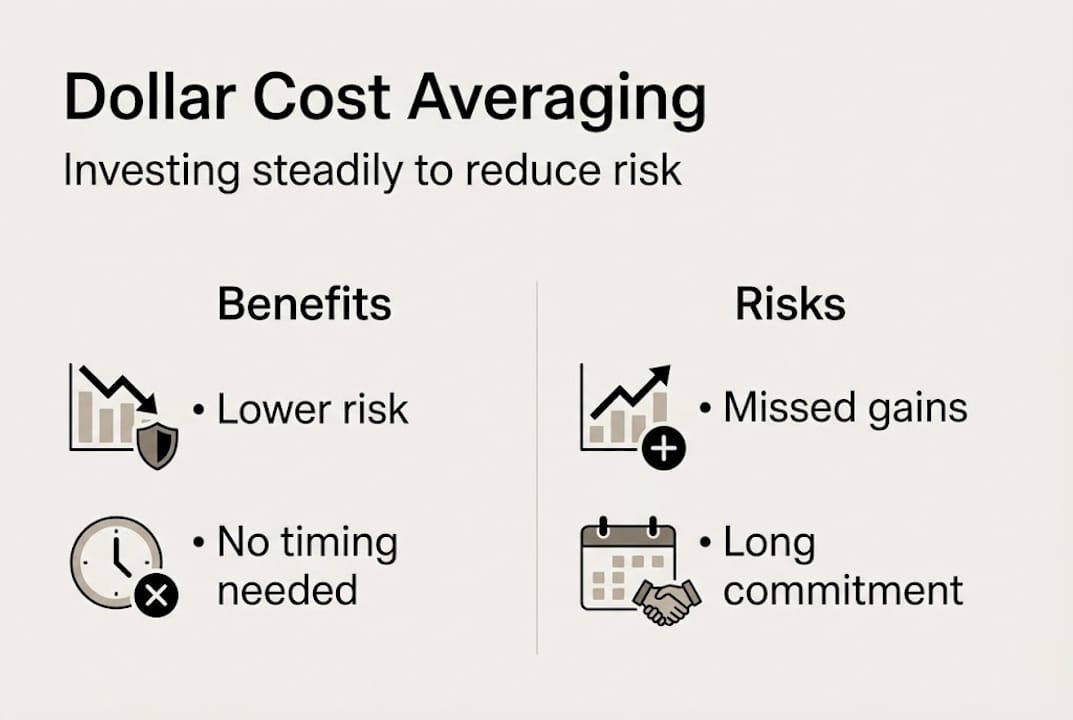
Getting started is simpler than most people expect. The hardest part is choosing a number and committing to it.
Step-by-step to launch your DCA plan:
- Decide on a fixed monthly amount you won’t miss, even in tough months
- Choose an investment vehicle: index funds and ETFs are ideal for DCA because of diversification and low fees
- Open or access a brokerage account, IRA, or 401(k) with automatic investment options
- Set up an automatic monthly transfer so the investment happens without your involvement
- Schedule a quarterly review to check allocations, but resist making changes based on short-term performance
Automatic investment plans streamline dollar cost averaging for most retirement accounts, making the process almost entirely hands-free.
DCA fits naturally into retirement planning. If your employer offers a 401(k) match, you’re already using a version of DCA with every paycheck. IRAs also work well with automated monthly contributions. You can compare your options in this retirement accounts comparison to find the right structure for your situation.
Common mistakes that derail DCA:
- Stopping contributions after a market drop (the worst time to quit)
- Changing the investment amount too frequently based on news
- Choosing volatile single stocks instead of diversified funds
- Expecting short-term results from a long-term strategy
- Letting lifestyle inflation eat into your contribution amount over time
If you want to avoid the broader pitfalls that hurt long-term returns, reviewing investment mistakes to avoid is a practical next step.
Consistency is the entire game. One bad month in the market is not a reason to pause. It’s actually an opportunity to buy more shares at a lower price.
The overlooked truth about dollar cost averaging
Most articles on DCA will walk you through the math, compare it to lump sum investing, and conclude that it’s a solid risk management tool. That’s all true. But here’s what those articles rarely say: DCA’s greatest value has almost nothing to do with your returns.
The real reason DCA works for real people is that it keeps them in the market. That sounds almost too simple, but consider this: most investors don’t lose wealth because they picked the wrong fund. They lose ground because they let fear pull them out of the market at exactly the wrong time, and they never fully get back in. Checking out our guide on beginner investing mistakes reinforces how common this pattern really is.
Conventional investing wisdom obsesses over finding the right entry point, the right asset, and the right exit. DCA quietly ignores all of that and focuses on something far more powerful: repeated participation. The investor who invests $200 every month for 20 years through three recessions and two bull markets will, in most real-world scenarios, end up far ahead of the investor who tried to be clever and timed their way in and out of positions.
DCA is a tool for behavior change. It turns investing from a high-stakes decision into a quiet habit. And quiet habits, practiced consistently, are how real wealth gets built.
Take the next step with your investing
Dollar cost averaging is one of the most reliable frameworks for building long-term wealth without needing to predict market movements. But it’s just one piece of a broader investing strategy. At Finblog, you’ll find practical, no-nonsense guides on everything from choosing the right retirement accounts to avoiding the mistakes that silently chip away at your returns over time. Whether you’re just getting started or refining a strategy you’ve been using for years, we’re here to make the path clearer. Explore the full library of resources and take the next step with confidence.
Frequently asked questions
What is the main advantage of dollar cost averaging?
Dollar cost averaging manages risk by spreading purchases over time, which means market swings have less impact on your overall entry price. Rather than risking everything on a single purchase, volatility spreads across each interval.
Is dollar cost averaging better than investing a lump sum?
Neither is universally better. DCA reduces the chance of a painful loss from bad timing, but lump sum can outperform in sustained rising markets when prices keep climbing.
Can I use dollar cost averaging for my retirement accounts?
Absolutely. Most 401(k) and IRA contributions are structured as regular fixed amounts, meaning retirement plans naturally follow a DCA pattern with every paycheck or scheduled contribution.
What investments work best with dollar cost averaging?
Diversified investments like mutual funds and ETFs are the strongest fit for DCA because they reduce single-asset risk. DCA is especially effective for broadly diversified portfolios where you want steady, long-term growth.
Is dollar cost averaging good in a falling market?
A falling market is actually one of the best environments for DCA. When prices drop, your fixed investment buys more shares, and average cost per share decreases, positioning you well for the eventual recovery.