

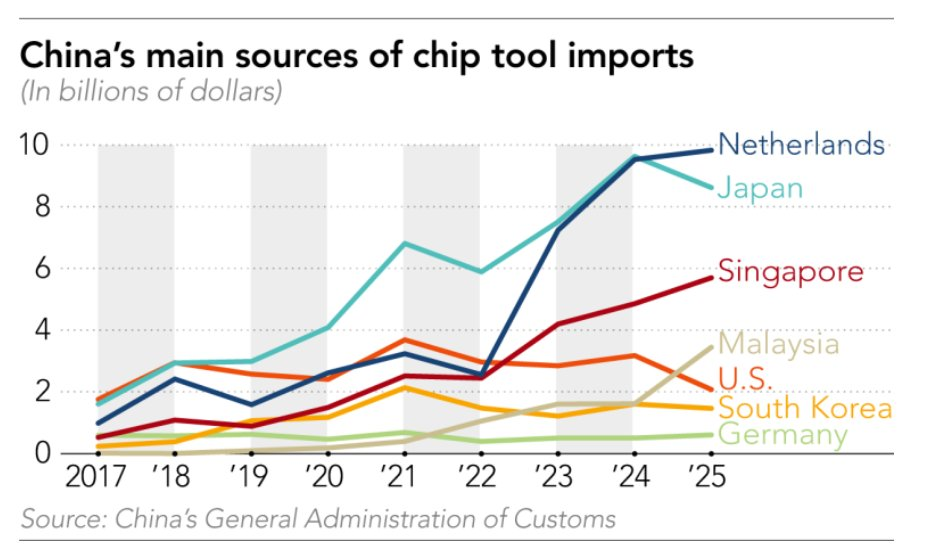
China is increasingly sourcing chipmaking equipment through Southeast Asia, as direct imports from the US continue to decline.
New data shows a clear shift in trade flows:
- Imports from Singapore rose 17% to $5.7B in 2025
- Shipments from Malaysia more than doubled to $3.4B
- Meanwhile, direct US imports dropped 34% to around $2B, hitting an eight-year low
This reflects a broader strategy. With US export restrictions tightening, Chinese companies are turning to intermediary countries to maintain access to critical semiconductor tools.
Instead of buying directly, equipment is now increasingly routed through regional trade hubs, allowing supply chains to adapt without fully breaking.
Chipmaking tools are essential for building advanced semiconductors. Any disruption in access can slow down China’s progress in areas like AI, advanced computing, and defense technology.
By shifting sourcing դեպի Southeast Asia, China is effectively:
- Reducing reliance on direct US trade
- Keeping supply lines active despite restrictions
- Building a more flexible, indirect procurement network
A growing supply chain workaround
This trend highlights how global tech restrictions are being reshaped in real time. Rather than stopping flows entirely, controls are redirecting them.
Southeast Asia is emerging as a key middle layer in the semiconductor supply chain, acting as a bridge between restricted markets and end buyers.
The chip war is not slowing down, it is evolving. Trade barriers are forcing rerouting, not stopping demand.
As competition between the US and China intensifies, supply chains are becoming more complex, less transparent, and increasingly global.
Disclosure: This article does not represent investment advice. The content and materials featured on this page are for educational purposes only.
Related: Europe has ‘maybe six weeks of jet fuel left’, energy boss warns