

Interest rates rarely stand still, and that constant motion creates both challenges and opportunities for investors. From mortgage rates in the United States to bond yields in the European Union, these numbers shape how money is saved, borrowed, and invested on a global scale. By grasping the core concepts behind interest rates, you gain the insight needed to adjust strategies, manage risks, and optimize your portfolio as markets shift.
Table of Contents
- Interest Rates And Core Concepts Explained
- Types Of Interest Rates Affecting Investments
- How Rate Changes Influence Asset Returns
- Portfolio Strategy Adjustments For Rate Moves
- Risks, Mistakes, And Mitigation Tactics
- Global Insights: Navigating Rate Volatility
Key Takeaways
| Point | Details |
|---|---|
| Interest Rates Influence | Interest rates are a fundamental factor that shapes borrowing costs, investment decisions, and economic growth. Monitoring rate changes is crucial for adjusting financial strategies. |
| Types of Interest Rates | Investors should understand various interest rates, including nominal, real, fixed, and variable, as they impact purchasing power and overall returns. |
| Asset Sensitivity to Rate Changes | Different asset classes react distinctively to interest rate movements, necessitating diversified portfolios to manage risk effectively. |
| Proactive Portfolio Management | Investors must proactively adapt their portfolio strategies in response to interest rate fluctuations to optimize returns and mitigate potential losses. |
Interest Rates and Core Concepts Explained
Interest rates represent the cost of borrowing money and the potential return for lending funds, serving as a critical mechanism in financial systems worldwide. When banks, investors, and financial institutions set interest rates, they create a dynamic pricing structure that influences economic behaviors and investment strategies.
At its core, an interest rate is a percentage charged by lenders for the use of their money, reflecting multiple economic factors. Central economic policymakers use interest rates as a strategic tool to manage economic growth, inflation, and overall financial stability. These rates impact everything from mortgage costs to business expansion opportunities.
The fundamental components that shape interest rates include:
- Inflation expectations: Higher anticipated inflation typically drives interest rates upward
- Economic growth indicators: Strong economic performance can increase borrowing costs
- Default risk assessments: Riskier borrowers face higher interest rates
- Central bank monetary policies: Government interventions directly influence lending rates
Interest rates operate on multiple timescales, varying across short-term and long-term financial instruments. Financial asset rewards fluctuate based on these complex interactions, creating nuanced opportunities for investors and borrowers alike.
Pro tip: Monitor Federal Reserve announcements and economic indicators to anticipate potential interest rate shifts and adjust your investment strategy proactively.
Types of Interest Rates Affecting Investments
Investors encounter various types of interest rates that significantly impact their investment strategies and portfolio performance. Interest rates come in multiple categories, each with unique characteristics that influence financial decision-making and economic outcomes.
The primary categories of interest rates investors must understand include:
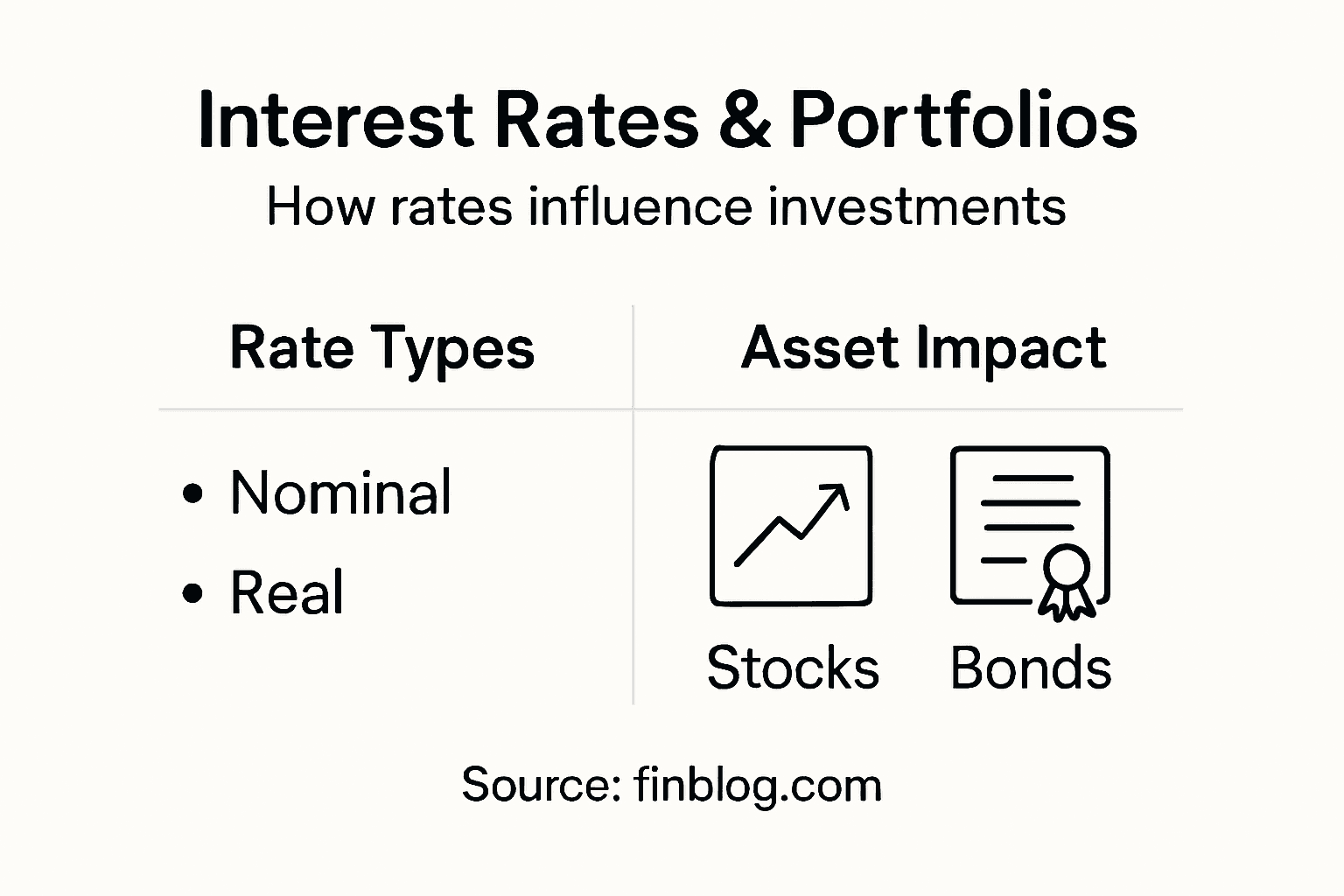
- Nominal Interest Rates: The stated rate without accounting for inflation
- Real Interest Rates: Adjusted for inflation to reflect actual purchasing power
- Fixed Interest Rates: Remain constant throughout the investment or loan term
- Variable Interest Rates: Fluctuate based on market benchmarks or economic indicators
- Short-Term Rates: Apply to investments or loans with brief durations
- Long-Term Rates: Connected to extended financial commitments
Different interest rate types significantly impact investment decisions. For instance, nominal rates provide a baseline understanding, while real rates offer insights into actual investment returns after accounting for economic erosion. Investors must carefully analyze these variations to make informed financial choices.
Each interest rate type serves a distinct purpose in financial markets. Fixed rates provide stability and predictability, making them attractive for risk-averse investors. Variable rates offer potential advantages during periods of declining market rates, allowing investors to benefit from changing economic conditions.
Here’s a comparison of key interest rate types and their uses:
| Rate Type | Definition | Typical Use |
|---|---|---|
| Nominal | Not adjusted for inflation | Quoting loan or deposit rates |
| Real | Adjusted for inflation effects | Measuring true investment returns |
| Fixed | Remains constant over time | Mortgages, long-term bonds |
| Variable | Changes with benchmarks | Adjustable-rate loans, short-term notes |
Pro tip: Always compare real interest rates against nominal rates to understand the true economic value of your investments and protect your purchasing power.
How Rate Changes Influence Asset Returns
Interest rate fluctuations create profound ripple effects across investment portfolios, dramatically reshaping asset performance and investor strategies. Inflation and interest rates significantly impact asset returns, creating complex economic dynamics that investors must carefully navigate.
The primary mechanisms through which interest rate changes influence asset returns include:
- Bond Market Sensitivity: Inverse relationship between interest rates and bond prices
- Stock Market Valuation: Lower rates typically boost equity valuations
- Real Estate Investment: Borrowing costs directly affect property market dynamics
- Commodity Pricing: Interest rates influence global commodity trading patterns
- Currency Fluctuations: Rate changes impact international investment attractiveness
Investment demand responds dynamically to interest rate shifts. Higher rates increase borrowing costs, potentially reducing investment enthusiasm, while lower rates can stimulate economic activity and encourage risk-taking among investors. The elasticity of these responses varies based on broader economic conditions and investor confidence.

Different asset classes demonstrate unique sensitivities to interest rate movements. Fixed-income securities experience more direct impacts, with bond prices typically declining when interest rates rise. Equity markets show more nuanced responses, where lower rates can drive investors toward stocks as alternative investment vehicles.
The table below summarizes how interest rate changes affect common asset classes:
| Asset Class | Sensitivity to Rate Changes | Example of Impact |
|---|---|---|
| Bonds | Highly sensitive | Prices fall as rates rise |
| Stocks | Moderately sensitive | Valuations often rise with lower rates |
| Real Estate | Sensitive via financing costs | Higher rates slow home sales |
| Commodities | Indirectly affected | Cost of holding inventory changes |
Pro tip: Maintain a diversified portfolio that can withstand interest rate fluctuations by balancing assets with different rate sensitivities.
Portfolio Strategy Adjustments for Rate Moves
Successful investors recognize that portfolio management requires proactive adaptation to changing interest rate environments. Portfolio strategy adjustments demand sophisticated optimization techniques that balance risk, return, and economic volatility.
Key strategies for portfolio rebalancing during interest rate shifts include:
- Duration Management: Shortening bond portfolio duration during rising rate periods
- Sector Rotation: Shifting allocations toward sectors less sensitive to rate changes
- Asset Class Diversification: Spreading investments across uncorrelated asset types
- Yield Curve Positioning: Adjusting fixed-income investments based on curve shape
- Alternative Investment Exploration: Incorporating assets with low interest rate correlation
Advanced portfolio optimization techniques now leverage machine learning and reinforcement algorithms to dynamically adjust asset allocations. These sophisticated approaches enable investors to anticipate and respond to potential market disruptions more effectively than traditional static models.
Investors must remain flexible and continuously monitor economic indicators that signal potential interest rate movements. This might involve regular portfolio reviews, stress testing asset allocations, and maintaining a strategic reserve of liquid investments to quickly reposition during market transitions.
Pro tip: Develop a systematic rebalancing framework that automatically triggers portfolio adjustments when predetermined interest rate thresholds are crossed.
Risks, Mistakes, and Mitigation Tactics
Interest rate fluctuations expose investors to complex financial risks that require sophisticated risk management strategies. Regulatory policies focus on identifying potential vulnerabilities arising from rapid interest rate changes, highlighting the need for proactive portfolio protection.
Common risks and potential mistakes investors encounter include:
- Duration Risk: Overexposure to long-term fixed-income securities
- Leverage Miscalculation: Excessive borrowing during volatile rate periods
- Concentration Risk: Insufficient portfolio diversification
- Emotional Decision-Making: Reactive trading based on short-term market movements
- Inadequate Stress Testing: Failure to model potential economic scenarios
Bank stability models demonstrate that systematic risk management requires continuous monitoring and adaptive strategies. Investors must develop robust frameworks that anticipate potential market disruptions and minimize potential losses.
Effective risk mitigation involves creating a multi-layered approach that includes diversification, regular portfolio reassessment, and maintaining financial flexibility. This means developing contingency plans, maintaining liquid assets, and implementing dynamic asset allocation strategies that can quickly respond to changing economic conditions.
Pro tip: Conduct quarterly stress tests on your portfolio, simulating various interest rate scenarios to identify potential vulnerabilities before they become critical.
Global Insights: Navigating Rate Volatility
Interest rate volatility has emerged as a critical challenge for global investors, demanding sophisticated strategies to manage economic uncertainty. Option-implied interest rate volatility provides crucial market signals that help investors anticipate and respond to potential economic shifts.
Key global strategies for managing rate volatility include:
- Geographic Diversification: Spreading investments across multiple international markets
- Dynamic Asset Allocation: Rapidly adjusting portfolio compositions
- Hedging Techniques: Using derivatives to mitigate potential losses
- Inflation-Protected Securities: Investing in instruments designed to preserve purchasing power
- Continuous Market Monitoring: Tracking global economic indicators in real-time
Volatility measurement tools have revolutionized how investors understand and respond to market fluctuations. Advanced analytics now enable more precise risk assessment, allowing investors to make data-driven decisions in complex economic environments.
Successful navigation of rate volatility requires a holistic approach that combines technological insights, rigorous analysis, and adaptive investment strategies. Investors must remain flexible, continuously educating themselves about global economic trends and maintaining a forward-looking perspective.
Pro tip: Develop a robust early warning system by tracking multiple global economic indicators and creating scenario-based investment contingency plans.
Strengthen Your Portfolio Against Interest Rate Shifts
Navigating the impact of interest rates on your investments can feel overwhelming. This article highlights core challenges like managing duration risk, adapting to rate volatility, and optimizing your portfolio to handle economic fluctuations. If you want to overcome the uncertainty of fluctuating interest rates and protect your wealth from unexpected market shifts you need expert guidance grounded in these critical concepts.
At finblog.com we specialize in empowering investors with proven strategies for portfolio rebalancing, risk mitigation, and dynamic asset allocation. Discover actionable insights and tools designed to help you anticipate rate moves and maintain control. Take action now and explore our comprehensive resources to start transforming volatility into opportunity. Secure your financial future today with trusted advice from finblog.com and learn how to make interest rate changes work for you.
Frequently Asked Questions
What are interest rates and why are they important?
Interest rates represent the cost of borrowing money and the potential return for lending funds. They are crucial in influencing economic behaviors and investment strategies, impacting everything from mortgages to business expansions.
How do interest rate changes affect investment portfolios?
Interest rate changes can dramatically reshape asset performance and investor strategies. Higher rates may raise borrowing costs, reducing investment enthusiasm, while lower rates can stimulate economic activity and encourage risk-taking among investors.
What types of interest rates should investors be aware of?
Investors should understand nominal, real, fixed, variable, short-term, and long-term interest rates. Each type influences financial decision-making and economic outcomes differently, making it essential for informed investing.
How can investors mitigate risks associated with interest rate fluctuations?
Investors can mitigate risks by diversifying their portfolios, managing duration in bond investments, and employing dynamic asset allocation strategies. Regular stress testing and maintaining liquidity are also critical for handling potential market disruptions.
Recommended
- Interest Rates Explained: Impact on Investments and Loans – Finblog
- Inflation’s Impact on Investments and Portfolio Strategy – Finblog
- Portfolio Risk Explained: Why It Matters for Investors – Finblog
- Risk Tolerance Definition: Shaping Smart Investment Decisions – Finblog
- Understanding Car Loan Basics for Smart Buyers | ReVroom
- How to Structure Property Loans for Maximum Investment Returns | Elite Wealth Creators