Sorting through mutual fund options can leave even smart investors feeling lost and uncertain. With confusing fee structures and disclosure documents, the simplest choices often become the hardest to make. The reality is that mutual funds pool money from many individuals to create a diversified investment, but unnecessarily complex disclosures make it tough for average investors to understand what they actually own and pay. This introduction will clarify what mutual funds truly are, highlight common pitfalls, and help you avoid mistakes that can eat away at your long-term gains.
Table of Contents
- Defining Mutual Funds And Common Misconceptions
- Types Of Mutual Funds Explained Clearly
- How Mutual Funds Operate And Generate Returns
- Fees, Taxes, And Common Investor Pitfalls
- Mutual Funds Versus Alternative Investments
Key Takeaways
| Point | Details |
|---|---|
| Understanding Mutual Funds | Mutual funds pool money from multiple investors to provide professional management and diversification across a variety of securities. |
| Investment Behavior Misconceptions | Investors often chase past performance, which can lead to poor long-term results due to emotional decision-making. |
| Fee Awareness | Investors should consider the impact of expense ratios on long-term returns, as even small differences can significantly affect gains over time. |
| Choosing the Right Type | Selecting the appropriate fund type and class based on investment goals and time horizon can save investors thousands over their investing lifetime. |
Defining Mutual Funds and Common Misconceptions
A mutual fund is essentially a pooled investment vehicle where money from multiple investors gets combined to purchase a diversified portfolio of stocks, bonds, or other securities. Think of it like a group of friends pooling money to buy different restaurant franchises instead of each person trying to open one alone. A professional fund manager oversees these decisions, selecting which securities to buy and sell based on the fund’s stated objectives. When you invest in a mutual fund, you own shares of the fund itself, not the individual securities inside it. This structure allows individual investors like you to access professional management and instant diversification without needing hundreds of thousands of dollars.
The appeal of mutual funds is straightforward. Instead of researching and purchasing individual stocks, which requires significant time and expertise, you can invest in a professionally managed portfolio with a single transaction. Mutual funds pool a variety of stocks to diversify risk and offer more efficient investment options compared to picking single stocks on your own. However, reality often diverges from expectations. Research shows that investors frequently make emotionally driven decisions when it comes to their mutual fund investments. Studies analyzing over 30,000 households reveal a troubling pattern: investors disproportionately buy funds with strong past performance, then sell winning funds too quickly while holding on to poorly performing ones. This behavior, known as performance chasing, often damages long-term returns because investors are trading at exactly the wrong times.
Cost misconceptions also plague mutual fund investing. Many investors focus heavily on transaction fees while underestimating the impact of operating expenses, which compound year after year. A fund with a 1.5% annual expense ratio might seem minor, but over 20 years, that compounds to significantly lower returns compared to a fund charging 0.1%. Additionally, fund disclosure documents remain unnecessarily complex, making it difficult for average investors to truly understand what they own or what they’re paying. The Securities and Exchange Commission recognizes this problem and has advocated for clearer disclosure standards. Another common misconception is that all mutual funds outperform the overall stock market. In reality, studies consistently show that many actively managed mutual funds underperform market benchmarks after accounting for fees. This doesn’t mean mutual funds lack value, but it does mean you should approach them with realistic expectations rather than assuming professional management guarantees superior returns.
Pro tip: Before investing in any mutual fund, read the expense ratio and compare it to similar funds with comparable strategies, as a difference of just 0.5% annually can mean thousands of dollars in lost gains over decades.
Types of Mutual Funds Explained Clearly
Mutual funds come in various shapes and sizes, each designed to serve different investment goals and risk tolerances. The main categories split along two fundamental lines: how the fund is managed and what assets it invests in. Actively managed funds employ professional managers who constantly buy and sell securities trying to outperform the market, while passively managed index funds simply track a specific market index like the S&P 500. The difference matters because active management comes with higher fees, and as you learned earlier, those costs compound dramatically over time. Index funds typically charge much less because computers do most of the work, simply mirroring what the index does. Within these management styles, you’ll find funds focused on different asset classes entirely.
Equity funds invest primarily in stocks and appeal to growth-oriented investors willing to accept volatility. Bond funds focus on fixed income securities and suit investors seeking steadier, more predictable returns with lower risk. Money market funds hold short-term, highly liquid securities and function almost like savings accounts but with slightly better returns. There are also balanced funds that mix stocks and bonds to provide middle-ground stability. Beyond these core types, you have sector funds that concentrate on specific industries like technology or healthcare, international funds that invest outside North America, and target-date funds automatically adjusting risk as you approach retirement. The SEC identifies various fund types based on investment focus and management style, each offering different risks, returns, fees, and operational features depending on your goals.

Here’s a breakdown of mutual fund types and their main characteristics:
| Fund Type | Primary Focus | Typical Risk Level | Common Investor Goal |
|---|---|---|---|
| Equity Fund | Stocks | High | Growth potential |
| Bond Fund | Fixed income | Moderate | Regular interest income |
| Money Market Fund | Short-term debt | Low | Capital preservation |
| Balanced Fund | Stocks & bonds mix | Moderate | Balanced growth and stability |
| Sector Fund | Specific industries | High | Industry exposure |
| International Fund | Non-U.S. markets | Moderate to high | Global diversification |
| Target-Date Fund | Varies with time | Changes with target | Retirement planning |
Another critical distinction involves share classes, which represent different fee structures within the same mutual fund. A single fund might offer Class A shares (upfront sales charges), Class B shares (backend sales fees), and Class C shares (ongoing higher expense ratios). These classes invest in identical portfolios but deliver different net returns based on when you pay fees and how much you pay annually. Someone investing $100,000 for 30 years should consider Class A shares, while a shorter investment horizon might favor Class C to avoid backend penalties. Your investment timeline and initial capital amount should determine which class makes sense for you. Matching the right fund type and share class to your specific situation can literally save thousands of dollars over your investing lifetime.
Pro tip: If you’re investing for over 10 years, research index funds with low expense ratios first before considering actively managed funds, since most active managers fail to justify their higher costs over longer time periods.
How Mutual Funds Operate and Generate Returns
When you buy shares in a mutual fund, you’re purchasing a slice of ownership in a professionally managed portfolio. The fund operates by pooling money from thousands of investors like you, then using that combined capital to purchase stocks, bonds, or other securities. A fund manager (or management team) makes all the buy and sell decisions based on the fund’s stated investment objective, whether that’s aggressive growth, income generation, or capital preservation. You own shares proportional to your investment amount. If you invest $5,000 into a fund and the total fund value is $100 million with 10 million shares outstanding, you own a tiny but real piece of that entire portfolio. This structure gives you instant access to diversification that would require tens of thousands of dollars to achieve on your own.
Returns come from multiple sources working together to grow your investment. When stocks in the fund pay dividends or bonds pay interest, that income flows into the fund and gets distributed to shareholders proportionally. When the underlying securities appreciate in value, your share value rises accordingly. The fund calculates your share price daily using something called net asset value, or NAV, which represents the total portfolio value divided by outstanding shares. If the fund owns $100 million in assets and has 10 million shares outstanding, each share is worth $10 at NAV. When you want to cash out, you sell your shares back to the fund at the current NAV price. This redeemability is a huge advantage over stocks, where you’re stuck waiting for a buyer if the market tanks.
However, generating returns doesn’t happen in a vacuum. Fees and expenses eat into your gains every single year. The fund pays for the manager’s salary, office space, legal compliance, and administrative costs. These expenses are deducted from fund assets before returns are calculated, which means you actually receive less than the raw investment performance. A fund returning 8% with a 1.5% expense ratio only nets you about 6.5%. Over 30 years, that difference compounds into staggering losses compared to a lower-cost alternative. Capital gains, dividends, and interest income generate returns but may be diminished by fund fees and expenses. This is precisely why understanding your fund’s expense ratio matters more than most investors realize. You’re not just paying for professional management, you’re paying for every operational aspect of running that fund.
Pro tip: Check your fund’s NAV price before buying and compare it to the fund’s expense ratio to estimate your true net return potential, then compare that expected return to lower-cost alternatives before committing your money.
Fees, Taxes, and Common Investor Pitfalls
Most investors focus on picking the “right” fund but overlook the financial bloodshed happening quietly in the background. Mutual fund fees come in multiple flavors, each designed to extract money from your returns. Shareholder fees include sales loads (upfront charges when you buy), redemption fees (charges when you sell), and exchange fees (costs to move between funds within the same family). Operating expenses cover the fund manager’s salary, administrative staff, and compliance costs. The SEC breaks down various mutual fund fees including shareholder fees and operating expenses that reduce overall returns significantly over time. Even differences of 0.5% annually seem tiny until you realize that compounds to thousands of dollars lost over decades. A fund charging 1.5% annually versus 0.5% will cost you roughly 30% less of your portfolio value over 30 years, assuming identical investment performance. That’s not a minor detail; that’s your retirement.
Taxes add another layer of complexity that catches many investors off guard. When a fund manager sells securities within the fund at a profit, those capital gains flow to shareholders as distributions, which you must report on your tax return regardless of whether you sold any shares yourself. Here’s the kicker: you can receive a capital gains distribution, owe taxes on it, and watch your investment value drop simultaneously because the fund distributed cash out. Mutual fund investors must report capital gains distributions even if they did not sell shares, as funds sell securities generating gains internally. Additionally, you’ll receive dividend distributions and potentially return of capital distributions, each treated differently for tax purposes. Someone in a high tax bracket could lose 20 to 37 percent of their distributions to federal income taxes alone, before considering state taxes.
Common pitfalls destroy returns faster than fees and taxes combined. Many investors buy high when a fund shows strong past performance, then panic sell during downturns, locking in losses at exactly the wrong moment. Others chase yields by investing in high-dividend funds without considering tax efficiency, essentially paying Uncle Sam instead of accumulating wealth. Some investors own multiple funds with overlapping holdings, creating accidental concentration risk while thinking they’re diversified. The biggest mistake is ignoring fees entirely, assuming all funds charge similarly. A fund from a discount provider costs dramatically less than the same fund from a traditional brokerage. Starting with index funds rather than actively managed funds eliminates both the performance chasing trap and the fee drag problem for most investors.
Pro tip: Before buying any mutual fund, calculate the combined impact of your expense ratio plus anticipated taxes, subtract that from historical returns, then ask yourself whether active management’s higher fees justify the reduced net returns you’ll actually pocket.
Mutual Funds Versus Alternative Investments
When you mention mutual funds at a dinner party, someone inevitably brings up real estate, cryptocurrency, or private equity as “better” investments. The reality is more nuanced. Traditional mutual funds invest in publicly traded stocks and bonds using straightforward strategies, offering instant diversification and professional management with reasonable fees. Alternative investments cast a wider net, encompassing real estate, commodities, hedge funds, private equity, and complex derivative strategies. The key distinction isn’t which category wins universally, but rather which aligns with your situation. For most novice investors in North America, traditional mutual funds remain the better choice. Alternative investments require significantly more capital, expertise, and risk tolerance than the average 25 to 40 year old investor possesses.
Alternative mutual funds blur the line between these two categories. These funds invest in non-traditional assets or employ complex strategies like short selling and derivatives, attempting to generate returns independent of market direction. Unlike private hedge funds accessible only to millionaires, alternative mutual funds are regulated, publicly available, and offer greater liquidity and investor protections than their unregulated counterparts. However, they typically charge higher fees and carry greater risk than traditional mutual funds. An alternative mutual fund charging 2 percent annually while targeting 10 percent returns needs to beat traditional funds by a huge margin just to break even after fees. Most don’t. The added complexity, opacity, and expenses make them suitable primarily for experienced investors seeking specific outcomes, not beginners building foundational wealth.
The comparison reveals why traditional mutual funds dominate retirement accounts for most people. You gain immediate exposure to hundreds of companies or bonds with minimal capital. Professional managers handle research and rebalancing. Regulatory oversight and SEC requirements ensure transparency and investor protections. You can buy or sell shares daily at predictable prices. Alternative investments lack these conveniences. Real estate requires substantial capital and illiquidity that locks your money away for years. Private equity demands accreditation and minimum investments of $50,000 or more. Hedge funds operate with minimal transparency and often produce volatile results. Commodities and cryptocurrencies introduce volatility that can devastate unprepared investors. For someone building wealth over 30 years while working full time, traditional mutual funds offer a straightforward path requiring minimal ongoing attention.
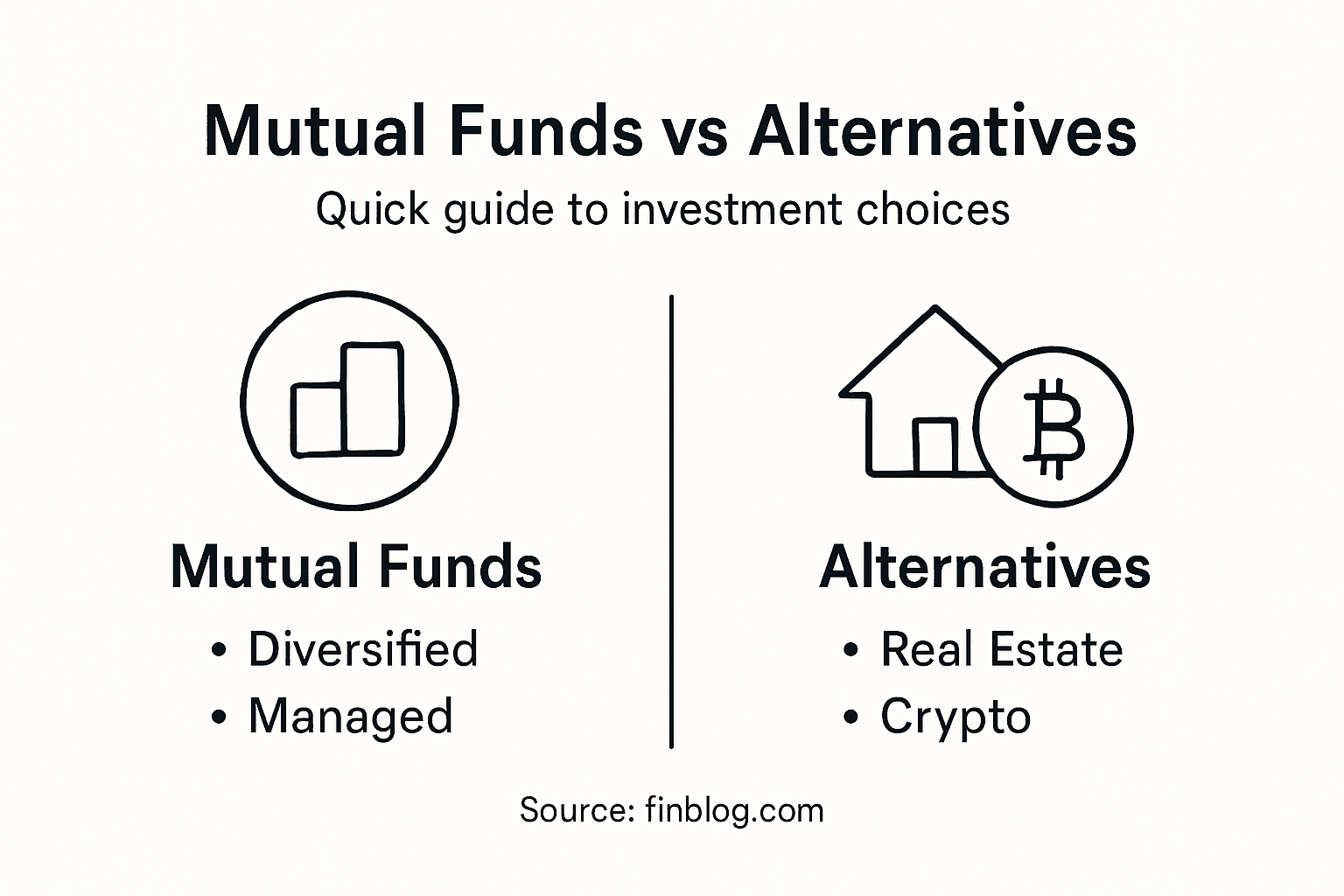
Compare traditional mutual funds with alternative investments at a glance:
| Feature | Traditional Mutual Funds | Alternative Investments |
|---|---|---|
| Minimum Investment | As low as $500 | Often $10,000 or more |
| Liquidity | Daily buy/sell at NAV | Often limited or locked-in |
| Management | Professional, regulated | Specialized, less regulated |
| Typical Fees | 0.1%–2% annually | 1%–3%+ annually |
| Investor Suitability | Beginners and experts | Experienced, high-net-worth only |
There’s room for both in sophisticated portfolios. Many financial advisors recommend a core allocation to low-cost index mutual funds, then small satellite positions in alternatives if you have both capital and expertise. But that conversation comes later. Right now, mastering mutual fund selection, minimizing fees, and staying disciplined through market cycles will generate far better results than chasing alternatives you don’t fully understand. Start with the fundamentals.
Pro tip: Stick exclusively with traditional mutual funds until you’ve invested consistently for at least five years and clearly understand your risk tolerance and investment goals.
Unlock the Full Potential of Your Mutual Fund Investments
Choosing the right mutual fund means understanding complex fees, share classes, and managing emotional decisions that impact your long-term gains. This article highlights common pitfalls like performance chasing and hidden expenses, challenges many investors face when navigating diverse fund types and returns. If you want to break free from confusion and maximize your investment outcomes through clear strategies and expert guidance now is the moment to act.
Explore how you can make confident decisions with tailored insights and professional advice at finblog.com. Discover practical ways to minimize fees optimize your portfolio mix and stay disciplined through market cycles by visiting finblog.com.
Don’t wait until costs and taxes erode your hard-earned savings—take control today by connecting with trusted financial expertise at finblog.com and start building a smarter investment future.
Frequently Asked Questions
What is a mutual fund?
A mutual fund is a pooled investment vehicle where money from multiple investors is combined to buy a diversified portfolio of stocks, bonds, or other securities, managed by professional fund managers.
Why do investors choose mutual funds?
Investors choose mutual funds for their professional management, instant diversification, and the ability to invest with a relatively small amount of capital compared to purchasing individual securities.
How do mutual funds generate returns for investors?
Mutual funds generate returns through capital appreciation of securities in the portfolio, as well as income from dividends and interest, all of which are distributed to shareholders based on their ownership shares.
What are common fees associated with mutual funds?
Common fees include sales loads (upfront or backend fees), operating expenses (annual management fees), and redemption fees (for selling shares), all of which can significantly impact overall returns over time.