
Most American millennials are surprised to learn that over $23 trillion is invested in mutual funds worldwide. If you live in a city and want smarter ways to build wealth without spending hours on financial research, understanding mutual funds could give you a powerful advantage. This guide uncovers the basics, global trends, and practical details young professionals need to use mutual funds for personal growth, smarter investment choices, and long-term financial stability.
Table of Contents
- Defining Mutual Funds And Core Concepts
- Types Of Mutual Funds Around The World
- How Mutual Funds Operate Daily
- Fees, Taxes, And Investment Requirements
- Risks, Common Mistakes, And Safer Alternatives
Key Takeaways
| Point | Details |
|---|---|
| Mutual Funds Offer Accessibility | Investors can access diversified portfolios with a relatively low initial investment compared to purchasing individual stocks. |
| Professional Management is Key | Fund managers make strategic decisions aimed at maximizing returns while managing risk through diversification. |
| Awareness of Fees Matters | Understanding expense ratios and their impact on net returns is crucial for effective mutual fund investing. |
| Perform Regular Portfolio Reviews | Regularly assessing fund performance and market conditions helps in making informed decisions about adjustments to your investment strategy. |
Defining Mutual Funds and Core Concepts
A mutual fund represents a professionally managed investment vehicle that pools money from multiple investors to purchase a diversified portfolio of stocks, bonds, or other securities. Unlike individual stock purchases, mutual funds offer everyday investors an opportunity to access broad market exposure with relatively low initial investment requirements. Global financial markets demonstrate how these investment vehicles foster systematic investment habits.
At its core, a mutual fund operates through a collective investment strategy where fund managers make strategic decisions about which securities to buy and sell on behalf of shareholders. These professional managers aim to generate returns that exceed benchmark market indices while managing risk through diversification. Investors purchase shares in the mutual fund, which represent a proportional ownership stake in the underlying portfolio of investments. Each share’s value fluctuates based on the performance of the securities held within the fund.
Mutual funds typically fall into several primary categories based on their investment objectives:
- Equity Funds: Primarily invest in stocks
- Bond Funds: Focus on fixed-income securities
- Money Market Funds: Target low-risk, short-term investments
- Balanced Funds: Combine stocks and bonds for moderate risk
- Sector Funds: Concentrate investments in specific industry sectors
Pro Tip: Strategic Selection: Research mutual fund expense ratios and historical performance before investing, as lower fees and consistent returns can significantly impact your long-term investment growth.
Understanding mutual funds compared to other investment vehicles helps investors make more informed financial decisions. By providing professional management, diversification, and accessibility, mutual funds represent a powerful tool for building wealth over time.
Types of Mutual Funds Around the World
Mutual funds have evolved into a diverse investment landscape, offering global investors multiple strategies tailored to different financial objectives and risk tolerances. International academic research reveals comprehensive classifications of mutual funds based on their principal investment characteristics, showcasing the complexity and adaptability of these financial instruments across world markets.
Globally, mutual funds are typically categorized into several primary classifications that reflect their investment focus and strategic approach:
- Equity Funds: Invest primarily in stocks from specific regions or global markets
- Domestic equity funds
- International equity funds
- Emerging market funds
- Fixed Income Funds: Target bonds and debt securities
- Government bond funds
- Corporate bond funds
- Municipal bond funds
- Balanced Funds: Combine stocks and bonds for moderate risk
- Sector-Specific Funds: Concentrate investments in particular industries
- Technology funds
- Healthcare funds
- Energy sector funds
Worldwide mutual fund markets demonstrate significant variation in fund composition and investor preferences. The global distribution of mutual fund assets reveals fascinating trends in investment strategies across different economic regions. North American markets tend to favor diversified equity funds, while European investors often prioritize balanced and fixed-income options.

Pro Tip: Regional Research: Investigate local market regulations and tax implications when exploring international mutual funds, as these factors can significantly impact your investment returns and overall strategy.
How Mutual Funds Operate Daily
Mutual funds operate through a complex daily ecosystem of financial management and strategic decision-making. The organizational structure and operational flow of mutual funds involve intricate processes that ensure efficient investor services, with professional fund managers working diligently to maximize investment performance.
The daily operational cycle of a mutual fund involves several critical functions:
- Portfolio Management
- Continuous monitoring of existing securities
- Analyzing market trends
- Making buy and sell decisions
- Net Asset Value (NAV) Calculation
- Computing daily share price
- Tracking total fund value
- Adjusting for market fluctuations
- Compliance and Reporting
- Ensuring regulatory requirements are met
- Preparing daily and quarterly financial statements
- Monitoring investment guidelines
Technological infrastructure plays a crucial role in modern mutual fund operations. Active investment strategies require sophisticated tracking and management systems that enable rapid decision-making and real-time portfolio adjustments. Fund managers utilize advanced algorithms and financial analysis tools to evaluate potential investments, assess risk, and optimize portfolio performance throughout each trading day.
Pro Tip: Performance Tracking: Monitor your mutual fund’s daily NAV and quarterly performance reports to understand how your investment is performing and make informed decisions about maintaining or adjusting your investment strategy.
Use this reference to understand key mutual fund operational terms:
| Term | What It Means | Importance for Investors |
|---|---|---|
| NAV | Net Asset Value per share | Determines share price each day |
| Expense Ratio | Annual fund operating costs | Directly reduces net returns |
| Capital Gains | Profits from fund investments sold | May trigger investor tax liability |
| Diversification | Spread across different securities | Reduces single-asset risk |
Fees, Taxes, and Investment Requirements
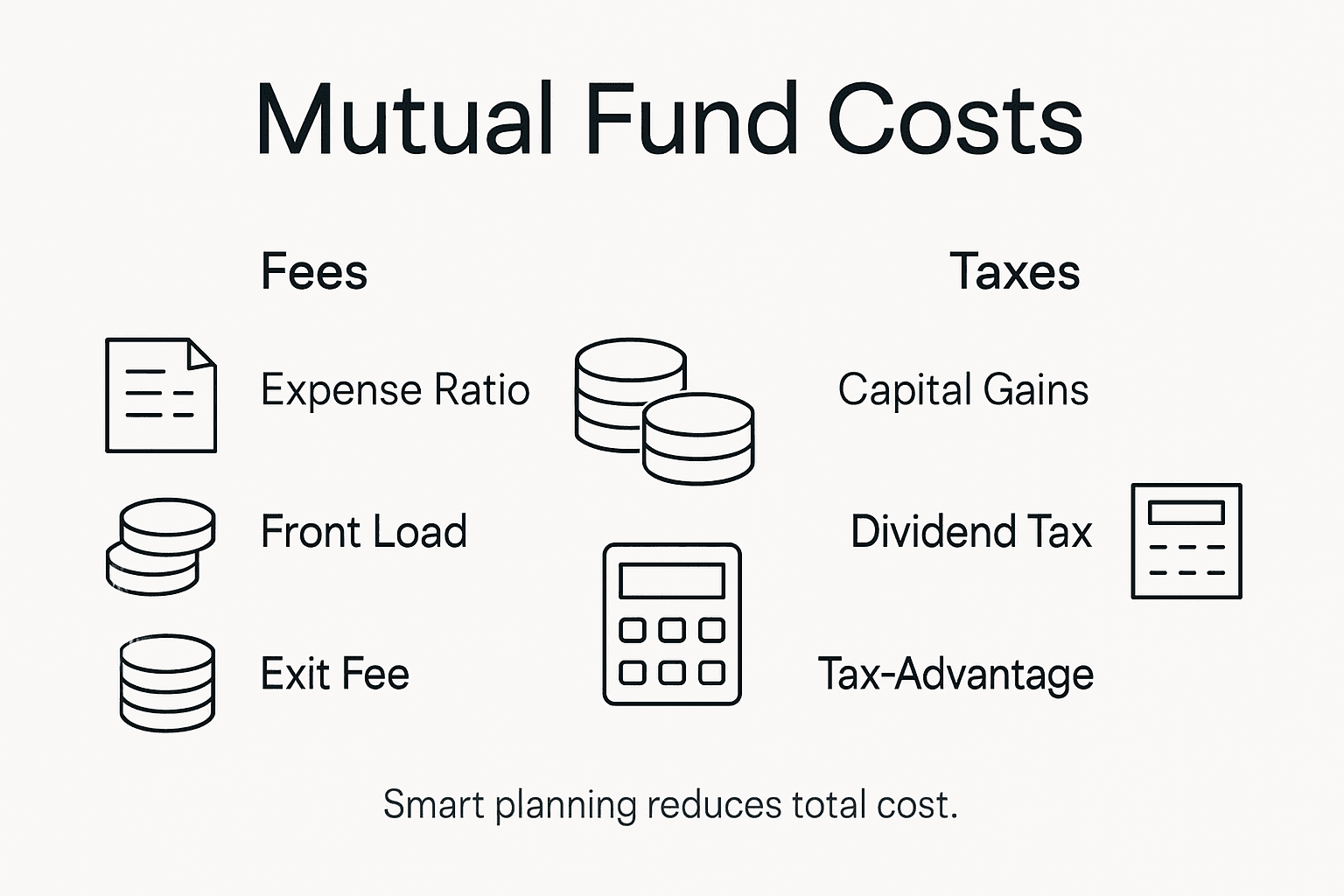
Mutual funds come with a complex financial landscape of fees, tax considerations, and specific investment parameters that every potential investor must understand. Expense ratios represent the primary ongoing cost associated with mutual fund investments, typically ranging from 0.5% to 2.5% annually and directly impacting overall investment returns.
Key financial components investors should consider include:
- Expense Ratio Breakdown
- Management fees
- Administrative costs
- Operating expenses
- Investment Minimums
- Initial investment requirements
- Subsequent investment thresholds
- Retirement account specific rules
- Tax Implications
- Capital gains distributions
- Dividend income reporting
- Short-term vs long-term investment tax rates
Understanding tax-efficient investing strategies can significantly reduce your overall tax burden and improve net investment returns. Investors should pay close attention to fund distributions, as these can trigger unexpected tax liabilities even when the fund’s value remains stable.
Some mutual funds require minimum initial investments ranging from $500 to $3,000, with many retirement-focused funds offering lower entry points. Institutional and high-net-worth investor funds may demand substantially higher minimum investments, sometimes exceeding $10,000.
Pro Tip: Strategic Planning: Always calculate the total cost of ownership, including expense ratios and potential tax implications, before committing to any mutual fund investment to ensure alignment with your financial goals.
Risks, Common Mistakes, and Safer Alternatives
Comprehensive risk analysis reveals mutual funds involve complex market and operational challenges that investors must carefully understand before committing their financial resources. Investors face multiple potential pitfalls, including market volatility, poor fund management, and unexpected tax implications that can significantly erode investment returns.
Common mistakes investors frequently encounter include:
- Ignoring Expense Ratios
- Overlooking high management fees
- Failing to compare fund performance against costs
- Lack of Diversification
- Concentrating investments in single fund type
- Neglecting asset allocation strategies
- Emotional Investment Decisions
- Panic selling during market downturns
- Chasing past performance
- Reacting to short-term market fluctuations
Alternative investment strategies offer more transparent and potentially lower-risk options. Exchange-traded funds (ETFs) increasingly provide investors with safer, more cost-effective investment vehicles that minimize many traditional mutual fund risks. ETFs typically feature lower expense ratios, greater tax efficiency, and more flexible trading mechanisms compared to conventional mutual funds.
Investors should conduct thorough research, understand their personal risk tolerance, and consider consulting financial professionals before making significant investment decisions. Careful evaluation of historical performance, management expertise, and overall fund strategy can help mitigate potential investment risks.
Here’s how mutual funds compare to exchange-traded funds (ETFs):
| Feature | Mutual Funds | ETFs |
|---|---|---|
| Trading Mechanism | Priced once daily after markets close | Traded throughout the trading day |
| Expense Ratios | Typically higher than ETFs | Generally lower than mutual funds |
| Minimum Investments | Often requires $500 or more | Can be purchased with 1 share |
| Tax Efficiency | Less tax-efficient, frequent turnover | More tax-efficient, investor-controlled |
Pro Tip: Risk Assessment: Regularly review your investment portfolio, analyze fund performance against benchmark indices, and be prepared to rebalance your investments to maintain optimal risk management.
Take Control of Your Mutual Fund Investments Today
Understanding mutual funds can be overwhelming with all the jargon like NAV, expense ratios, and tax implications. This article highlights key challenges such as managing fees, avoiding common mistakes, and choosing the right fund type to fit your financial goals. If you want to move from confusion to confidence while navigating the complex world of mutual funds, you are not alone.
Finblog.com empowers investors like you to make smarter choices by offering clear, expert guidance on mutual fund investing. Our tailored resources help you assess risks, optimize your portfolio, and understand the daily workings of your investments. Start improving your investment strategy with insights designed to reduce costly errors and maximize returns. Don’t wait until market volatility affects your savings. Visit Finblog.com now and explore how our expert tips and strategies can elevate your financial journey. Ready to take the next step? Discover more and get personalized advice at Finblog.com.
Frequently Asked Questions
What is a mutual fund?
A mutual fund is a professionally managed investment vehicle that pools money from multiple investors to create a diversified portfolio of stocks, bonds, or other securities. It allows individual investors to access a broad market with relatively low initial investments.
How do mutual funds operate daily?
Mutual funds operate through a structured daily process that includes portfolio management, calculating the net asset value (NAV), and ensuring compliance with regulatory requirements. Fund managers monitor securities, analyze market trends, and make buy and sell decisions to optimize returns for investors.
What types of fees should I expect with mutual funds?
Investors should anticipate various fees, primarily the expense ratio, which includes management and administrative costs. These fees can range from 0.5% to 2.5% annually and can significantly impact your overall returns. Additionally, there may be minimum investment requirements and tax implications to consider.
What are the risks associated with mutual funds?
Mutual funds involve several risks, including market volatility, high expense ratios, and potential tax liabilities from capital gains distributions. Common investor mistakes include lack of diversification and emotional decision-making during market fluctuations. Regular monitoring and research are crucial for managing these risks.