

More than 45 percent of American households hold mutual funds, yet many working professionals are still unclear about how these investments actually work. In a world where retirement planning and financial independence drive everyday decisions, understanding mutual funds is key for anyone looking to grow their wealth over time. By revealing how mutual funds operate and the practical benefits they offer, you can make more strategic choices that match your personal goals.
Table of Contents
- What Are Mutual Funds and How They Work
- Types of Mutual Funds and Key Benefits
- Mutual Fund Fees, Returns, and Tax Impacts
- Risks in Mutual Funds and How to Mitigate
- Comparing Mutual Funds to Other Investments
Key Takeaways
| Point | Details |
|---|---|
| Professional Management | Mutual funds are managed by professionals who strategically build and maintain a diversified portfolio for investors. |
| Immediate Diversification | Investing in mutual funds provides instant access to a diversified range of securities, which helps mitigate individual investment risk. |
| Variety of Fund Types | There are different types of mutual funds, including stock, bond, money market, and balanced funds, catering to diverse financial goals and risk tolerances. |
| Expense Awareness | Understanding and comparing expense ratios is crucial, as lower fees can enhance long-term investment returns significantly. |
What Are Mutual Funds and How They Work
Mutual funds represent a powerful investment strategy where multiple investors pool their money to purchase a diversified portfolio of stocks, bonds, and other securities. Mutual funds are professionally managed investment vehicles registered with the Securities and Exchange Commission (SEC) that provide everyday investors an opportunity to access professionally curated investment portfolios.
At their core, mutual funds work by collecting money from numerous investors and distributing those funds across various financial instruments. When you purchase a mutual fund share, you’re essentially buying a proportional piece of an extensive, professionally managed investment portfolio. This approach allows individual investors with limited capital to gain exposure to a broad range of securities that would be challenging or expensive to purchase independently. Unlike buying individual stocks, mutual funds offer instant diversification, spreading investment risk across multiple companies and sectors.
The mechanics of mutual funds involve professional fund managers who make strategic investment decisions on behalf of shareholders. These managers analyze market trends, economic conditions, and individual securities to build and maintain a portfolio designed to meet specific investment objectives. Some funds focus on growth, targeting stocks with high potential appreciation, while others prioritize income generation through dividend-paying securities. Investors can choose from various fund types, including stock funds, bond funds, balanced funds, and sector-specific funds, each tailored to different financial goals and risk tolerances.
Pro Investment Strategy: Research and compare mutual fund expense ratios before investing. Lower expense ratios can significantly improve your long-term investment returns by reducing management fees and operational costs.
Key Characteristics of Mutual Funds:
- Professional management
- Diversification across multiple securities
- Accessible to investors with smaller capital
- Variety of investment strategies
- Potential for steady returns
Types of Mutual Funds and Key Benefits
Investors have several strategic options when selecting mutual funds, with each type designed to meet specific financial objectives and risk tolerances. The primary categories include stock funds, bond funds, money market funds, and balanced funds, each offering unique advantages for different investment strategies. Mutual funds provide investors with professional management and diversification across various financial instruments.
Stock mutual funds represent perhaps the most dynamic investment category, subdividing into growth, value, and blend funds that target different market segments. Growth funds focus on companies with high potential for capital appreciation, while value funds seek undervalued stocks with strong fundamentals. Blend funds combine both approaches, offering a balanced investment strategy. Bond funds provide more conservative investors with steady income streams, ranging from government and municipal bonds to corporate and international debt securities. These funds typically generate consistent returns and offer lower volatility compared to stock-based investments.
Money market and balanced funds provide additional investment flexibility for risk-averse investors. Money market funds invest in short-term, low-risk securities like treasury bills and commercial paper, prioritizing capital preservation and liquidity. Balanced funds, also known as hybrid funds, strategically combine stocks and bonds to create a more stable investment profile that balances growth potential with income generation. These funds automatically adjust asset allocations to maintain an optimal risk-reward ratio, making them ideal for investors seeking moderate growth with reduced market volatility.
Here’s a concise overview comparing major types of mutual funds:
| Fund Type | Typical Investment Focus | Risk Level | Common Investor Goal |
|---|---|---|---|
| Stock Funds | Domestic/international equities | Moderate to High | Long-term growth |
| Bond Funds | Government or corporate bonds | Low to Moderate | Steady income |
| Money Market Funds | Short-term debt instruments | Very Low | Capital preservation |
| Balanced Funds | Mix of stocks and bonds | Moderate | Growth with income balance |
Comprehensive Benefits of Mutual Funds:
- Professional investment management
- Instant portfolio diversification
- Lower investment minimums
- Flexible investment options
- Potential tax efficiency
Pro Investment Strategy: Always review a mutual fund’s expense ratio and historical performance before investing. Lower fees and consistent returns can significantly impact your long-term investment growth.
Mutual Fund Fees, Returns, and Tax Impacts
Understanding the financial landscape of mutual funds requires careful examination of their associated costs, potential returns, and tax implications. Mutual funds incur various fees that directly impact investment performance, making it crucial for investors to comprehend the complex fee structure before committing their capital. The primary fee categories include management fees, administrative costs, and sales charges, which can significantly erode potential investment gains if not carefully evaluated.

Expense Ratios and Fee Structures play a critical role in determining a mutual fund’s overall performance. Management fees typically range from 0.5% to 2% annually, covering the cost of professional portfolio management and operational expenses. Sales loads represent additional charges that can be levied either when purchasing (front-end load) or selling (back-end load) mutual fund shares. Some funds offer no-load options, which eliminate these upfront or backend charges, potentially providing more attractive investment opportunities for cost-conscious investors.
Tax considerations represent another essential dimension of mutual fund investments. Investors face potential tax liabilities from dividend distributions, interest income, and capital gains realized within the fund. The timing and frequency of these distributions can create unexpected tax burdens, particularly for funds with high turnover rates. Strategically selecting tax-efficient funds or holding investments in tax-advantaged accounts can help minimize the tax impact and maximize overall investment returns.
Key Financial Considerations:
- Management fees range from 0.5% to 2%
- Sales loads can reduce initial investment
- Potential tax implications from fund distributions
- Importance of expense ratio analysis
- Impact of fund turnover on tax efficiency
Pro Investment Strategy: Always calculate the total expense ratio and potential tax implications before investing. A seemingly attractive mutual fund can quickly become less appealing when all associated costs are thoroughly examined.
Risks in Mutual Funds and How to Mitigate
Investing in mutual funds involves navigating a complex landscape of potential financial risks that can significantly impact portfolio performance. Mutual funds carry inherent risks such as market fluctuations, credit uncertainties, and interest rate volatilities that require strategic understanding and proactive management. These risks range from systemic market challenges to fund-specific vulnerabilities that can erode investment value if not carefully monitored and addressed.
Market Risk represents the most fundamental challenge for mutual fund investors. This risk encompasses the potential for investment value to decline due to broader economic factors, including stock market downturns, economic recessions, and geopolitical events. Different mutual funds exhibit varying levels of market sensitivity, with growth-oriented funds typically experiencing more significant fluctuations compared to more conservative bond or money market funds. Investors can mitigate market risk through strategic diversification, spreading investments across multiple fund types, sectors, and geographic regions to reduce overall portfolio vulnerability.
Beyond market risk, investors must consider specific fund-related risks such as management performance, sector concentration, and liquidity challenges. Some mutual funds may be heavily concentrated in particular economic sectors or geographic regions, creating additional vulnerability to localized economic shifts. Credit risk becomes particularly relevant for bond funds, where the financial stability of bond issuers directly impacts fund performance. Sophisticated investors protect themselves by carefully analyzing fund prospectuses, understanding underlying asset compositions, and maintaining a balanced approach to portfolio construction.
Key Risk Mitigation Strategies:
- Diversify across multiple fund types
- Analyze fund historical performance
- Understand individual fund objectives
- Monitor economic indicators
- Regularly rebalance investment portfolio
Pro Investment Strategy: Conduct comprehensive due diligence before investing. Review a fund’s complete prospectus, examine its five-year performance history, and assess how its risk profile aligns with your personal financial goals and risk tolerance.
Comparing Mutual Funds to Other Investments
Investment strategies vary widely, with each approach offering unique advantages and challenges for portfolio development. Mutual funds distinguish themselves from other investment vehicles through their distinctive approach to diversification and professional management, providing investors with a structured pathway to market participation that differs significantly from direct stock or bond investments.
Individual Stocks vs. Mutual Funds present a fundamental contrast in investment methodology. While individual stocks require investors to select and manage specific company shares, mutual funds offer instant diversification through professional portfolio management. Stock investments demand more personal research and active monitoring, whereas mutual funds provide a hands-off approach where experienced fund managers make strategic investment decisions. This key difference makes mutual funds particularly attractive for investors with limited time or expertise in financial markets, allowing them to benefit from professional investment strategies without extensive personal involvement.
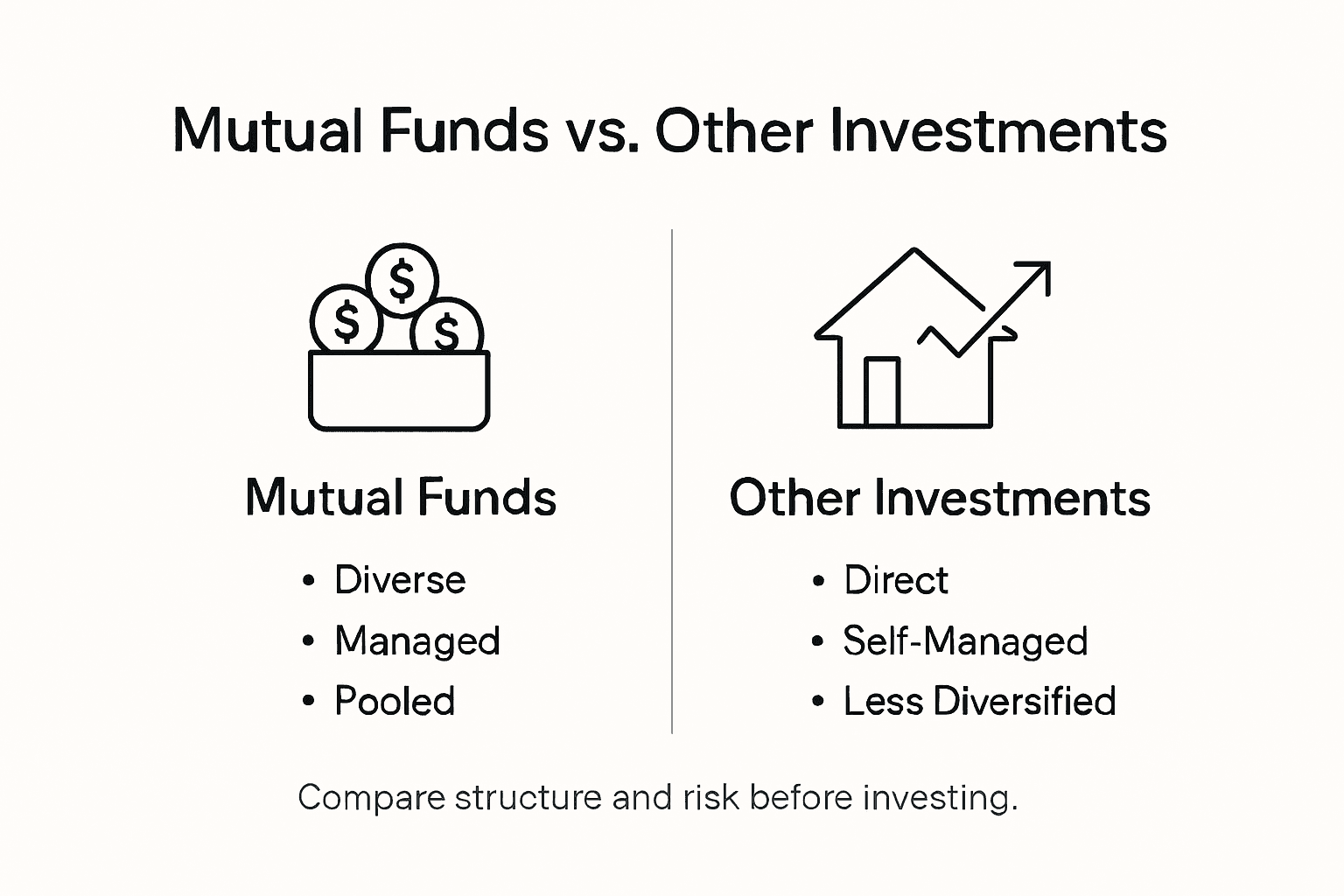
Compared to other investment instruments like Exchange-Traded Funds (ETFs) and individual bonds, mutual funds offer unique characteristics that appeal to different investor profiles. ETFs trade continuously throughout the trading day with price fluctuations, while mutual funds are priced and traded at the end of each trading day based on their net asset value. Bonds provide fixed-income returns with predetermined interest rates, whereas mutual funds can offer more dynamic return potential through actively managed portfolios that adapt to changing market conditions. This flexibility allows mutual funds to potentially generate more consistent returns across various economic environments.
This table highlights key differences between mutual funds, ETFs, and individual stocks:
| Feature | Mutual Funds | ETFs | Individual Stocks |
|---|---|---|---|
| Trading | End of day NAV | Intraday on exchanges | Intraday on exchanges |
| Diversification | Broad, via pooled assets | Broad, index or sector-based | Limited to selected company |
| Management Style | Active or passive | Mainly passive (some active) | Investor managed |
| Minimum Investment | Typically low | Varies, usually low | One share minimum |
Key Investment Comparisons:
- Professional management
- Built-in diversification
- Lower individual investor research requirements
- Adaptive portfolio strategies
- Potential for consistent returns
Pro Investment Strategy: Always compare the total expense ratio, historical performance, and management approach across different investment vehicles before making a final investment decision. Understanding the nuanced differences can help you select the most appropriate investment strategy for your financial goals.
Take Control of Your Mutual Fund Investments Today
Understanding mutual funds means facing challenges like managing fees, navigating risks, and choosing the right fund type for steady growth and income. If you want expert help to overcome these hurdles and maximize your investment potential, you are not alone. Many investors struggle with analyzing expense ratios, balancing portfolios, and finding trustworthy advice tailored to their goals.
At finblog.com, we specialize in providing professional financial guidance and personalized strategies to help you unlock the full benefits of mutual funds without the confusion. Discover how you can make smarter investment decisions backed by data and expert insight. Start by exploring our insights and consulting services now at finblog.com. Your path to confident investing begins here.
Take the next step towards financial growth. Visit finblog.com and connect with seasoned advisors ready to help you build a diversified, well-managed mutual fund portfolio tailored to your unique needs.
Frequently Asked Questions
What are mutual funds?
Mutual funds are investment vehicles where multiple investors pool their money to purchase a diversified portfolio of stocks, bonds, and other securities, managed by professional fund managers.
How do mutual funds work?
When you invest in a mutual fund, your money is combined with that of other investors, allowing for broader investment across various financial instruments, providing instant diversification and professional management of your portfolio.
What are the types of mutual funds available?
Common types of mutual funds include stock funds, bond funds, money market funds, and balanced funds. Each type is designed for different investment strategies and risk tolerances, catering to various investor goals.
What should I consider regarding mutual fund fees?
Mutual funds incur various fees that can impact your investment returns, including management fees and sales loads. Be sure to review the expense ratios and total cost associated with the fund before investing to enhance potential returns.