Over one hundred million American investors choose index funds for their simplicity and cost savings. For anyone feeling overwhelmed by the stock market’s complexity, these funds offer an easy entry point with broad diversification and lower fees. Whether you’re new to investing or want a smarter way to grow your money, understanding how index funds work can help you make confident decisions that align with your long-term financial goals.
Table of Contents
- What Are Index Funds And How They Work
- Types Of Index Funds And Key Differences
- Performance, Costs, And Common Benefits
- Risks, Limitations, And Alternatives Compared
- How To Invest In Index Funds Safely
Key Takeaways
| Point | Details |
|---|---|
| Understanding Index Funds | Index funds aim to replicate the returns of a specific market index, offering broad market exposure and lower fees. |
| Types of Index Funds | Investors can choose between Mutual Fund Index Funds and ETF Index Funds based on their trading preferences. |
| Performance and Costs | Index funds typically have lower expense ratios, leading to higher net returns over time compared to actively managed funds. |
| Safe Investment Practices | Assess key factors like expense ratios, tracking accuracy, and diversification to mitigate risks in index fund investments. |
What Are Index Funds and How They Work
Investing can feel like navigating a complex maze, but index funds provide a straightforward path to building wealth. An index fund is a type of mutual fund or exchange-traded fund that seeks to replicate the returns of a specific market index by tracking a predetermined collection of investments.
Think of an index fund like a snapshot of an entire market segment. Instead of picking individual stocks, these funds automatically invest in all (or a representative sample) of the securities within a specific market index like the S&P 500. This approach means you’re not betting on a single company’s performance, but rather capturing the broader market’s momentum. The beauty of index funds lies in their simplicity: they offer instant diversification, lower fees, and a passive investment strategy that historically outperforms many actively managed funds.
The mechanics of index funds are surprisingly straightforward. Fund managers carefully select securities that mirror the composition of a chosen market index, maintaining a proportional representation of each component. This strategy means if the Nasdaq changes, the index fund adjusts accordingly. Investors benefit from reduced risk through broad market exposure and typically lower management expenses compared to actively traded funds. Many index funds have minimum investment requirements ranging from $1,000 to $3,000, making them accessible to both new and experienced investors.
Pro Tip – Smart Indexing: Before selecting an index fund, compare expense ratios and track the fund’s historical performance relative to its benchmark index. Lower fees can significantly impact your long-term investment returns, so even a 0.1% difference in expenses can translate to substantial savings over decades of investing.
Types of Index Funds and Key Differences
Investors have multiple pathways to engage with index funds, each offering unique characteristics and investment strategies. Index funds come in various forms, including mutual funds and exchange-traded funds (ETFs), each with distinct features such as trading flexibility and fee structures, catering to different investor preferences and financial goals.
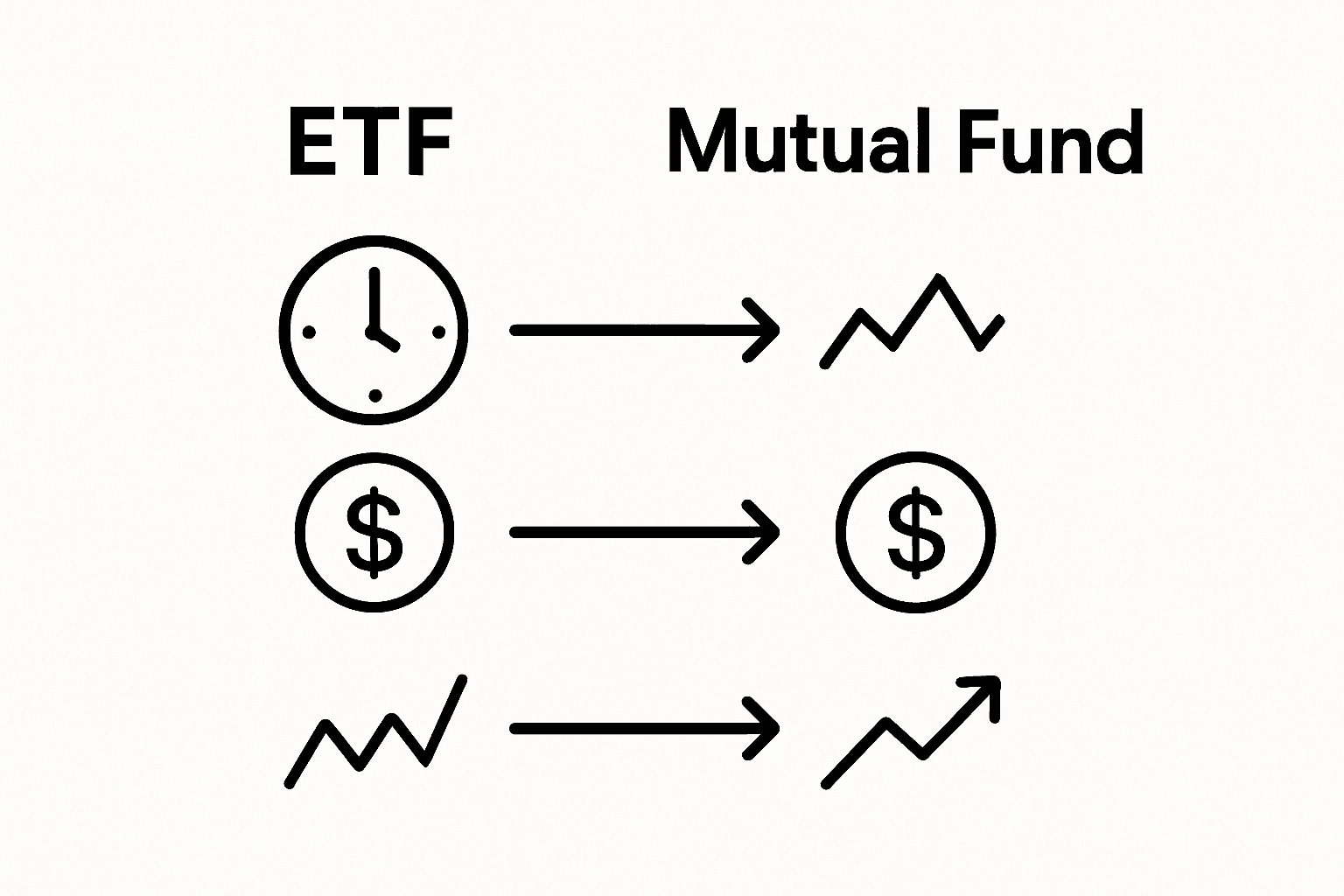
The two primary types of index funds are Mutual Fund Index Funds and Exchange-Traded Index Funds (ETFs). Mutual fund index funds trade once per day at the market’s closing price, providing a more traditional investment approach. They typically have minimum investment requirements and are ideal for long-term, consistent investors. In contrast, ETF index funds trade throughout the day like stocks, offering greater flexibility and real-time pricing. This means investors can buy and sell shares instantly, making them more attractive for active traders who want immediate market responsiveness.

Here’s a comparison of mutual fund index funds and ETF index funds to help clarify their differences:
| Feature | Mutual Fund Index Fund | ETF Index Fund |
|---|---|---|
| Trading Frequency | Once daily at market close | Throughout the trading day |
| Investment Minimums | Often $1,000 or higher | Can be as low as one share |
| Price Determination | End-of-day NAV | Real-time market price |
| Best For | Long-term, hands-off investors | Active, cost-conscious traders |
Beyond trading mechanics, index funds differentiate themselves through market segment focus. Some track broad market indices like the S&P 500, offering wide-ranging exposure, while others specialize in specific sectors such as technology, healthcare, or international markets. Investors can choose funds that align with their risk tolerance and investment strategy. Active vs Passive Investing: Complete Comparison Guide provides additional context on selecting the right investment approach.
Pro Tip – Strategic Fund Selection: Always compare expense ratios and historical performance when selecting an index fund. A difference of 0.2% in annual fees can translate to thousands of dollars in lost returns over a decade, so scrutinize the fund’s cost structure carefully before investing.
Performance, Costs, and Common Benefits
Index funds have revolutionized investment strategies by offering a unique combination of performance, affordability, and accessibility. Their core appeal lies in delivering consistent market returns with significantly lower expenses compared to actively managed funds. Active vs Passive Investing: Complete Comparison Guide highlights the fundamental advantages of this investment approach.
The performance metrics of index funds are particularly compelling. Historically, these funds have demonstrated remarkable consistency, typically matching the broader market’s performance. Unlike actively managed funds that attempt to beat the market, index funds aim to mirror market indices, which paradoxically results in more stable long-term returns. Most index funds boast annual expense ratios between 0.03% and 0.25%, dramatically lower than the 1-2% fees charged by traditional mutual funds. This cost efficiency translates directly into higher net returns for investors, as less money is spent on management fees and more remains invested.
Beyond cost savings, index funds offer several strategic benefits for investors. They provide instant diversification by tracking entire market segments, spreading risk across multiple securities automatically. This approach minimizes the impact of individual stock performance, protecting investors from dramatic losses associated with single-stock investments. Additionally, index funds typically have lower portfolio turnover, which means reduced transaction costs and more tax-efficient investing. The transparent nature of these funds allows investors to understand exactly what they’re holding, with holdings that closely match the underlying index.
Pro Tip – Smart Indexing Strategy: Regularly rebalance your index fund portfolio and consider dollar-cost averaging to maximize long-term investment potential. By investing a fixed amount consistently, you can smooth out market volatility and potentially lower your average purchase price over time.
Risks, Limitations, and Alternatives Compared
While index funds offer numerous advantages, investors must carefully understand their inherent limitations and potential risks. Active vs Passive Investing: Complete Comparison Guide provides valuable insights into the nuanced landscape of investment strategies, highlighting the critical trade-offs between different approaches.
Index funds come with specific structural limitations that investors should consider. By design, these funds are engineered to track market indices, which means they cannot outperform the market. When market segments decline, index funds will correspondingly drop, offering no protective mechanism against broad economic downturns. Additionally, they lack the flexibility of actively managed funds to quickly adjust holdings during volatile market conditions. Some index funds might also be heavily concentrated in specific sectors or large-cap companies, potentially creating unexpected portfolio vulnerabilities. This concentration risk means investors might unknowingly have significant exposure to particular market segments or technological industries.
Compared to alternative investment strategies, index funds present a mixed portfolio solution. Active mutual funds offer professional management and potential for targeted gains, albeit at higher expense ratios. Individual stock picking allows precise control but demands significant research and market expertise. Exchange-traded funds (ETFs) provide similar passive investment benefits with potentially more trading flexibility. Investors seeking more dynamic approaches might explore sector-specific funds, growth-oriented portfolios, or balanced investment strategies that blend multiple asset classes to mitigate risks and optimize returns.
Pro Tip – Risk Mitigation Strategy: Always diversify your investment portfolio across multiple index funds representing different market segments, geographic regions, and asset classes to minimize potential downside risks and create a more resilient long-term investment approach.
How to Invest in Index Funds Safely
When choosing an index fund, consider factors such as low expense ratios, strong tracking performance, and sufficient trading volume to ensure a sound investment strategy. Safely navigating the index fund landscape requires a strategic approach that balances risk management with long-term financial goals. Investment Risk Management: Complete Expert Guide offers additional insights into protecting your investment portfolio.
Beginners should start by establishing clear investment parameters. This means thoroughly researching potential index funds, examining their historical performance, and understanding their underlying market indices. Key evaluation criteria include expense ratios (aim for under 0.20%), tracking error (how closely the fund mirrors its benchmark index), and total assets under management. Investors should prioritize funds with established track records, consistent performance, and low management fees. Diversification remains critical – consider spreading investments across multiple index funds representing different market sectors, company sizes, and geographic regions to minimize potential risks.
Technical due diligence is equally important when selecting index funds. Analyze the fund’s expense ratio, tracking accuracy, and trading volume. Look for funds with minimal tracking errors, which indicate how precisely the fund replicates its target index. Some investors prefer broader market index funds like those tracking the S&P 500, while others might choose more specialized funds focusing on specific sectors or international markets. Pay close attention to the fund’s underlying holdings, ensuring they align with your investment philosophy and risk tolerance.
This summary highlights key considerations for safely investing in index funds:
| Consideration | Why It Matters | What to Look For |
|---|---|---|
| Expense Ratio | Directly affects long-term returns | Below 0.20% preferred |
| Tracking Accuracy | Indicates how closely fund mirrors index | Low tracking error |
| Diversification | Reduces overall investment risk | Broad market or sector exposure |
| Trading Volume | Ensures liquidity for buying/selling | Consistently high volume |
Pro Tip – Systematic Investment Strategy: Implement a dollar-cost averaging approach by consistently investing fixed amounts at regular intervals, which helps smooth out market volatility and reduces the risk of making large investments at potentially unfavorable market moments.
Take Control of Your Investment Journey with Expert Guidance
Navigating index funds can feel overwhelming, especially when you want to balance low costs, diversification, and consistent returns. This article highlighted key challenges such as understanding expense ratios, tracking accuracy, and managing risk through diversification. If you want to avoid costly mistakes and build a smarter investment portfolio with confidence, mastering concepts like passive investing and dollar-cost averaging is essential.
At Finblog, we specialize in helping investors like you transform knowledge into action. Unlock personalized insights and strategies that align with your financial goals. Whether you are selecting your first index fund or refining your current portfolio, our expert advice and tailored resources make investing straightforward and secure. Explore more about Active vs Passive Investing: Complete Comparison Guide to deepen your understanding. Don’t wait for market uncertainty to disrupt your plans. Visit Finblog now and start building a resilient investment strategy designed to grow your wealth over the long term.
Frequently Asked Questions
What are index funds?
Index funds are investment vehicles that aim to replicate the performance of a specific market index by investing in a predetermined collection of securities within that index, providing automatic diversification and typically lower fees than actively managed funds.
How do I choose the right index fund?
Consider factors such as the fund’s expense ratio, historical performance against its benchmark index, and the underlying market segment it tracks. Aim for funds with low fees and a strong track record of tracking accuracy.
What are the differences between mutual fund index funds and ETF index funds?
Mutual fund index funds trade once daily at market close and usually have minimum investment requirements, ideal for long-term investors. In contrast, ETF index funds trade throughout the day like stocks, offering real-time pricing and greater flexibility for active traders.
What are the risks associated with investing in index funds?
Index funds are subject to market risks and can decline in value when the market segments they track drop. They also lack the flexibility to adjust holdings in volatile conditions and may concentrate investments in specific sectors, leading to potential vulnerabilities.