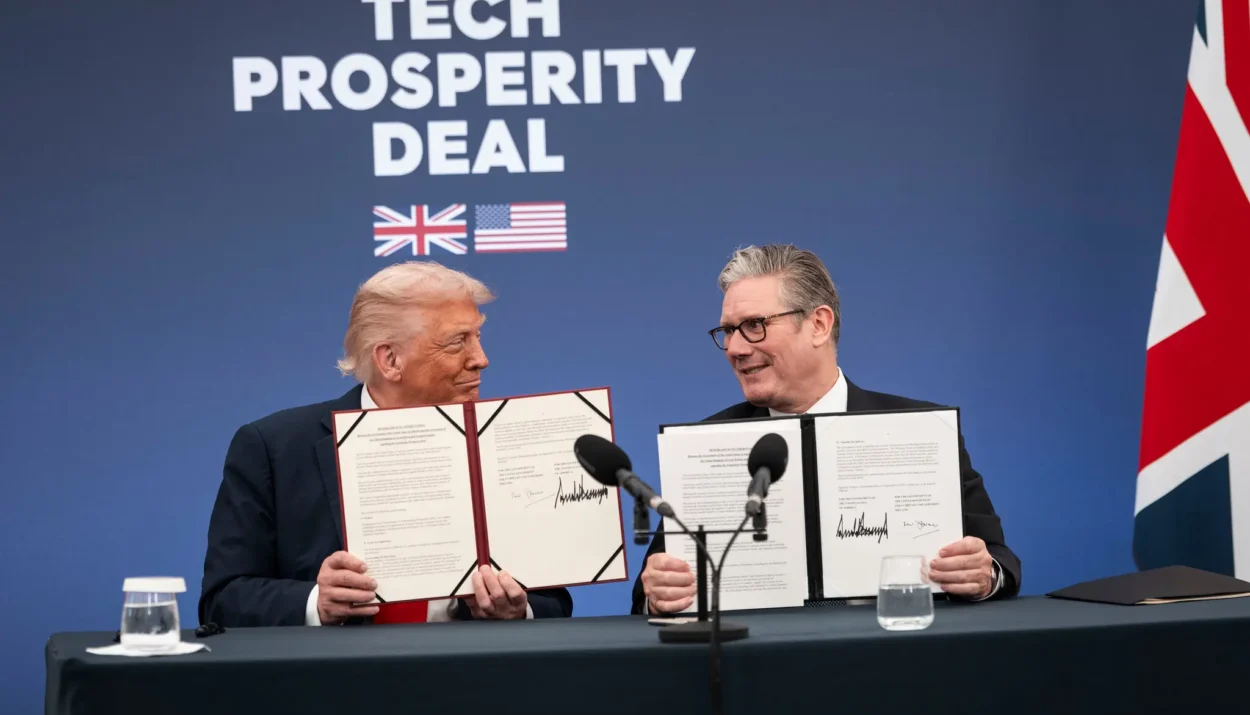

The US government has paused implementation of its high-profile Tech Prosperity Deal with UK, citing disagreements over digital regulations and food safety rules, a move that exposes growing tensions beneath what was once hailed as President Donald Trump’s first major trade pact of his second term.
According to officials familiar with the decision, Washington believes Prime Minister Keir Starmer’s government has failed to make sufficient progress in reducing trade barriers, a key condition tied to the broader Economic Prosperity Deal signed in May 2025.
When Trump visited London in September, both sides celebrated what they described as a “new era” in transatlantic cooperation. The Tech Prosperity Deal promised joint research on AI and nuclear energy, alongside $40 billion in US tech investment commitments from giants like Amazon, Microsoft, and Google.
But that agreement included a clause stating it would only become “operative” if Britain demonstrated substantive progress on the May trade deal, which, US officials now argue, has not happened.
Washington Pushes Back
Trump’s trade team has grown frustrated with the lack of movement on agriculture and digital policy. While Britain agreed to expand US beef exports and reduce tariffs on cars, it has not loosened its food import standards or amended its digital services tax, which disproportionately impacts American tech companies.
The White House, sources say, is leveraging this impasse to pressure the UK for further concessions, part of Trump’s broader push to realign global trade on US terms.
“Britain is firmly committed to ensuring the Tech Prosperity Deal delivers opportunity for hardworking people in both countries,” a UK government spokesperson said, downplaying the setback.
Meanwhile, US trade officials, including Commerce Secretary Howard Lutnick, Trade Representative Jamieson Greer, and Treasury Secretary Scott Bessent, met with UK Business Secretary Peter Kyle in Washington last week. Discussions focused on tariffs on whisky and steel, as well as cooperation on critical minerals, but ended without a breakthrough. Both sides agreed to resume talks in January.
A Familiar Pattern
The pause reflects a broader challenge facing Trump’s second-term trade strategy. The administration has now announced limited deals with 15 nations, but many remain stalled or only partially implemented.
Observers note a recurring theme: headline-grabbing announcements followed by months of technical gridlock, as countries resist Washington’s hardline conditions.
In Britain’s case, officials have privately questioned whether the US is using the deal’s ambiguity as leverage — especially as Trump faces mounting domestic legal challenges to his tariff authority and growing economic concerns over the inflationary effects of his trade policies.
The collapse in momentum underscores how Trump’s transactional trade diplomacy continues to reshape global alliances. Even traditional partners like Britain are finding it difficult to balance domestic regulation, public opinion, and US demands for deeper market access.
As one senior trade official put it, the current pause “doesn’t kill the deal — but it sends a message.”
Whether London bends on digital taxes and food safety could now determine whether the Tech Prosperity Deal revives — or becomes another casualty of Trump’s unpredictable trade playbook.
Related: Trump’s Fed pick comes into focus, economic data, earnings: What to watch this week