
Market downturns can feel especially unsettling when your retirement income is on the line. For many retired professionals, the real risk is not just how much your investments grow, but when those returns happen. Sequence of Returns Risk threatens longstanding financial plans by exposing portfolios to harm if losses strike just as withdrawals begin. Understanding this risk empowers you to safeguard your income and adopt strategies designed to protect your savings during uncertain times.
Table of Contents
- Defining Sequence of Returns Risk
- How Sequence of Returns Risk Impacts Retirees
- Examples and Real-World Scenarios
- Strategies to Minimize Sequence of Returns Risk
- Comparing Alternatives and Common Mistakes
Key Takeaways
| Point | Details |
|---|---|
| Understanding Sequence of Returns Risk | The order of returns during retirement significantly impacts portfolio sustainability, especially when withdrawals coincide with market downturns. |
| Flexibility in Withdrawal Strategies | Implementing a dynamic withdrawal strategy can help mitigate the negative impacts of market fluctuations on retirement funds. |
| Importance of Cash Reserves | Building cash reserves can prevent forced selling of investments during downturns, helping to preserve long-term capital. |
| Avoiding Common Mistakes | Investors should avoid overly aggressive asset allocations and ensure they regularly rebalance their portfolios to manage risk effectively. |
Defining Sequence of Returns Risk
Sequence of Returns Risk represents a critical yet often misunderstood challenge facing retirees and near-retirement investors. Retirement finance experts define this risk as the potential for experiencing poor market performance precisely when portfolio withdrawals begin, which can dramatically impact long-term financial sustainability.
This risk emerges from a simple but profound mathematical reality: the order of investment returns matters significantly more during retirement than during wealth accumulation phases. When negative market returns occur early in retirement while you’re simultaneously withdrawing funds, the combination can create a compounding destructive effect on your portfolio’s future growth potential.
Key characteristics of Sequence of Returns Risk include:
- Occurs during early retirement years
- Triggered by market downturns coinciding with portfolio withdrawals
- Amplifies potential portfolio depletion faster than static return scenarios
- Disproportionately impacts investors taking consistent percentage-based withdrawals
- Can reduce portfolio longevity by several years unexpectedly
Consider a hypothetical scenario where two investors have identical average returns over 30 years, but experience those returns in different sequences. The investor encountering negative returns early will likely deplete their portfolio substantially faster, even though their long-term average returns remain unchanged. This demonstrates why market timing and withdrawal strategies become crucial retirement planning considerations.
Pro tip: Develop a flexible withdrawal strategy that can adapt to market conditions, potentially reducing withdrawal rates during significant market downturns to preserve long-term portfolio sustainability.
How Sequence of Returns Risk Impacts Retirees
Retirees face unique financial challenges that make them especially vulnerable to Sequence of Returns Risk. When investors transition from accumulating wealth to drawing income from their investments, the timing of market performance becomes critically important. Retirement withdrawal strategies can help mitigate the potential devastating impacts of this risk.

The most significant impact occurs during the first decade of retirement, when portfolios are most susceptible to permanent damage from market downturns. Imagine two retirees with identical total investment returns over 30 years, but with different return sequences. The one experiencing negative returns early will likely exhaust their funds much faster, even though their average returns remain the same.
Key ways Sequence of Returns Risk impacts retirees include:
- Accelerates portfolio depletion during market downturns
- Reduces long-term income sustainability
- Creates increased financial stress and uncertainty
- Limits ability to recover from early investment losses
- Potentially forces unexpected lifestyle compromises
Retirees are particularly vulnerable because they typically have less time to recover from significant market losses. Unlike younger investors who can wait out market fluctuations, retirees must simultaneously manage ongoing expenses while protecting their remaining investment capital. Portfolio flexibility becomes crucial in navigating these financial challenges.
Sequence of Returns Risk transforms market volatility from a theoretical concern into a real threat to retirement financial security.
Pro tip: Consider implementing a dynamic withdrawal strategy that allows for reduced spending during market downturns to preserve long-term portfolio sustainability.
Examples and Real-World Scenarios
Understanding Sequence of Returns Risk becomes clearer through concrete examples that illustrate its potential devastating impact on retirement portfolios. Annuity investment strategies can provide some protection, but real-world scenarios reveal the complexity of this financial challenge.
Consider two hypothetical retirement portfolios, each starting with $1 million and experiencing identical average annual returns of 7% over 30 years, but with dramatically different return sequences. In Scenario A, positive returns occur early, while in Scenario B, significant market downturns happen during the first five years of retirement.
Comparative scenarios demonstrate the risk’s impact:
- Scenario A (Favorable Sequence)
- Initial portfolio value: $1,000,000
- Consistent positive returns early
- Portfolio remains stable throughout retirement
- Minimal withdrawal adjustments required
- Scenario B (Unfavorable Sequence)
- Initial portfolio value: $1,000,000
- Significant market losses in early retirement years
- Forced to sell investments at reduced values
- Portfolio depletes much faster despite identical average returns
Market timing becomes critically important in retirement planning. The investor in Scenario B might deplete their portfolio 5-7 years earlier than the investor in Scenario A, despite having the same total investment performance over three decades.
Sequence of Returns Risk proves that average investment returns mean little when the timing of those returns becomes unpredictable.
Pro tip: Develop a flexible retirement withdrawal strategy that includes cash reserves and alternative income sources to buffer against potential early-retirement market volatility.
Strategies to Minimize Sequence of Returns Risk
Investors approaching retirement can implement several sophisticated strategies to mitigate the potential devastating impacts of Sequence of Returns Risk. Advanced risk mitigation techniques offer multiple approaches to protect retirement portfolios from market volatility during critical early retirement years.
One primary strategy involves dynamic asset allocation, which requires carefully adjusting investment portfolios to reduce risk as retirement approaches. This typically means gradually shifting from aggressive growth investments to more stable, income-generating assets that can provide consistent returns while protecting principal.
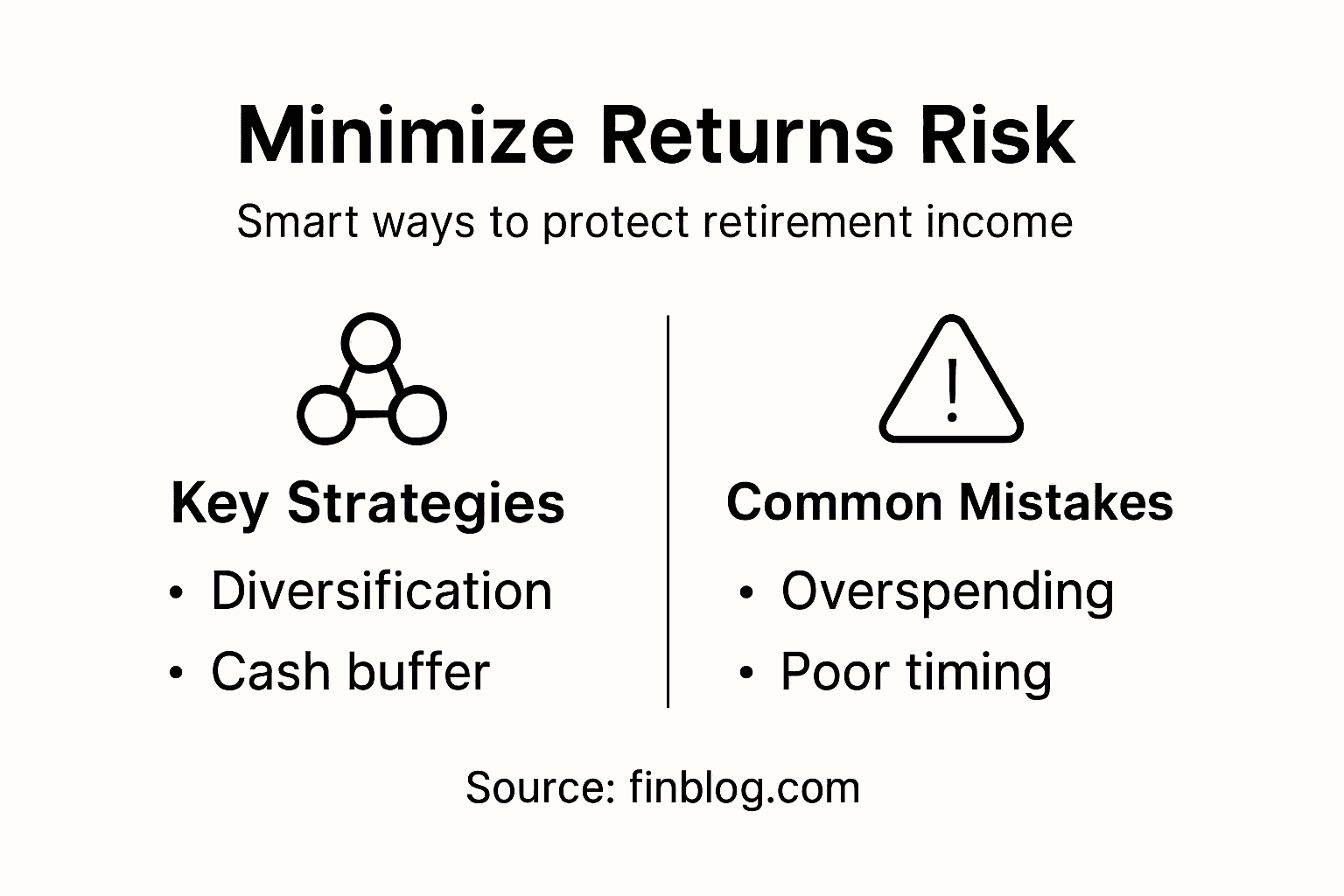
Key strategies to minimize Sequence of Returns Risk include:
- Implement a flexible withdrawal strategy
- Maintain diversified investment allocations
- Create substantial cash reserves for early retirement
- Use dollar-cost averaging techniques
- Consider partial annuitization of retirement assets
- Develop multiple income streams beyond traditional investments
Retirees can also explore more advanced risk management techniques such as creating protective investment buffers. This involves maintaining 2-3 years of living expenses in highly liquid, low-risk assets like money market funds or short-term government bonds, which can be drawn upon during market downturns to avoid selling depreciated long-term investments.
Proactive risk management matters more than perfect market timing.
Pro tip: Design a retirement income plan with multiple contingency layers, ensuring you have accessible funds that can be tapped without disrupting your core investment strategy during market volatility.
The table below summarizes practical steps and their potential impacts for minimizing Sequence of Returns Risk:
| Action Step | Main Benefit | Considerations |
|---|---|---|
| Build Cash Reserves | Avoid selling in downturns | Opportunity cost if prolonged |
| Use Dynamic Asset Allocation | Lower risk as retirement nears | May reduce growth potential |
| Regular Portfolio Rebalancing | Keeps risk exposure appropriate | Requires discipline |
Comparing Alternatives and Common Mistakes
Retirement investors have multiple approaches to managing Sequence of Returns Risk, each with unique advantages and potential pitfalls. Safe investment options can help mitigate potential portfolio vulnerabilities, but understanding their limitations is crucial for effective risk management.
Investors frequently encounter several critical mistakes when attempting to protect their retirement portfolios. The most common errors stem from oversimplified strategies that fail to account for the complex dynamics of market performance and personal financial circumstances.
Common mistakes to avoid include:
- Maintaining overly aggressive asset allocations near retirement
- Failing to establish emergency cash reserves
- Assuming consistent market returns
- Ignoring inflation’s impact on withdrawal strategies
- Relying solely on historical performance metrics
- Neglecting regular portfolio rebalancing
Alternative risk management approaches offer varying levels of protection. Systematic withdrawal strategies can provide more predictable income streams, while dynamic asset allocation allows for more flexible response to changing market conditions. Each approach requires careful evaluation of individual financial goals, risk tolerance, and potential market scenarios.
Here’s a comparison of two key retirement withdrawal strategies:
| Strategy Type | Flexibility | Protection from Downturns | Long-Term Income Predictability |
|---|---|---|---|
| Systematic Withdrawals | Low | Limited | High |
| Dynamic Withdrawals | High | Strong (if adjusted) | Moderate (varies over time) |
Not all risk mitigation strategies are created equal – personalization is key to effective retirement planning.
Pro tip: Consult with a financial advisor to develop a customized risk management strategy that accounts for your specific retirement timeline and income requirements.
Protect Your Retirement Income From Sequence of Returns Risk Today
Sequence of Returns Risk can quietly erode your retirement savings when market downturns strike just as you begin withdrawing funds. The challenge lies in managing early retirement market volatility while maintaining sustainable income. If you want to protect your nest egg from unexpected depletion and reduce financial stress during your golden years, understanding dynamic withdrawal strategies and building cash reserves is essential.
At finblog.com you can explore expert insights on retirement withdrawal strategies and discover practical tips like creating diversified income streams and adopting flexible portfolio plans. Don’t leave your retirement to chance. Get started now with personalized advice from trusted financial experts available on finblog.com and secure the income you deserve.
Frequently Asked Questions
What is Sequence of Returns Risk?
Sequence of Returns Risk is the potential for negative market returns that occur during the early years of retirement, which can significantly impact long-term financial sustainability as withdrawals are taken from investment portfolios.
How can Sequence of Returns Risk affect retirees?
It can accelerate portfolio depletion, reduce long-term income sustainability, create financial stress, and limit an individual’s ability to recover from early investment losses, making it critical to formulate effective withdrawal strategies.
What strategies can help mitigate Sequence of Returns Risk?
Strategies include implementing a flexible withdrawal strategy, maintaining diversified investments, creating cash reserves for early retirement, using dollar-cost averaging, and developing multiple income streams to buffer against market volatility.
Why is market timing important in retirement planning?
Market timing is important because the order of investment returns can drastically affect the longevity of a retirement portfolio, especially when negative returns coincide with early withdrawals, leading to potentially quicker depletion of funds.