

Flexible work arrangements let employers and employees change where, when, or how much work gets done to improve productivity and work-life balance. The most common types in U.S. workplaces are:
- Remote work (fully off-site)
- Hybrid work (split between office and remote)
- Flextime (variable start/end times within core hours)
- Compressed workweek (full hours in fewer days, typically four)
- Job sharing (two employees split one full-time role)
- Part-time or reduced hours
- Results-only work environments (output-based, no fixed schedule)
This guide is U.S.-focused and covers everything from policy design to manager checklists and copy-ready agreement fields.
Key Takeaways
Well-designed flexible work arrangements require documented agreements, defined KPIs, and scheduled annual reviews to deliver lasting benefits for employees, managers, and HR teams.
| Point | Details |
|---|---|
| Document every arrangement | Use a written agreement with signed approval, defined metrics, and a review date before the arrangement starts. |
| Match type to role constraints | Remote and ROWE suit knowledge work; shift flexibility and compressed weeks fit operational and field roles better. |
| Measure output, not presence | Set 2–3 role-specific KPIs before day one and evaluate performance against them, not hours logged. |
| Address compliance early | Cross-state remote work triggers payroll and tax issues; confirm approved states with HR before approving out-of-state arrangements. |
| Review annually | Schedule a full arrangement review at fiscal year start, store the updated agreement in the HR system, and revise KPIs as the role evolves. |
Table of Contents
- Why flexible work arrangements matter for employees and employers
- What are the most common types of flexible work arrangements?
- How to implement flexible work arrangements: the HR and manager checklist
- How to manage performance and collaboration across flexible teams
- Common pitfalls in flexible work and how to avoid them
- What does the research say about designing healthy flexible work?
- Copy-ready FWA checklist and sample agreement fields
- Finblog’s take on adopting flexible work responsibly
- Sources
Why flexible work arrangements matter for employees and employers
Flexible work arrangements improve retention, productivity, and well-being when they are well-managed and clearly documented. The business case is strong on both sides of the employment relationship.
Employee benefits:
- Greater control over schedule and location, which reduces commute stress
- Better ability to manage caregiving, health, and personal obligations
- Reduced burnout risk when boundaries are clearly set
- Higher job satisfaction and sense of autonomy
Employer benefits:
- Lower voluntary turnover and reduced recruiting costs
- Access to a wider talent pool, including candidates outside commuting range
- Reduced real estate and overhead costs for remote-heavy teams
- Greater capacity to cover extended hours without mandatory overtime
- Measurable productivity gains in roles where output is trackable
The health dimension is not optional to consider. A GAO report on long work hours links excessive hours directly to coronary heart disease, type 2 diabetes, and stroke. Organizations that design flexible arrangements with firm boundaries around total hours are not just being generous; they are managing a real liability.
The Work & Well-Being Initiative (a research collaboration between Harvard and MIT) identifies three foundational levers for improving worker well-being: increase worker control over schedule and tasks, reduce excessive demands, and preserve social connection. Well-designed flexible arrangements address all three. Poorly designed ones, where employees are always on call or expected to compress 40 hours into four days without any reduction in workload, undermine all three.
Pro Tip: Pair any new flexible arrangement with a boundary-setting routine, such as a defined end-of-day shutdown ritual, to prevent work from bleeding into personal time. This is especially important for employees working from home for the first time.
What are the most common types of flexible work arrangements?
Remote work (full telecommuting)
The employee works entirely off-site, typically from home or a co-working space. Best suited to knowledge work roles with low dependency on physical presence: software development, writing, data analysis, financial analysis. The main eligibility constraint is whether the role requires in-person client contact, equipment access, or supervisory presence.
The U.S. Department of Labor treats flexible schedules as an established alternative to fixed 9-to-5 work, and the OPM’s 2025 Guide to Telework and Remote Work draws a useful distinction: routine telework follows a regular, recurring schedule, while situational telework is occasional and event-driven. That distinction matters for how you document the arrangement and what approval process applies.
Hybrid work model
The employee splits time between on-site and remote work, typically with a defined minimum number of in-office days per week. A common structure is two or three anchor days in the office for collaboration and the remainder remote. Hybrid arrangements work across a wide range of roles but require explicit scheduling norms to avoid the “empty office on Fridays” problem.
Flextime
Employees vary their arrival and departure times around a set of defined core hours when everyone must be available. For example, core hours might run 10 AM to 3 PM, with employees free to start as early as 7 AM or finish as late as 7 PM. The DOL notes that any flextime policy should explicitly state core hours, lunch break rules, and how total weekly hours are tracked. For nonexempt employees under the Fair Labor Standards Act (FLSA), accurate time-tracking is non-negotiable.
Compressed workweek (four-day week)
Employees work their full weekly hours across four days instead of five. A standard 40-hour week becomes four 10-hour days. This arrangement suits roles with predictable workloads and minimal real-time client dependency. The risk: a compressed week that does not actually reduce total hours can increase fatigue rather than reduce it. Design the schedule so the workload compresses, not just the calendar.
Job sharing
Two part-time employees share the responsibilities of one full-time role, dividing hours, tasks, and sometimes client relationships. This works well for senior roles where continuity matters but full-time availability is not required. It demands clear handoff protocols and strong communication between the two employees.
Part-time and reduced hours
Employees work fewer than the standard full-time hours, either permanently or temporarily. Eligibility for benefits often changes at certain hour thresholds, so HR should review benefits implications before approving a reduction. For employees considering a shift toward part-time or freelance work, the financial planning implications deserve attention early.
Results-only work environments (ROWE)
No fixed schedule, no required hours. Employees are evaluated entirely on whether they meet defined output targets. This model works best in roles with clear, measurable deliverables. It demands strong performance management infrastructure and is not appropriate for customer-facing or supervisory roles that require real-time availability.
Shift and break flexibility
Employees choose from a menu of available shifts or adjust break timing within operational constraints. Common in retail, healthcare, and manufacturing. The flexibility is narrower than flextime but still meaningfully improves employee control.
The table below maps common role types to the arrangements most likely to fit their operational constraints.
| Role type | Best-fit arrangements | Key constraint |
|---|---|---|
| Customer-facing (service, retail) | Shift flexibility, part-time | Coverage windows, real-time availability |
| Knowledge work (analyst, writer, developer) | Remote, hybrid, flextime, ROWE | Data security, output measurability |
| Field or on-site (facilities, lab, clinical) | Compressed week, shift flexibility | Physical presence requirements |
| Supervisory or team-lead | Hybrid, flextime | Team coordination, real-time decision-making |
A U.S.-specific note: For nonexempt employees, FLSA requires accurate tracking of all hours worked regardless of arrangement type. Cross-state remote work triggers payroll withholding and potential tax nexus issues; many employers restrict remote work to a pre-approved list of states and require HR review before approving out-of-state arrangements.
How to implement flexible work arrangements: the HR and manager checklist
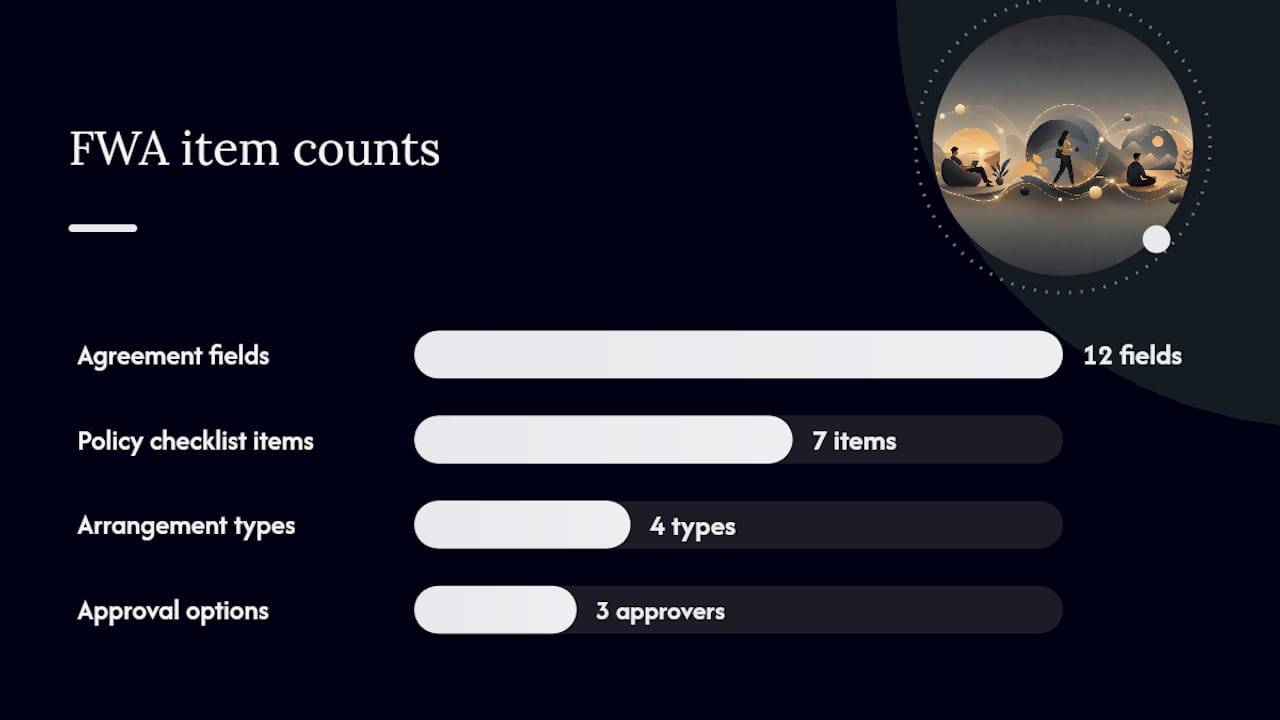
The most reliable way to launch flexible arrangements is through clear, documented agreements with defined trial periods and scheduled review cycles. Improvised arrangements that live in email threads collapse under turnover and management changes.
Policy checklist (numbered for sequence):
- Define eligibility criteria. Which roles, tenure levels, and performance standings qualify? Document the criteria in writing so decisions are consistent.
- Establish approval authority. Specify who can approve arrangements: direct manager only, department head, or HR sign-off required. Duke University’s remote work policy requires unit-level approval and an assessment of operational impact before any agreement is signed.
- Use a written agreement. Every arrangement needs a signed document. Verbal agreements create disputes. Use a standard template where possible.
- Set a trial period. UCLA’s remote work guidance recommends a recommended trial period, with performance evaluated on results during that window. Build in a formal check-in at the midpoint.
- Specify equipment and security requirements. Who provides the laptop, monitor, and internet stipend? What VPN, endpoint security, or data-handling rules apply? Document it.
- Define time-tracking expectations. For nonexempt employees, specify the time-tracking tool and submission cadence. For exempt employees, clarify how availability and output will be monitored.
- Set communication norms. What are the expected response times for email, Slack, or Teams messages? When are employees expected to be reachable? Which meetings are mandatory and synchronous?
- Address tax and payroll compliance. For remote employees working in a different state than the employer’s registered location, consult payroll and HR before approving. Many employers maintain an approved-state list and require HR review for exceptions.
- Document reasonable accommodation intersections. If the arrangement is requested as an ADA accommodation, route it through the appropriate HR process. A standard FWA and an ADA accommodation are legally distinct.
- Schedule a review and renewal date. UW-Madison’s flexible work policy requires arrangements to be reviewed on a regular, recurring schedule and stored in the HR system. Build that cadence into the agreement from day one.
FWA agreement: fields to include
- Employee name and role
- Arrangement type (remote, hybrid, flextime, compressed, etc.)
- Start date and initial end/review date
- Working pattern / on-site days (e.g., Mon/Wed in office; Tue/Thu/Fri remote)
- Core hours or availability window
- Primary performance metrics (what will be measured during the trial)
- Equipment responsibility (employer-provided vs. employee-owned; stipend amount if any)
- Expense reimbursement terms
- Data security requirements (VPN, approved networks, device encryption)
- Revocation terms (notice period required by either party; a typical notice period is required)
- Point of contact for issues
- Signatures (employee and approving manager or unit head, with date)
UCLA’s remote work guidelines note that arrangements may be terminated by either party and that department heads retain authority to deny or revoke based on business needs. Include that language in the agreement so it is not a surprise.
How to manage performance and collaboration across flexible teams
Measure output and outcomes, not face time. A manager who tracks when people log on is measuring presence; a manager who tracks whether deliverables arrive on time and at quality is measuring work. Those are not the same thing.
Manager actions that keep flexible teams productive:
- Set clear, written expectations for deliverables, deadlines, and quality standards before the arrangement starts, not after the first missed deadline.
- Standardize async communication norms: define which channels are for urgent issues, which are for non-urgent updates, and what the expected response window is for each.
- Schedule periodic synchronous touchpoints, whether weekly team calls or monthly in-person days, so relationships do not atrophy entirely into text threads.
- Document workflows and decisions in a shared system (Confluence, Notion, or a shared drive) so remote employees are not excluded from institutional knowledge.
- Actively manage visibility. Remote contributors are often overlooked for stretch assignments and promotions not because of performance but because they are out of sight.
Sample KPIs by role type:
| Role type | Example KPIs |
|---|---|
| Knowledge work (analyst, developer) | Project milestone completion rate, code review turnaround, report accuracy |
| Customer-facing | First-response time, customer satisfaction score, resolution rate |
| Supervisory | Team delivery SLA, direct report engagement score, peer feedback frequency |
| Field or operational | Task completion rate, quality audit score, safety incident rate |
Pro Tip: Rotate meeting facilitation among team members and send a brief quarterly “showcase update” for each remote contributor to the broader team. Both practices combat the visibility gap that quietly derails remote employees’ career progression without anyone intending it.
Common pitfalls in flexible work and how to avoid them
Flexible work arrangements create measurable benefits, but they also produce trade-offs that must be actively managed. The problems that sink FWA programs are almost always predictable.
Problem → mitigation pairs:
- Equity gaps between remote and on-site staff. On-site employees may feel penalized for commuting while remote colleagues skip it. Mitigation: apply consistent performance standards and ensure remote employees are equally considered for promotions and stretch assignments.
- Career stagnation for remote workers. Out-of-sight employees are passed over for opportunities at higher rates. Mitigation: document career development conversations and track promotion rates by arrangement type annually.
- Burnout from always-on expectations. Remote workers often work longer hours, not shorter ones. Mitigation: set explicit response-time windows and enforce a right-to-disconnect policy. The GAO’s findings on long work hours make the health stakes clear.
- Isolation and weakened social connection. Fully remote employees report higher loneliness over time. Mitigation: schedule regular in-person or video touchpoints and create informal channels (a virtual coffee chat, a non-work Slack channel) that replicate hallway conversation.
- Time-zone and scheduling friction. Distributed teams across multiple time zones struggle to find synchronous windows. Mitigation: define a “collaboration window” of two to three overlapping hours and protect it from meeting creep.
- Managerial bias toward visible workers. Managers unconsciously favor employees they see daily. Mitigation: use structured performance reviews tied to documented KPIs rather than impressionistic assessments.
- Cross-state tax and payroll compliance. An employee who moves to a different state without notifying HR can create payroll withholding errors and tax nexus exposure for the employer. Mitigation: require employees to notify HR before working from a new state and maintain an approved-state list.
- Data security risks on home networks. Personal networks and devices are higher-risk environments. Mitigation: require VPN use, mandate device encryption, and include security requirements in the written agreement.
Red flags that signal an arrangement needs review:
- Team delivery SLAs are consistently missed
- Missed deadlines are concentrated among flexible workers
- On-site staff turnover rises while remote staff turnover stays flat (equity signal)
- A remote employee has not appeared on video in more than two weeks
- A manager cannot describe a remote employee’s current project without checking notes
What does the research say about designing healthy flexible work?
Three evidence-backed principles should anchor any FWA design: increase worker control over schedule and tasks, reduce excessive demands, and preserve social ties.

The GAO’s report on long work hours is the clearest institutional statement of the health stakes. Long hours are not just a productivity issue; they are a health risk with documented links to coronary heart disease, type 2 diabetes, and stroke. Any FWA that compresses hours without reducing workload, or that creates implicit pressure to be available around the clock, fails on this dimension.
Psychology Today’s analysis of work-life balance frames balance not as a fixed state but as an ongoing negotiation, a dilemma to manage rather than a problem to solve. That framing matters for policy design: no arrangement eliminates tension between work and personal life, but rituals and boundaries reduce spillover. Dr. Kendra Thomas at SNHU points to the same mechanism: blurred home-work boundaries create chronic stress, and employers who support clear shutdown rituals and explicit expectations reduce that stress measurably.
Design do’s and don’ts grounded in the evidence:
- Do set firm boundaries around response expectations. Define hours when employees are not expected to reply.
- Do build required disconnect time into compressed-week schedules. Four 10-hour days should not become four 12-hour days.
- Do design regular collaboration touchpoints for remote and hybrid teams to preserve social connection.
- Don’t let a compressed week become a longer workday without compensating rest. The health risk from long hours applies regardless of how the schedule is labeled.
- Don’t treat flexibility as a substitute for adequate staffing. Flexible arrangements work when workloads are manageable; they fail when they are used to mask understaffing.
- Don’t skip the annual review. UW-Madison’s policy mandates annual review and HR system storage for exactly this reason: arrangements drift without a scheduled reset.
Institutional templates from OPM, UCLA, Duke, and UW-Madison all reflect these principles in their policy mechanics, which is why they are worth modeling rather than reinventing from scratch.
Copy-ready FWA checklist and sample agreement fields
Use this checklist as a starting point. Adapt it to your organization’s HR system and approval workflow.
Pre-launch approvals checklist:
- [ ] Role eligibility confirmed against written criteria
- [ ] Manager and department head approval obtained in writing
- [ ] Operational impact assessed (coverage, client-facing requirements, team dependencies)
- [ ] Written FWA agreement drafted using standard template
- [ ] Data security and equipment requirements documented
- [ ] Time-tracking method confirmed (tool, submission cadence)
- [ ] Cross-state or out-of-state work reviewed by payroll/HR if applicable
- [ ] ADA/reasonable accommodation pathway confirmed if relevant
Trial period steps:
- [ ] Trial start date and end date set (recommended: 1–3 months per UCLA guidance)
- [ ] Midpoint check-in scheduled with manager
- [ ] Performance metrics defined and communicated to employee before day one
- [ ] Agreement signed by employee and approving manager
Ongoing monitoring checkpoints:
- [ ] Monthly: manager reviews KPI progress informally
- [ ] Quarterly: formal check-in documented in HR system
- [ ] Annually: full arrangement review at fiscal year start; agreement renewed or modified
- [ ] As needed: arrangement modified or revoked with written notice (a typical notice period is required)
Sample agreement field names with placeholder guidance:
| Field | Placeholder guidance |
|---|---|
| Arrangement type | Remote / Hybrid / Flextime / Compressed / ROWE |
| Working pattern | e.g., Mon/Wed in office; Tue/Thu/Fri remote |
| Core hours / availability window | e.g., 10 AM to 3 PM local time, Monday through Friday |
| Primary performance metrics | List 2–3 measurable outputs tied to role |
| Equipment responsibility | Employer-provided laptop; employee provides internet |
| Expense reimbursement | e.g., $X/month internet stipend per company policy |
| Revocation notice period | written notice by either party |
| Review date | Annual review at fiscal year start; next review: [date] |
| Signatures | Employee signature, manager signature, date |
Store the signed agreement in the HR system on day one. Do not keep it in email. UW-Madison’s flexible work policy and UCLA’s remote work guidelines both require HR system storage and annual review as baseline standards. Treat those as the floor, not the ceiling.
Finblog’s take on adopting flexible work responsibly
The conversation about flexible work has shifted from “should we allow it” to “how do we do it well.” That is progress, but it has also produced a lot of half-measures: arrangements that exist on paper, lack metrics, and get quietly abandoned when a new manager arrives or a business priority shifts.
The organizations that get this right share one habit: they treat flexible work as a managed program, not a perk. That means written agreements, defined KPIs, scheduled reviews, and a willingness to revoke arrangements that are not working. It also means designing for equity from the start, because the evidence on career stagnation for remote workers is consistent enough that ignoring it is a choice, not an oversight.
For managers and HR teams starting today: run a 90-day pilot with a small cohort, define two or three measurable outcomes before day one, and schedule a formal review at the end. That structure is what separates a durable program from a well-intentioned experiment. For employees: document your own output proactively. Do not wait for your manager to notice your contributions; make them visible.
Finblog’s focus on practical financial and professional guidance extends to the workplace decisions that affect long-term career and financial health. If you are navigating a shift to flexible work, explore Finblog’s resources for tools that support smarter professional and financial decision-making.
Sources
These institutional sources informed this guide and provide templates, policy language, and legal context you can use directly.
- GAO — Long work hours and health risks
- 2025 Guide to Telework and Remote Work (OPM)
- Remote Work Guidelines and Policies | Administration
- Remote Work Policy | Human Resources (Duke University)
- UW–Madison Flexible Work Policy (UW-5087)
- Flexible schedules – U.S. Department of Labor