

Many investors assume dividend investing is just about collecting a few extra dollars each quarter, like spare change from a vending machine. That misconception overlooks the real power of dividends: they’re a proven wealth-building engine that transforms regular payouts into exponential growth through compounding. This guide shows you how dividend investing works, why it’s essential for long-term financial success, and practical strategies to start generating reliable passive income while growing your portfolio steadily over time.
Table of Contents
- Key takeaways
- Understanding dividend investing basics
- Top strategies for successful dividend investing
- Benefits and risks of dividend investing
- How to start dividend investing: a step-by-step guide
- Explore more about investment success with Finblog
- FAQ
Key Takeaways
| Point | Details |
|---|---|
| Passive income from dividends | Regular dividend payouts create a steady passive income stream that compounds wealth over time. |
| Dividend reinvestment compounding | Automatically reinvesting dividends accelerates growth by buying more shares and increasing future payouts. |
| Diversification reduces risk | Diversifying across sectors helps protect income and smooth returns during market swings. |
| Dividend Aristocrats and Kings | Dividend Aristocrats and Kings have demonstrated long term payout growth, making them reliable core holdings. |
Understanding dividend investing basics
Dividend investing involves buying stocks of companies that pay regular dividends to generate passive income and achieve long-term wealth growth through reinvestment and compounding. When you own shares in a dividend-paying company, you receive a portion of the company’s profits distributed directly to your brokerage account. These payments typically arrive quarterly, though some companies pay monthly or annually depending on their dividend policy.
The beauty of this approach lies in its dual benefit. First, you collect cash payments without selling a single share. Second, when you reinvest those dividends to purchase additional shares, you create a snowball effect where your investment grows faster each year. This compounding process turns modest initial investments into substantial wealth over decades, especially when you stick with quality companies that consistently raise their payouts.
Most dividend-paying stocks follow a predictable schedule:
- Declaration date: Company announces upcoming dividend
- Ex-dividend date: Cutoff for eligibility to receive payment
- Record date: Company identifies shareholders entitled to dividend
- Payment date: Dividend deposited into your account
“The real magic happens when you reinvest dividends automatically. Each payout buys more shares, which generate more dividends, which buy even more shares. This cycle transforms a simple income strategy into a wealth compounding machine.”
Understanding these fundamentals helps you appreciate why dividend investing serves as a cornerstone strategy for individual investors seeking financial independence. The understanding dividend investing guide explores these concepts in greater depth, showing how regular payouts create both immediate income and long-term appreciation. Unlike growth stocks that rely solely on price increases, dividend stocks reward you twice: through cash distributions and potential share price growth.
Top strategies for successful dividend investing
Building a successful dividend portfolio requires more than randomly selecting high-yield stocks. The most effective approach combines quality selection, strategic reinvestment, and smart diversification. Dividend Aristocrats and Kings represent the gold standard for reliable dividend stocks because they’ve proven their ability to increase payouts consistently for 25 and 50 years respectively.
Dividend Aristocrats have raised dividends for at least 25 consecutive years, demonstrating financial stability through multiple economic cycles. Dividend Kings take this further with 50+ years of uninterrupted dividend growth. These companies typically operate in stable industries with strong competitive advantages, making them ideal core holdings for income-focused investors.
| Category | Minimum Track Record | Example Sectors | Risk Level |
|---|---|---|---|
| Dividend Aristocrats | 25 years of increases | Consumer goods, healthcare, industrials | Moderate |
| Dividend Kings | 50+ years of increases | Utilities, consumer staples, manufacturing | Lower |
Reinvesting dividends amplifies returns dramatically over time. When you automatically purchase additional shares with each dividend payment, you harness the mathematical power of compounding. A dividend investing strategy for steady income shows how this approach transforms a 3% yield into double-digit total returns when combined with dividend growth.

Pro Tip: Set up automatic dividend reinvestment through your brokerage’s DRIP program to eliminate the temptation of spending dividend payments. This ensures every dollar works continuously toward building your wealth.
Diversification across sectors protects your income stream from industry-specific downturns. Follow these steps to build a balanced dividend portfolio:
- Identify 3-5 different sectors with strong dividend histories
- Select 2-3 quality companies within each sector
- Allocate capital evenly to avoid concentration risk
- Review holdings quarterly to ensure diversification remains intact
- Rebalance annually to maintain target sector allocations
Combining these strategies creates a resilient portfolio that generates growing income regardless of market conditions. The diversification strategies winning in 2026 guide demonstrates how spreading investments across multiple sectors reduces volatility while maintaining strong total returns. Focus on companies with sustainable payout ratios below 60%, ensuring they retain enough earnings to fund future growth while rewarding shareholders generously.
Benefits and risks of dividend investing
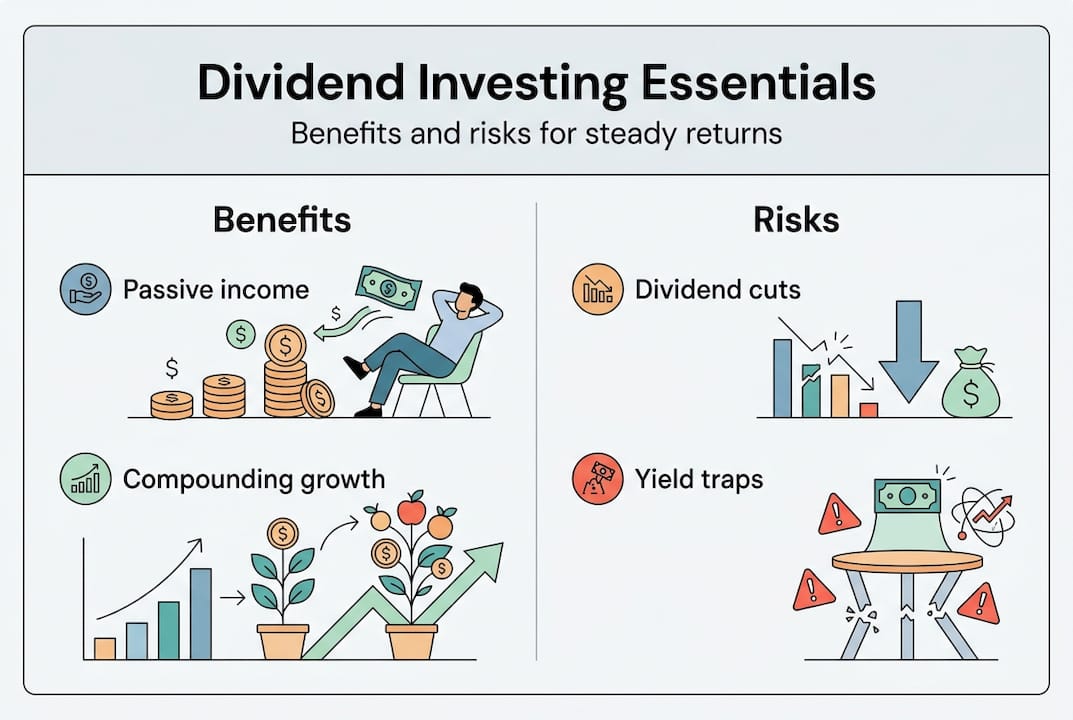
Dividend investing offers compelling advantages that make it attractive for both new and experienced investors. The primary benefit is predictable passive income that arrives in your account like clockwork, providing cash flow you can reinvest or use for living expenses. Companies pay dividends quarterly from earnings to reward shareholders, creating a reliable income stream independent of stock price fluctuations.
Key benefits include:
- Steady income generation regardless of market volatility
- Compounding growth when dividends are reinvested automatically
- Inflation hedge through companies that raise dividends annually
- Lower volatility compared to pure growth stocks
- Tax advantages in qualified dividend accounts
The compounding effect deserves special attention. When you reinvest dividends to buy additional shares, those new shares generate their own dividends, which buy more shares, creating exponential growth. Over 20-30 years, this snowball effect can multiply your initial investment several times over, even without adding new capital.
Dividend stocks also tend to be less volatile than non-dividend payers. Companies mature enough to pay consistent dividends usually have stable business models, strong cash flows, and experienced management teams. This stability translates to smaller price swings, helping you sleep better during market turbulence.
However, dividend investing carries risks you must understand:
- Market downturns can reduce stock prices despite continued dividends
- Companies may cut or eliminate dividends during financial stress
- Concentration risk if you over-invest in high-yield sectors
- Interest rate sensitivity affecting dividend stock valuations
- Dividend traps where unsustainably high yields signal underlying problems
Pro Tip: Monitor payout ratios and free cash flow regularly to spot potential dividend cuts before they happen. A payout ratio above 80% or declining free cash flow often signals trouble ahead.
The biggest risk is chasing yield without examining fundamentals. Some companies offer tempting 8-10% yields precisely because their business is deteriorating. When the dividend gets cut, the stock price typically plummets, leaving you with losses that far exceed the income you collected. Focus on sustainable passive income ideas that prioritize dividend growth over current yield.
Balancing these benefits and risks requires due diligence and diversification. Stick with financially healthy companies, spread investments across sectors, and reinvest dividends consistently. This approach maximizes the wealth-building potential while minimizing the downside risks inherent in any investment strategy.
How to start dividend investing: a step-by-step guide
Starting your dividend investing journey requires a systematic approach that balances income generation with long-term growth. Begin by identifying companies with strong fundamentals: consistent earnings growth, manageable debt levels, and a history of raising dividends. Look for payout ratios between 40-60%, indicating the company retains sufficient earnings for reinvestment while rewarding shareholders generously.
Follow these steps to launch your dividend portfolio:
- Open a brokerage account with low fees and DRIP capabilities
- Research Dividend Aristocrats and Kings in different sectors
- Start with 8-12 positions to achieve adequate diversification
- Enable automatic dividend reinvestment for all holdings
- Contribute regularly to dollar-cost average into positions
- Review portfolio quarterly and rebalance annually
Setting up a Dividend Reinvestment Plan (DRIP) automates the compounding process. Most brokers offer this feature at no cost, automatically purchasing fractional shares with each dividend payment. This eliminates transaction fees and ensures every penny works toward building your wealth. A 3% yield combined with 7% growth through reinvestment leads to exponential growth that dramatically outpaces simple income collection.
Monitoring your portfolio involves tracking several key metrics:
- Dividend growth rate over the past 5 years
- Payout ratio trends to spot sustainability issues
- Total return including reinvested dividends
- Sector allocation to maintain diversification
- Yield on cost as your position matures
Pro Tip: Calculate your yield on cost annually by dividing current annual dividends by your original investment amount. This metric shows your true return and motivates long-term holding as it often exceeds 10% after a decade of dividend growth.
The combination of dividend growth and reinvestment creates wealth faster than either strategy alone. When you reinvest dividends from companies that raise payouts annually, you benefit from both increasing share counts and rising per-share dividends. This double compounding effect explains why patient dividend investors often accumulate substantial wealth even with modest starting capital.
Integrating dividend investing into your broader long-term investment planning ensures it complements other wealth-building strategies. Consider allocating 40-60% of your portfolio to dividend stocks, with the remainder in growth stocks, bonds, and alternative investments. This balanced approach provides income, growth, and stability across different market environments.
As you gain experience, explore how to diversify investments naturally by adding international dividend stocks, real estate investment trusts, and preferred shares. These additions enhance diversification while maintaining your focus on income generation and compounding growth.
Explore more about investment success with Finblog
Building wealth through dividend investing represents just one component of a comprehensive financial strategy. The resources available at Finblog provide deeper insights into portfolio construction, risk management, and wealth accumulation strategies tailored for individual investors and working professionals. Whether you’re just beginning your investment journey or refining an existing portfolio, the understanding dividend investing guide offers practical frameworks you can implement immediately.
Explore additional strategies for generating reliable cash flow through the best passive income ideas for smart investors guide. These complementary approaches work alongside dividend investing to create multiple income streams that accelerate your path to financial independence. Continuous learning and strategic diversification form the foundation of lasting investment success.
FAQ
What is dividend investing?
Dividend investing involves buying stocks that regularly pay dividends to generate income and grow wealth. It’s a strategy favored for passive income and compounding growth. Companies distribute a portion of their profits to shareholders, typically quarterly, providing cash flow without requiring you to sell shares.
How often do companies pay dividends?
Most companies pay dividends quarterly, usually every three months. Some companies may pay annually or monthly, but quarterly is the standard practice. The payment schedule follows a predictable pattern with declaration, ex-dividend, record, and payment dates that help you plan cash flow.
What are Dividend Aristocrats and Kings?
Dividend Aristocrats are companies with 25+ years of consecutive dividend increases. Dividend Kings have over 50 years of consistent dividend growth, often considered the most dependable. These elite companies demonstrate exceptional financial stability and shareholder commitment through multiple economic cycles.
Can dividends be reinvested automatically?
Yes, many brokers offer Dividend Reinvestment Plans (DRIPs) to automatically buy more shares. Automatic reinvestment helps compound returns faster over time. This eliminates transaction fees and ensures every dividend payment immediately works toward growing your position.
Is dividend investing risky?
Risks include market volatility and possible dividend cuts. Diversifying your dividend stocks can lower risks and protect your income stream. Following the why diversify investments guide helps you spread risk across sectors while maintaining strong income generation.