

A career growth plan sets a measurable direction for your work and forces you to track whether you’re actually moving toward it. The first step isn’t a vision board. It’s picking one 90-day priority and one metric that tells you if it’s working. Frameworks like the Career growth strategies by stage diagnostic and resources from Finblog can help you fund and prioritize what comes next.
TL;DR:
- Focus on building skills and visibility through stretch projects and mentoring rather than relying solely on credentials.
- Track measurable progress such as project outcomes, stakeholder invitations, and responsibilities to accurately assess career growth.
- Prioritize aligning your 90-day actions with specific, countable metrics and review them regularly to stay responsive to changing circumstances.
- Incorporate work-life boundaries into your plan to prevent burnout and ensure sustainable long-term progress.
- Budget for course fees and certifications carefully, using resources that compare costs and help you plan financially for skill development.
Table of Contents
- How Do You Build a Career Growth Plan Step by Step?
- How Do You Write SMART Career Goals?
- Closing the Skill Gap: Mentors, Stretch Projects, and AI Literacy
- What Metrics Actually Show Career Progress?
- One-Page Career Growth Plan Template You Can Fill in Today
- Why Experience and Visibility Beat Credentials for Advancement
- How Do You Handle Setbacks Without Losing Momentum?
- How Should You Ask for and Use Feedback?
- Where Does Work-Life Balance Fit Into Career Planning?
- Planning My Next 90 Days: A Note on Protecting Focus
- Fund Your Growth Plan Without Guessing at the Cost
- Sources
How Do You Build a Career Growth Plan Step by Step?
Most career plans fail because they start with goals instead of an honest inventory. Do the audit first, then set direction.
- Assess your current state. List three recent wins, your top strengths, your core values, and the skills you actually use versus the ones on your resume.
- Define a 3-year vision and a 1-year target. Get specific about the role, scope, or impact you want, not just a title.
- Run a gap analysis. Compare what the target role requires against what you have now, and name the resources (a mentor, a certification, a stretch project) that close each gap.
- Write SMART goals tied to 90-day milestones. Break the 1-year target into three measurable chunks.
- Build an action plan with deadlines. Assign a review date and someone (a manager, mentor, or accountability partner) who checks your progress.
A structured professional development plan works as an iterative cycle, not a one-time document. You’ll revisit and rewrite pieces of it as you learn what’s realistic and what isn’t. That’s expected. Treating the plan as fixed is the mistake, not the revision.
Keep these five components visible somewhere you’ll actually see them weekly:
- Current state assessment
- Desired future state
- SMART goals with deadlines
- A resources list (mentors, training, stretch projects)
- Tracking metrics and review dates
How Do You Write SMART Career Goals?
A goal like “get better at leadership” measures nothing. A SMART version does: specific, measurable, achievable, relevant, time-bound.
Take a 1-year goal like “move into a team lead role” and split it into three 90-day milestones:
- Days 1 to 90: Lead one cross-functional project end to end; metric is on-time delivery and a debrief with your manager.
- Days 91 to 180: Mentor one junior colleague and present results to leadership twice; metric is two stakeholder invitations to strategy meetings.
- Days 181 to 270: Own a budget or headcount decision, even a small one; metric is documented ownership in a performance review.
Fill-in templates that work in almost any role:
- “In the next 90 days, I will [specific action] measured by [metric], reviewed on [date].”
- “By [date], I will have [skill/credential] demonstrated through [visible output].”
Pro Tip: Pick metrics you can count without asking permission, like meetings you were invited to or projects you led, not vague ones like “increased visibility.”
Closing the Skill Gap: Mentors, Stretch Projects, and AI Literacy
Build a simple skills matrix: list five to seven skills the target role requires down one column, rate your current level 1 to 5, then rate the required level. The gaps with the widest spread go first.
Prioritize experiential learning over classroom learning unless you’re pivoting into a field that legally or structurally requires a credential (law, medicine, certain finance licenses). Research on career advancement strategies consistently finds that stretch projects and mentoring build both competence and visibility faster than coursework alone.
Realistic channels to close gaps:
- Internal mobility: a lateral move or rotation program inside your current company
- A mentor or sponsor who can vouch for you in rooms you’re not in yet
- Microcourses for narrow, fast skills (a specific software tool, a certification module)
- Stretch projects that put you in front of new stakeholders
Don’t skip digital and AI literacy. Career advisors now recommend auditing AI skills for nearly every role, not just technical ones. If your gap analysis doesn’t include at least one AI-adjacent skill, it’s probably outdated already.
Pro Tip: A tool offering a learning platform roundup can help you compare course costs before committing budget to a credential you might not need.
What Metrics Actually Show Career Progress?
Vague feelings of “doing well” don’t hold up in a review. Track things you can count.
- Number of stretch project outcomes you can point to
- Stakeholder invitations (meetings, strategy sessions, cross-team asks)
- New responsibilities added to your role, documented somewhere
- Written feedback collected from managers or peers
Review cadence matters as much as the metrics themselves. Do a five-minute check weekly, a full evaluation every 90 days, and a strategy reset annually.
If you’ve run a focused strategy for six months without new objective signals, that’s usually not a sign to try harder. It’s a sign the environment, not your effort, is the barrier. That’s when internal mobility or an external move starts to make more sense than another quarter of the same tactic.
One-Page Career Growth Plan Template You Can Fill in Today
A one-page plan removes the excuse of “I’ll write it properly later.” Use these fields:
- Current state (skills, strengths, values)
- 3-year vision
- 1-year target
- Three 90-day milestones
- KPIs for each milestone
- Resources needed (mentor, course, project)
- Review dates (weekly, 90-day, annual)
Two quick examples show how differently this looks by career stage:
| Field | Early-career example | Mid-career example |
|---|---|---|
| 1-year target | Land a specialist role in data analysis | Move into a director-level position |
| 90-day milestone | Complete a demonstrable portfolio project | Secure a sponsor and lead a visible initiative |
| Key resource | A microcourse plus a mentor for feedback | An internal mobility conversation with HR |
| Primary KPI | Portfolio pieces completed and shared | Executive meeting invitations |
The early-career plan leans on building proof of skill. The mid-career plan leans on visibility and sponsorship, since skill is usually no longer the bottleneck at that stage.
Why Experience and Visibility Beat Credentials for Advancement
Research syntheses on advancement consistently point to the same pattern: experiential learning combined with mentoring and networking produces faster competence growth and faster visibility than credentials alone.
The fastest path to advancement usually isn’t another certificate. It’s a stretch project that puts your work in front of people who can advocate for you, backed by a mentor who tells you what you can’t see about your own blind spots.
Run the Career Growth Compass diagnostic once, scoring yourself on skills, visibility, relationships, and positioning. Whichever score is lowest is your priority. Test that one strategy for six months before judging whether it worked.
How Do You Handle Setbacks Without Losing Momentum?
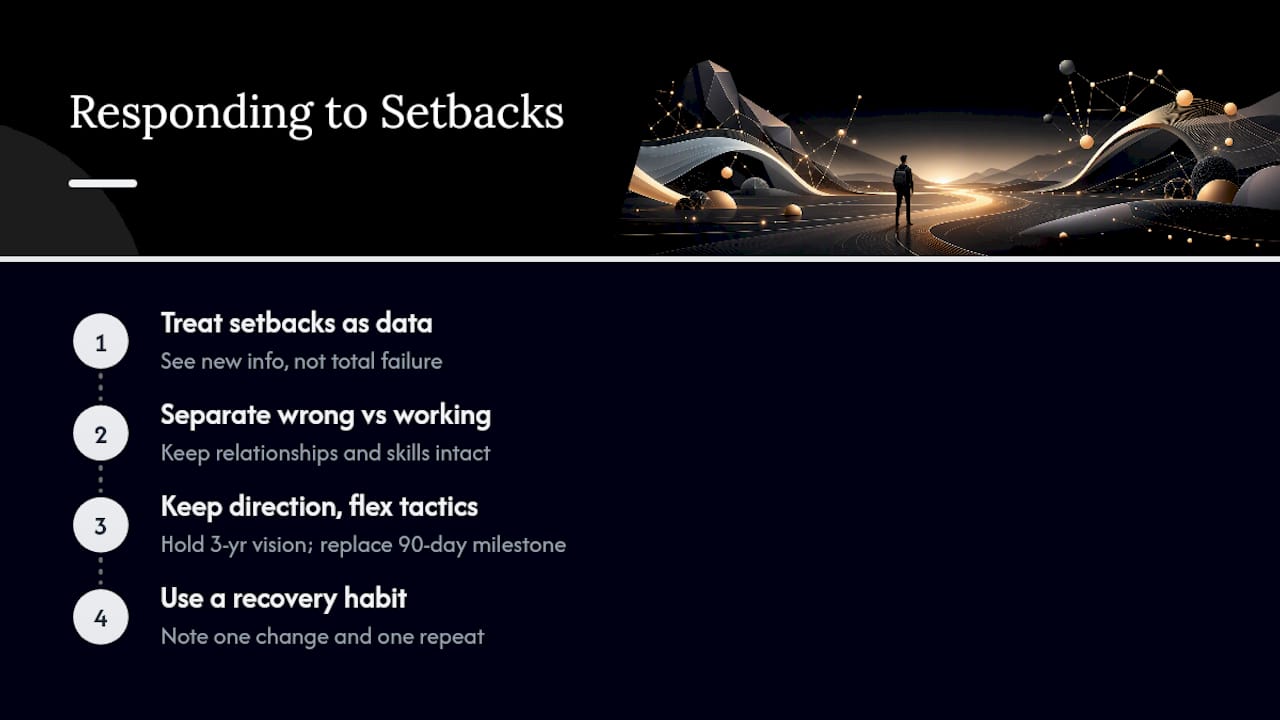
A stalled promotion or a project that falls apart doesn’t mean the plan failed. It means you got new data.
The mistake most people make is treating a setback as proof the whole plan was wrong, then abandoning it and starting from scratch. That’s expensive. It wastes the progress you already made building relationships and skills that still count.
A better response: separate what went wrong from what still works. If a stretch project got cancelled for budget reasons, the relationships you built during it are still real. If you got passed over for a promotion, ask specifically what the deciding factor was rather than assuming it was everything about you.
Resilience in career planning looks less like grit and more like flexibility. Keep the 3-year vision steady, but treat the 90-day milestones as expendable. If one doesn’t work, replace it, don’t rewrite the whole roadmap. That’s the practical version of an agile approach: the direction holds, the tactics flex.
Build in a recovery habit, too. After any real setback, write down one thing you’d do differently and one thing you’d repeat. That two-line note turns a bad quarter into usable information for the next one, instead of just a memory you’d rather avoid.
How Should You Ask for and Use Feedback?
Feedback is the fastest way to close the gap between how you think you’re performing and how you’re actually perceived, and most people wait far too long to ask for it.
The problem isn’t a lack of feedback. It’s that most feedback people get is either too vague (“great job this quarter”) or arrives only during formal reviews, months after it would have been useful.
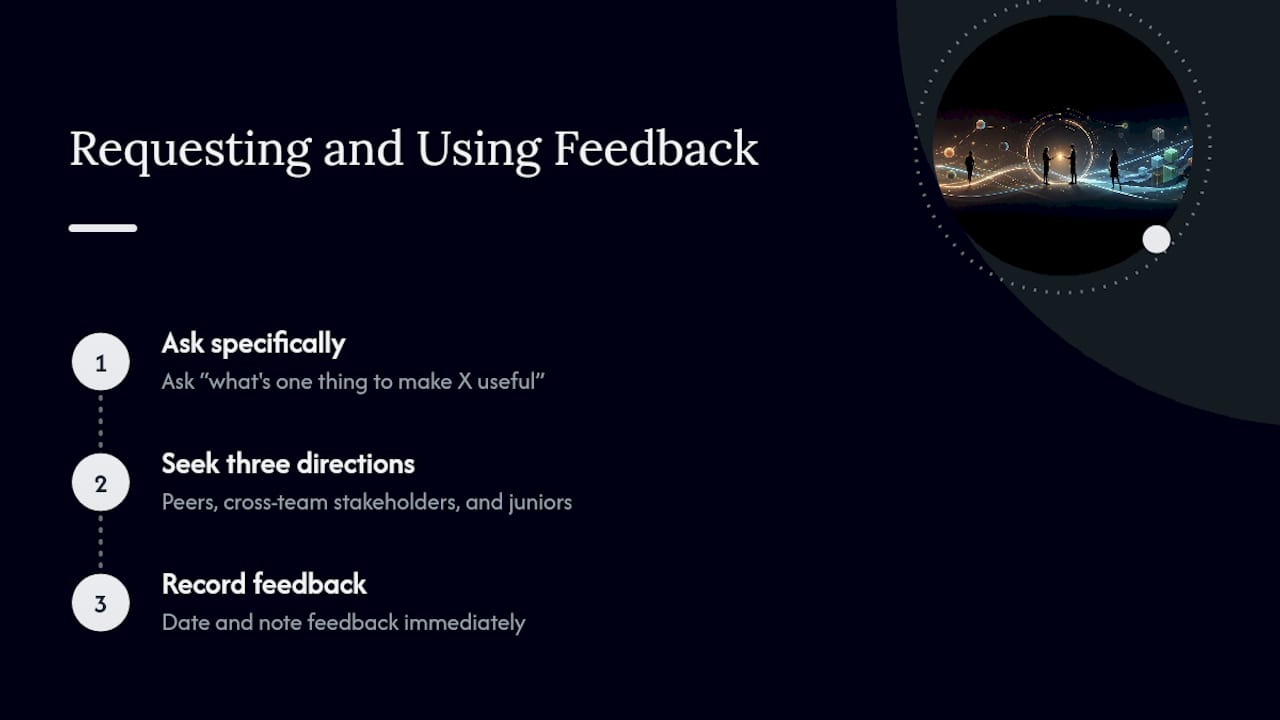
Ask for feedback more specifically and more often than feels comfortable. Instead of “how am I doing,” ask “what’s one thing that would make my work on X more useful to you.” That question is narrow enough that people actually answer it honestly.
Seek feedback from three directions, not just your manager: peers who see your daily work, stakeholders outside your team who only see your output, and anyone junior to you who might notice things a manager misses. Each angle catches something the others don’t.
Write feedback down immediately, even the informal kind from a hallway conversation. It’s easy to remember praise and conveniently forget critique. A simple running note, dated and specific, becomes real evidence for your next review and real material for adjusting your 90-day milestones.
Where Does Work-Life Balance Fit Into Career Planning?
A career plan that ignores your life outside work usually collapses within a year, because burnout doesn’t respect ambitious deadlines.
Work-life balance isn’t a competing priority to career growth. It’s the thing that determines whether you can sustain the effort long enough to see results. Stretch projects and visibility plays take real energy, and that energy is finite.
Build boundaries into the plan itself, not around it. If your 90-day milestone requires leading a cross-functional project, decide in advance what you’re willing to trade for it (maybe less time on a side hustle, not less time with family) and what you’re not.
Watch for a specific warning sign: if every milestone in your plan requires working evenings and weekends to hit, the plan is overbuilt for your actual capacity. Scale it down before you burn out and lose the progress entirely.
Planning My Next 90 Days: A Note on Protecting Focus
Pick one priority for the next 90 days and put weekly focus blocks on the calendar before anything else fills them. Everything else waits.
Protecting that time means saying no to requests that feel urgent but don’t move the milestone forward. Guard the runway you’ve built; it disappears fast if you let every meeting invite win by default.
Momentum comes from noticing progress, not just hitting the final number. Mark small wins as they happen. A completed milestone deserves five minutes of actual recognition, not an immediate jump to the next task.
— Povilas
Fund Your Growth Plan Without Guessing at the Cost
A career growth plan is only as strong as the budget behind it, and that’s where most people improvise. Course fees, certification costs, and even the unpaid time behind a stretch project all add up, and Finblog exists to help you plan for that side of the equation. Its roundup of online learning platforms compares costs across providers so you’re not overpaying for a course your gap analysis says you need. Pair that with Finblog’s guide to setting SMART financial goals to budget training investments the same way you budget any other financial goal. Finblog doesn’t replace a mentor or a stretch project. It’s the resource you check before you spend money on either. Visit Finblog to sign up for updates and start planning the financial side of your next career move.
Sources
For deeper reading on the frameworks used here, see Cornell Career Services on iterative PDPs, Canva’s plan template for the five core components, Glassdoor’s AI-age career guide for skill-gap mapping, and Goals & Progress for the Career Growth Compass diagnostic and internal mobility tactics.
- Career planning in the AI age: 10 actions for 2026 (Glassdoor)
- How to create a professional development plan for career growth (Cornell Career Services)