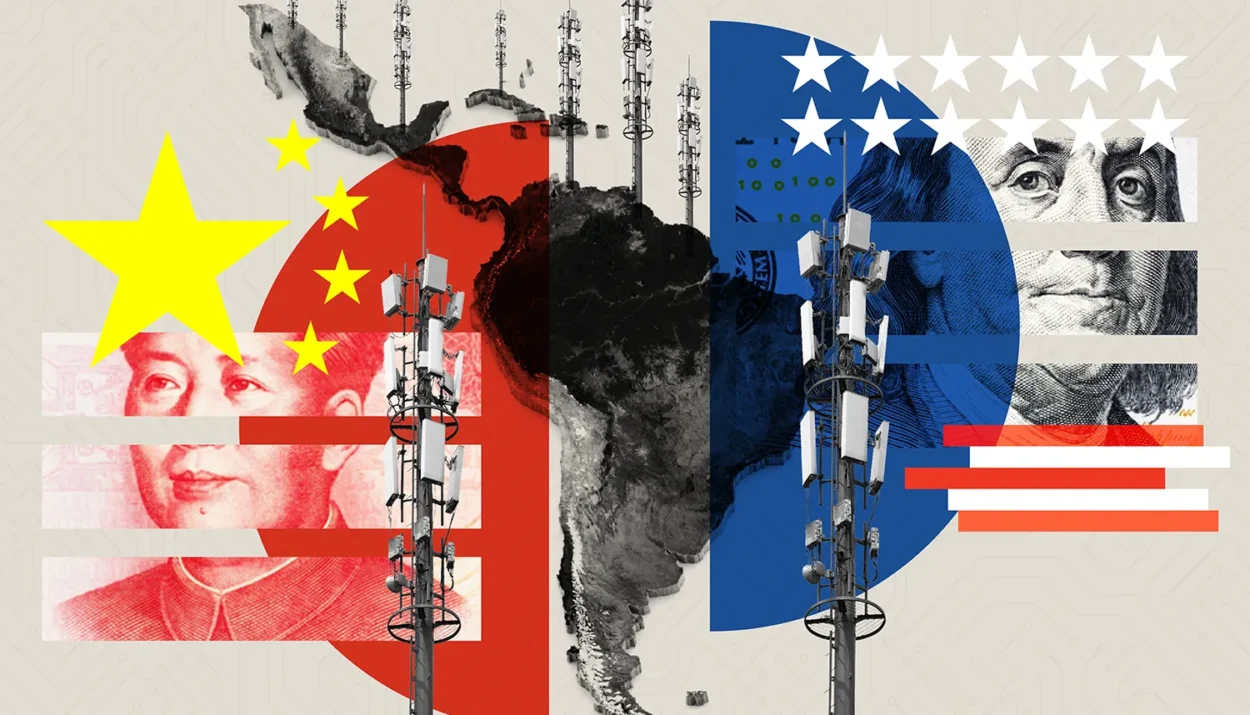

The US and China are competing for influence across Latin America, but they are increasingly using different tools. Washington still holds major political, security and trade advantages, while Beijing is expanding its economic presence into industries that could shape the region for decades.
China’s role is no longer mainly about buying copper, lithium, iron ore and other commodities. Chinese investment is moving further into electric vehicles, batteries, renewable energy, manufacturing, machinery, digital infrastructure and data centers, according to Bloomberg.
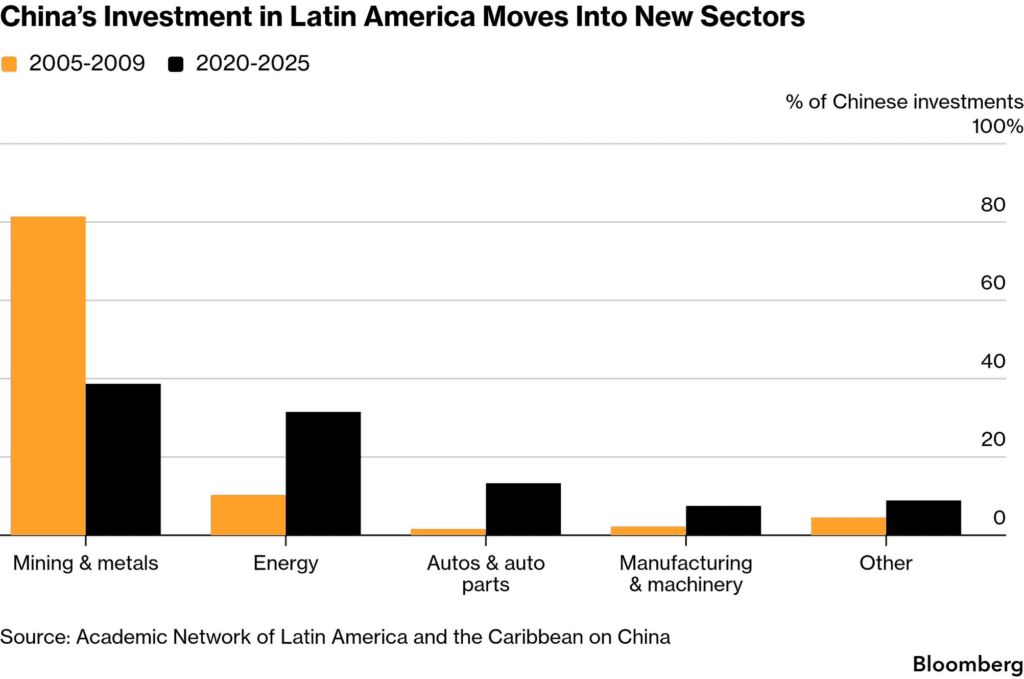
The shift is clear in investment patterns. Between 2005 and 2009, roughly 80% of Chinese investment in Latin America went into mining and metals. Between 2020 and 2025, that share fell to around 40%, while energy, autos, auto parts and manufacturing became much larger destinations for Chinese capital.
China Is Moving Up the Value Chain
Brazil provides one of the clearest examples. Chinese EV giant BYD has expanded aggressively in the country, building a nationwide presence while investing heavily in local manufacturing and marketing.
Infrastructure is another part of Beijing’s strategy. Chinese companies are involved in major projects across the region, including the Bogotá Metro, whose first line is being built by a Chinese-led consortium.
Even governments politically close to Washington continue courting Beijing. Ecuadorian President Daniel Noboa, a Trump ally with close US security ties, traveled to China seeking additional investment.
The relationship is also supported by rapidly growing trade. China has already become Latin America’s second-largest trading partner and South America’s largest export market. Bilateral trade was approaching $500 billion as early as 2022, compared with just over $14 billion in 2000.
More recent data suggest the relationship is still expanding. ECLAC estimated that Latin American exports to China increased 7% in 2025, faster than exports to the US, while imports from China jumped about 13%.
The US Still Has a Huge Economic Advantage
China’s rise does not mean the US has lost Latin America.
The region accounted for 19.2% of total US trade in 2024, including 23.2% of American goods trade. The US imported $661 billion in goods from Latin America and the Caribbean that year while exporting $517 billion to the region.
Washington has also scored important political wins and maintains deep security relationships across the region. Argentina, for example, has placed obstacles in front of Chinese-backed projects including a proposed nuclear power plant and telescope project.
The broader investment market remains enormous. Latin America and the Caribbean attracted $194.2 billion in foreign direct investment in 2025, up 1.7% from the previous year. Brazil alone received $77.7 billion, while Mexico attracted $43.2 billion.
Why This Competition Matters
The biggest change is therefore not simply that China is investing more. It is what China is investing in.
Beijing originally built much of its Latin American presence around access to commodities. Increasingly, Chinese companies are trying to participate in the next stage of the value chain by turning those resources into batteries, EVs, electricity, manufactured products and digital infrastructure.
For Latin American governments, choosing one side is often unnecessary. A country can maintain close security and trade relationships with Washington while accepting Chinese investment at the same time.
Bottom line: The US remains deeply embedded in Latin America’s economy and politics, but China is becoming harder to push out. Beijing’s expansion from commodities into technology, manufacturing and infrastructure means the US-China competition in Latin America is increasingly about who helps build the region’s future economy, rather than simply who buys its resources.
Related: Who does Iran trade with, and what could Trump’s ‘economic D-Day’ mean?