

TL;DR:
- Creating a valid will involves choosing a drafting method, listing assets, and signing with witnesses according to state laws.
- A well-prepared will ensures clear asset distribution, appointment of trusted executors, and proper storage to avoid disputes.
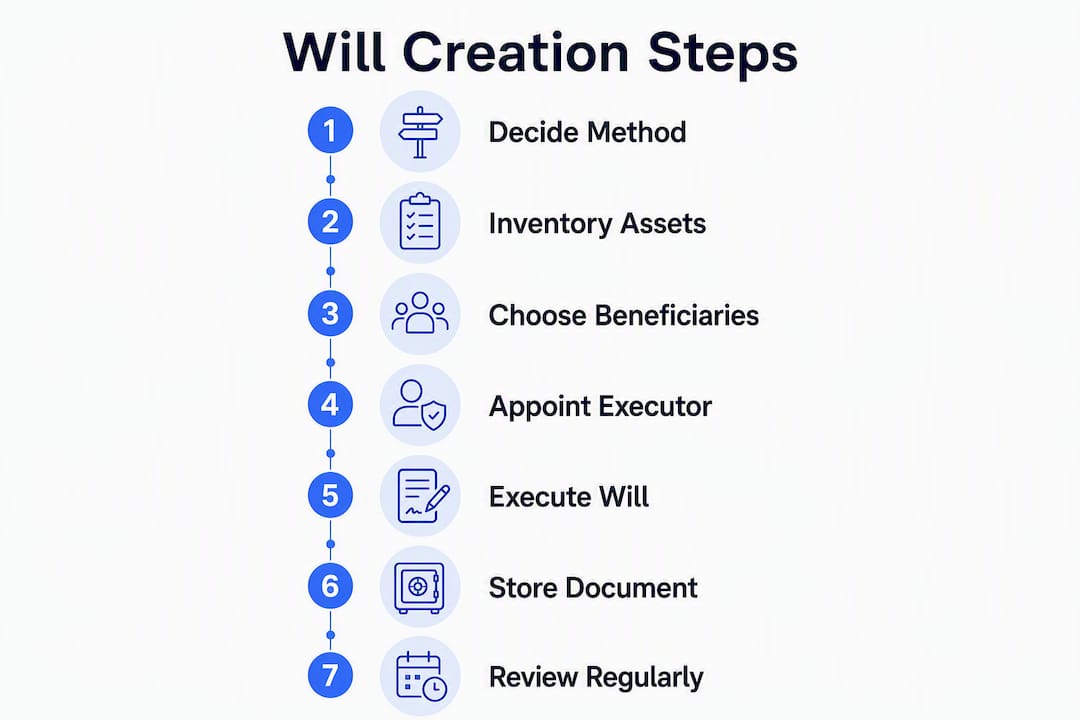
To set up a legally valid will in the United States, you need to choose how you’ll create it, inventory your assets, name your beneficiaries and executor, sign the document in front of the witnesses your state requires, and store the original somewhere your executor can actually find it. That’s the whole process. Everything else is detail.
Here’s where to start right now:
- Choose your method. An attorney, an online will-maker like FreeWill, or a DIY template. Simple estates can often use an online tool; complex situations need an attorney.
- List your assets. Real estate, bank accounts, investments, personal property, and business interests. Note which accounts already have beneficiary designations or transfer-on-death (TOD) designations, because those pass outside the will.
- Name beneficiaries and an executor. Pick a primary and at least one contingent beneficiary for each gift. Choose an executor you trust and name an alternate.
- Sign with witnesses. Most states require two disinterested adult witnesses. Some require notarization. Check your state’s probate court for exact rules.
- Add a self-proving affidavit. Signing before a notary at the same time creates a self-proving affidavit that can eliminate the need for witnesses to appear in probate later.
- Store the original safely. Tell your executor exactly where it is.
Table of Contents
- How to set up a will: a step-by-step walkthrough
- What state rules can affect your will’s validity
- Attorney, online will-maker, or DIY: which method fits you?
- How to execute, store, and update your will
- Common mistakes that can undermine your will
- What to bring to an attorney meeting and what to ask
- How a will affects the probate process
- What your will cannot control
- How to include digital assets in your will
- How long does creating a will take, and what does it cost?
- Will validity requirements in major U.S. states
- How to revoke or amend your will
- Key Takeaways
- Why setting up a will is an act of care, not a chore
- Finblog can help you take the next step
- Useful sources and further reading
How to set up a will: a step-by-step walkthrough
Step 1: Decide how you’ll prepare the document
Three realistic options exist: hire an estate attorney, use an online will-maker like FreeWill, or fill out a DIY template. Each fits a different situation.
An attorney makes sense for blended families, business ownership, large estates, or any situation where you’re unsure what your state requires. Online tools work well for straightforward estates with clear beneficiary designations and no major tax concerns. DIY templates carry the highest risk of formatting errors and ambiguous language that can trigger probate litigation costing far more than the drafting fee you saved.
Step 2: Inventory your assets
Write down everything you own: real property (with deed information), bank accounts without TOD designations, brokerage accounts, vehicles, valuable personal property, and any business interests. Separate the assets your will can control from those that pass automatically — jointly titled property with right of survivorship, retirement accounts with named beneficiaries, and life insurance all transfer outside the will regardless of what the document says.

Step 3: Choose beneficiaries and describe your gifts
Name a primary beneficiary for each asset or gift, and always name a contingent beneficiary as a fallback. Naming alternate beneficiaries for every gift reduces the risk of any portion of your estate falling into intestacy. Specific bequests name a particular item or dollar amount to a particular person; the residuary clause catches everything else and should name its own primary and contingent beneficiaries.
Step 4: Appoint an executor and an alternate
Your executor (sometimes called a personal representative) manages the probate process, pays debts, and distributes assets. Choose someone organized and trustworthy, and name at least one alternate in case your first choice is unable or unwilling to serve. Granting your executor broad powers in the will itself — to sell property, manage investments, and pay expenses without court approval for each action — prevents delays.

Step 5: Nominate a guardian for minor children
If you have children under 18, this is the most consequential decision in the document. Without a guardian nomination, a court decides who raises your children, and it may not choose who you’d pick. Use the guardian’s full legal name and address, and get their consent before naming them. Courts treat a parent’s nomination seriously, though they retain authority to act in the child’s best interest.
Pro Tip: Name a backup guardian too. Life circumstances change, and a single nomination with no fallback leaves the court with no guidance if your first choice is unavailable.
Step 6: Consider a testamentary trust
If a beneficiary is a minor, has a disability, or struggles with financial management, a testamentary trust created inside the will holds assets on their behalf until conditions you specify are met. The trust only activates at death and is administered through probate, so it’s simpler than a living trust but still provides meaningful protection. For generational wealth planning, a testamentary trust is often the right middle ground between outright gifts and a full revocable living trust.
Step 7: Draft the document
A valid will typically includes: an opening declaration (your name, residence, and statement that this is your will), a revocation clause canceling all prior wills, specific bequests, a residuary clause, executor and guardian appointments, and a signature block. Testamentary capacity requires that you understand what property you own, who your natural heirs are, what a will does, and how those elements relate to each other. When capacity might be questioned later, a physician’s note documenting your mental state at the time of signing can head off a contest.
Step 8: Execute the will properly
Sign the will in front of your witnesses at the same time. Most states require two disinterested adult witnesses — people who receive nothing under the will. Some states accept one witness; Louisiana has its own formal requirements. After signing, execute a self-proving affidavit before a notary. This single step can eliminate the need for your witnesses to appear in probate court years later, when they may be difficult to locate.
Step 9: Store it and tell your executor
Store the original in a fireproof home safe, with your attorney, or in a probate court safekeeping program if your state offers one. Tell your executor exactly where it is and how to access it. Update beneficiary designations on IRAs, 401(k)s, and life insurance to match your intentions, and set a calendar reminder to review the will every few years.
What state rules can affect your will’s validity
State law governs will execution, and the differences matter. A will that’s perfectly valid in one state can face challenges in another.
The common baseline across most states: the testator must be at least 18, have testamentary capacity, and sign the will in front of two adult witnesses who are not beneficiaries. Minnesota, for example, follows this standard precisely — the testator must be 18, have capacity, and sign before two witnesses; a self-proving affidavit reduces probate friction there as it does in most states.
Key variations to know:
- Holographic wills. About half of U.S. states recognize handwritten, unwitnessed wills if the material provisions are in the testator’s own handwriting and the document is signed and dated. California, Texas, and Virginia accept them; New York and Florida do not.
- Community property states. Arizona, California, Idaho, Louisiana, Nevada, New Mexico, Texas, Washington, and Wisconsin treat most assets acquired during marriage as equally owned by both spouses. A will can only dispose of your half of community property, not your spouse’s share.
- Electronic wills. A growing number of states have adopted versions of the Uniform Electronic Wills Act, allowing wills to be signed and witnessed remotely. Check your state’s probate court website for current status, since this area of law is still evolving.
- Military wills. Active-duty service members may have access to simplified execution rules or JAG-prepared wills at no cost.
- Wills executed in another state. Most states will recognize a will that was validly executed under the laws of the state where it was signed, but verify this with your state’s probate court before relying on it.
Always verify your state’s exact execution requirements at your state probate court’s self-help center or official website before signing. California Courts, for example, maintains a self-help resource that explains local rules clearly.
Attorney, online will-maker, or DIY: which method fits you?
The right method depends on your estate’s complexity, your budget, and your tolerance for risk.
When to hire an attorney
Hire an estate attorney if any of these apply: you own a business, you have a blended family with children from prior relationships, your estate may be subject to federal or state estate taxes, you want to disinherit someone, you’re dealing with a disabled beneficiary who receives government benefits, or you’ve been through a recent divorce. An attorney’s fee is a one-time cost; a contested will or a probate dispute costs far more.
When an online will-maker works
For a straightforward estate — a married couple with children, clear beneficiary designations, no business interests, and assets below the federal estate tax threshold — an online tool like FreeWill can produce a legally valid document at a fraction of the cost. FreeWill is free for individuals and is designed to walk you through the process state by state.
Cost comparison
| Method | Typical cost range | Complexity handled | Risk of error | State-specific guidance |
|---|---|---|---|---|
| Estate attorney (simple will) | $150–$400 | Low to moderate | Low | Yes, built in |
| Estate attorney (complex will) | $500–$2,000+ | High | Very low | Yes, built in |
| Online will-maker (e.g., FreeWill) | — | Low to moderate | Moderate | Varies by platform |
| DIY template | — | Low only | Higher | Minimal |
Cost figures reflect Minnesota attorney and online service ranges and are representative of many U.S. markets; your state and attorney may differ.
Pro Tip: If you use an online will-maker, download the final document and compare the execution instructions it provides against your state probate court’s requirements before you sign. Platforms update their templates, but state laws change too.
How to evaluate an online provider
- Confirm the platform generates state-specific execution instructions, not a generic template.
- Check that you receive an exportable, printable signed copy.
- Look for an option to have an attorney review the finished document.
- Verify the platform’s reputation through sources like the BBB or Trustpilot before entering personal information.
How to execute, store, and update your will
The signing ceremony
Gather everyone in the same room at the same time: you (the testator), your two witnesses, and a notary if you’re adding a self-proving affidavit. Sign the will first, then have each witness sign while you and the other witness are present. The notary then acknowledges the signatures for the affidavit. The self-proving affidavit is a small step that can save your executor significant time and expense in probate.
Witnesses must be disinterested — they should receive nothing under the will. A witness who is also a beneficiary may be disqualified from inheriting in some states, even if the will itself remains valid.
Where to store the original
- Fireproof home safe: Accessible, but only if your executor knows the combination and can get to it after your death.
- Attorney’s office: Many estate attorneys store originals for clients at no charge. Your executor knows exactly where to go.
- Probate court safekeeping: Some states allow you to file the original with the probate court during your lifetime. It’s retrievable only by you or, after death, by your executor.
- Safe-deposit box: Convenient but problematic. After death, accessing a safe-deposit box often requires a court order, which delays the process. Use this option only if your executor is a joint holder on the box.
Pro Tip: Write a one-page “executor letter” that lists where the original will is stored, where your key financial accounts are held, and who your attorney is. Keep it with the will or in a place your executor can access immediately.
When to review and update
Review your will every 3–5 years, and immediately after any of these events: marriage, divorce, the birth or adoption of a child, the death of a beneficiary or executor, a significant change in assets, or a move to a different state. Updating your financial plan after major life events applies directly to your will — the same triggers that prompt a financial review should prompt a will review.
Common mistakes that can undermine your will
Most will problems are preventable. Here are the ones that show up most often in probate disputes.
- Failing to update beneficiary designations. Retirement accounts and life insurance pay to whoever is named on the beneficiary form, regardless of what your will says. An ex-spouse named on a 401(k) will receive those funds even if your will leaves everything to your current spouse. Beneficiary designations override wills — sync them every time you update the document.
- Vague asset descriptions. “My jewelry” or “my car” creates disputes when you own multiple vehicles or a collection. Use specific descriptions: make, model, VIN, or appraised item description.
- Using an interested witness. A beneficiary who witnesses the will may lose their inheritance in states that apply the “interested witness” rule. Use people who receive nothing under the document.
- Storing the original where no one can find it. A will that can’t be produced is treated as if it doesn’t exist in most states. Tell your executor where it is, in writing.
- Skipping the self-proving affidavit. Without it, witnesses may need to appear in probate court years later. Locating them is not guaranteed.
- Drafting your own will for a blended family. This is the highest-risk DIY scenario. Competing claims from children of prior relationships and a current spouse require careful drafting that generic templates rarely handle correctly.
A will that was never updated after a divorce, a remarriage, or the birth of a child is one of the most common sources of probate litigation in the United States; avoid these pitfalls by learning about common budgeting sins to avoid for better family finances to help keep your family’s financial plans aligned. The document you signed ten years ago may actively contradict your current wishes — and the court will follow the document, not your intentions.
For a broader look at financial planning mistakes that affect estate outcomes, Finblog’s resources cover the overlap between everyday financial decisions and long-term estate planning.
What to bring to an attorney meeting and what to ask
Walking into an attorney consultation prepared cuts the meeting time in half and reduces your bill.
Documents to bring
- A complete asset list: real estate deeds, account statements, vehicle titles, and business agreements
- Current beneficiary designation forms for all retirement accounts and life insurance policies
- Any prior wills or codicils
- Names, addresses, and contact information for your proposed executor, alternate executor, and guardian
- Government-issued ID for yourself
Questions to ask
- What is your fee structure — flat fee or hourly — and what does it include?
- Is my estate likely to go through probate, and what can we do to minimize that?
- Do you recommend a testamentary trust or a revocable living trust for my situation?
- What powers should I grant my executor, and should I waive the bond requirement?
- Are there any state or federal estate tax considerations I should plan around?
- How long will it take to draft and execute the documents?
- Will you store the original, and what happens to it if your firm closes?
Pro Tip: Ask for a sample deliverable — a redacted will the attorney has drafted for a similar situation. This tells you more about their drafting quality than any credential.
What to expect in a first consultation
Most estate attorneys offer a 30–60 minute initial consultation, sometimes at no charge. They’ll ask about your family structure, asset types, and goals. Come with your asset list and beneficiary information already organized. The estate planning essentials Finblog covers can help you frame the right questions before you walk in.
How a will affects the probate process
Probate is the court-supervised process of validating a will and distributing an estate. Having a valid, properly executed will makes probate faster and more predictable. Without one, the estate passes under your state’s intestacy laws, which may distribute assets in ways you’d never choose.
When a person dies with a will (called dying “testate”), the executor files the original will with the probate court in the county where the deceased lived, along with a death certificate and a petition to open the estate. The court validates the will, appoints the executor formally, and supervises the payment of debts and distribution of assets. The process typically takes several months to over a year, depending on estate complexity and state court backlogs.
A self-proving affidavit speeds this up by eliminating the need for witnesses to testify that the signing was valid. A well-drafted will with clear executor powers reduces the number of court approvals needed for routine estate management decisions.
Assets that pass outside the will — jointly titled property, retirement accounts, life insurance, and assets in a living trust — skip probate entirely. For many families, a combination of a will and properly designated beneficiary forms keeps most assets out of probate while the will handles everything else.
What your will cannot control
A will is powerful, but it doesn’t control everything. Several categories of assets pass outside the will regardless of what the document says.
- Jointly titled property with right of survivorship. When two people own property as joint tenants with right of survivorship (JTWROS), the surviving owner inherits automatically. The will has no effect on that transfer.
- Retirement accounts (IRAs, 401(k)s, 403(b)s). These pass to whoever is named on the beneficiary designation form. The will cannot override it.
- Life insurance proceeds. Same rule: the named beneficiary on the policy receives the proceeds directly.
- Assets held in a revocable living trust. The trust document controls distribution, not the will.
- Payable-on-death (POD) and transfer-on-death (TOD) accounts. Bank accounts and brokerage accounts with these designations transfer automatically to the named recipient.
- Your spouse’s share of community property. In community-property states, you can only will your half of jointly acquired marital assets.
Understanding what falls outside the will is as important as drafting the will itself. A thorough wealth protection strategy coordinates all of these mechanisms together.
How to include digital assets in your will
Digital assets are easy to overlook and surprisingly difficult to transfer after death. They include cryptocurrency wallets, online bank accounts, email and social media accounts, digital photo libraries, domain names, online businesses, and subscription services.
The challenge is access. A will can direct who receives a digital asset, but it can’t transfer a password. Most platforms have their own policies on account access after death, and some — like Google and Facebook — have legacy contact or inactive account manager features that operate independently of a will.
To handle digital assets effectively:
- Create a digital asset inventory. List every account, the platform, and the type of asset. Store it separately from the will (never put passwords in the will itself, which becomes a public document in probate).
- Use a password manager. Tools like 1Password or Bitwarden allow you to grant emergency access to a trusted person without exposing all your credentials at once.
- Reference the inventory in your will. Direct your executor to the location of the digital asset inventory and grant them explicit authority to access, manage, and distribute digital property.
- Check state law. Many states have adopted the Revised Uniform Fiduciary Access to Digital Assets Act (RUFADAA), which gives executors legal authority to access digital accounts. Verify your state’s version at your state’s legislature website.
- Cryptocurrency requires special handling. If you hold crypto, your executor needs the private key or seed phrase. Without it, the assets are permanently inaccessible. Store this information in a secure, offline format and tell your executor where it is.
How long does creating a will take, and what does it cost?
The timeline depends almost entirely on your method and how prepared you are.
An online will-maker like FreeWill can produce a completed, printable will in under an hour for a straightforward estate. Add the signing ceremony and you’re done in an afternoon. An attorney-drafted will typically takes one to three weeks from the initial consultation to the signing appointment, depending on the attorney’s schedule and the complexity of your situation.
Cost follows the same pattern. Simple attorney-drafted wills commonly run $150–$400; complex wills with trusts or tax planning often reach $500–$2,000 or more. Online services range from free (FreeWill) to around $120 for platforms that include attorney review. DIY templates cost little to nothing upfront but carry the risk of errors that can cost an estate far more in probate.
The factors that push attorney costs higher: blended families, business ownership, out-of-state property, potential estate tax exposure, and any situation where someone might contest the will. For financial estate planning that goes beyond the will itself, those same complexity factors usually signal the need for a broader planning conversation.
Will validity requirements in major U.S. states
Beyond the general two-witness rule, several states have requirements worth knowing before you sign.
California: The testator must be 18 or older and of sound mind. Two witnesses must sign, both present at the same time, and neither can be a beneficiary (or their inheritance may be voided). Holographic wills are valid if the material provisions and signature are in the testator’s handwriting. California does not require notarization, but a self-proving affidavit is available.
Texas: Two witnesses required; holographic wills accepted. Texas is a community-property state, so spouses can only will their half of community assets. Texas also allows a “self-proved” will through notarization.
Florida: Two witnesses required; holographic wills are NOT recognized. Florida requires the testator and both witnesses to sign in each other’s presence. Notarization is optional but enables a self-proving affidavit.
New York: Two witnesses required; holographic wills are not generally recognized (limited exception for military personnel). New York does not require notarization for a basic will, but a self-proving affidavit requires a notary.
Illinois: Two witnesses required; holographic wills are not recognized. Illinois does not require notarization for the will itself, but a self-proving affidavit is available and recommended.
Always confirm current requirements at your state’s official probate court or legislature website. Laws change, and a will executed under outdated rules may face challenges.
How to revoke or amend your will
Revoking a will
You can revoke a will at any time while you have testamentary capacity. The most reliable method is to execute a new will that contains an explicit revocation clause canceling all prior wills and codicils. Physical destruction — burning, tearing, or shredding the original with the intent to revoke — also works in most states, but only if you destroy the original. Destroying a copy has no legal effect.
Marriage and divorce automatically affect wills in many states. Some states revoke a will entirely upon marriage; others revoke only the provisions that benefit a former spouse after divorce. Never assume your existing will reflects your current marital status without checking your state’s rules.
Amending a will with a codicil
A codicil is a formal amendment to an existing will. It must be executed with the same formalities as the original — signed and witnessed by the required number of witnesses. Codicils work well for minor changes: updating an executor, adding a specific bequest, or changing an address. For substantial changes, drafting a new will is cleaner and less likely to create ambiguity between the original document and the amendment.
One practical note: if you’ve made several codicils over the years, consolidate them into a new will. A will with multiple codicils is harder to interpret and more likely to generate disputes in probate.
Key Takeaways
Setting up a valid will requires choosing your method, executing the document with the witnesses your state requires, and keeping beneficiary designations synchronized with the will’s instructions.
| Point | Details |
|---|---|
| Execute with witnesses | Most states require two disinterested adult witnesses; sign all at once and add a self-proving affidavit before a notary. |
| Sync beneficiary designations | Retirement accounts and life insurance override the will; update those forms every time you revise the document. |
| Review every 3–5 years | AARP recommends reviewing after major life events: marriage, divorce, births, large asset changes, or a move to a new state. |
| Store the original accessibly | A safe-deposit box can require a court order after death; a fireproof home safe or attorney’s office is more practical for your executor. |
| Finblog for next steps | Finblog’s estate planning resources help you prepare for an attorney consultation or get started with a simple estate plan today. |
Why setting up a will is an act of care, not a chore
Most people delay writing a will because it forces them to think about death. That framing is backwards. The document isn’t for you. It’s for the people who will be managing your affairs at the worst possible moment in their lives, without a roadmap, under time pressure, and possibly in conflict with each other.
A will that names a guardian for your children, gives your executor clear authority, and specifies exactly who gets what doesn’t just protect assets. It removes an enormous burden from the people you love most. The families who struggle most in probate are rarely the ones with complicated estates. They’re the ones where no one knew what the deceased wanted, and everyone had a different answer.
Finblog covers estate planning essentials and wealth transfer strategies for readers who want to go deeper than the will itself. For complex situations — blended families, business succession, large estates — the article’s guidance is a starting point, not a substitute for licensed counsel.
Finblog can help you take the next step
Getting a will done is one of the highest-leverage financial decisions you can make, and the barrier is lower than most people think. Finblog provides educational resources, planning checklists, and access to consultation referrals for readers who want guidance without the confusion of figuring out where to start.
Whether you’re ready to use a free tool like FreeWill for a simple estate or you need to connect with an estate attorney for something more complex, Finblog’s resources help you walk in prepared. Visit finblog.com to access estate planning guides, download preparation checklists, or get matched with a planning consultation.
Finblog is an informational and referral resource. The content on this site is general financial education, not legal advice. Complex estate situations require a licensed estate attorney in your state.
Useful sources and further reading
The sources below back the claims in this article and are worth bookmarking for state-specific verification.
National guidance:
- How to Write a Will — AARP: practical execution tips, self-proving affidavit guidance, and update cadence recommendations.
- How to Prepare a Will: Step-by-Step Process — LegalClarity: testamentary capacity, beneficiary designation priority, and drafting best practices.
- How Can I Make a Will Without a Lawyer? — NCOA: holographic vs. typed will options and when DIY is appropriate.
State-specific resources:
- Wills, Estates, and Advance Care Planning — California Courts Self-Help: California execution requirements and probate process overview.
- Making a Will — Michigan Legal Help: Michigan-specific rules and plain-language guidance.
- Writing a Will in Minnesota: Guide — LegalFeesGuide: Minnesota execution requirements and DIY risk analysis.
Finblog resources for further reading:
- Estate Planning Essentials: Protect Your Family’s Future
- Financial Estate Planning: Your Complete 2026 Guide
- Wealth Transfer Strategies: Secure Your Financial Legacy
This article is general information, not legal advice. Verify current execution requirements with your state’s probate court or a licensed estate attorney before signing any legal document.