



TL;DR:
- Beginners should focus on one simple trading strategy while strictly limiting risk to 1% per trade.
- Consistent journaling, disciplined execution, and understanding basic technical concepts are essential for long-term success.
The four basic stock trading strategies worth starting with are trend-following/momentum, swing trading, dollar-cost averaging (DCA), and simple scalping. Before you pick one, there is a single rule that matters more than any strategy: never risk more than 1% of your account on a single trade. That one constraint keeps you alive long enough to actually learn.
Here is the short version:
- Trend-following/momentum: Buy stocks moving in a clear direction, confirmed by volume. Best for beginners with a few hours per week.
- Swing trading: Hold for a few days, targeting a price move between support and resistance. Works well if you can check charts once or twice a day.
- Dollar-cost averaging (DCA) / buy-and-hold: Invest a fixed amount on a regular schedule. The lowest-effort approach and the most forgiving for beginners.
- Simple scalping: Very short intraday trades lasting minutes. High skill demand — treat it as practice, not income, at first.
The single non-negotiable rule: Define your stop-loss and position size before you place any trade. A plan you make in the moment, under pressure, is not a plan.
Your immediate first action: Open a cash account (not a margin account) and paper-trade one strategy for at least one week before putting real money in. The SEC investor bulletin specifically recommends using limit orders rather than market orders, since market orders can produce unexpected fills in fast or thinly traded conditions.
Pro Tip: Default to limit orders from day one. Set the price you are willing to pay, submit the order, and let the market come to you. It adds a moment but helps avoid poor fills.
Table of Contents
- How does your trading timeframe change which strategy you should use?
- What are the most practical beginner strategies and how do you use each one?
- Which technical concepts should you learn before placing your first trade?
- What are the non-negotiable risk rules every beginner must follow?
- What do you need to know about order types before you place a trade?
- A step-by-step checklist to get started this week
- What mistakes do most beginners make, and how do you fix them fast?
- A research-backed 8–12 week starter plan with weekly objectives
- Key Takeaways
- Why patient habits beat clever hacks in trading
- Finblog’s beginner resources can help you follow through
- Useful sources and recommended further reading
How does your trading timeframe change which strategy you should use?
The timeframe you trade in shapes everything: how often you watch your screen, what tools you need, how much capital you require, and how much emotional energy you burn. Getting this wrong is one of the most common early mistakes.
| Timeframe | Holding Period | Monitoring Needed | Skill Level | Best For |
|---|---|---|---|---|
| Scalping | Seconds to minutes | Constant, real-time | High | Active learners with dedicated screen time |
| Day trading | Minutes to hours (closed by end of day) | Continuous during market hours | High | Full-time or near-full-time traders |
| Swing trading | 2–10 days | Once or twice daily | Moderate | Part-time traders with a day job |
| Position trading | Weeks to months | Weekly check-ins | Low–Moderate | Long-term investors, beginners with patience |
Active trading timeframes are defined by holding period, but the real difference is what each demands from you personally.
Scalping requires a direct-access platform, Level 2 quotes, and the ability to make fast decisions without second-guessing. It is not a beginner’s first strategy for building wealth; it is a skill-building exercise that teaches you how price moves in real time.
Day trading means closing all positions before the market closes at 4:00 PM ET. If you use a margin account and execute four or more day trades within five business days, FINRA’s Pattern Day Trader rule kicks in and requires a minimum $25,000 account balance. A cash account sidesteps this entirely.
Swing trading is the sweet spot for most beginners with a regular job. You analyze charts in the evening, set your orders, and check in the next morning. The emotional pace is manageable.
Position trading overlaps with buy-and-hold investing. You are holding for weeks or months, so short-term noise matters very little. Tax treatment is also simpler: positions held longer than one year qualify for long-term capital gains rates, which are lower than ordinary income rates for most taxpayers.
When-to-choose rule of thumb: If you have less than two hours a day, start with swing trading or DCA. If you have a full trading day and want to learn execution mechanics, paper-trade day trading first. Never scalp with real money until you have at least 50 paper trades logged.
What are the most practical beginner strategies and how do you use each one?
Trend-following / momentum
A momentum trade is simple: find a stock moving in a clear direction, confirm the move with volume, and enter in the direction of the trend. You are not predicting a reversal; you are joining a move already in progress.

Example: Stock XYZ has been making higher highs for three days. Volume is above its 20-day average. You buy when price pulls back slightly to the 10-day moving average, set a stop-loss 2% below your entry, and target a moderate gain. That is a 2:1 reward-to-risk ratio.
Main risk: Momentum reverses fast. A news event or earnings report can flip a trend in minutes. Keep stops tight.
Swing trading
Swing trading targets the move between a support level (where price tends to bounce) and a resistance level (where it tends to stall). You hold for days, not hours.
Example: Stock ABC has bounced off $45 three times in the past month. It is trading at $46. You buy at $46, place a stop at $44 (below support), and target $52 (near the previous resistance high). Risk is $2 per share; potential reward is $6. That is a 3:1 ratio.
When to use it: Trending or range-bound markets both work. Avoid swing trading into a major earnings announcement unless you are comfortable with gap risk.
Dollar-cost averaging / buy-and-hold
DCA and passive index investing are the most reliable low-effort approaches for beginners who do not want to monitor charts daily. You invest a fixed dollar amount on a set schedule, say $100 every two weeks into an S&P 500 index ETF, regardless of whether the market is up or down. Over time, you buy more shares when prices are low and fewer when they are high.
This is not exciting. It is also the strategy most beginners actually stick with long enough to see results.
Simple scalping (as a learning tool)
Scalping involves very short trades lasting minutes, targeting a small price move. The profit per trade is tiny, so you need high accuracy and low fees to make it work. For beginners, treat scalping as a simulator exercise, not a primary strategy.
Example: You notice a stock opening with strong volume and a gap up. You buy at the open, target a 0.5% move, and exit within 10 minutes. Stop is placed just below the opening candle’s low.
Pro Tip: Pick two indicators maximum to confirm any trade entry. One trend indicator (like a moving average) and one momentum indicator (like RSI) is enough. Adding more indicators does not add clarity; it adds noise and hesitation.
Warren Buffett’s simplified rule applies here too: start with companies you understand. If you work in healthcare, you already know which drug approvals matter. That personal knowledge narrows your watchlist and reduces the research burden immediately.
Which technical concepts should you learn before placing your first trade?
You do not need to master technical analysis before trading. You need four concepts, applied consistently.
Support and resistance are price levels where buying or selling pressure has historically been strong. Support is a floor; resistance is a ceiling. When price breaks through resistance on high volume, that level often becomes new support. These levels are your map for placing stops and targets.
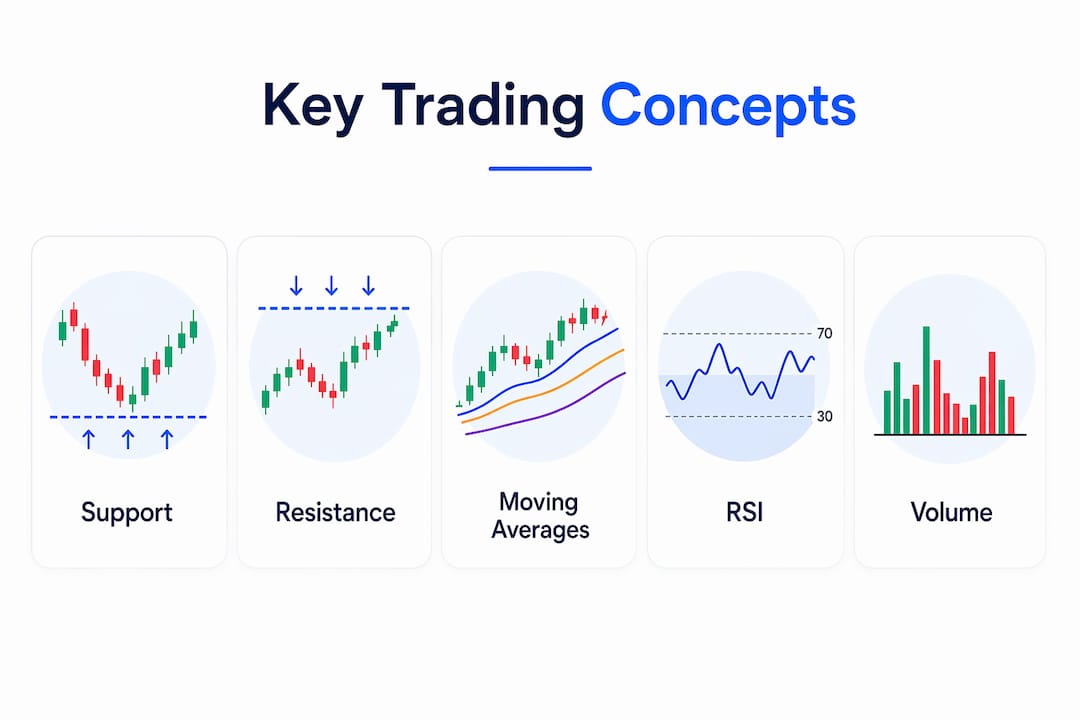
Moving averages smooth out price data so you can see the trend clearly. The 50-day simple moving average (SMA) and the 200-day SMA are the most widely watched. When price is above the 50-day SMA and the 50-day is above the 200-day, the stock is in an uptrend. The exponential moving average (EMA) weights recent prices more heavily and reacts faster, which makes it useful for shorter timeframes.
RSI (Relative Strength Index) measures momentum on a scale of 0–100. Readings above 70 suggest a stock may be overbought; readings below 30 suggest oversold. For a beginner, the most practical use is simple: avoid buying a stock with RSI above 75, and look for entries when RSI is between 40 and 60 during an uptrend.
Volume confirms everything else. A price breakout on low volume is suspect. The same breakout on two to three times average volume is credible. Always check volume before acting on a price signal.
How to combine them in a trade: Price crosses above the 50-day SMA. RSI is at 52 (not overbought). Volume is 1.5 times the 20-day average. That is a reasonable entry setup. Place your stop below the SMA and set a target at the next resistance level.
A useful framework for combining fundamental cues with technical setups is covered in this valuation analysis, which shows how a stock’s valuation narrative can shift before the price chart confirms it.
What are the non-negotiable risk rules every beginner must follow?
Risk management is not optional. It is the only reason you will still have an account in six months.
The 1% rule and position sizing
Never risk more than 1% of your total account on a single trade. The position-sizing formula converts that rule into a share count:
Number of shares = (Account value × Risk %) ÷ (Entry price − Stop-loss price)
Example: Account = $5,000. Risk = 1% = $50. Entry = $20. Stop = $18.50. Distance = $1.50.
Shares = $50 ÷ $1.50 = 33 shares. Maximum loss on this trade: $50.
That math takes 30 seconds and removes all guesswork about how many shares to buy.
Risk-reward ratio
For every dollar you risk, you should target a reasonable potential gain higher than the risk. A 1.5:1 ratio is the floor; 2:1 is a reasonable beginner target. At 2:1, you can be wrong on half your trades and still break even before fees.
Pre-trade checklist
Before placing any order, confirm all five of these:
- Entry price defined
- Stop-loss level set
- Profit target set
- Position size calculated using the formula above
- Rationale written in your trade journal (one sentence is enough)
Margin warning: Margin amplifies both gains and losses. A 10% move against a 2:1 leveraged position wipes out 20% of your capital. Beginners should avoid margin entirely. A cash account eliminates margin risk and the Pattern Day Trader constraint simultaneously.
Averaging down (buying more of a losing position to lower your average cost) feels logical but often accelerates losses. If your stop is hit, exit. Do not negotiate with a losing trade.
What do you need to know about order types before you place a trade?
Order types are the vocabulary of execution. Using the wrong one at the wrong time costs money.
- Market order: Executes immediately at the best available price. Fast, but in volatile or thinly traded stocks, the fill price can be far from what you expected. Use sparingly.
- Limit order: Executes only at your specified price or better. You control the fill price. This is the default for beginners and the order type you should use for most entries and exits.
- Stop-loss order: Triggers a market order when price hits your stop level. It exits your position automatically but can suffer slippage in fast markets.
- Stop-limit order: Triggers a limit order at your stop level. Reduces slippage risk but may not fill if price gaps through your limit. Know this trade-off before relying on it.
- GTC (Good Till Canceled): Keeps your order active until filled or manually canceled. Useful for swing trades where you set an entry and walk away.
- Day order: Expires at market close if not filled. The default for most platforms.
For beginners, the practical rule is straightforward: use limit orders for entries, use stop-loss orders for exits, and avoid market orders except in highly liquid stocks when speed is genuinely critical. Check your broker’s fee schedule too. Even “commission-free” brokers earn on the spread through payment for order flow, which is worth understanding before you assume trading is free.
A step-by-step checklist to get started this week
Getting started does not require a large account or a perfect strategy. It requires a sequence.
- Open a cash account at a regulated broker. Verify the broker is registered using FINRA BrokerCheck and confirm accounts are SIPC-protected up to $500,000. Two-factor authentication on from day one.
- Activate paper trading on your broker’s platform or a simulator. Most major brokers offer this at no cost.
- Paper-trade one strategy for one to two weeks. Treat every paper trade as if it were real money: calculate position size, set a stop, record the rationale. The emotional gap between paper and real trading is real, but paper trading builds the mechanical habit.
- Build a starter watchlist of five to ten stocks. Use these criteria: sectors you already understand, average daily volume above 500,000 shares (liquidity), and a clear recent trend. Start with large-cap names before moving to small-caps.
- Fund a small real account and place one to three trades using the 1% rule. Small size is not a limitation; it is the point. You are buying experience, not returns.
- Review every trade within 24 hours. What was the setup? Did you follow your plan? What would you do differently?
Pro Tip: Treat your first real-money trades as tuition, not investments. The goal is to execute your plan correctly, not to make money. Correct execution on a losing trade is a success; a profitable trade where you broke your rules is a warning sign.
Broker selection factors for beginners:
- No account minimums or low minimums
- Fractional shares available (lets you practice with small dollar amounts)
- Built-in paper trading or demo mode
- Educational resources and charting tools included
- Easy access to basic market terms and order-type explanations
For a broader walkthrough of account setup and terminology, Finblog’s beginner trading guide covers the practical steps in plain language.
What mistakes do most beginners make, and how do you fix them fast?
The Rule of 90 is a sobering benchmark in trading circles: a large proportion of new traders lose money in their first year. The reasons are almost always behavioral, not analytical.
Common mistakes and quick fixes:
- Overtrading: Taking too many trades out of boredom or FOMO. Fix: limit yourself to three trades per day maximum. Quality over quantity.
- Revenge trading: Doubling down after a loss to “get it back.” Fix: mandatory 30-minute break after any loss that hits your daily limit. Walk away from the screen.
- Ignoring fees and spreads: Assuming commission-free means cost-free. Fix: calculate the total round-trip cost (spread + any fees) before entering a trade. On small accounts, fees eat returns fast.
- Moving stop-losses: Widening a stop because you “believe in the trade.” Fix: stops are set before entry and never moved against you. Period.
- Switching strategies constantly: Abandoning a strategy after two losing trades. Fix: commit to one strategy for at least 20 trades before evaluating it. Two losses prove nothing statistically.
- Ignoring taxes: Short-term capital gains (positions held under one year) are taxed as ordinary income in the U.S. Fix: keep a trade log from day one. Your broker’s 1099-B will not catch every nuance.
Rapid-fix checklist for an active losing streak:
- Stop trading for the rest of the day.
- Review your last five trades in your journal.
- Identify whether losses came from bad setups or correct setups that just lost.
- Reduce position size by 50% for the next five trades.
- If losses continue, return to paper trading for one week.
The psychological traps (revenge trading, overtrading, moving stops) destroy more accounts than bad strategy selection. Discipline around process is the actual edge beginners need to develop.
A research-backed 8–12 week starter plan with weekly objectives
This plan converts theory into practice without blowing up your account. The structure draws on the principle that backtesting builds statistical confidence while small real-money experience teaches the emotional management that paper trading cannot replicate.
- Weeks 1–2: Education and platform setup. Read your broker’s educational center. Learn the four order types. Set up your charting platform with two indicators (50-day SMA and RSI). Paper-trade five setups per week using one strategy only.
- Weeks 3–4: Watchlist building and backtesting. Build a 10-stock watchlist using the criteria from the startup checklist. Backtest your chosen strategy on three months of historical data. Record win rate and average reward-to-risk ratio.
- Weeks 5–6: First small real trades. Fund your account with an amount you can afford to lose entirely. Place one to two trades per week using the 1% rule. Journal every trade within 24 hours.
- Weeks 7–9: Review cycles. Calculate your win rate, average risk per trade, average reward-to-risk, and any slippage incidents. Identify your two most common mistakes. Adjust one variable at a time.
- Weeks 10–12: Gradual scaling. If your win rate is above 40% and your average reward-to-risk is above 1.5:1, consider adding one more trade per week. Do not increase position size until your process is consistent.
| Week Range | Primary Objective | What to Measure |
|---|---|---|
| 1–2 | Platform fluency and paper trading | Trades executed per plan (yes/no) |
| 3–4 | Watchlist and backtesting | Win rate, average R:R on historical data |
| 5–6 | First real trades at 1% risk | Actual vs planned entry/exit prices |
| 7–9 | Review and error correction | Slippage incidents, rule violations |
| 10–12 | Controlled scaling | Consistency of process, not P&L |
For deeper corporate analysis as your skills grow, the forensic financial analysis guide at Lacuna Journal covers how to identify high-risk narrative companies before they show up in the price chart.
Key Takeaways
The most effective approach to basic stock trading strategies is to pick one simple method, apply strict 1% risk per trade, and build the habit of journaling before you ever think about scaling up.
| Point | Details |
|---|---|
| Start with one strategy | Pick swing trading or DCA first; master one before adding complexity. |
| Apply the 1% rule every trade | Use the position-sizing formula: (Account × 1%) ÷ (Entry − Stop) to set share count. |
| Use limit orders as a best practice | Limit orders protect you from bad fills; market orders are for liquid stocks only. |
| Journal every trade | Record entry, stop, target, and rationale before placing the order, not after. |
| Finblog beginner resources | Finblog’s guides and 8–12 week starter plan give you a structured path from paper trading to real trades. |
Why patient habits beat clever hacks in trading
Most beginner content focuses on finding the “right” strategy, as if the strategy itself is what separates profitable traders from losing ones. After studying how new traders actually develop, the pattern is clear: the strategy matters far less than the habit of executing it consistently.
The traders who survive their first year are not the ones who found a clever edge. They are the ones who kept their losses small enough to stay in the game while they learned. That sounds obvious until you are sitting in front of a screen watching a position move against you, and every instinct is telling you to hold on just a little longer.
The Rule of 90 exists because most beginners skip the boring part: the journaling, the position sizing, the 20-trade minimum before evaluating a strategy. They want to trade, not to practice trading. The distinction costs them real money.
The 8–12 week plan in this article is not arbitrary. It mirrors the timeline most traders actually need to move from “I understand the concept” to “I can execute this under pressure.” Months of small, low-stakes repetition build the muscle memory that makes discipline automatic. Early losses are not failures; they are the tuition for a skill that pays for itself if you survive long enough to develop it.
Finblog’s beginner resources are built around exactly this principle: structured learning before capital commitment, with risk controls baked into every step.
Finblog’s beginner resources can help you follow through
Reading about trading strategies is the easy part. The harder part is following a structured plan when the market is moving and your emotions are not cooperating. Finblog’s beginner guides, risk-management articles, and educational content are built specifically for that gap: the space between understanding a concept and executing it with discipline.
The Finblog beginner hub includes step-by-step guides on position sizing, order types, and watchlist building, all structured around the 8–12 week framework covered in this article. If you want a clear path from paper trading to your first real trades, with risk controls built in at every stage, that is the right starting point. Sign up for Finblog’s beginner newsletter to get the full starter sequence delivered directly to your inbox.
Useful sources and recommended further reading
These are the primary sources used in this article and the best places to go deeper on each topic:
- SEC Trading Basics (investor bulletin): The authoritative U.S. government source on order types, execution risks, and investor protections. Bookmark this for order-type reference.
- FINRA: Use FINRA’s BrokerCheck to verify any broker before opening an account. Also covers the Pattern Day Trader rule and margin requirements in plain language.
- SIPC: Explains how your brokerage account is protected up to $500,000 in the event of broker failure. Read this before funding any account.
- Investopedia: Investment Strategies: Clear explainers on DCA, passive investing, and common beginner approaches. Good for reinforcing the strategy concepts in this article.
- Investopedia: Four Types of Active Traders: The clearest breakdown of timeframes and what each demands from a trader.
- TradeAlgo Beginner Guide: Covers position sizing, cash vs margin accounts, and practical execution steps for new traders.
- TradingSim: Equity Trading Guide: Strong on backtesting methodology and the value of small real-money experience after paper trading.
- TrendSpider: Rule of 90: A reality check on beginner failure rates and why conservative risk management is the only sustainable path.
- Finblog: Stock Trading Risk Management: Finblog’s in-depth guide to position sizing, stop strategies, and risk controls, structured for beginners.
- Finblog: Introduction to the Stock Market: A high-level primer on market structure and common instruments, useful before diving into strategy selection.
This article is general educational information, not personalized investment advice. Confirm current rules and tax treatment with a qualified financial professional or the relevant regulatory body for your specific situation.