

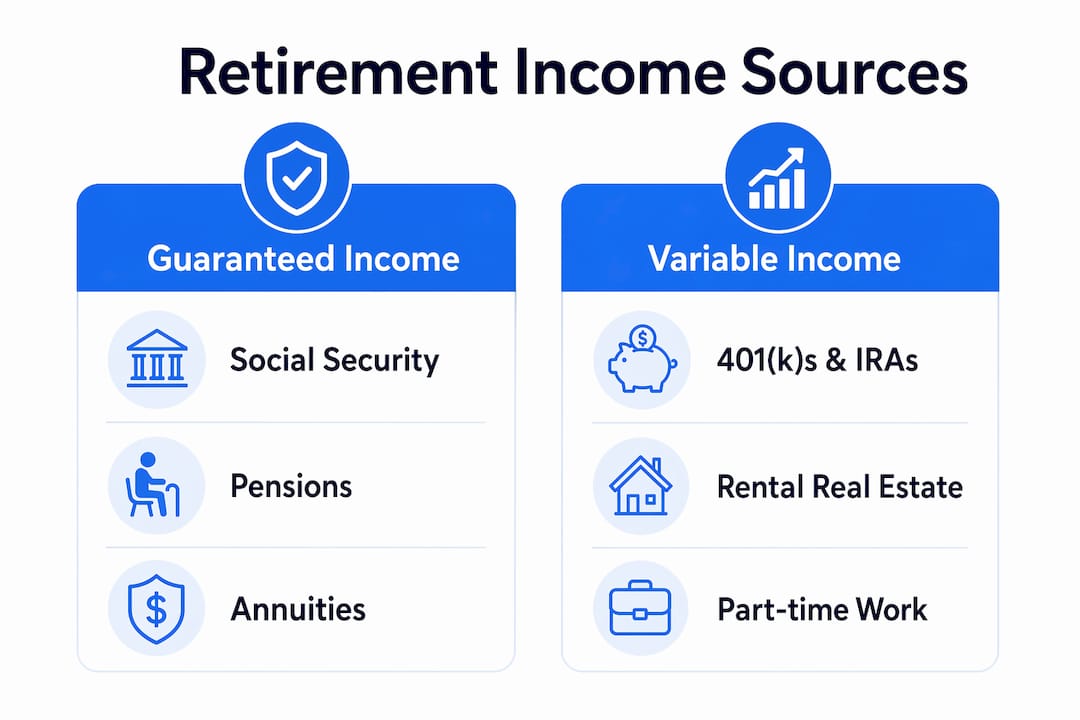
Cover your essential expenses first with guaranteed income — Social Security, pensions, or annuities — then layer variable sources on top. That single principle, backed by Vanguard’s retirement income framework, separates retirees who sleep well from those who don’t. The main retirement income sources available to Americans are:
- Social Security — inflation-adjusted, lifetime income from the Social Security Administration
- Workplace pensions and defined-contribution accounts — 401(k)s, 403(b)s, and IRAs, subject to IRS RMD rules
- Annuities — contracts that convert a lump sum into guaranteed lifetime cash flow
- Investment income — bonds, dividend stocks, and total-return portfolio withdrawals
- Rental real estate and REITs — direct property cash flow or publicly traded real estate income
- Part-time or consulting work — earned income that reduces early portfolio withdrawals
- Home equity options — reverse mortgages for homeowners who qualify
Start here: Pull your Social Security statement at ssa.gov and gather your latest account balances. That two-minute inventory tells you exactly how large your income gap is — and which sources need to fill it.
The average retired worker collects about $2,071 per month from Social Security in 2026. For most households, that covers part of the floor but rarely all of it, which is why assembling multiple streams matters.
Table of Contents
- What role does Social Security play in your retirement income?
- How do you turn 401(k)s, IRAs, and pensions into steady income?
- Are annuities worth it for guaranteed retirement income?
- Which investment approaches generate reliable retirement income?
- Can rental real estate and REITs fund your retirement?
- How does part-time work fit into a retirement income plan?
- How do taxes and RMDs affect your net retirement income?
- How do you build a retirement income plan step by step?
- Key Takeaways
- The floor-and-layers framework is more than a planning concept
- Finblog helps you convert savings into reliable retirement income
- Useful sources for further reading
What role does Social Security play in your retirement income?
Social Security is the closest thing most Americans have to a guaranteed pension, and it should be treated like one. The monthly benefit is inflation-adjusted, lasts for life, and carries no investment risk. That combination makes it the logical anchor for covering essential expenses before anything else.
Your benefit is calculated from your highest 35 years of indexed earnings. Claim at 62 and you lock in a permanently reduced amount — roughly 25–30% below your full retirement age (FRA) benefit. Wait until 70 and you collect about 32% more than your FRA amount. For someone whose FRA benefit is $2,000/month, that gap between claiming at 62 versus 70 can exceed $700/month for life.
The average retired-worker benefit of $2,071/month in 2026 reflects many people who claimed early. Delaying even two or three years past FRA meaningfully raises that floor.
Quick claiming checklist:
- Log in to ssa.gov and download your Social Security statement
- Check your spouse’s benefit — survivor benefits can be significant if there is a large earnings gap
- Run a break-even calculation: delaying from 62 to 70 typically pays off around age 80–82
- If you have limited guaranteed income from other sources, delaying is almost always worth it
Pro Tip: If your guaranteed income base is thin, delaying Social Security is one of the most cost-effective ways to raise your spending floor — more efficient than buying an annuity for the same dollar amount in most cases.
How do you turn 401(k)s, IRAs, and pensions into steady income?
Defined-benefit pensions are straightforward: you receive a monthly check, often for life. The challenge is that DB pensions now cover far fewer workers than a generation ago, and most people rely primarily on defined-contribution accounts — 401(k)s, 403(b)s, and IRAs — which require active withdrawal decisions.

The IRS requires you to begin taking required minimum distributions (RMDs) from traditional accounts starting at age 73 (under current SECURE 2.0 rules). RMDs are calculated by dividing your prior year-end balance by an IRS life-expectancy factor. Miss one and the penalty is steep. Roth IRAs have no RMD requirement during the owner’s lifetime, which is why Roth conversions before age 73 can be a smart tax move.
Withdrawal options compared:
| Approach | Predictability | Flexibility | Tax impact |
|---|---|---|---|
| Systematic withdrawals | Moderate | High | Ordinary income each year |
| Partial annuitization | High | Low | Partially excludable (after-tax basis) |
| RMD-driven distributions | Forced schedule | Low | Ordinary income, can spike brackets |
| Roth withdrawals | High | High | Tax-free |
A simple worked example: a $200,000 traditional IRA at a 4% withdrawal rate produces $8,000/year, or about $667/month. Add $2,071 from Social Security and you have roughly $2,738/month before taxes. That covers comfortable living in many mid-cost cities, though housing costs vary significantly by location.
Vanguard’s guidance frames a 3.5%–4% withdrawal rate as a reasonable starting point for a 30-year retirement, with the caveat that individual circumstances — health, spending flexibility, other income — should drive the final number.
Before you turn 73, check these off:
- Review your plan’s distribution rules and any required forms
- Update beneficiary designations on every account
- Model Roth conversions in low-income years before RMDs begin
- Consider consolidating scattered accounts to simplify withdrawal management
For a deeper look at retirement withdrawal strategies, Finblog’s sequencing guide walks through tax-bracket management year by year.
Are annuities worth it for guaranteed retirement income?
An annuity does one thing exceptionally well: it converts a lump sum into income you cannot outlive. Think of it as buying a private pension. Whether that trade makes sense depends on how much guaranteed income you already have and how much longevity risk keeps you up at night.
The main types worth knowing:
- Single Premium Immediate Annuity (SPIA) — you hand over a lump sum and monthly payments start within 30 days. Best for retirees who need income now and have a predictable essential-expense gap.
- Deferred Income Annuity (DIA) / QLAC — payments start at a future date (say, age 80 or 85). A Qualifying Longevity Annuity Contract (QLAC) can be funded from IRA assets up to IRS limits and reduces RMDs in the meantime.
- Variable or indexed annuities — returns tied to market performance; more complex, higher fees, and generally less suitable for pure income planning.
| Feature | SPIA | DIA/QLAC | Variable annuity |
|---|---|---|---|
| Liquidity | None after purchase | None | Limited (surrender charges) |
| Inflation protection | Optional rider (costly) | Optional | Depends on subaccounts |
| Typical cost | Low | Low | High (1%–3%+ annually) |
| Best for | Immediate income gap | Longevity insurance | Growth with some guarantees |
BlackRock’s analysis found that adding guaranteed lifetime income alongside a more growth-oriented portfolio generated about 29% more annual spending ability and reduced downside risk by about 33% compared to a portfolio-only approach. That is the case for partial annuitization in a sentence.
Questions to ask before signing anything: What are the total fees? Is there an inflation rider and what does it cost? What is the surrender period? How are payouts taxed? Is the insurer rated A or better by AM Best?
Pro Tip: Annuitize only the portion needed to close your essential-expense gap. Keep the rest in a liquid portfolio. Full annuitization sacrifices flexibility you will almost certainly need for health care or unexpected costs.
For more on the tradeoffs, Finblog’s guide to annuity pros and cons covers the fee structures and rider questions in detail.
Which investment approaches generate reliable retirement income?
Investment income can supplement guaranteed sources, but it carries risks that guaranteed income does not: market volatility, inflation erosion, and sequence-of-returns risk (the danger that a bad market early in retirement permanently damages your portfolio). Understanding that context shapes how you use each approach.
Common income-generating strategies:
- Bond ladders — purchase individual bonds maturing in successive years (say, 1–10 years out). Each maturity funds one year of spending, eliminating the need to sell during downturns. Predictable, but yields vary with the rate environment.
- Short-duration bond funds — lower interest-rate sensitivity than long-term bonds; useful for the near-term spending bucket.
- Dividend-paying equities — stocks with consistent dividend histories (think S&P 500 dividend payers) generate cash flow without selling shares. Qualified dividends are taxed at preferential capital gains rates, which is a meaningful advantage over ordinary income. Dividend yields fluctuate, and companies can cut dividends.
- Covered-call strategies — selling call options on existing equity positions generates premium income. More complex and best suited to investors comfortable with options mechanics.
- Total-return approach — rather than chasing yield, you hold a diversified portfolio and sell a planned percentage each year. This avoids the trap of reaching for high-yield assets that carry hidden risk.
A quick example: a $300,000 bond ladder yielding 4.5% generates roughly $13,500/year. Combined with $2,071/month from Social Security, total monthly income reaches about $3,196 before taxes — enough to cover essentials in many markets.
For building a steady cash-flow portfolio, Finblog’s income investing guide covers asset selection and rebalancing in practical terms. A solid portfolio diversification framework can also help you balance income-generating assets against growth holdings.
Pro Tip: Match time horizon to asset type. Money you need in the next three years belongs in cash or short-term bonds. Money you won’t touch for a decade or more can stay in equities or a total-return strategy.
Can rental real estate and REITs fund your retirement?

Rental real estate can produce reliable monthly cash flow, but “passive income” is a stretch when you own the property directly. Vacancies happen, roofs leak, and tenants leave. A property manager solves the time problem but costs 8–12% of gross rent, which compresses your net return.
Direct rental pros and cons:
- Stable cash flow when occupied, with potential for appreciation
- Rental income is taxable as ordinary income, but depreciation deductions can offset a meaningful portion
- Vacancy and maintenance costs must be budgeted conservatively — a 5–10% vacancy buffer and 1% of property value annually for maintenance are standard assumptions
- Illiquid: you cannot sell a bedroom to cover a medical bill
Simple net cash-flow example: A property renting for $1,800/month with a $900 mortgage payment, $200 in taxes and insurance, $90 vacancy buffer (5%), and $150 in maintenance leaves roughly $460/month in net cash flow. That is before income taxes and any property management fee.
REITs (Real Estate Investment Trusts) solve the liquidity and management problems. You buy shares on a stock exchange and receive dividends funded by the trust’s rental income. REIT dividends are generally taxed as ordinary income (not at the lower qualified dividend rate), so they are most tax-efficient inside a traditional IRA or 401(k).
REIT due-diligence checklist:
- Check the dividend yield and payout ratio — a payout ratio above 90% of funds from operations (FFO) is normal for REITs but watch for unsustainable levels
- Review the property sector (residential, commercial, healthcare, industrial) and its economic sensitivity
- Confirm the REIT’s debt load; high leverage amplifies downside in rate-rising environments
How does part-time work fit into a retirement income plan?
Part-time work is the most flexible retirement income source available. You can scale it up or down, stop entirely, and it requires no capital at risk. For many people, it also provides structure and social connection that pure retirement does not.
Common options and who they suit:
- Consulting or freelancing — best for professionals with specialized skills; often pays well per hour and can be done remotely
- Seasonal or retail work — accessible, lower-paying, but straightforward to start and stop
- Teaching or tutoring — community colleges and online platforms hire experienced professionals; schedule is predictable
- Part-time employment with benefits — some employers offer health coverage for part-time workers, which can reduce Medicare supplement costs before age 65
One tax interaction worth knowing: if you claim Social Security before your full retirement age and earn above the annual earnings limit (set by the SSA each year), your benefit is temporarily reduced. After FRA, there is no earnings limit. High earned income can also push you into higher Medicare IRMAA tiers, raising Part B and Part D premiums.
Pro Tip: Use part-time income to fund discretionary spending — travel, dining, hobbies — so your guaranteed income stays dedicated to essentials. That separation keeps your floor intact even if you stop working.
How do taxes and RMDs affect your net retirement income?
Taxes are the largest controllable variable in retirement income planning. Two retirees with identical account balances can end up with very different after-tax income depending on how they sequence withdrawals.
RMD basics: Under current IRS rules (post-SECURE 2.0), RMDs begin at age 73 for most traditional retirement accounts. The annual RMD is your prior December 31 balance divided by the IRS Uniform Lifetime Table factor for your age. At age 73, that factor is roughly 26.5, meaning a $500,000 balance generates an RMD of about $18,868 — taxed as ordinary income.
| RMD start age | Applies to | Key rule |
|---|---|---|
| Age 73 | Traditional 401(k), 403(b), IRA | SECURE 2.0 (current law) |
| No RMD | Roth IRA (owner’s lifetime) | Tax-free growth continues |
| Age 73 | SIMPLE and SEP IRAs | Same schedule as traditional |
Common tax impacts to plan for:
- Traditional IRA and 401(k) withdrawals are ordinary income — they can push Social Security benefits into taxation (up to 85% of benefits become taxable above certain thresholds)
- Qualified dividends and long-term capital gains are taxed at 0%, 15%, or 20% depending on taxable income — often lower than ordinary rates
- Roth withdrawals are tax-free and do not count toward IRMAA income calculations
- Medicare IRMAA surcharges kick in when modified adjusted gross income exceeds IRS thresholds (adjusted annually)
Practical steps:
- Model Roth conversions in years when your income is low — typically between retirement and age 73 when RMDs begin
- Coordinate Social Security claiming with your withdrawal plan to avoid unnecessary bracket creep
- Consider bunching deductions in alternating years if you are near the standard deduction threshold
Pro Tip: The years between retirement and your first RMD are often your lowest-income years. That window is the best time for Roth conversions — you pay tax now at a lower rate to avoid higher rates later when RMDs stack on top of Social Security.
How do you build a retirement income plan step by step?
The floor-and-layers approach is the most practical framework for converting savings into reliable income. Vanguard’s research and BlackRock’s analysis both point to the same core idea: secure essential expenses with predictable income first, then use layered sources for everything else.
Step-by-step process:
- Inventory your guaranteed income. Add up Social Security (at your planned claiming age), any pension income, and any annuity payments. This is your floor.
- Calculate your essential expenses. Housing, food, utilities, health care, and transportation. Use a simple budget with five categories. Essential expenses typically represent 60–75% of total spending for most retirees.
- Estimate the gap. Subtract guaranteed income from essential expenses. If your floor covers them, you are in good shape. If not, the gap must be filled by portfolio withdrawals, part-time work, or additional annuity income.
- Decide how to fill the gap. Options: increase guaranteed income (delay Social Security, buy a SPIA), draw from the portfolio at 3.5%–4%, or plan earned income for the early retirement years.
- Layer discretionary spending on top. Travel, dining, and hobbies come from portfolio withdrawals or part-time income — not from your guaranteed floor.
- Plan tax sequencing and build a contingency buffer. Keep 6–12 months of essential expenses in cash or short-term bonds. Sequence withdrawals to manage brackets: taxable accounts first, then traditional, then Roth.
Worked example (30-year plan):
- Social Security at 67 (FRA): $2,200/month
- Traditional IRA balance: $350,000 at 4% withdrawal = $14,000/year ($1,167/month)
- Total monthly income: $3,367
- Essential expenses: $2,800/month
- Surplus for discretionary: $567/month, supplemented by part-time consulting income in early years
At 3.5% withdrawal, the same $350,000 IRA produces $12,250/year — more conservative, extends the portfolio further, and leaves room for RMD growth.
For a structured planning workflow, the investment planning guide at Ollatrade walks through portfolio construction alongside income planning in practical steps. Finblog’s step-by-step income planning guide also provides templates and worked examples tailored to this framework.
Key Takeaways
A reliable retirement income plan starts by covering essential expenses with guaranteed income, then layers variable sources on top to fund discretionary spending.
| Point | Details |
|---|---|
| Cover the floor first | Match guaranteed income (Social Security, pensions, annuities) to essential expenses before drawing on investments. |
| Use the 3.5%–4% guideline | Vanguard frames a 3.5%–4% withdrawal rate as a reasonable starting point for a 30-year retirement after guaranteed income is secured. |
| RMDs start at 73 | Traditional IRA and 401(k) RMDs begin at age 73 under current law; Roth IRAs have no RMD during the owner’s lifetime. |
| Partial annuitization beats full | BlackRock’s analysis shows combining guaranteed lifetime income with a growth portfolio raised annual spending ability by about 29% versus a portfolio-only approach. |
| Finblog planning consult | Gather your Social Security statement and account balances, then use Finblog’s planning resources to model your income gap and sequencing strategy. |
The floor-and-layers framework is more than a planning concept
Most retirement income articles spend their energy on accumulation — how much to save, which funds to pick. The harder problem, and the one that actually determines whether you run out of money, is decumulation: how you convert what you have into what you need, year after year, across a retirement that could last 30 years or more.
The floor-and-layers approach is not just a framework. It is a discipline. Retirees who treat their portfolio as a single undifferentiated pool tend to either overspend in good markets or underspend out of fear in bad ones. Separating guaranteed income from discretionary income removes that ambiguity. You know what is covered. You know what is flexible. That clarity changes behavior in ways that matter.
Where this gets genuinely complex: large concentrated stock positions, complex estates, pensions with survivor-benefit elections, or situations where health care costs could spike well above average projections. Those cases benefit from a professional who can model the specific numbers, not just apply rules of thumb. Before any advisor meeting, gather your Social Security statement, pension estimates, recent account balances, and a rough monthly budget. That preparation cuts the time to a real plan in half.
Finblog helps you convert savings into reliable retirement income
Retirement income planning is not a one-time calculation — it is an ongoing process of matching income sources to expenses as markets, tax laws, and personal circumstances shift. Finblog’s financial planning resources give you the modeling tools and expert guidance to build a plan that holds up across a 20–30 year retirement, not just on paper today.
Before a planning consultation, prepare these documents:
- Your most recent Social Security statement (download at ssa.gov)
- Pension benefit estimates from any former employers
- Recent balances for all retirement accounts (401(k), IRA, Roth IRA)
- A rough monthly budget separating essential from discretionary expenses
Ready to map your income sources and close the gap? Start your retirement plan at Finblog and get a clear picture of what your income will look like — and what needs to change before you stop working.
Useful sources for further reading
- Social Security Administration (ssa.gov) — the primary source for benefit estimates, claiming rules, and survivor benefit calculations. Create a my Social Security account to access your personal statement.
- IRS RMD guidance / SSA policy research — SSA policy documents on shifting income sources and DC plan measurement; useful background on why RMD planning matters for DC-heavy retirees.
- Vanguard’s Principles for Retirement Income — the most practical research-backed framework for the floor-and-layers approach, withdrawal rate guidance, and tax sequencing.
- BlackRock retirement income optimization — quantitative analysis on combining guaranteed income with growth portfolios; the source for the 29% spending improvement and 33% downside reduction figures cited above.
- Investopedia 2026 retirement income overview — a readable catalog of income source types with current benefit figures including the $2,071/month average Social Security benefit.
- Finblog retirement income strategies — Finblog’s own guide to decumulation strategies, withdrawal sequencing, and income planning for 2026.
- Finblog retirement planning checklist — a document-and-task checklist to prepare before meeting with a financial advisor or starting your income plan.