

TL;DR:
- Choosing a financial advisor involves selecting a qualified professional who aligns with your financial goals, fee preferences, and trust standards. The right advisor can help with retirement planning, tax reduction, and confident decision-making during market fluctuations, while the wrong choice may lead to costly mistakes. Verifying credentials, understanding fee structures, and asking the right questions are crucial steps to find an advisor who genuinely serves your interests.
Choosing a financial advisor is the process of finding a qualified professional who aligns with your financial goals, fee preferences, and trust standards. The right advisor does more than manage investments. They help you build a retirement plan, reduce tax exposure, and make confident decisions during market volatility. Getting this choice wrong costs you money and time. This guide walks you through advisor types, fee structures, credential checks, and the exact questions to ask before you sign anything.
What types of financial advisors exist and which might you need?
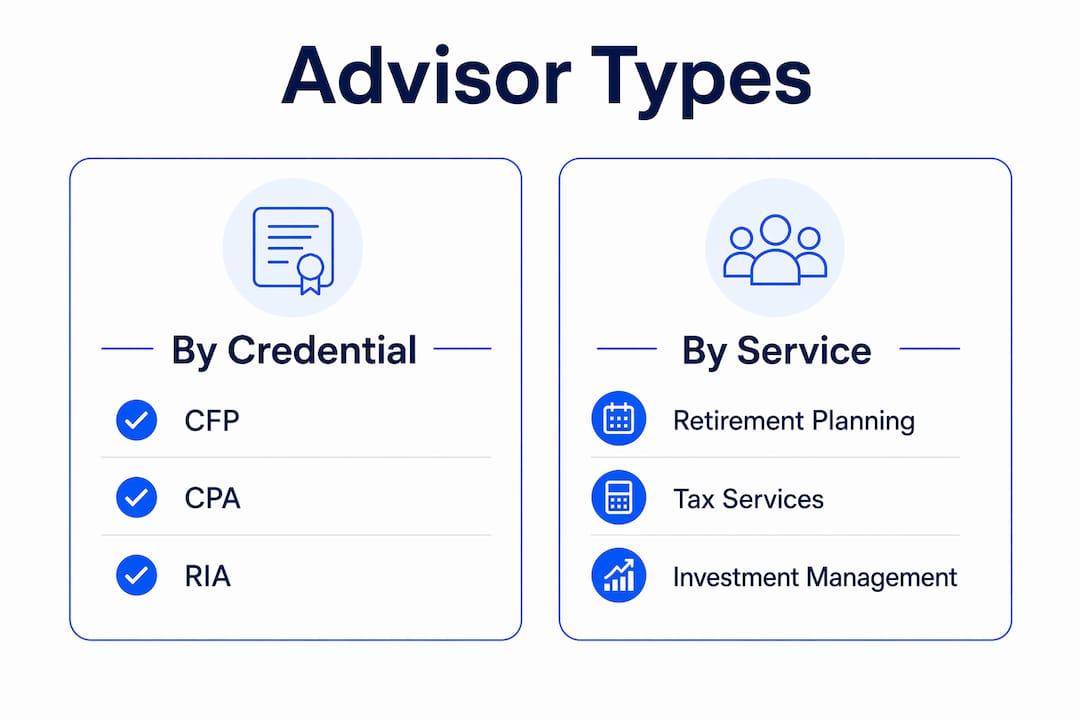
Not all financial advisors hold the same credentials or offer the same services. Understanding the differences is the first step in any financial advisor selection guide worth following.

Certified Financial Planners (CFPs) are widely considered the gold standard in personal finance. CFPs complete rigorous coursework and exams, and they operate under a fiduciary duty. That means they are legally required to act in your best interest, not their own.
Registered Investment Advisors (RIAs) are firms or individuals registered with the SEC or state regulators. They manage investment portfolios and also carry fiduciary obligations. Certified Public Accountants (CPAs) specialize in tax planning and preparation. They are the right choice if your primary concern is minimizing your tax bill rather than growing a portfolio.
Here is a quick breakdown of which advisor type fits which need:
- CFP: Comprehensive financial planning, retirement strategy, estate planning
- RIA: Portfolio management and investment advice
- CPA: Tax planning, business accounting, IRS compliance
- Wealth manager: High-net-worth clients needing integrated investment, tax, and estate services
You may need more than one type. A CPA handles your taxes while a CFP manages your retirement plan. Working with multiple advisors for different needs is common among serious investors and is not a sign of complexity. It is a sign of precision.
What are the common fee structures and how to decide what fits your budget?
Fee structure is the single most misunderstood part of hiring a financial planner. Knowing how your advisor gets paid tells you a great deal about whose interests they serve.
| Fee Model | How the advisor is paid | Best for |
|---|---|---|
| AUM (assets under management) | Percentage of your portfolio annually | Investors with $250,000+ in assets |
| Fee-only | Flat fee, hourly rate, or retainer paid by you | Anyone who wants zero conflicts of interest |
| Fee-based | Combination of client fees and product commissions | Clients who understand the trade-offs |
| Commission-based | Paid when you buy or sell financial products | Generally the least transparent model |
AUM fees typically fall between 0.50% and 1.00% annually in 2026. On a $500,000 portfolio, that means $2,500 to $5,000 per year in advisory costs. That number compounds over decades, so it matters.
The fee-only model eliminates conflicts of interest by removing commissions entirely. Your advisor earns nothing extra by recommending one product over another. That alignment is why fee-only advisors are generally the most transparent and client-focused option available.
Pro Tip: If you only need a one-time financial plan and not ongoing investment management, separating planning fees from management fees can cut your annual costs significantly. Advice-only advisors charge for their time, not a percentage of your assets.
Hourly rates for financial planners typically range from $150 to $400 per hour. Flat fees for a full financial plan often run $1,000 to $3,000. Retainer arrangements, where you pay a fixed monthly or annual fee for ongoing access, are growing in popularity among younger investors with smaller portfolios.
How do you verify an advisor’s credentials and regulatory background?
Credential verification is not optional. It is the step that separates a trusted advisor from a costly mistake. Use these steps in order.
-
Check FINRA BrokerCheck. The SEC’s Investment Professional Online Tool and FINRA BrokerCheck let you review any advisor’s licensing status, employment history, and disciplinary actions. Both tools are free and take under five minutes to use.
-
Review Form ADV. RIAs must file Form ADV with the SEC. This document discloses their fee structure, services, and any conflicts of interest. Request it directly or find it through the SEC’s IAPD database. Reading it takes 20 minutes and reveals more than any sales pitch will.
-
Confirm the CFP designation. The CFP Board maintains a public directory at cfp.net. Search your advisor’s name to confirm their certification is active and in good standing.
-
Look for disciplinary history. Red flags include vague fee explanations, disciplinary actions, and high-pressure sales tactics. Any advisor who cannot clearly explain how they are compensated is not worth your time.
-
Run a basic web search. Search the advisor’s name alongside terms like “complaint,” “fraud,” or “lawsuit.” Public court records and news coverage surface problems that regulatory databases sometimes miss.
-
Verify regulatory registration. Advisors managing more than $100 million must register with the SEC. Those managing less register with state regulators. Confirm the registration matches what the advisor claims.
The verification process takes less than an hour. Skipping it has cost investors far more than that in losses. You can also review how regulatory databases work for due diligence across financial service providers.
What questions should you ask a potential financial advisor?
Interviewing multiple advisors before hiring one is the single best practice in any financial advisor interview process. Treat each consultation as a job interview where you are the employer.
Ask these questions directly:
- “Are you a fiduciary at all times?” Some advisors are fiduciaries only in certain contexts. You want one who holds that standard across every recommendation.
- “How are you compensated, and do you earn commissions?” A clear, direct answer signals transparency. Hesitation or deflection signals a conflict of interest.
- “What is your experience with clients in my financial situation?” An advisor who works primarily with retirees may not be the right fit for a 35-year-old building a portfolio from scratch.
- “How often will we communicate, and through what channels?” Monthly check-ins, quarterly reviews, and email access are reasonable expectations. Vague answers here predict poor service later.
- “What services are included in your fee, and what costs extra?” Tax planning, estate coordination, and insurance review are sometimes bundled and sometimes billed separately.
Pro Tip: Bring a written list of your top three financial goals to every consultation. Advisors who ask follow-up questions about those goals are demonstrating the kind of attention your financial planning needs actually require.
The quality of communication matters as much as credentials. An advisor who explains complex concepts clearly, listens before speaking, and respects your timeline is worth more than one with impressive letters after their name who talks over you.
Common mistakes to avoid when hiring a financial planner
The most expensive mistake in hiring a financial planner is skipping the background check. The second most expensive is choosing based on personality alone without verifying credentials or fee structure.
“The biggest red flags are advisors who avoid direct answers about fees, promise guaranteed returns, or pressure you to decide quickly. Legitimate advisors welcome your questions and give you time to think. If something feels off in the first meeting, trust that instinct.”
Avoid commission-based advisors unless you fully understand what they earn from each recommendation. A commission-based advisor selling you a high-fee annuity may be acting legally, but their financial incentive does not align with yours. The benefits of working with a fiduciary advisor are well-documented for long-term wealth outcomes.
Review your advisor’s performance and fees at least once per year. Markets change, your goals change, and fee structures that made sense at $200,000 in assets may not make sense at $800,000. Staying passive about the relationship is how small problems become large ones.
Key Takeaways
Choosing the right financial advisor requires matching credentials, fee transparency, and personal communication style to your specific financial goals.
| Point | Details |
|---|---|
| Verify credentials first | Use FINRA BrokerCheck and SEC tools to confirm licensing and check for disciplinary history. |
| Prioritize fee-only advisors | Fee-only models remove commission conflicts and deliver the most transparent advice. |
| AUM fees compound over time | At 0.50%–1.00% annually, a $500,000 portfolio costs $2,500–$5,000 per year in advisory fees. |
| Ask fiduciary status directly | Confirm the advisor holds fiduciary duty at all times, not just in certain transactions. |
| Interview at least three advisors | Comparing multiple candidates reveals differences in communication style, services, and cost. |
Why credentials alone won’t find you the right advisor
I have reviewed a lot of advisor relationships over the years, and the ones that fail rarely fail because the advisor lacked technical skill. They fail because the client and advisor never aligned on communication, values, or expectations.
Think of a financial advisor the way you think of a personal trainer. You would not hire a trainer who never asks about your injury history, ignores your schedule, and pushes a program that does not fit your body. The same logic applies here. A CFP with 20 years of experience who talks past you is less useful than a newer advisor who genuinely understands your goals and explains every decision clearly.
The advisor’s role in your wealth goes beyond picking investments. It includes keeping you calm during market drops, helping you avoid emotional decisions, and building a plan that survives life changes. That requires trust, and trust requires communication. Finding the right advisor is like hiring a financial personal trainer: personal fit matters as much as credentials.
My honest advice is to spend as much time evaluating how an advisor communicates as you spend evaluating their credentials. Both matter. But the credentials get you in the door. The communication keeps the relationship working for decades.
— Povilas
Finblog: financial guidance for every stage of your plan
Finblog publishes in-depth resources on financial planning, advisor selection, and wealth management for investors at every stage. Whether you are building your first portfolio or refining a retirement strategy, the guides at Finblog give you the context to make confident decisions. The site covers fee structures, credential standards, and the practical questions that separate a good advisor match from a costly one. If you want to go deeper on any topic covered here, Finblog’s library is a strong next step for anyone serious about their financial future.
FAQ
What does “fiduciary” mean for a financial advisor?
A fiduciary advisor is legally required to act in your best interest at all times. This standard is higher than the “suitability” standard, which only requires that a recommendation be appropriate, not optimal.
How much does a financial advisor typically cost in 2026?
AUM fees run between 0.50% and 1.00% annually. Hourly rates typically fall between $150 and $400, and flat fees for a full financial plan often range from $1,000 to $3,000.
What is the difference between a CFP and an RIA?
A CFP is an individual credential focused on comprehensive financial planning. An RIA is a registered entity, either a firm or individual, that manages investment portfolios and is registered with the SEC or state regulators.
How do I check if a financial advisor has a clean record?
Use FINRA BrokerCheck or the SEC’s Investment Professional Online Tool. Both are free, publicly accessible, and show licensing status, employment history, and any disciplinary actions.
Is a fee-only advisor always the best choice?
Fee-only advisors are the most transparent option because they earn no commissions. They are the best fit for most investors, though clients who need minimal ongoing management may find an advice-only or hourly model more cost-effective.