
TL;DR:
- Financial literacy helps individuals make informed decisions about money and build financial stability. Many adults lack sufficient knowledge, leading to higher debt and lower emergency savings. Practicing budgeting, saving, and understanding financial products can improve financial resilience and long-term well-being.
Financial literacy is defined as the knowledge, skills, and tools needed to make informed decisions about earning, saving, investing, and borrowing. The purpose of financial literacy goes beyond balancing a checkbook. It gives you the foundation to build real financial stability, avoid costly mistakes, and prepare for life’s unexpected turns. Yet U.S. adults scored an average of just 49% correct on financial literacy tests as of 2025. That number tells you most people are making major money decisions with only half the knowledge they need.
What is the purpose of financial literacy?
Financial literacy is the core skill that separates reactive money management from intentional financial planning. Without it, you respond to financial problems as they happen. With it, you anticipate them and build systems that protect you.
Financial literacy encompasses knowledge, skills, and tools to make informed decisions across every major financial area. Experts now frame it not just as number-crunching but as the foundation of financial wellness, which is your ability to meet current needs, absorb financial shocks, and work toward long-term goals. The distinction matters because financial wellness is a measurable outcome, not just a feeling.
The importance of financial literacy shows up most clearly in what happens without it. People without strong financial knowledge tend to carry more high-interest debt, save less, and retire with far less than they need. Financial literacy is the skill that closes that gap.
What are the key components of financial literacy?
Financial literacy is not one single skill. It is a set of connected competencies that work together to support sound financial decisions.
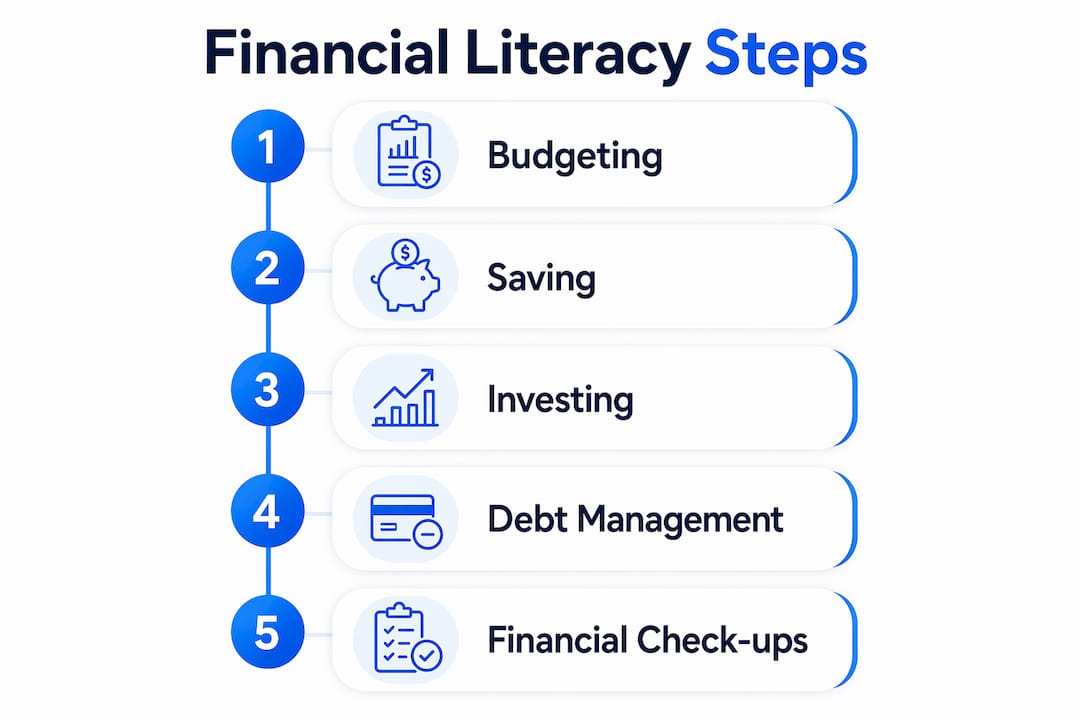
The five core components are:
- Budgeting: Tracking income and expenses to understand where your money goes each month. A budget is not a restriction. It is a map.
- Saving: Setting aside money consistently, starting with an emergency fund and building toward specific goals like a home purchase or education.
- Investing: Understanding how assets like stocks, bonds, and retirement accounts grow over time, and how to evaluate risk versus reward.
- Debt management: Knowing the difference between productive debt (a mortgage) and destructive debt (high-interest credit card balances), and having a plan to reduce what you owe.
- Risk evaluation: Assessing financial products, insurance options, and investment choices based on your personal situation and goals.
These skills reinforce each other. A person who budgets well has more money to save. A person who saves consistently can invest earlier. A person who understands risk avoids products that erode wealth. Financial capability, the ability to act on financial knowledge, grows when all five areas develop together.
Pro Tip: Start with budgeting before anything else. You cannot save, invest, or manage debt effectively if you do not know your baseline income and spending.
How does financial literacy impact financial health and resilience?
The connection between financial literacy and financial health is direct and well-documented. Those with very low financial literacy are twice as likely to be debt-constrained and five times more likely to lack emergency savings. Those are not small gaps. They represent the difference between financial stability and financial crisis.
Financial resilience is your ability to absorb an economic shock without falling into debt or financial ruin. A job loss, a medical bill, or a car repair can destabilize anyone without a financial cushion. Only 56% of adults worldwide can reliably access extra funds within 30 days to handle such shocks. That means nearly half the global adult population has no real buffer against financial emergencies.
Building financial resilience starts with an emergency fund covering 3–6 months of living expenses. Financial literacy practitioners identify this as the single most critical measure for surviving economic disruption without long-term damage to your financial health.
The behavioral dimension of financial literacy matters just as much as the technical knowledge. Budgeting gives you control over your finances rather than imposing restrictions. That reframe changes how people engage with money management. When you see a budget as a tool for freedom rather than a cage, you are far more likely to stick with it. Readers who want to build this kind of resilience can find practical guidance in Finblog’s resilience planning guide.
Why is financial literacy increasingly essential?
The economic environment has shifted the burden of financial planning squarely onto individuals. Understanding why financial literacy is important today requires looking at structural changes, not just personal habits.
-
The retirement savings shift. The responsibility for retirement savings has moved from employers to individuals through 401(k)s and IRAs. Previous generations relied on defined-benefit pensions that paid a fixed monthly income. Today, you decide how much to contribute, how to invest it, and how to draw it down. Without financial literacy, that responsibility becomes a serious risk of insufficient retirement income.
-
Inflation and purchasing power. Rising living costs mean that money sitting in a low-yield savings account loses real value over time. Understanding inflation and how to position savings and investments against it is now a basic financial survival skill.
-
Complex financial products. Credit cards, adjustable-rate mortgages, variable annuities, and buy-now-pay-later services all carry terms that can trap uninformed consumers. Financial literacy gives you the ability to read, compare, and reject products that do not serve your interests.
-
Job market volatility. Career disruptions, gig economy work, and contract employment mean income is less predictable for many people. Financial literacy helps you plan for income gaps and avoid debt spirals during transitions.
-
Systemic policy concerns. Low financial literacy is a systemic issue that limits financial health at a societal level. Policymakers and regulators identify it as a barrier to economic stability and financial inclusion. Only 18% of EU citizens have a high level of financial literacy, according to the 2023 Eurobarometer survey. That gap has real consequences for household debt levels, retirement security, and economic mobility across entire populations.
The need for financial literacy has never been greater. The financial products available today are more complex, the safety nets are thinner, and the cost of poor decisions compounds faster than it did for previous generations.
How can you apply financial literacy to improve your financial decisions?
Knowing why financial literacy matters is only useful if you act on it. The practical application of financial knowledge starts with a few concrete habits.

Build your budget first. List every source of income and every monthly expense. Categorize spending into fixed costs (rent, utilities) and variable costs (dining, entertainment). The gap between income and expenses is your starting point for saving and debt repayment. Finblog’s guide for beginners walks through this process step by step.
Start your emergency fund small. Starting small with savings is the key behavioral principle here. Saving $25 per paycheck builds the habit before the amount becomes significant. Once the habit is established, increasing the contribution is straightforward. The target is 3–6 months of living expenses in a liquid, accessible account.
Understand your credit. Know your credit score, what affects it, and how lenders use it. A higher credit score reduces the interest rate you pay on loans and mortgages, which directly affects how much money you keep over a lifetime. Effective personal credit practices can meaningfully reduce the cost of borrowing.
Evaluate financial products before you sign. Compare interest rates, fees, and terms across products. Use the annual percentage rate (APR) as a standard comparison tool for loans and credit cards. Never sign a financial agreement you cannot explain in plain language.
Schedule regular financial check-ups. Review your budget, savings progress, and investment performance at least quarterly. Financial literacy is not a one-time event. It requires ongoing attention as your income, expenses, and goals change.
Pro Tip: Set a recurring calendar reminder every three months labeled “Money Review.” Treat it like a doctor’s appointment. Skipping it has real consequences.
| Skill area | Practical first step |
|---|---|
| Budgeting | Track all expenses for 30 days before building a formal budget |
| Saving | Open a dedicated savings account and automate a fixed transfer |
| Investing | Contribute enough to your 401(k) to capture any employer match |
| Debt management | List all debts by interest rate and target the highest rate first |
| Risk evaluation | Read the fee disclosure on any financial product before signing |
Key Takeaways
Financial literacy is the foundational skill that connects budgeting, saving, investing, and debt management into a system that builds lasting financial stability.
| Point | Details |
|---|---|
| Core purpose | Financial literacy gives you the knowledge to make informed decisions across all areas of personal finance. |
| Literacy gap is real | U.S. adults averaged just 49% on financial literacy tests, showing most people lack critical money skills. |
| Resilience requires a cushion | An emergency fund covering 3–6 months of expenses is the most critical measure of financial resilience. |
| Retirement is now your job | The shift to 401(k)s and IRAs means financial literacy is a necessary skill for retirement security. |
| Start small, stay consistent | Building savings habits with small amounts is more effective than waiting until you can save large sums. |
Financial literacy changed how I think about money
Most people treat financial literacy as a subject you study once, like a driver’s ed course. That framing is wrong, and it costs people years of progress.
I have seen readers arrive at financial content with the belief that investing is for wealthy people and budgeting is for people in trouble. Both assumptions are backward. Budgeting is what wealthy people do to stay wealthy. Investing is what ordinary earners use to build wealth over time. The misconception that financial literacy is remedial keeps a lot of capable people from ever starting.
The other mistake I see constantly is waiting for a crisis to engage with personal finance. A job loss, a medical bill, or a divorce forces the conversation. But by then, the options are narrower and the stress is higher. The readers who build financial knowledge before they need it are the ones who navigate those crises without lasting damage.
Financial literacy is not about perfection. You will make bad financial decisions. Everyone does. The goal is to make fewer of them, recover faster from the ones you make, and build a system that works even when your discipline slips. That is what the importance of financial education is really about. It is not a grade. It is a practice.
— Povilas
Finblog’s resources for building your financial knowledge
Finblog publishes practical, evidence-based content designed for people who want to take real control of their finances. Whether you are building your first budget, learning how to evaluate investment options, or planning for long-term financial security, the site covers each stage with clear, direct guidance. The content is built for adults who are serious about improving their financial decisions, not for people looking for shortcuts. If you are ready to move from knowing that financial literacy matters to actually applying it, Finblog is a practical place to start.
FAQ
What is financial literacy in simple terms?
Financial literacy is the knowledge and skill to manage money effectively, including budgeting, saving, investing, and borrowing. It gives you the ability to make informed financial decisions that support your long-term goals.
Why is financial literacy important for everyday life?
Financial literacy directly affects your ability to avoid debt, build savings, and prepare for emergencies. Adults with low financial literacy are twice as likely to be debt-constrained and five times more likely to lack emergency savings.
How much should I save in an emergency fund?
Financial literacy practitioners recommend saving 3–6 months of living expenses in a liquid, accessible account. This cushion protects you from financial ruin during job loss, medical emergencies, or other unexpected events.
What is the biggest barrier to financial literacy?
Low financial literacy is a systemic issue tied to limited access to financial education, complex financial products, and cultural attitudes toward money. Only 18% of EU citizens report a high level of financial literacy, reflecting how widespread the gap is globally.
How do I start improving my financial literacy?
Start by tracking your income and expenses for 30 days, then build a simple budget. From there, open a dedicated savings account, learn how your credit score works, and review your finances at least once per quarter.