

TL;DR:
- Many people dismiss annuities as too complicated and expensive, overlooking their role in solving longevity risk.
- They transfer the risk of outliving savings into guaranteed income, making them valuable retirement tools for appropriate individuals.
Annuities get dismissed more than any other retirement product. Too complicated. Too expensive. Only for the ultra-wealthy. These assumptions lead people to ignore financial tools that could actually solve their biggest retirement fear: running out of money. Understanding annuities is not about mastering insurance law or memorizing contract terms. It is about knowing what problem they solve, which version fits your life, and when they genuinely make sense. This guide cuts through the noise and gives you a clear, practical picture of how annuities work, what types exist, and whether one belongs in your retirement plan.
Table of Contents
- Key takeaways
- Understanding annuities: the basics
- Types of annuities and their risk profiles
- Benefits and drawbacks for retirement planning
- Is an annuity right for your retirement plan?
- Common myths and expert insights
- My take on annuities after years of research
- Ready to take the next step?
- FAQ
Key takeaways
| Point | Details |
|---|---|
| Annuities solve longevity risk | They transfer the risk of outliving your savings to an insurance company through guaranteed income. |
| Five main types exist | Fixed, MYGA, fixed index, variable, and income annuities each carry different risk and return profiles. |
| Fees and surrender charges matter | Surrender charges often start at 7% to 9% and free withdrawals may be capped at 10% per year. |
| Suitability is age and asset dependent | Annuities typically work best for individuals aged 55 to 75 with at least $50,000 to invest. |
| They complement, not replace, other income | Annuities work best alongside Social Security, pensions, and diversified investment accounts. |
Understanding annuities: the basics
An annuity is a legal contract between you and an insurance company. You hand over a lump sum or make a series of payments, and in return the insurer promises to pay you back on a schedule, either immediately or at some future date. That is the core of how annuities work, and everything else flows from that single structure.
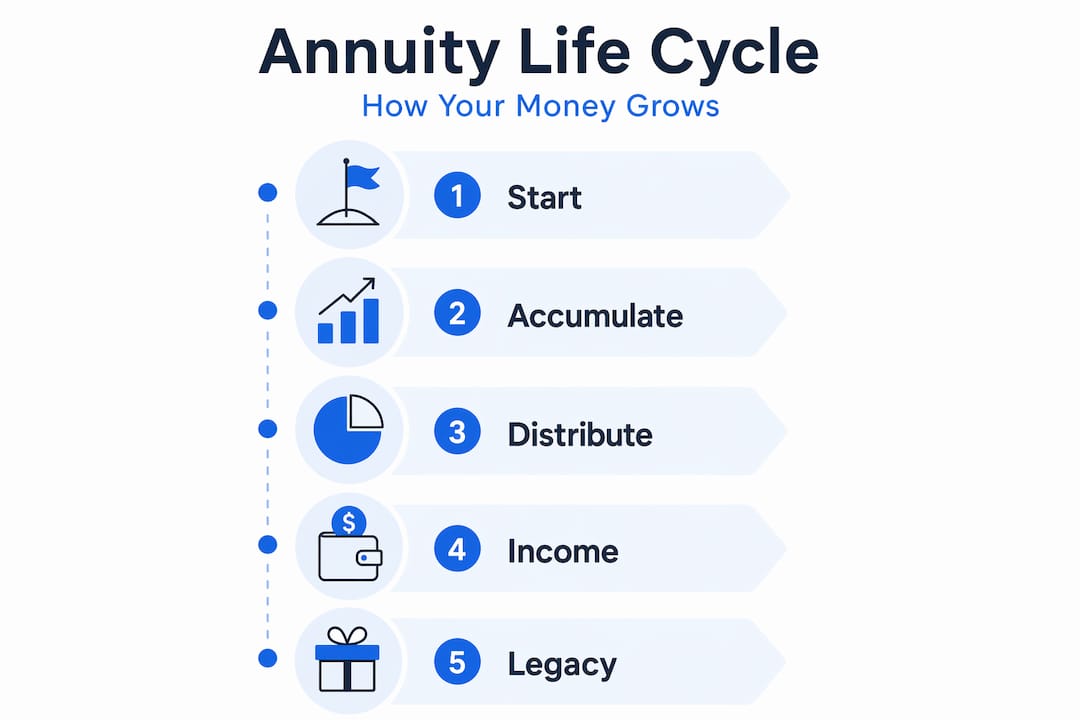
Most annuities move through two phases. The first is the accumulation phase, where your money grows inside the contract, typically with tax-deferred treatment. The second is the distribution phase, where the insurer pays out income according to your contract terms. Some contracts skip the accumulation phase entirely and begin paying out right away.
Here is what many people miss: annuities are insurance products, not bank accounts or stock market investments. That distinction matters because it changes who backs your money. Annuities are not FDIC insured but are backed by state guaranty associations, which cover up to $250,000 per owner per insurer. That is not the same as a bank deposit guarantee, and it is worth understanding before you sign.
Liquidity is the sharpest trade-off. Most annuity contracts include surrender charges that start high and decrease over time. Surrender charges typically start at 7% to 9% and step down annually over a five to ten year period. Free withdrawals are often capped at 10% per year during the surrender period.
Key restrictions to understand before you commit:
- Withdrawals before age 59½ trigger a 10% IRS early withdrawal penalty on top of ordinary income tax on gains
- Surrender charges can apply even after the IRS penalty window passes
- Some contracts allow penalty-free withdrawals for qualifying medical events or nursing home stays
- Most annuities are illiquid by design. They are built for long-term holds, not short-term flexibility
Pro Tip: Before purchasing any annuity, read the surrender charge schedule in full. A product with a ten-year surrender period is fundamentally different from one with a five-year window, even if the initial rates look identical.
Types of annuities and their risk profiles
Differentiating annuity types by risk-return profile is the single most useful skill you can develop when evaluating these products. The category of annuity you choose determines how your money grows, how much risk you absorb, and what income you ultimately receive.
Here is a side-by-side look at the five main categories:
| Type | How growth works | Principal protection | Best for |
|---|---|---|---|
| Fixed annuity | Guaranteed interest rate set by insurer | Yes | Safety-focused savers |
| MYGA | Locked-in rate for a set term (e.g., 3-7 years) | Yes | Those wanting CD-like returns |
| Fixed index annuity | Returns linked to a market index, with a floor of 0% | Yes | Moderate risk tolerance |
| Variable annuity | Returns tied directly to investment sub-accounts | No | Higher risk tolerance, growth focus |
| SPIA / DIA (income annuity) | Converts premium into immediate or deferred income stream | Varies | Guaranteed lifetime income seekers |
Fixed annuities and MYGAs offer the most predictability. Fixed and MYGA annuities currently pay between 4.50% and 5.90%, which in many cases outperforms what standard bank CDs offer. If you want to compare how these products stack up against bonds for income, Finblog’s guide on investing in bonds offers useful context.
Fixed index annuities link your potential returns to a stock market index such as the S&P 500, but with a floor that prevents you from losing principal during a down year. You give up some upside in exchange for that protection. The trade-off is real, but for someone within ten years of retirement, that floor can be enormously valuable.
Variable annuities sit at the opposite end of the spectrum. Your money goes directly into investment sub-accounts, which means you participate fully in market gains and bear the full weight of market losses. Variable annuities carry fees between 2.5% and 3.5% annually, which is a significant drag on returns. They are not the right product for everyone, and they deserve careful scrutiny before purchase.

Pro Tip: If you are comparing a fixed index annuity to a variable annuity, ask specifically for the participation rate and cap rate on the index annuity. These numbers determine how much of the market’s upside you actually capture.
Benefits and drawbacks for retirement planning
Annuities solve real problems. They also create real limitations. Understanding both sides clearly is how you make an informed decision rather than a sales-driven one.
The case for annuities:
- Tax-deferred growth means your money compounds without annual tax drag during the accumulation phase
- Lifetime income options make them the closest thing to a private pension available to most Americans. Annuities provide guaranteed income for life, transferring longevity risk to the insurer
- No contribution limits apply to non-qualified annuities, unlike IRAs or 401(k) plans
- Principal protection is available in fixed and fixed index versions
- Death benefits can pass contract value to beneficiaries, though terms vary by product
The case against annuities:
- Surrender charges can trap your money for years if your financial situation changes unexpectedly
- Fees in variable annuities, including mortality and expense charges, can erode returns significantly. Annuity costs may include commissions of 5% to 8% plus additional rider costs
- Gains are taxed as ordinary income, not at the lower capital gains rate you get with stocks held in a taxable account
- Opportunity cost is real. Money locked in a fixed annuity cannot benefit from a strong stock market run
Many financial advisors recommend annuities as one component of a broader retirement portfolio, particularly to cover essential monthly expenses. The goal is not to put everything into an annuity. The goal is to use one strategically, the same way you would use any other financial tool. Finblog’s breakdown of annuity pros and cons goes deeper on this calculus for investors who want the full picture.
Is an annuity right for your retirement plan?
Annuities are not universal solutions. They are situational tools. Whether one fits your plan depends on your age, assets, income needs, and comfort with complexity. Here is a practical way to think it through:
- Assess your income floor. Add up your guaranteed monthly income from Social Security and any pension. If that number covers your essential expenses comfortably, you may not need an annuity at all. If there is a gap, an annuity could fill it.
- Check your asset level. Annuities generally suit individuals with at least $50,000 to invest who are seeking safety and long-term income. Below that threshold, fees eat a disproportionate share of your return.
- Consider your age. Purchasing annuities too early can lock funds away during peak earning years. Most people buy in their 60s to early 70s to align income with retirement timelines. Insurance companies typically stop issuing annuities around age 85, so there is still flexibility across a wide window.
- Evaluate your liquidity needs. If you might need access to a significant portion of your savings within the next five years, a long surrender-period product could cause serious problems. Match the surrender schedule to your realistic cash needs.
- Compare alternatives honestly. MYGAs often compete directly with CDs and short-term bonds. For a side-by-side look at how retirement accounts stack up, Finblog’s retirement accounts comparison is a solid starting point.
Pro Tip: Ask any advisor selling you an annuity to show you a full fee disclosure in writing, including their commission. The life expectancy considerations that affect your payout calculations should also be explained clearly before you commit.
Common myths and expert insights
The biggest myth about annuities is that they are one uniform product. They are not. Fixed annuities and variable annuities are about as similar as a savings account and a stock portfolio. Treating them as the same category creates dangerous misunderstandings.
A second persistent misconception is that annuities are only for people close to death who want to squeeze out guaranteed payments before they go. The truth is the opposite. Annuities function as longevity insurance. They are most powerful when you live longer than expected, because they keep paying regardless of how long that turns out to be.
“The real risk in retirement is not losing money in the market. It is outliving the money you saved.” This is why guaranteed income products attract serious attention from retirement planners who take longevity risk seriously.
Beware of commission-driven sales pitches that push complex products with layers of riders. Those riders often have real value, but they also carry real costs. A review of longevity and life settlement data reinforces why understanding exactly how long your money needs to last is so critical before you lock into any income strategy.
Pro Tip: Look for annuities with transparent fee structures and short surrender periods if you are uncertain about your long-term cash needs. Simpler products are easier to evaluate and easier to live with.
My take on annuities after years of research
I have spent considerable time studying how retirees actually use annuities versus how they are sold to them. The gap between those two realities is where most of the frustration lives.
What I have found is that annuities rarely fail people because of the product itself. They fail people because of mismatched expectations. Someone buys a ten-year surrender period product at 68 and then needs a significant withdrawal at 72. That is a planning failure, not a product failure. The contract did exactly what it said it would do.
My honest view is that critics who dismiss annuities wholesale are doing their audience a disservice. A MYGA at 5.20% for five years, with guaranteed principal protection, is a genuinely attractive instrument for someone who has already accumulated enough and wants to stop taking unnecessary risk. The problem is not annuities. It is annuities sold without context, without full fee disclosure, and without a clear match to the buyer’s actual financial picture.
What I recommend is this: do not buy an annuity because someone showed you an income illustration that looked impressive. Build a full retirement planning checklist first. Understand your total income picture. Then evaluate whether a guaranteed income layer fills a real gap or simply sits alongside assets you already have working for you. The annuity should solve a specific problem you actually have.
— Povilas
Ready to take the next step?
If this guide clarified how annuities work and where they fit, the natural next move is building a complete retirement income picture. Finblog has you covered with resources that go deeper on each piece of the puzzle. Start with the tax-efficient withdrawal guide to understand how annuity income interacts with your other retirement accounts at tax time. From there, explore the full retirement withdrawal strategies resource to see how to sequence income from Social Security, annuities, and investments without overpaying the IRS. The goal is to make every dollar of your savings last as long as you need it to.
FAQ
What is an annuity in simple terms?
An annuity is a contract with an insurance company where you pay a lump sum or series of payments, and the insurer returns income to you on a set schedule, either for a fixed period or for life.
How do annuities work during retirement?
During retirement, you enter the distribution phase where the insurer pays out income according to your contract terms. Payments can be monthly, quarterly, or annually, and may continue for life depending on the type you selected.
Are annuities a good investment for retirement?
Annuities are best suited for individuals aged 55 to 75 with at least $50,000 to invest who want guaranteed income and principal protection. They are not ideal for everyone, particularly those who need flexible access to their savings.
What are the main types of annuities?
The five main types are fixed, multi-year guaranteed (MYGA), fixed index, variable, and income annuities (SPIA and DIA). Each carries a different risk level, fee structure, and income guarantee.
What fees should I watch for with annuities?
Watch for surrender charges that can start at 7% to 9%, annual fees in variable annuities of 2.5% to 3.5%, and agent commissions that can reach 5% to 8% of your initial premium.