

TL;DR:
- Understanding the difference between simple and compound interest is crucial for making smarter financial decisions.
- While compound interest accelerates savings growth over time, it can significantly increase debt costs when unpayable balances compound daily.
Most people assume that earning “5% interest” on their savings means the same thing regardless of which bank or account they choose. It doesn’t. The method used to calculate your interest can mean the difference between earning a few hundred dollars and building tens of thousands over the same period. Whether you’re saving for retirement, paying off a credit card, or comparing loan offers, understanding how interest actually works is one of the most valuable financial skills you can develop. This article breaks down how simple and compound interest differ, what the numbers look like side by side, and how to use this knowledge to make smarter decisions with your money.
Table of Contents
- How simple interest and compound interest work
- Visual comparison: Growth of simple vs compound interest
- APR, APY, and compounding frequencies: Why it matters
- Compounding in loans and taxes: When interest works against you
- Choosing and applying the right type of interest
- Our take: The compounding gap is wider than most people realize
- Ready to put compound interest to work for your future?
- Frequently asked questions
Key Takeaways
| Point | Details |
|---|---|
| Compound vs simple | Compound interest grows your money much faster than simple interest over time, especially for long-term investments. |
| Compounding debt risk | Compounding also means debts can spiral quickly if not managed, making it essential to understand your loan terms. |
| Always compare APY | When evaluating savings or loans, APY gives a truer picture of what you’ll earn or owe compared to APR. |
| Pay early, earn longer | The sooner you pay off compounding debt or start investing with compound interest, the more you benefit. |
How simple interest and compound interest work
Interest comes in two fundamental flavors: simple and compound. Both use a rate applied to your money, but they produce dramatically different results because of one key mechanic.
Simple interest is calculated only on your original deposit, which is called the principal. Every period, you earn the same fixed amount based on that original figure and nothing else. The growth is linear, meaning it goes up at a steady, predictable pace. If you deposit $1,000 at a 5% annual rate, you earn $50 each year. After five years, you have $1,250. Straightforward, consistent, and easy to calculate. As simple interest works by applying the rate only to the original principal, you never benefit from previously earned interest.
Compound interest is different because it folds previously earned interest back into the principal. This means that in year two, you’re earning interest on a bigger number than you started with. That bigger number earns even more interest in year three, and so on. The effect is exponential, not linear.
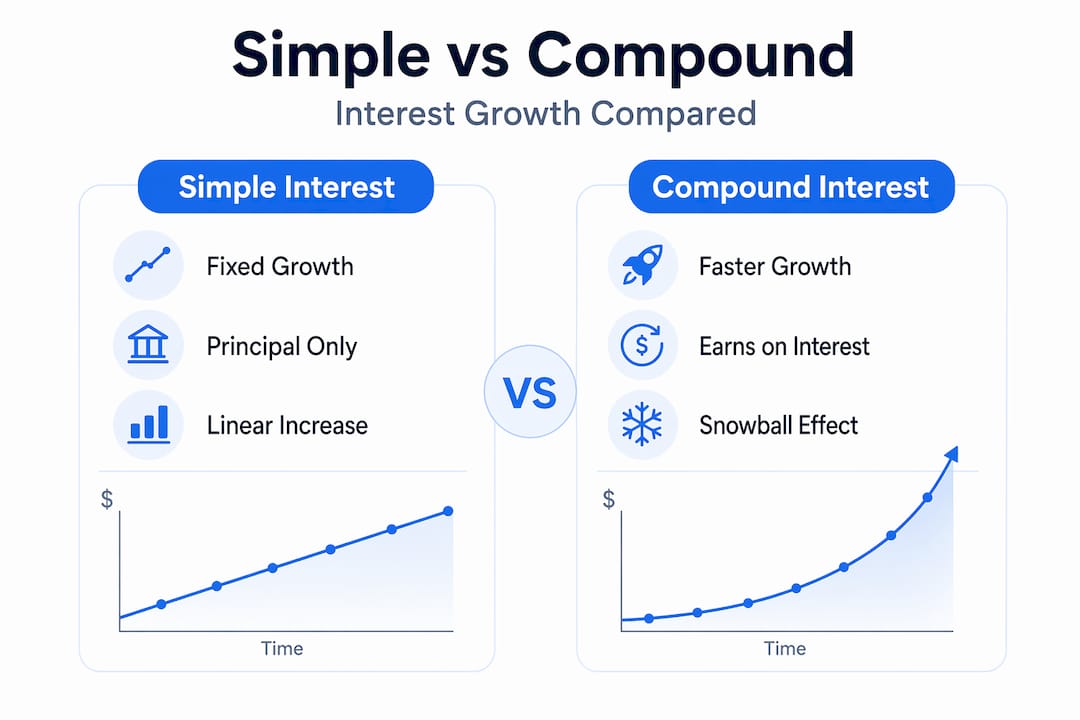
Here’s a quick comparison using the same $1,000 principal and a 5% annual rate:
| Year | Simple interest balance | Compound interest balance |
|---|---|---|
| 1 | $1,050 | $1,050 |
| 2 | $1,100 | $1,102.50 |
| 3 | $1,150 | $1,157.63 |
| 4 | $1,200 | $1,215.51 |
| 5 | $1,250 | $1,276.28 |
At the five-year mark, the compound account delivers $26.28 more. That may seem small, but extend this to 20 or 30 years and the gap runs into thousands of dollars. The key advantages of the compound interest definition include:
- Exponential growth that accelerates over time rather than growing at a flat pace
- Self-reinforcing returns where each period’s gains become part of the next period’s earning base
- Powerful rewards for patience since the greatest gains appear in the later years of a long investment window
Pro Tip: Starting even five years earlier in a compound account can result in significantly more money than starting later and contributing a larger amount. Time is the most powerful input in compounding, not the size of your contributions.
Visual comparison: Growth of simple vs compound interest
Now that you see the definitions, let’s visualize what these differences mean in numbers.
Consider two investors who each put $10,000 into an account earning 6% annually. One account uses simple interest. The other compounds annually. Over a 30-year period, the numbers look like this:
| Year | Simple interest ($10,000 at 6%) | Compound interest ($10,000 at 6%) |
|---|---|---|
| 5 | $13,000 | $13,382 |
| 10 | $16,000 | $17,908 |
| 20 | $22,000 | $32,071 |
| 30 | $28,000 | $57,435 |
At 30 years, the simple interest account produces $28,000. The compound account delivers over $57,400. That’s more than double on the same principal at the same rate. The only difference is how the interest is calculated.

The mechanics behind this are sometimes described as the “snowball” effect. As compounding works by reinvesting each period’s interest into the next period’s base, the snowball gets heavier and heavier as it rolls. Early on, the extra gains are modest. After a decade or two, they become the dominant driver of total growth.
This is exactly why compounding matters so much for long-term goals like retirement. If you’re saving in a 401(k) or IRA, your account likely benefits from compound returns. Over a 35-year career, the difference between a simple return and a compounded return at the same rate could easily represent an extra $100,000 or more in retirement funds, depending on contribution levels. The same logic applies to college savings plans and other long-horizon accounts.
The flip side is that compounding works against you just as powerfully when you’re the borrower. That’s a topic we’ll address in a later section because it changes how you should think about carrying balances on debt.
APR, APY, and compounding frequencies: Why it matters
Understanding these terms helps you make smarter comparisons. Here’s what you need to know next.
When you look at a bank account or loan offer, you’ll usually see two different rates: APR and APY. Many people treat them as interchangeable. They are not.
APR stands for Annual Percentage Rate. It represents the nominal interest rate for a year without accounting for compounding. It’s the simpler of the two numbers and doesn’t tell you the whole story on returns or costs.
APY stands for Annual Percentage Yield. This number accounts for the effect of compounding over the year. It reflects what you actually earn or pay in a year when compounding is factored in. As the impact of interest rates shows on savings products, even a small gap between APR and APY compounds into meaningful differences on larger balances.
Compounding doesn’t only happen once a year. Banks and lenders apply interest at different intervals, called compounding frequencies. Here are the most common:
- Annually: Interest is added once per year
- Quarterly: Interest is added four times per year
- Monthly: Interest is added 12 times per year
- Daily: Interest is added 365 times per year
The more frequently interest compounds, the more you earn (or owe). A savings account with a 5% APR compounded daily will produce slightly more than one compounding monthly at the same APR. The math behind compounding frequency and quoted rates shows that APR and APY matter significantly in real financial products, particularly when you’re comparing options across banks, credit unions, or loan providers.
For example, a 5% APR compounded daily has an APY of approximately 5.13%. That gap grows larger as the interest rate increases. On a $50,000 savings balance, 0.13% translates to $65 per year in extra earnings.
Pro Tip: When you’re comparing savings accounts or investment products, always ask for the APY. Don’t let a bank convince you to choose based on APR alone. Higher frequency compounding on savings is an advantage. Lower frequency compounding on a loan is better for you as the borrower.
Compounding in loans and taxes: When interest works against you
Now, let’s move from earnings to costs. What happens when compounding is used against you?
Compounding isn’t a neutral force. On savings and investments, it works in your favor. On debt, it works against you. The math is identical but the direction is reversed. When you carry a balance on a credit card or fail to pay off a loan quickly, compounding means that yesterday’s unpaid interest becomes tomorrow’s principal. Your debt grows on itself.
Here’s a step-by-step look at how compounding increases debt costs:
- You carry a $3,000 credit card balance at 22% APR compounded daily
- Day one’s interest is added to your balance, making it $3,001.81 (approximately)
- Day two’s interest is calculated on the new, higher balance
- Each day you don’t pay, the balance grows slightly faster than the day before
- After one year without payments, your balance has grown to roughly $3,736
That’s $736 in interest on a $3,000 balance, and you haven’t added a single new charge. Now imagine carrying that for two or three years. The numbers become painful fast.
Carrying balances is a situation where compounding flips its advantage against the borrower, making credit card debt and similar high-rate liabilities dramatically more expensive than simple interest would be. This is exactly why minimum payments on credit cards are so dangerous. They barely outpace the daily interest additions, meaning the principal barely shrinks.
Federal tax debt is another context where compounding hits hard. The IRS is required by law to charge compound interest on unpaid taxes.
“Interest shall be allowed and paid upon any overpayment in respect of any internal revenue tax at the overpayment rate established under section 6621. Interest shall be compounded daily.” — IRC §6622
As US Code 26 §6622 makes explicit, daily compounding on IRS debt is a legal mandate, not a policy choice. If you owe back taxes and delay resolution, the debt grows every single day with no exceptions.
Smart debt repayment strategies prioritize high-rate compounding debts first, particularly credit card debt strategies built around eliminating the highest-interest balances before anything else. At the same time, redirecting freed-up cash into tax-advantaged accounts lets you put compounding to work on your side. You can also use tools like an after-tax compound growth calculator to model exactly how much your investments can grow versus how much your debt costs you over time.
Choosing and applying the right type of interest
Let’s pull all these concepts together so you can apply them to your own choices.
Not every financial product works the same way, and now that you understand how interest is calculated, you can be a more strategic shopper. The key is knowing when each type of interest serves your goals and when it works against them.
When simple interest is actually better for you:
- Short-term personal loans where you pay off the balance quickly
- Some auto loans, where simple daily interest means paying off early saves real money
- Any loan product where you’re certain to pay it off faster than the term requires
When compound interest should be your priority:
- Long-term savings accounts, especially high-yield online accounts
- Retirement accounts such as 401(k) plans and Roth IRAs
- Taxable brokerage accounts where reinvested dividends create compounding returns
- Education savings accounts designed for multi-year growth
The practical decision isn’t complicated once you understand the mechanic. For growing money, compound interest is almost always the better tool. For borrowing money, simple interest is almost always cheaper. The challenge is that many financial products are marketed in ways that obscure which type of interest applies. Simple interest applied to only the principal creates predictable, straight-line growth, which lenders sometimes market as “transparent” even when the rate itself is high.
Pro Tip: When a lender promotes an “easy” or “flexible” interest structure, always ask directly whether the interest is simple or compound and what the compounding frequency is. A low APR on a compound loan can quietly cost more than a higher APR on a simple loan over the same term.
For anyone actively working to pay down existing debt, reviewing your managing your debt strategy through the lens of compound interest is a useful exercise. Identify which balances compound most frequently, and attack those first. Even a few months of aggressive repayment can significantly reduce the long-term cost.
Our take: The compounding gap is wider than most people realize
Here’s something most financial content glosses over. Compounding is talked about constantly as a positive force for investors, but the same articles rarely drive home how violently it works on the debt side. The gap between saving with compound interest and borrowing with compound interest is not just mathematical. It represents a fundamental difference in financial trajectory.
We’ve seen readers who were diligently putting $200 per month into a high-yield savings account while simultaneously carrying $8,000 in credit card debt at 24% APR. The savings were growing at maybe 4.5% compounded daily. The debt was compounding at more than five times that rate. Their net worth was actively shrinking even as they felt they were building savings.
The uncomfortable truth is that most financial marketing is designed to make compounding feel like a reward for savers, while disguising it as just another “interest rate” for borrowers. Understanding that the mechanism is identical in both cases, just working in opposite directions, fundamentally changes how you should prioritize your money. Clearing high-rate compound debt is not an alternative to investing. For most working professionals carrying credit card balances, eliminating that debt is the investment, with a guaranteed return equal to your interest rate.
The second thing most people miss is the asymmetry of time. Compounding rewards those who start early and punishes those who carry debt long. A 25-year-old who starts a retirement account this year and contributes modestly will very likely outperform a 35-year-old who contributes aggressively for the same number of years, simply because those extra years of compounding are irreplaceable. Start saving now. Pay off compound debt fast. Both sides of the same principle.
Ready to put compound interest to work for your future?
At finblog.com, we make financial concepts like compound versus simple interest practical and actionable for everyday investors and working professionals. Whether you want to build a smarter savings plan, understand how debt compounding is quietly costing you money, or find the right investment accounts to maximize your long-term returns, we offer expert guidance and personalized resources to help you move forward confidently. Explore our in-depth guides, use our financial tools, and connect with advisors who understand your goals. Subscribe to our newsletter or reach out today to start making interest work for you, not against you.
Frequently asked questions
What’s the main difference between simple and compound interest?
Simple interest is calculated only on your original amount, while compound interest pays you on both the principal and any previously earned interest, creating accelerating growth over time.
Does compounding always grow your money faster than simple interest?
Yes. Over any meaningful time period, compound interest at the same rate will always produce more growth because interest earns interest on itself each period, while simple interest does not.
How does APR vs APY affect my earnings or debt payments?
APY reflects the true annual return or cost including compounding effects, while APR does not. As APR reflects a simple-interest rate without compounding, it will always appear lower than the APY on the same product, which can be misleading.
Are all debts compounded daily?
No. Only certain debts, such as federal tax debt and most credit cards, require daily compounding. Federal tax interest is mandated by IRC §6622, while other loan types vary based on the lender’s terms.
Where does compounding make the biggest difference?
The biggest impact appears over very long time horizons, typically a decade or more. The longer your money is invested or your debt remains unpaid, the more dramatically compounding accelerates the gap between simple and compound outcomes.