

Every year, countless American professionals and small business owners watch their hard-earned dollars slip away because of missed tax opportunities. With complex regulations and evolving policies, staying ahead feels challenging yet necessary. By organizing critical documents, identifying valuable credits, and efficiently using tax-advantaged accounts, you can reclaim control and uncover meaningful tax savings that empower long-term financial growth.
Table of Contents
- Step 1: Gather Essential Financial Documents
- Step 2: Identify Eligible Deductions And Credits
- Step 3: Maximize Retirement And Savings Contributions
- Step 4: Leverage Tax-Advantaged Accounts Effectively
- Step 5: Review And Verify Your Tax Savings
Quick Summary
| Key Insight | Explanation |
|---|---|
| 1. Gather essential documents | Collect income statements, deduction receipts, and IDs to ensure accurate tax filing and maximize deductions. |
| 2. Identify deductions and credits | Explore available tax deductions and credits based on personal circumstances to reduce tax liability significantly. |
| 3. Maximize retirement contributions | Increase contributions to tax-advantaged accounts like 401(k)s and IRAs to lower taxable income and boost savings. |
| 4. Leverage tax-advantaged accounts | Use accounts like HSAs and Roth IRAs effectively to optimize tax efficiency while building long-term financial security. |
| 5. Review your tax filing thoroughly | Cross-check all financial documents and claims before submitting to catch errors and increase potential savings. |
Step 1: Gather essential financial documents
Getting your financial documents organized is the critical first step in preparing an accurate tax return. By collecting all necessary records in advance, you can streamline your filing process and maximize potential deductions.
Start by gathering key income documentation like forms W-2, 1099 variants, and Social Security statements. These official documents will report your total earnings for the year. You should also collect comprehensive tax records including bank statements, investment income reports, receipts for potential deductions like charitable donations, mortgage interest statements, and retirement account contribution records.
Make sure you have essential personal identification information ready as well. This includes Social Security numbers for everyone listed on your tax return, along with bank account and routing numbers for direct deposit of potential refunds. Having these documents easily accessible will help prevent processing delays and ensure you claim all eligible credits and deductions.
Pro tip: Create a dedicated folder or digital file where you can consistently store tax documents throughout the year to simplify next year’s preparation process.
Here’s a quick overview of essential financial records professionals should prepare for tax filing:
| Document Type | Purpose | Typical Source |
|---|---|---|
| Income statements | Report yearly earnings | Employers, clients |
| Tax deduction receipts | Support claimed deductions | Charities, banks |
| Retirement contributions | Validate retirement savings | Banks, investment firms |
| Personal identification | Verify taxpayer’s identity | Government agencies |
Step 2: Identify eligible deductions and credits
Understanding available tax deductions and credits can dramatically reduce your overall tax liability and potentially increase your refund. These financial benefits provide strategic opportunities for professionals to minimize their tax burden legally and effectively.

Begin by exploring tax credits and deductions that apply specifically to your income level and personal circumstances. For professionals, common deductions often include expenses related to home office use, professional development, business travel, continuing education, and work equipment purchases. Education credits like the Lifetime Learning Credit can offset costs for job related training, while credits such as the Earned Income Tax Credit provide additional financial relief for working individuals.
Carefully document all potential deductions throughout the year by maintaining organized records of receipts, expenses, and supporting financial documents. Some professionals overlook valuable deductions like retirement account contributions, health savings account payments, student loan interest, and charitable donations. These strategic financial moves can substantially reduce your taxable income and provide meaningful tax savings.
Pro tip: Consider consulting a tax professional who can help identify niche deductions specific to your professional field and personal financial situation.
Step 3: Maximize retirement and savings contributions
Strategically increasing your retirement and savings contributions can provide significant long term financial benefits, reducing your taxable income while building wealth for the future. Understanding how to optimize these contributions requires careful planning and knowledge of available investment vehicles.
Start by exploring retirement account strategies that align with your professional income and financial goals. Consider maximizing contributions to tax advantaged accounts like 401k plans, traditional IRAs, and Roth IRAs. For professionals in higher tax brackets, contributing the maximum allowed amount can substantially reduce your annual tax liability while simultaneously growing your retirement savings. Workplace retirement plans often offer employer matching, which represents essentially free money you should take full advantage of whenever possible.
Look beyond traditional retirement accounts and explore additional savings opportunities like health savings accounts (HSAs), which offer triple tax advantages: tax deductible contributions, tax free growth, and tax free withdrawals for qualified medical expenses. Self employed professionals can also explore specialized retirement options like SEP IRAs or Solo 401k plans that provide higher contribution limits and greater flexibility for independent workers.
Pro tip: Set up automatic monthly contributions to retirement accounts to ensure consistent savings and take advantage of dollar cost averaging investment strategies.
Step 4: Leverage tax-advantaged accounts effectively
Maximizing tax-advantaged accounts requires a strategic approach that goes beyond simple contributions. By understanding the nuanced benefits of different investment vehicles, professionals can significantly reduce their tax liability while building long term financial security.
Start by exploring tax efficient investing strategies that align with your specific financial goals. Different accounts offer unique tax benefits: traditional 401k and IRA contributions provide immediate tax deductions, while Roth accounts offer tax free growth and withdrawals. Self employed professionals should particularly investigate specialized accounts like SEP IRAs and Solo 401k plans that provide higher contribution limits and more flexible tax management opportunities.
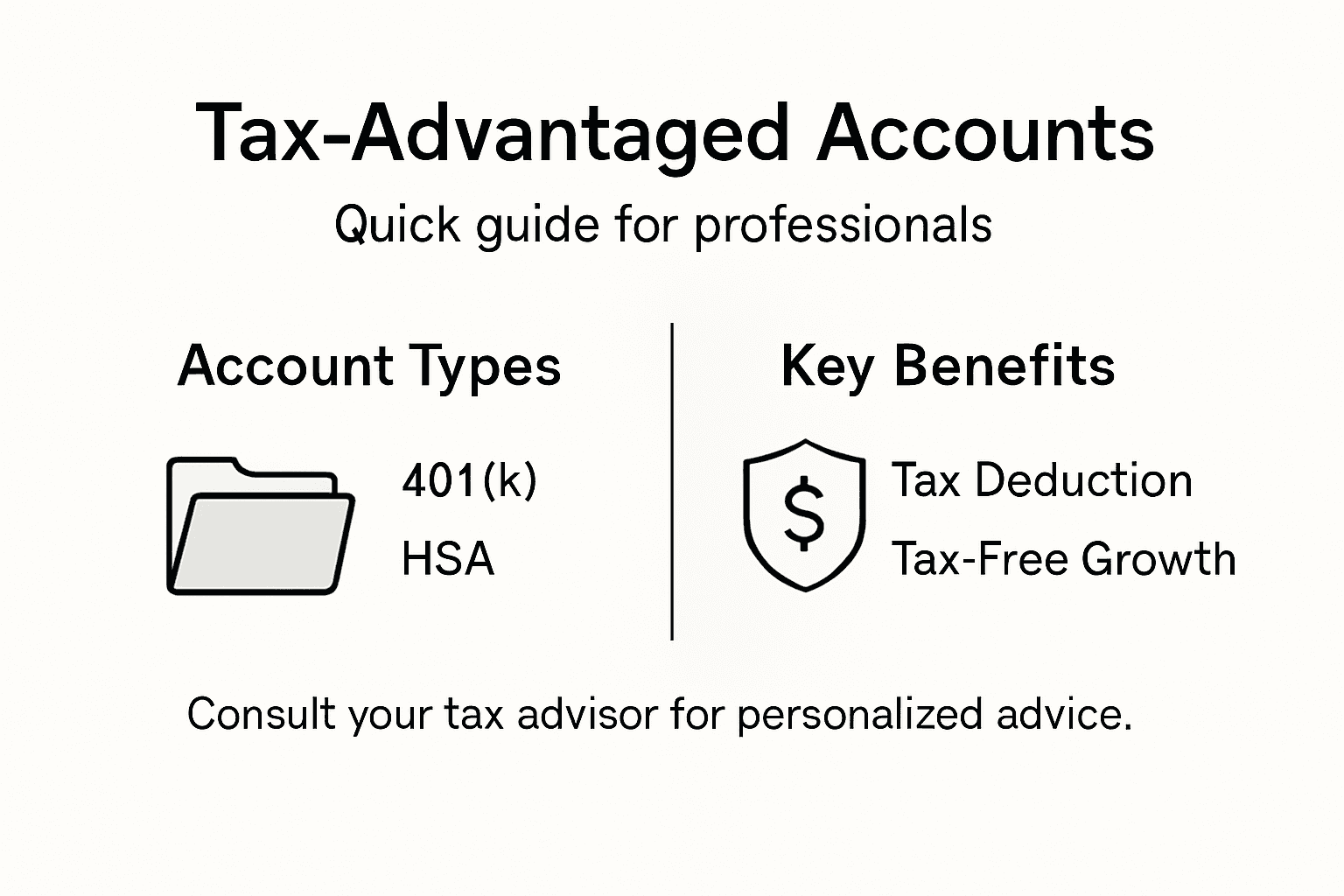
Pay close attention to annual contribution limits and potential phase out ranges based on your income level. High earning professionals can strategically utilize backdoor Roth conversions, mega backdoor Roth strategies, and strategic rollovers to maximize tax advantaged space. Health savings accounts (HSAs) represent another powerful tool, offering triple tax advantages that can significantly enhance your overall tax efficiency.
Pro tip: Consult a tax professional annually to optimize your account strategies and ensure you are maximizing available tax advantaged contribution opportunities.
This table compares popular tax-advantaged accounts and their unique benefits:
| Account Type | Tax Benefit Type | Who Can Contribute | Maximum Contribution (2024) |
|---|---|---|---|
| 401(k) | Tax-deductible contributions | Employees, employers | $23,000 + catch-up |
| Roth IRA | Tax-free growth/withdrawals | Anyone within income limits | $7,000 + catch-up |
| HSA | Triple tax advantage | Individuals with HDHP | $4,150 (single), $8,300 (family) |
| SEP IRA | Higher deduction limit | Self-employed/Small business | Up to $66,000 |
Step 5: Review and verify your tax savings
Carefully reviewing your tax documents is the final critical step in ensuring you maximize your potential savings and minimize the risk of costly errors. A systematic and thorough verification process can help you catch potential mistakes before they become problematic.
Begin by reviewing tax filing resources and carefully cross checking all income documents. Verify that every W-2, 1099, and additional income statement accurately reflects your earnings. Pay special attention to Social Security numbers, income amounts, and the precise details of any deductions or credits you are claiming. Double check that all financial information matches your original source documents, including receipts, bank statements, and investment records.
Create a comprehensive checklist that includes verifying personal information, income sources, deduction documentation, and credit eligibility. Reconcile your tax documents against your financial records from the past year, looking for any discrepancies or overlooked opportunities for additional tax savings. Consider using tax preparation software or consulting a professional tax advisor who can provide an additional layer of scrutiny and help identify potential missed deductions or credits.
Pro tip: Perform your tax review at least two weeks before the filing deadline to allow sufficient time for corrections and minimize last minute stress.
Take Control of Your Tax Savings with Expert Guidance
Navigating the complex world of tax deductions, credits, and retirement contributions can be overwhelming for professionals eager to maximize their savings. This article highlights key challenges like organizing financial documents, identifying eligible deductions, and leveraging tax-advantaged accounts effectively. Feeling uncertain about how to apply strategies such as backdoor Roth conversions or how to optimize your SEP IRA contributions is common, but you do not have to face these decisions alone.
Unlock the full potential of your tax strategies today by exploring proven solutions designed to simplify your financial planning. At FinBlog, you gain access to expert insights and tailored advice that help you avoid costly errors and maximize your tax benefits. Ready to take the next step toward financial confidence and security Visit FinBlog’s main site now and start your journey toward smarter investing and tax saving. Don’t wait – your financial future deserves proactive steps today.
Frequently Asked Questions
What financial documents do I need to save on taxes as a professional?
Gather essential financial documents such as W-2 and 1099 forms, receipts for deductions, and bank statements. Organizing these documents can streamline your filing process and help ensure you claim all eligible deductions.
How can I identify tax deductions and credits specific to my profession?
Explore available tax deductions and credits that relate to your income level and circumstances, such as home office expenses and professional development costs. Keep thorough records of your expenses throughout the year to maximize your potential savings.
What are the benefits of maximizing my retirement contributions?
Contributing to tax-advantaged retirement accounts like 401(k)s and IRAs can lower your taxable income while helping you save for the future. Aim to contribute the maximum allowed to these accounts, which can reduce your tax bill significantly within the year.
How do I effectively use tax-advantaged accounts?
Utilize accounts like HSAs and Roth IRAs to gain various tax benefits, including tax-free growth. Review and adjust your contributions each year, ensuring you stay within allowable limits and take full advantage of the opportunities available to you.
How can I verify my tax savings before filing?
Review all income documents and cross-check them for accuracy to avoid errors that could affect your tax return. Create a checklist to verify your personal information and any deductions or credits claimed, ideally at least two weeks before the filing deadline.
Recommended
- Understanding Tax Efficient Investing: How It Works – Finblog
- Understanding the Tax Implications of Investing – Finblog
- Tax Loss Harvesting Explained: Boosting Investment Returns – Finblog
- Master Financial Planning for Freelancers in 2025 – Finblog
- 7 Key Points on Switzerland Tax Benefits List for Entrepreneurs