



More than 60 percent of American adults admit they do not have a long-term financial plan in place. With the unpredictability of today’s economy, understanding your financial strength is vital for every individual aiming for stability. By uncovering practical steps to evaluate finances, set goals, and build reliable security, this guide empowers you to make smarter decisions and protect your future.
Table of Contents
- Step 1: Evaluate Your Current Financial Situation
- Step 2: Set Realistic Security Goals and Priorities
- Step 3: Implement Key Protective Measures
- Step 4: Diversify Investments for Risk Management
- Step 5: Monitor Progress and Adjust Strategies
Quick Summary
| Key Point | Explanation |
|---|---|
| 1. Assess Your Financial Situation | Conduct a thorough evaluation of your current financial health by gathering all income and expense documentation. |
| 2. Set Specific Financial Goals | Establish short-term and long-term goals, quantifying them to enhance accountability and track progress effectively. |
| 3. Implement Protective Measures | Create an emergency fund and secure insurance to mitigate potential financial risks and ensure stability. |
| 4. Diversify Your Investments | Spread your investments across various asset classes to optimize risk management and align with your financial objectives. |
| 5. Monitor and Adjust Regularly | Consistently review your financial strategy, making necessary adjustments based on performance and life changes. |
Step 1: Evaluate Your Current Financial Situation
Understanding your financial landscape begins with a comprehensive assessment of where you currently stand. This crucial first step involves gathering and analyzing all your financial information to create a clear snapshot of your monetary health. Financial statement analysis techniques provide a systematic approach to evaluating your personal economic status.
Start by compiling a complete inventory of your financial resources and obligations. This means collecting documentation for all income sources such as salary statements, investment returns, and any additional revenue streams. On the opposite side, list out all your financial commitments including monthly bills, loan payments, credit card debts, and recurring expenses. Creating a personal balance sheet will help you visualize your net worth and understand the relationship between your assets and liabilities.
Pro tip: Be brutally honest during this assessment. Many people inadvertently overlook small expenses or underestimate their total debt. Tracking every single financial transaction for one month can reveal surprising insights about your spending patterns and help you make more informed decisions. This granular approach transforms your financial evaluation from a generic overview to a precise roadmap for future improvement.
Once you have a comprehensive picture of your financial situation, you will be ready to move forward with strategic planning and goal setting. Your detailed assessment becomes the foundation for building a robust financial strategy that aligns with your long-term objectives.
Step 2: Set Realistic Security Goals and Priorities
Transforming your financial assessment into actionable objectives requires strategic planning and clear goal setting. Creating SMART financial goals provides a structured framework for turning your financial aspirations into achievable targets. Think of these goals as your personal financial roadmap navigating you toward long-term stability and security.
Start by categorizing your goals into short-term and long-term priorities. Short-term goals might include building an emergency fund, reducing high-interest debt, or creating a monthly budget. Long-term goals could encompass retirement planning, purchasing a home, or establishing significant investment portfolios. Assign specific numerical targets to each goal such as saving $10000 in emergency funds within 12 months or reducing credit card debt by 30% in the next year. Quantifying your goals makes them tangible and trackable.
Pro tip: Always align your financial goals with your personal values and lifestyle. A goal that feels disconnected from your core desires will quickly lose momentum. Consider your unique circumstances, risk tolerance, and career trajectory when designing these objectives. Regularly reassess and adjust your goals as your life circumstances evolve, maintaining flexibility while staying committed to your overall financial vision.
By establishing clear, realistic security goals, you create a powerful framework for financial growth. Your next step involves developing strategic approaches to turn these priorities into reality.
Step 3: Implement Key Protective Measures
Protecting your financial future requires strategic resource allocation and proactive risk management. Mathematical models of household financial planning suggest implementing a systematic approach to distribute your income and safeguard your financial stability. The fundamental principle is creating multiple layers of financial protection that work together to shield your economic well-being.
Begin by establishing an emergency fund that covers three to six months of living expenses. This fund acts as your primary financial buffer against unexpected challenges such as job loss, medical emergencies, or major repairs. Next, diversify your protective measures by exploring multiple income protection strategies. This might include obtaining comprehensive health insurance, disability coverage, and life insurance tailored to your specific life stage and family responsibilities. Family resource allocation research emphasizes the importance of balancing immediate needs with long-term security measures.

Pro tip: Consider your financial protections as an interconnected system rather than isolated tools. Review and update your protective measures annually, ensuring they adapt to your changing life circumstances. Pay special attention to your risk tolerance and adjust your strategies accordingly. Young professionals might prioritize different protective measures compared to those closer to retirement.
Implementing these key protective measures transforms your financial plan from a passive document into an active shield against potential economic uncertainties. Your next step involves developing a strategic investment approach that complements these protective foundations.
Step 4: Diversify Investments for Risk Management
Maslowian Portfolio Theory reveals a sophisticated approach to investment strategy that goes beyond traditional financial thinking. Diversification is not just about spreading your money across different assets but strategically aligning your investments with your fundamental financial needs and risk tolerance. The goal is to create a resilient portfolio that can withstand market fluctuations while supporting your long-term financial objectives.
Begin by creating a balanced investment mix that includes multiple asset classes. This means spreading your investments across stocks, bonds, real estate, and potentially alternative investments like commodities or cryptocurrencies. Advanced investment optimization techniques suggest using data-driven approaches to determine the ideal allocation. A typical starting point might involve a 60% stocks, 30% bonds, and 10% alternative investments strategy, though this should be customized based on your age, risk tolerance, and financial goals.
Pro tip: Regularly rebalance your portfolio to maintain your desired risk level. Markets change, and your investments will naturally drift from their original allocation. Set a schedule to review and adjust your investments at least annually, or after significant market movements. Consider working with a financial advisor who can provide personalized guidance tailored to your specific financial situation and evolving life circumstances.
By thoughtfully diversifying your investments, you create a robust financial defense mechanism that can help protect and grow your wealth over time. Your next step involves developing a consistent investment strategy that supports these diversification efforts.
Step 5: Monitor Progress and Adjust Strategies
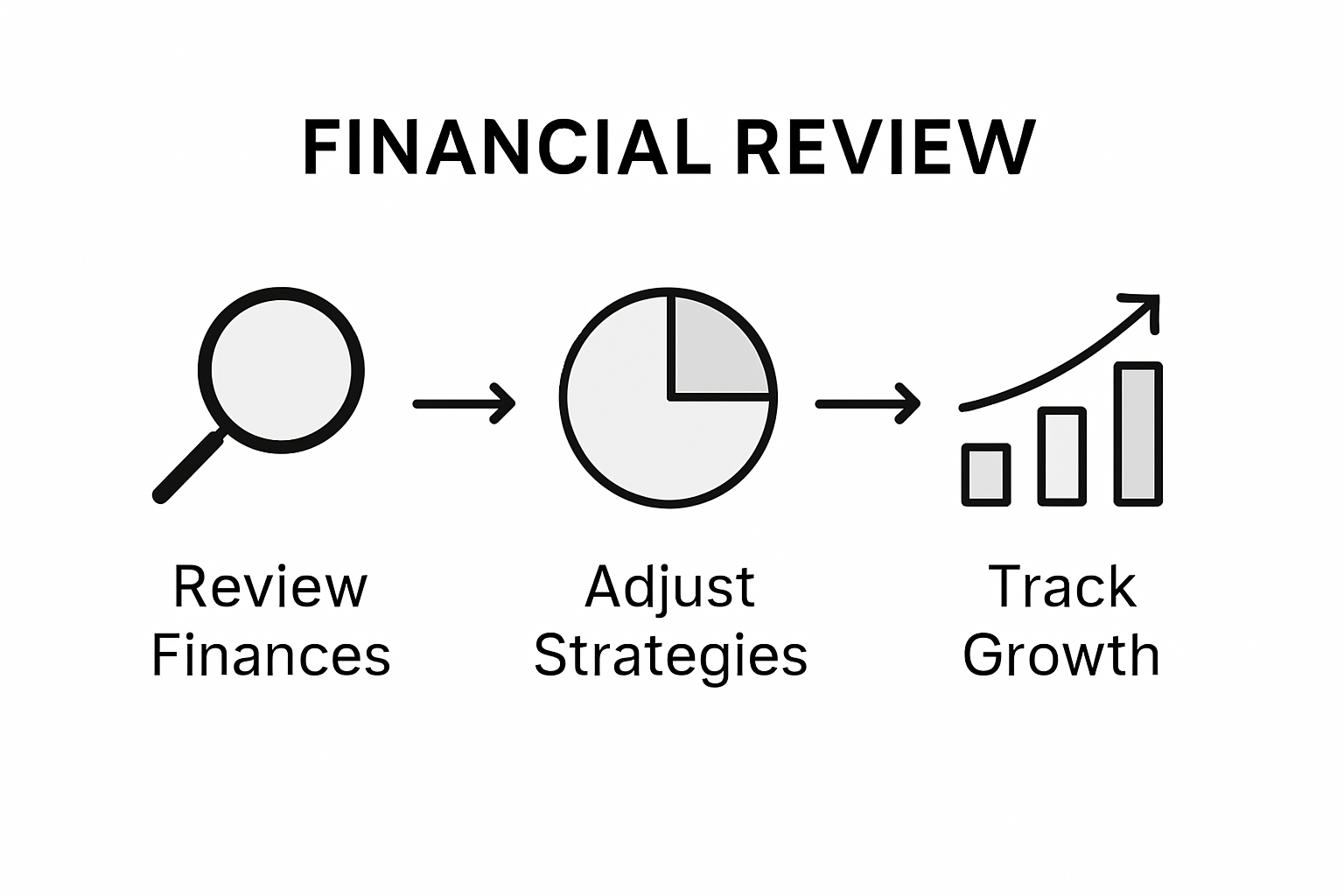
Advanced goal-based financial management strategies reveal that successful wealth building requires continuous monitoring and strategic adaptation. Your financial journey is not a one-time setup but an ongoing process of evaluation, learning, and refinement. The key is developing a systematic approach to tracking your financial progress and making informed adjustments.
Establish a consistent review schedule to assess your financial performance. This might involve quarterly reviews of your investment portfolio, annual tax planning sessions, and comprehensive financial check-ups every six months. During these reviews, compare your actual financial results against the goals you initially set. Look at key metrics such as investment returns, savings rate, debt reduction progress, and overall net worth growth. Pay attention to both quantitative data and qualitative changes in your financial landscape.
Pro tip: Create a dynamic financial tracking system that goes beyond simple number crunching. Develop a holistic approach that considers not just financial metrics but also your evolving life goals and personal circumstances. Building an investment portfolio requires flexibility and a willingness to adapt. Be prepared to make strategic shifts in response to significant life changes such as career transitions, marriage, having children, or approaching retirement.
By maintaining a proactive and adaptive approach to your financial strategy, you transform your financial plan from a static document into a living, breathing roadmap for success. Your commitment to regular monitoring and strategic adjustment will be the cornerstone of your long-term financial security.
Secure Your Financial Future with Expert Guidance
Struggling to achieve long-term financial stability can feel overwhelming. This article highlights common challenges like creating an emergency fund, setting SMART financial goals, and diversifying investments to reduce risk. The pain points of managing debt, protecting your income, and monitoring progress are real obstacles that require practical solutions tailored to your unique situation.
Take control today by exploring proven strategies at finblog.com. Our platform offers expert insights and personalized support designed to help you implement key protective measures and build a resilient investment portfolio. Don’t wait for uncertainty to strike. Visit finblog.com now to start crafting a realistic, adaptable financial plan. Secure your peace of mind and take the next step toward long-term financial security.
Frequently Asked Questions
How can I evaluate my current financial situation effectively?
To evaluate your financial situation, gather documentation for all income sources and list out your financial obligations. Create a personal balance sheet to visualize your net worth, and track every transaction for one month to uncover spending patterns.
What are SMART financial goals, and how can I set them?
SMART financial goals are specific, measurable, achievable, relevant, and time-bound objectives. Start by categorizing your goals into short-term and long-term, assigning numerical targets, such as saving $10,000 in an emergency fund within 12 months.
What kind of protective measures should I implement for financial security?
Establish an emergency fund covering three to six months’ worth of living expenses and consider obtaining health insurance and life insurance tailored to your needs. Regularly review and update your protective measures at least once a year to ensure they adapt to your life circumstances.
How can I diversify my investments for better risk management?
To diversify your investments, create a balanced mix across various asset classes like stocks, bonds, and real estate. Consider starting with an allocation of 60% in stocks, 30% in bonds, and 10% in alternative investments, then rebalance your portfolio at least annually.
How often should I monitor my financial progress and make adjustments?
Establish a consistent review schedule, ideally quarterly, to assess your investment portfolio and overall financial performance. Compare your actual results against your goals and be ready to adjust your strategies in response to significant life changes or market fluctuations.
Recommended
- Effective Financial Stress Management for a Secure Future – Finblog
- 7 Safe Investment Options for Your Financial Future – Finblog
- What is a Financial Plan? Understanding Its Importance – Finblog
- How to Build Wealth: Proven Steps for Lasting Financial Success – Finblog
- Where To Put Your Money If You Don’t Trust Banks! –