

Big Tech’s dominance is being tested as all “Magnificent 7” stocks slide sharply, with investors rotating out of growth and questioning the true payoff of AI.
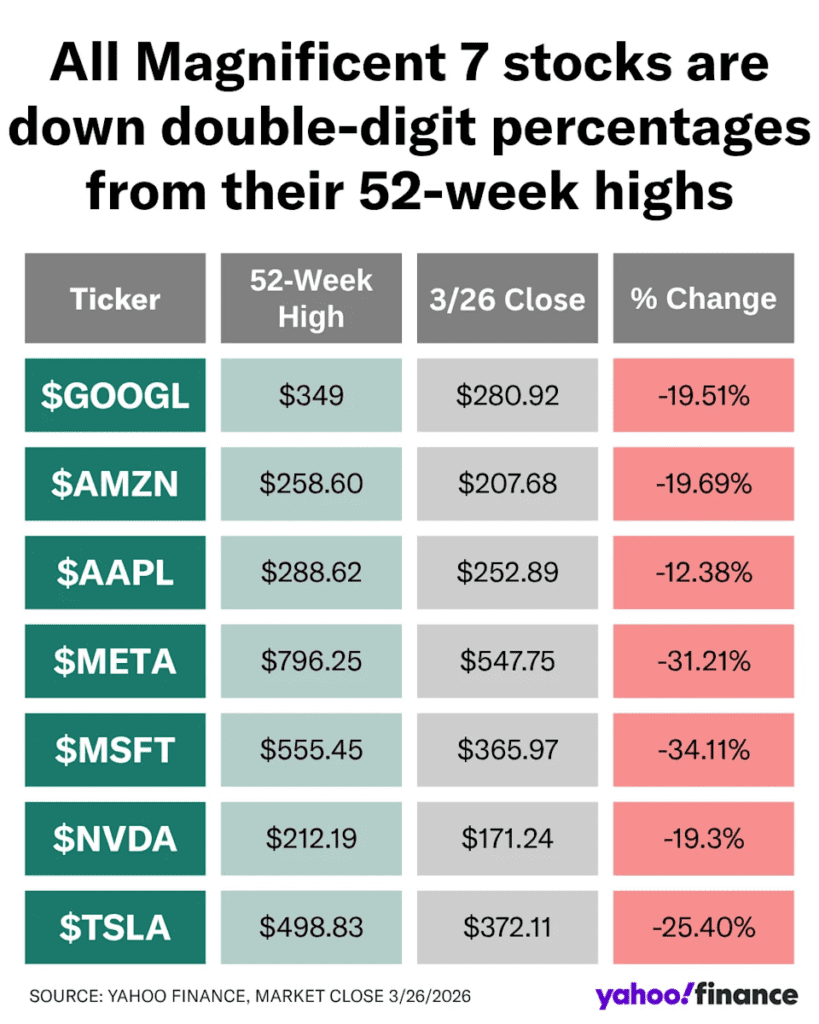
The so-called “Magnificent 7” tech giants are facing a broad and unexpected downturn, with every major name now down double digits from recent highs. What was once the strongest trade in the market is now under pressure from a powerful mix of rising oil prices, higher interest rates, and growing concerns over massive AI spending.
Even companies at the center of the AI boom are not immune.
A Sharp Reversal for Big Tech
The scale of the decline is striking.
- Microsoft has dropped more than 30% from its peak
- Meta, Amazon, and Google have all seen significant double-digit losses
- The entire group is now firmly in correction territory
This marks a major shift from 2025, when these companies drove market gains on AI optimism and strong earnings momentum.
Now, that narrative is being challenged.
Why Tech Is Suddenly Under Pressure
The selloff is not driven by one factor, but several converging forces. First, rising oil prices linked to the Iran conflict are pushing inflation higher again. This is forcing the Federal Reserve into a “higher-for-longer” rate stance, which is particularly damaging for growth stocks.
Higher rates reduce the present value of future earnings, a key driver of tech valuations. Second, the scale of AI investment is beginning to worry investors.
Major tech firms including Microsoft, Amazon, Google, and Meta are expected to spend more than $650 billion in 2026 on AI infrastructure, a roughly 60% increase from the previous year.
While this spending is meant to secure long-term dominance, it is raising short-term concerns:
- Pressure on profit margins
- Uncertain return on investment
- Slower earnings growth in the near term
The “Show Me” Moment for AI
Investors are no longer satisfied with projections. After years of hype, the AI trade is entering what analysts describe as a “show me” phase, where markets demand real, measurable returns rather than long-term promises.
Strong announcements and ambitious plans are no longer enough to support valuations. Instead, investors are asking a more direct question:
Where are the profits?
Money Is Moving Elsewhere
Another key driver of the selloff is capital rotation.
Institutional investors are shifting away from high-growth tech and into sectors seen as more resilient in a geopolitical and inflation-driven environment: Energy, Defense, Domestic manufacturing
These sectors are benefiting directly from the current global backdrop, while tech is facing headwinds.
Not Time to Buy the Dip?
Some strategists believe the correction may not be over. Market experts warn that there could still be downside risk for the Magnificent 7, especially if:
- Inflation remains elevated
- Interest rates stay high
- AI investments fail to quickly translate into profits
However, others suggest that if valuations fall far enough, these stocks could eventually become attractive again, potentially shifting from growth plays to value opportunities.
The Bigger Picture
The decline of the Magnificent 7 reflects a broader shift in market dynamics.
For the past two years, tech led everything. Now:
- Geopolitics is driving oil
- Oil is driving inflation
- Inflation is shaping interest rates
- Rates are pressuring tech valuations
At the same time, the AI narrative is evolving from excitement to scrutiny. The Magnificent 7 are no longer untouchable. They are now facing: Higher rates, Rising costs, Investor scepticism. If inflation cools and AI investments start delivering returns, the group could recover.
But for now: Big Tech is entering a new phase where dominance alone is no longer enough to sustain market leadership.
Disclosure: This article does not represent investment advice. The content and materials featured on this page are for educational purposes only.
Related: 3 weeks of war, possible rate hikes, and AI’s ‘show me’ phase: What to watch this week