
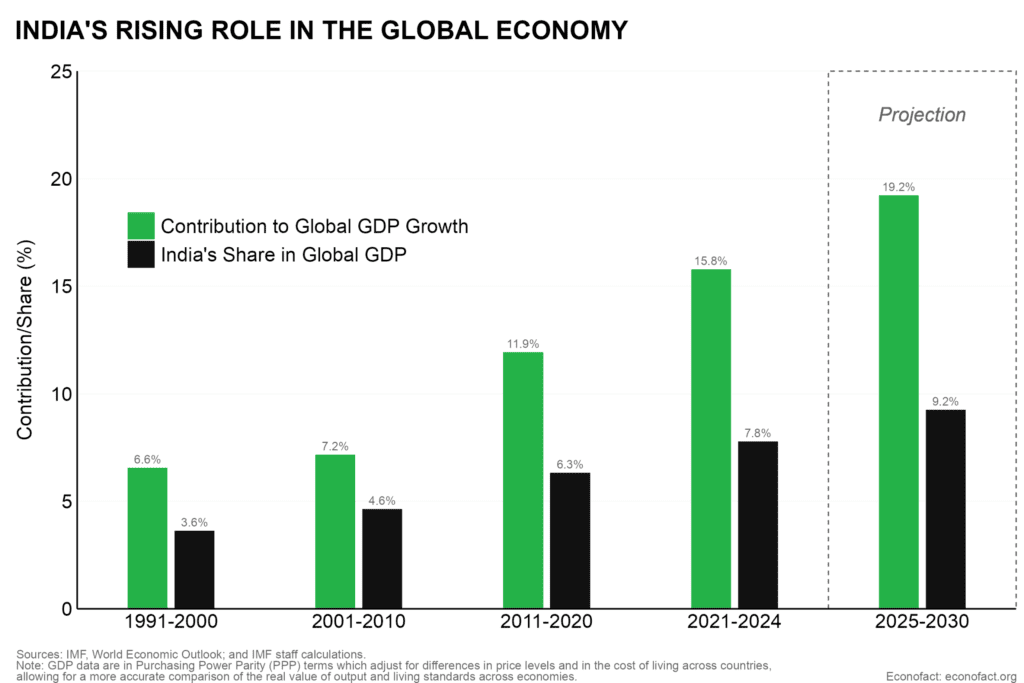
New data shows India’s economy expanded by 7.5 percent in 2025, making it the fastest growing major economy for the fourth consecutive year. While currency fluctuations kept it from overtaking Japan in dollar terms last year, India’s momentum continues to reshape the global economic landscape.
Closing In on the Top Four
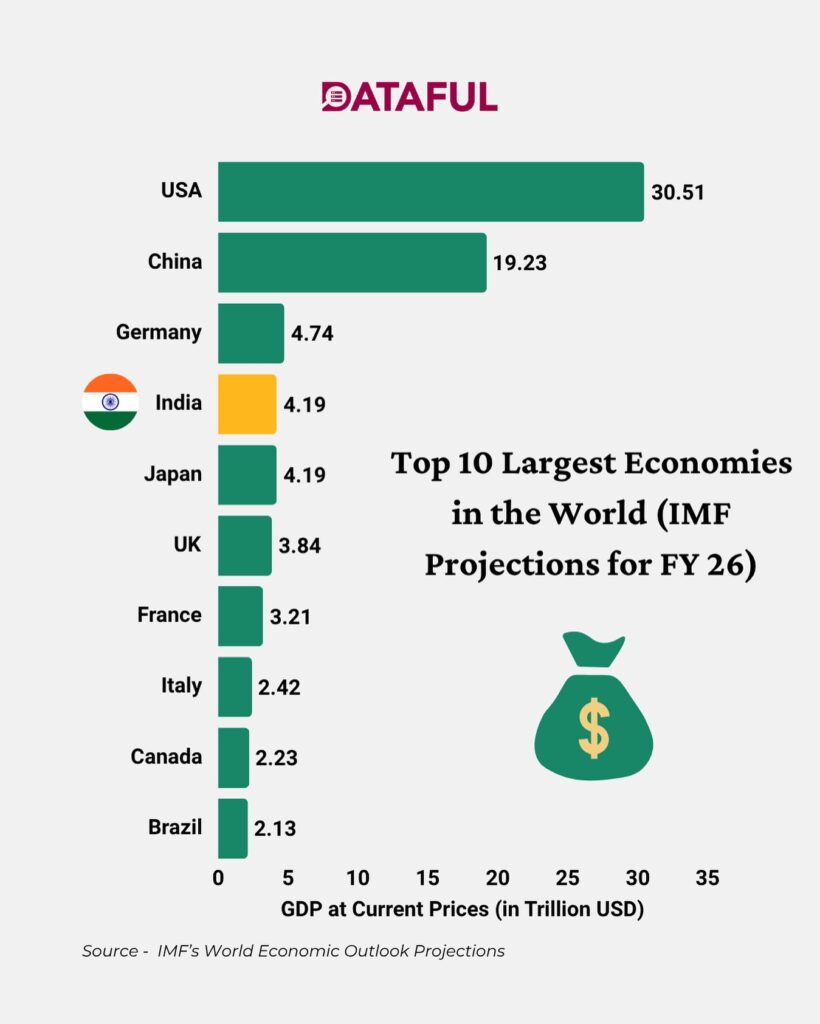
India became the world’s fifth-largest economy in 2021, surpassing the UK. The International Monetary Fund now expects it to overtake Japan in 2026, pushing it into fourth place globally.
Growth in India significantly outpaced Japan’s 1.1 percent expansion last year, as well as slower gains in the US, China, and Germany.
With annual growth consistently above 6 to 7 percent, India is on track to double the size of its economy every decade, a pace far beyond most developed nations.
A Different Growth Model
Unlike traditional economic powerhouses that relied on heavy industrialization, India’s rise has been driven largely by:
• Services
• Finance
• Technology
• Digital infrastructure
Manufacturing accounts for only 13 percent of India’s economy, down from 16 percent in 2015. Instead, sectors like digital payments, software services, and financial technology are powering expansion.
India’s digital payment system now handles around 20 billion transactions each month, pulling millions into the formal banking system and enabling massive scale lending.
Big Companies Driving Gains
While small businesses employ the majority of India’s workforce, a growing share of economic gains is coming from large conglomerates and financial firms.
Companies such as Bajaj Finserv have seen dramatic expansion, growing assets from $550 million to $53 billion, reflecting the broader shift toward finance and services.
Growth With Contradictions
Despite rapid expansion, India remains a relatively poor country in income terms. Average income is roughly $2,900 per year, far below developed nations.
At the same time:
• Massive investments are flowing into data centers and airports
• Nearly 800 million people still rely on free food programs
• Economic inequality remains deeply entrenched
Still, India’s population of over 1.4 billion people provides a vast consumer base, with an estimated 400 million middle-income consumers already creating major opportunities for businesses.
A Long-Term Global Player
Prime Minister Narendra Modi has set a target of turning India into a fully developed nation by 2047.
Whether India can sustain its rise without a strong manufacturing base remains an open question. But its unique mix of services-led growth, digital expansion, and demographic scale is already redefining how major economies emerge.
India’s ascent is no longer theoretical. It is becoming a central force in shaping the global economic order.
Disclosure: This article does not represent investment advice. The content and materials featured on this page are for educational purposes only.
Related: India Markets Get Tariff Relief, but Investors Are Not Ready to Buy