

Gold prices rebounded on Wednesday but failed to hold above $5,000, with futures trading around $4,910 per ounce, as renewed geopolitical tensions lifted safe-haven demand but fading momentum capped gains.
Gold (GC=F) pared earlier advances to hover near $4,900 per ounce, while silver (SI=F) rallied for a second day in a row as investors bought the dip following last week’s sharp selloff that rattled Wall Street.
The move also followed confirmation that the US military shot down an Iranian drone after it approached an American aircraft carrier in the Arabian Sea. Iran has not commented on the incident.
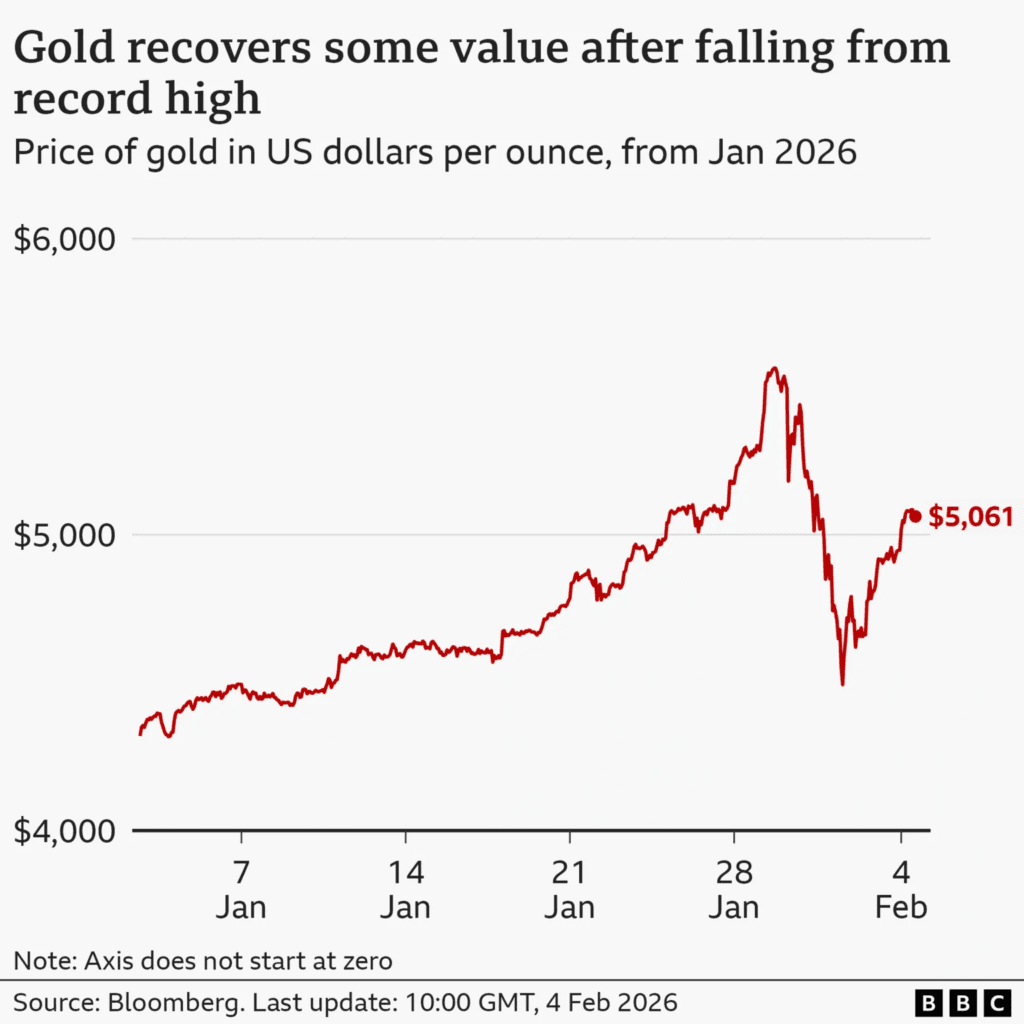
From record highs to record volatility
Gold surged to an all-time high above $5,500 in January, driven by trade tensions, geopolitical risk and heavy central bank buying. But prices collapsed last Friday, marking the largest one-day drop since 1983, after US President Donald Trump nominated Kevin Warsh as Federal Reserve chair, easing fears about central bank independence.
Despite the pullback, gold remains around 80% higher than a year ago, supported by geopolitical risk, central bank buying and investor demand. Strategists say the rebound reflects aggressive dip buying rather than a clear return to calm.
Emma Wall of Hargreaves Lansdown said the slump proved “too enticing to ignore,” adding that gold’s long-term drivers remain intact. Still, she warned that investors should expect further sharp swings as markets digest US rate decisions, November’s midterm elections and ongoing conflicts in Ukraine and the Middle East.
Banks still bullish on gold, cautious on silver
Despite the turbulence, major banks remain constructive on gold.
- Goldman Sachs reiterated a year-end 2026 target of $5,400, citing steady central bank buying and rising gold ETF demand as the Fed cuts rates.
- JPMorgan went further, forecasting gold could reach $6,300 by end-2026, even after the recent crash.
Silver’s outlook is more mixed. While JPMorgan sees a floor around $75 to $80 per ounce, Goldman warned that tight supply in the London market is amplifying price swings, making silver unsuitable for volatility-averse investors.
Disclosure: This article does not represent investment advice. The content and materials featured on this page are for educational purposes only.
Related: Gold and Silver Crashed. Here’s What Really Happened and Why It Matters
Gold, silver and defence: reasons to be bullish and bearish
Is It Too Late to Invest in Gold in 2026?
Three Reasons Gold Hit Record Highs — and One Key Reason It’s Falling Now