

Choosing where your money goes is about more than just chasing returns. For many young professionals, investing now means weaving personal values with financial ambitions to support causes that matter—from environmental protection to diversity in the workplace. If you want your portfolio to reflect your beliefs, understanding ethical investing can help you build wealth while positively impacting society and the world.
Table of Contents
- What Is Ethical Investing And Why It Matters
- Types Of Ethical Investment Approaches
- How Esg Criteria Shape Investment Decisions
- Building And Managing Ethical Portfolios
- Risks, Limitations, And Greenwashing Concerns
Key Takeaways
| Point | Details |
|---|---|
| Ethical Investing Focus | Ethical investing combines personal values with financial strategies, prioritizing companies that excel in environmental, social, and governance (ESG) practices. |
| Investment Strategies | Various approaches exist, such as Socially Responsible Investing (SRI), ESG Integration, Impact Investing, and Thematic Investing, each tailored to different ethical considerations. |
| ESG Criteria Importance | ESG criteria enhance investment decision-making, revealing a company’s sustainability and risk management potential beyond traditional financial metrics. |
| Risks and Challenges | Investors must be vigilant against greenwashing and seek third-party verification to ensure genuine ethical practices and avoid misleading claims. |
What Is Ethical Investing and Why It Matters
Ethical investing represents a transformative approach to finance where personal values directly intersect with investment strategies. Unlike traditional investment models that prioritize pure financial returns, ethical investing integrates environmental, social, and governance (ESG) considerations into the decision-making process.
At its core, ethical investing involves deliberately choosing investments that align with specific moral principles. These principles might include supporting companies that:
- Demonstrate strong environmental sustainability practices
- Prioritize fair labor standards
- Promote diversity and inclusive workplace policies
- Develop technologies addressing critical global challenges
- Maintain transparent corporate governance structures
The fundamental philosophy behind ethical investing goes beyond simply avoiding harmful investments. Instead, it actively seeks to create positive societal impact while generating competitive financial returns. Responsible investing integrates ethical considerations into investment strategies, reflecting a deliberate commitment to universal moral principles.
Why does this approach matter? Because investors increasingly recognize that financial performance and social responsibility are not mutually exclusive. Companies with strong ethical practices often demonstrate more resilient business models, better risk management, and long-term sustainability.
Ethical investing encourages transparency, stakeholder engagement, and corporate accountability by redirecting financial resources toward organizations creating positive societal value.
Modern investors, particularly younger generations, are demanding more than just financial returns. They want their investments to reflect their personal values and contribute to meaningful global progress. This shift represents a profound transformation in how we conceptualize the role of capital in society.
Pro tip: Start by researching investment funds or exchange-traded funds (ETFs) that specifically focus on companies with strong ESG ratings to begin your ethical investing journey.
Types of Ethical Investment Approaches
Responsible investing encompasses multiple strategic approaches, each offering unique ways to align financial goals with personal values. These approaches provide investors with flexible methods to create positive impact while pursuing competitive returns.
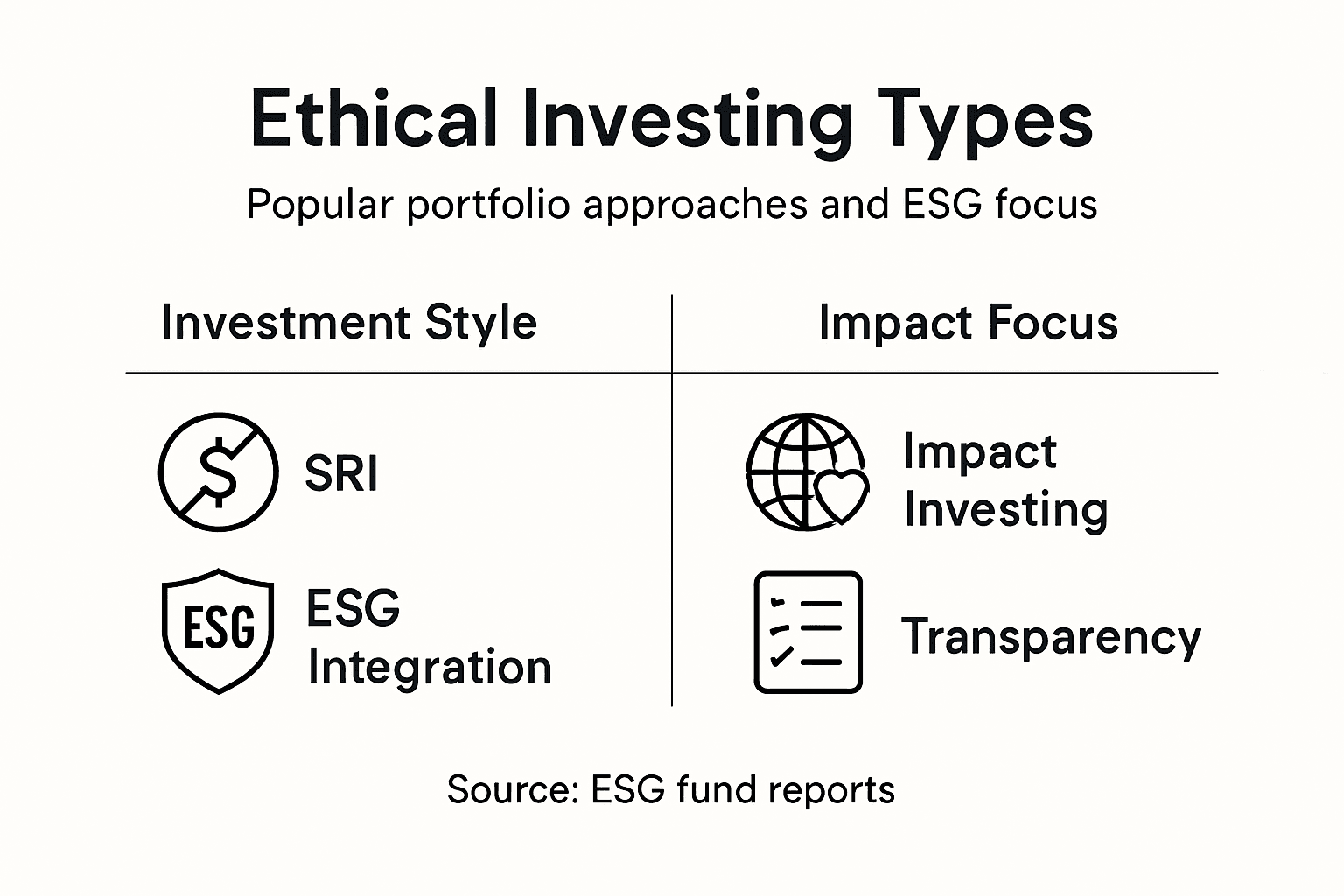
Responsible investing includes several key strategies, each targeting different aspects of ethical investment:
- Socially Responsible Investing (SRI): Applies negative screening to exclude companies in controversial industries like tobacco, weapons, or fossil fuels
- ESG Integration: Systematically incorporates environmental, social, and governance factors into investment analysis
- Impact Investing: Specifically targets investments that generate measurable social or environmental outcomes
- Thematic Investing: Focuses on specific sectors driving positive change, such as renewable energy or healthcare innovation
- Shareholder Advocacy: Uses investor influence to encourage corporate policy changes and improved practices
Socially Responsible Investing (SRI) represents the most traditional approach, where investors proactively avoid supporting industries that conflict with their moral standards. This method typically involves creating exclusionary lists that prevent investment in companies involved in activities like environmental damage, human rights violations, or unethical labor practices.
Here’s how ethical investment approaches differ in strategy and intended impact:
| Approach | Screening Method | Intended Outcome | Typical Example |
|---|---|---|---|
| Socially Responsible | Excludes specific sectors | Avoid support for controversial industries | Tobacco-free funds |
| ESG Integration | Incorporates ESG metrics | Prioritize companies with strong practices | Comprehensive ESG funds |
| Impact Investing | Targets direct outcomes | Achieve measurable social impact | Sustainable agriculture bonds |
| Thematic Investing | Focuses on specific themes | Advance sector-based progress | Renewable energy ETFs |
| Shareholder Advocacy | Influences company policy | Push for improved corporate behaviors | Proxy voting campaigns |
Ethical investment strategies are not about sacrificing financial performance, but about creating long-term value that benefits both investors and society.
ESG integration has gained significant momentum in recent years, offering a more nuanced approach. Instead of simple exclusion, this strategy involves comprehensively analyzing a company’s environmental impact, social responsibility, and governance practices as part of the overall investment assessment.

Impact investing takes ethical investment a step further by intentionally seeking out opportunities that can generate positive, measurable social and environmental change alongside financial returns. This approach is particularly appealing to investors who want to see direct, tangible results from their investment choices.
Pro tip: Begin your ethical investing journey by researching funds that provide detailed ESG ratings and transparency in their investment selection process.
How ESG Criteria Shape Investment Decisions
Environmental, Social, and Governance (ESG) criteria have fundamentally transformed how investors evaluate potential investments. These comprehensive metrics go far beyond traditional financial analysis, providing a holistic view of a company’s potential for sustainable long-term performance.
ESG investing involves systematic measurement and analysis of critical organizational characteristics across three key dimensions:
-
Environmental Factors:
- Carbon emissions tracking
- Renewable energy investments
- Waste management practices
- Climate change resilience strategies
-
Social Factors:
- Labor practices and employee treatment
- Workplace diversity and inclusion
- Community engagement initiatives
- Human rights considerations
-
Governance Factors:
- Board diversity and independence
- Executive compensation structures
- Transparency in financial reporting
- Ethical business conduct
Investors use these multifaceted criteria to assess not just financial metrics, but a company’s potential risks and opportunities from a broader societal perspective. This approach recognizes that companies demonstrating strong ESG performance often exhibit more robust risk management, innovation potential, and long-term sustainability.
ESG criteria are not just ethical checkboxes, but sophisticated tools for identifying companies with resilient, forward-thinking business models.
The nuanced evaluation process involves deep analysis of how companies manage complex challenges beyond traditional financial statements. Investors examine a company’s carbon footprint, labor practices, board composition, and strategic approaches to emerging global challenges.
Modern investment strategies increasingly recognize that financial performance and social responsibility are deeply interconnected. Companies with strong ESG practices often demonstrate greater operational efficiency, better stakeholder relationships, and more adaptive strategic planning.
Pro tip: Request detailed ESG reports from potential investment options and learn to interpret the metrics beyond surface-level scores.
Building and Managing Ethical Portfolios
Ethical portfolio construction represents a strategic approach that balances financial performance with values-driven investment decisions. It requires thoughtful planning, ongoing research, and a commitment to aligning investment choices with personal and societal principles.
Building ethical portfolios involves a purposeful, step-by-step process that demands careful consideration:
-
Define Ethical Investment Goals
- Identify core personal values
- Establish clear financial objectives
- Determine acceptable risk tolerance
- Prioritize impact areas (climate, social justice, governance)
-
Select Appropriate Investment Vehicles
- Research ESG-focused mutual funds
- Explore socially responsible ETFs
- Consider impact investing platforms
- Evaluate individual stock sustainability ratings
-
Implement Screening Strategies
- Negative screening: Exclude problematic industries
- Positive screening: Actively support progressive companies
- Best-in-class approach: Choose top performers within sectors
Successful ethical portfolio management requires continuous monitoring and strategic adaptation. Investors must remain vigilant about changing corporate practices, emerging sustainability trends, and evolving ethical standards that might impact their investment choices.
Ethical investing is not about perfect purity, but about making intentional choices that reflect your values while maintaining financial pragmatism.
The complexity of ethical investing goes beyond simple exclusion. It involves deep research, understanding nuanced corporate behaviors, and recognizing that sustainable practices often correlate with long-term financial resilience. Companies demonstrating strong environmental, social, and governance practices frequently show greater innovation potential and risk mitigation.
Modern ethical investors understand that financial performance and social responsibility are not mutually exclusive. By carefully selecting investments that align with personal values, they can potentially achieve competitive returns while contributing to positive global change.
Pro tip: Develop a dynamic ethical investment strategy by regularly reviewing your portfolio’s ESG performance and remaining open to rebalancing as corporate practices evolve.
Risks, Limitations, and Greenwashing Concerns
Ethical investing, while promising, is not without significant challenges that investors must carefully navigate. Understanding the potential pitfalls is crucial for making informed and genuinely impactful investment decisions.
Greenwashing represents a critical challenge in ethical investing, involving deliberate misrepresentation of environmental and social credentials:
-
Common Greenwashing Red Flags:
- Vague or unsubstantiated sustainability claims
- Lack of transparent, measurable ESG metrics
- Overemphasis on minor environmental initiatives
- Inconsistency between marketing claims and actual practices
- Absence of third-party verification
-
Potential Investment Risks:
- Misleading performance representations
- Potential financial underperformance
- Limited actual social or environmental impact
- Higher management fees for ESG products
- Complexity in verifying ethical claims
The complexity of ethical investing stems from the nuanced nature of corporate sustainability. Companies often present carefully crafted narratives that may not accurately reflect their true environmental and social practices. Investors must develop sophisticated analytical skills to distinguish genuine commitment from marketing rhetoric.
The following table summarizes key risks and vigilance strategies in ethical investing:
| Risk or Concern | Potential Impact | How to Mitigate |
|---|---|---|
| Greenwashing | Misleading sustainability claims | Request third-party verification |
| Limited Disclosure | Lack of ESG transparency | Compare multiple data sources |
| High Fees | Reduced investment returns | Review expense ratios |
| Unverified Impact | Minimal real social change | Analyze measurable outcomes |
Ethical investing requires ongoing skepticism, continuous research, and a willingness to challenge seemingly positive corporate narratives.
Regulatory frameworks are slowly evolving to address these challenges, but investors cannot rely solely on external oversight. Personal due diligence becomes paramount in identifying truly responsible investment opportunities that align with personal values and demonstrate meaningful societal impact.
Modern ethical investors must approach their strategies with a critical eye, recognizing that sustainable investing is an complex ecosystem requiring constant vigilance, nuanced understanding, and a commitment to deep, comprehensive research.
Pro tip: Develop a robust verification process by cross-referencing ESG claims with multiple independent sources and sustainability ratings before making investment decisions.
Take Control of Your Investments with Ethical Guidance
Ethical investing offers a powerful way to align your financial goals with your personal values. If you are concerned about navigating complex ESG criteria or wary of greenwashing, you are not alone. Many investors struggle to build portfolios that truly reflect their commitment to social responsibility without sacrificing returns. At finblog.com, we specialize in helping you overcome these challenges by providing expert insights and personalized advice tailored to ethical investment strategies.
Discover how to define your ethical investment goals, select the right ESG-focused funds, and avoid common pitfalls by accessing our trusted resources. Start shaping a portfolio that balances impact and financial performance today. Don’t wait to make your values drive growth. Visit finblog.com now and take the first step toward informed, confident ethical investing.
Frequently Asked Questions
What is ethical investing?
Ethical investing is an approach that integrates personal values with investment strategies by prioritizing environmental, social, and governance (ESG) considerations over solely financial returns.
How do I start ethical investing?
Begin your ethical investing journey by researching funds or exchange-traded funds (ETFs) that focus on companies with strong ESG ratings, and define your personal values and investment goals.
What are the different types of ethical investment strategies?
The main types of ethical investment strategies include Socially Responsible Investing (SRI), ESG Integration, Impact Investing, Thematic Investing, and Shareholder Advocacy, each targeting different aspects of ethical impact.
How can I ensure my investments are genuinely ethical?
To ensure your investments are genuinely ethical, request detailed ESG reports, develop a verification process by cross-referencing claims with multiple independent sources, and remain vigilant about the potential for greenwashing.
Recommended
- Growth vs. Value Investing: Making the Right Choice – Finblog
- Growth Stocks vs Value Stocks: Complete Guide – Finblog
- Understanding the Ethical Investing Guide for Investors – Finblog
- Master Building an Investment Portfolio for Profits – Finblog
- Ethical Leadership Principles – Shaping Organisational Culture|CS
- Sustainable Business Growth: Impactful Digital Strategies – seo analytic