

More than half of American investors struggle to distinguish between growth stocks and value stocks in a rapidly changing market. Choosing the right investment path matters because every decision can shape long-term financial outcomes. By clarifying the key traits and performance differences of these two popular stock types, you can make smarter portfolio choices that fit your unique goals and risk tolerance.
Table of Contents
- Defining Growth Stocks And Value Stocks
- Key Characteristics Of Growth And Value Stocks
- Evaluating Performance And Risk Factors
- Investment Strategies For Each Stock Type
- Comparing Historical Returns And Volatility
Key Takeaways
| Point | Details |
|---|---|
| Distinction Between Stock Types | Growth stocks focus on companies with high future growth potential, while value stocks are undervalued, stable businesses. |
| Investment Strategies | Growth investors prioritize innovation and momentum, while value investors emphasize long-term fundamentals and steady income. |
| Performance and Risk Factors | Growth stocks exhibit higher volatility and risk, whereas value stocks tend to offer stable returns and solid financial performance. |
| Portfolio Diversification | Balancing both growth and value stocks can create a resilient portfolio, mitigating risks while maximizing returns. |
Defining Growth Stocks and Value Stocks
Investors navigating the stock market encounter two fundamental investment strategies: growth stocks and value stocks. Each approach represents a distinct philosophy for identifying potential investment opportunities. Growth investing focuses on companies expected to expand faster than the broader market, while value investing targets undervalued securities with strong fundamental potential.
Growth stocks are characterized by companies demonstrating robust earnings expansion, typically in dynamic sectors like technology and innovation. These stocks often have higher price-to-earnings ratios, reflecting market expectations of substantial future growth. Investors are typically willing to pay a premium for stocks of companies showing significant potential for revenue and profit increases. Companies like emerging technology firms or innovative startups frequently represent classic growth stock examples.
Conversely, value stocks represent mature businesses trading below their intrinsic worth. These stocks generally have lower price-to-earnings ratios and may offer steady dividend income. Value investors seek companies with solid fundamentals that appear undervalued by the market. Such stocks are often found in traditional industries like utilities, manufacturing, and established consumer goods sectors. The goal is identifying high-quality companies temporarily overlooked by broader market sentiment, presenting potential opportunities for patient investors willing to wait for market recognition.

The key distinction between growth and value stocks lies in their underlying investment philosophy. Growth investors prioritize future potential and expansion trajectory, while value investors emphasize current financial strength and potential undervaluation. Both strategies offer unique advantages and can play complementary roles in a well-diversified investment portfolio.
Key Characteristics of Growth and Value Stocks
Investors must understand the unique characteristics that distinguish growth stocks from value stocks to make informed investment decisions. While both investment strategies aim to generate returns, they approach stock selection through fundamentally different lenses. Value investing principles reveal nuanced approaches to identifying potential investment opportunities across different market segments.
Growth stocks exhibit several defining characteristics that set them apart. These stocks typically represent companies with above-average earnings growth potential, often in emerging or innovative industries. Key features include:
- Higher price-to-earnings (P/E) ratios
- Substantial revenue expansion rates
- Limited or no dividend payments
- Strong reinvestment in research and development
- Significant market share growth potential
Value stocks, in contrast, demonstrate entirely different investment attributes. These securities represent established companies trading below their intrinsic market value. Characteristic features include:
- Lower price-to-earnings (P/E) ratios
- Consistent dividend distributions
- Stable financial performance
- Mature business models
- Strong balance sheet fundamentals
Understanding these distinctive characteristics helps investors strategically allocate their portfolios. Growth stocks offer potential for significant capital appreciation, while value stocks provide more predictable income streams and potential stability. Sophisticated investors often balance both approaches to create diversified investment strategies that mitigate risk and maximize potential returns.
Evaluating Performance and Risk Factors
Investors must carefully analyze the performance and risk profiles of growth and value stocks to make informed investment decisions. Building an investment portfolio requires understanding the nuanced trade-offs between potential returns and associated risks for different stock categories.
Growth stocks typically present higher risk and volatility compared to value stocks. Key performance evaluation metrics include:
- Earnings growth rate
- Revenue expansion
- Market capitalization trends
- Price momentum
- Sector-specific growth potential
Value stocks generally demonstrate more stable performance characteristics, with risk mitigation strategies centered on:
- Consistent dividend yields
- Lower price-to-earnings ratios
- Strong balance sheet fundamentals
- Established market positions
- More predictable financial performance
Risk assessment involves multiple dimensions beyond traditional financial metrics. Investors must consider macroeconomic factors, industry dynamics, and individual company characteristics. Sophisticated investors often employ diversification strategies that balance growth and value stock exposures, creating resilient portfolios capable of weathering market fluctuations and capturing potential opportunities across different economic environments.
Investment Strategies for Each Stock Type
Investors must develop targeted strategies that align with the unique characteristics of growth and value stocks. Asset allocation strategies play a critical role in maximizing investment potential across different stock categories, requiring nuanced approaches tailored to individual investment goals.
Growth Stock Investment Strategies:
- Implement momentum investing techniques
- Focus on emerging technology and innovative sectors
- Prioritize companies with high earnings growth potential
- Accept higher volatility for potential above-market returns
- Regularly rebalance portfolio to capture emerging opportunities
- Conduct thorough research on company innovation and market positioning
Value Stock Investment Strategies:
- Emphasize long-term fundamental analysis
- Target undervalued companies with strong financial foundations
- Seek consistent dividend income streams
- Prioritize stocks with low price-to-earnings ratios
- Develop a patient investment approach
- Focus on established industries with stable performance
Successful investors recognize that effective stock selection requires a balanced approach. By understanding the distinct characteristics of growth and value stocks, investors can create diversified portfolios that leverage the strengths of both investment styles, mitigating risk while maintaining potential for meaningful financial growth.
Comparing Historical Returns and Volatility
Investors seeking comprehensive insights must carefully analyze the performance nuances between growth and value stocks across different market cycles. How to pick stocks requires understanding the historical return patterns and volatility characteristics unique to each investment strategy.
Historical Performance Comparison:
-
Growth Stocks Characteristics:
• Higher average annual returns during bull markets
• More significant price fluctuations
• Greater potential for substantial capital appreciation
• Typically outperform during technological and economic expansion periods -
Value Stocks Characteristics:
• More consistent and stable returns
• Lower price volatility
• Enhanced performance during economic downturns
• Higher likelihood of generating steady dividend income
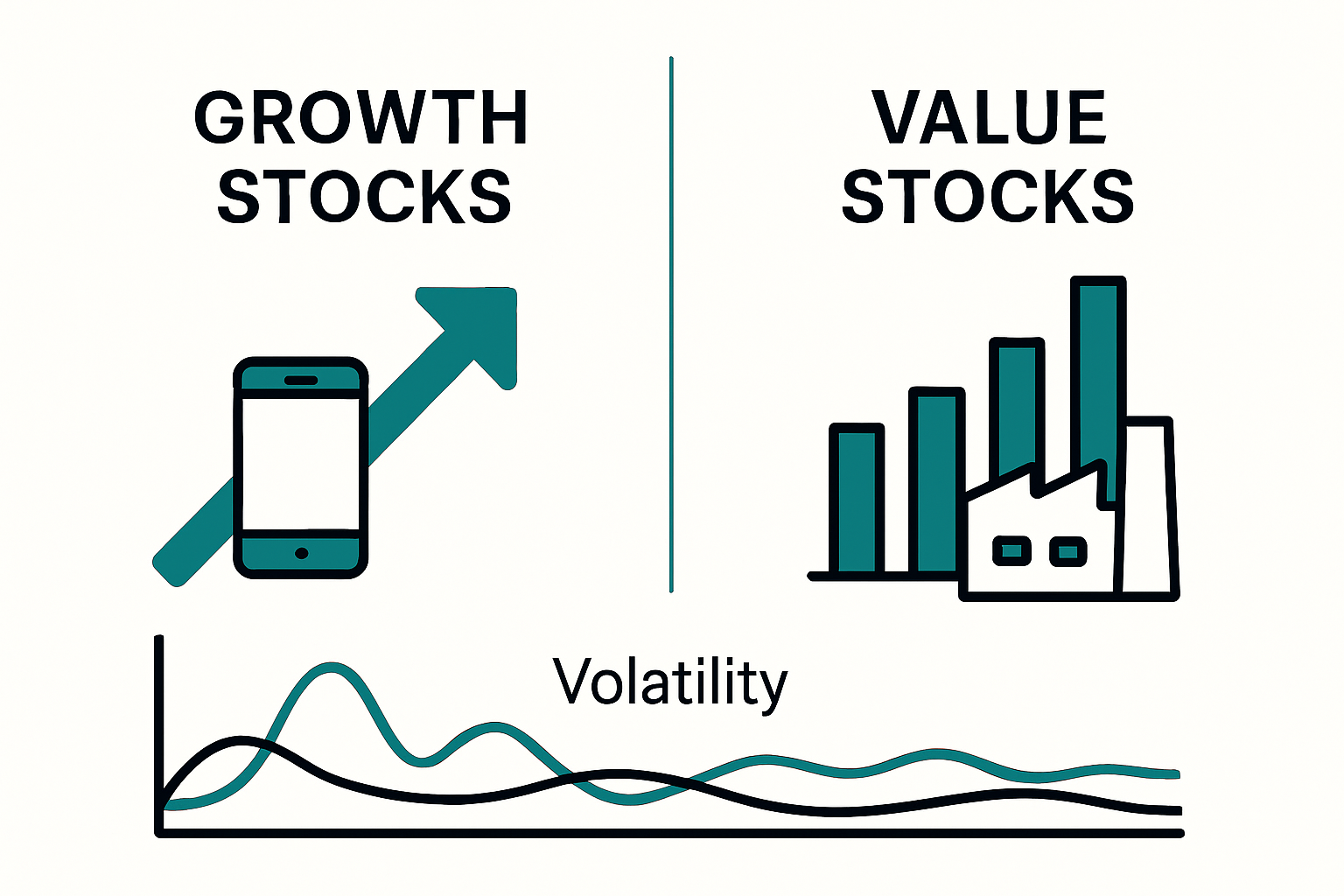
Volatility Analysis reveals critical insights for strategic investment planning. Growth stocks demonstrate more pronounced price swings, reflecting their dependence on market sentiment and future growth expectations. Conversely, value stocks exhibit more predictable performance patterns, anchored by established business fundamentals and consistent financial metrics. Sophisticated investors recognize that balancing these two approaches can create a resilient portfolio capable of navigating diverse economic environments while mitigating overall investment risk.
Discover Your Ideal Investment Approach with Expert Guidance
Understanding the complex differences between growth stocks and value stocks can feel overwhelming. You want to build a portfolio that balances future potential with financial stability but need clear advice tailored to your goals. Whether you’re aiming for high earnings growth or consistent dividends, navigating these options requires trusted insights and strategies designed to protect your investment while maximizing returns.
At finblog.com, we provide comprehensive resources and expert consultation to help you confidently choose between growth and value investments. Explore our investment portfolio building guide to learn how to structure your assets effectively. Ready to take the next step? Visit finblog.com now to start crafting a well-diversified investment plan that aligns with your financial ambitions.
Frequently Asked Questions
What are growth stocks?
Growth stocks are shares in companies that are expected to grow at an above-average rate compared to other companies in the market. They typically have higher price-to-earnings ratios and reinvest their profits into expanding operations.
What are value stocks?
Value stocks are shares in companies that are considered undervalued relative to their true worth. These stocks usually have lower price-to-earnings ratios and may offer consistent dividends, indicating established businesses with stable financial health.
How can I evaluate growth vs. value stocks?
To evaluate growth stocks, consider metrics such as earnings growth rate and market momentum. For value stocks, focus on price-to-earnings ratios, dividend yields, and the company’s overall financial stability. Both types require careful analysis of performance metrics and market conditions.
What are some investment strategies for growth and value stocks?
For growth stocks, strategies include momentum investing and focusing on emerging sectors with high earnings potential. For value stocks, strategies involve long-term analysis to target undervalued companies and prioritize stable dividend income.
Recommended
- Growth Investing: Everything You Need to Know – Finblog
- Complete Guide to Value Investing Principles – Finblog
- 14 Companies That Could Benefit From Trump’s State Capitalism
- Master Building an Investment Portfolio for Profits – Finblog
- Business Blog Explained: Key Benefits for Growth | Ibrandmedia
- 10 Powerful Examples of Investment Strategies – Future Family Office