

More than 20 million American adults have added cryptocurrency to their investment portfolios, yet misconceptions linger about how these digital assets really work. For professionals seeking smarter ways to diversify beyond stocks and bonds, understanding cryptocurrency opens new possibilities but brings unique risks. This article separates myth from reality while offering clear guidance so you can confidently evaluate if cryptocurrency fits your financial strategy.
Table of Contents
- Cryptocurrency Defined And Common Myths
- Major Types Of Digital Assets Explained
- How Blockchain Powers Cryptocurrency Transactions
- Regulatory Landscape And Taxation Issues
- Risks, Security, And Investing Mistakes To Avoid
Key Takeaways
| Point | Details |
|---|---|
| Understand Cryptocurrency Risks | Cryptocurrency investing involves high volatility and security vulnerabilities; be aware of potential losses and emotional decision-making pitfalls. |
| Conduct Thorough Research | Before investing, familiarize yourself with the complexities of digital assets and the underlying technology of cryptocurrencies. |
| Adhere to Regulatory Compliance | Stay updated on evolving cryptocurrency regulations to ensure proper reporting and compliance, particularly regarding taxation. |
| Implement Risk Management Strategies | Apply disciplined investment strategies, limit exposure to 5% of your total portfolio, and use security measures to protect your assets. |
Cryptocurrency Defined And Common Myths
Cryptocurrency represents a groundbreaking digital asset that transforms traditional financial transactions. At its core, cryptocurrency is a decentralized digital currency utilizing blockchain technology to enable secure, peer-to-peer financial exchanges without requiring traditional banking intermediaries. Understanding cryptocurrencies involves recognizing how cryptographic proofs replace centralized trust mechanisms.
Contrary to popular belief, cryptocurrencies are not simple digital cash equivalents. They represent complex technological systems with significant volatility and unique transaction characteristics. Many people mistakenly assume cryptocurrencies function exactly like traditional currencies, but research on cryptocurrency myths reveals critical differences. These digital assets often experience dramatic price fluctuations, making them unreliable for consistent everyday transactions.
Key myths about cryptocurrencies include misconceptions about their stability, usability, and investment potential. Most people incorrectly believe cryptocurrencies are:
- A guaranteed stable investment
- Universally accepted as payment
- Easy to understand and use
- Completely anonymous
- Free from regulatory oversight
In reality, cryptocurrencies represent a sophisticated technological innovation requiring significant financial literacy and risk management strategies. Their decentralized nature means they operate outside traditional financial systems, presenting both unique opportunities and substantial challenges for investors.
Pro Tip: Before investing in any cryptocurrency, conduct thorough research, understand the underlying blockchain technology, and only invest what you can afford to potentially lose.
Major Types Of Digital Assets Explained
Digital assets represent a revolutionary approach to financial interactions, encompassing a wide range of technological and economic innovations. Digital asset classifications fundamentally divide into two primary categories: fungible and nonfungible digital assets. Fungible digital assets function as interchangeable units, with cryptocurrencies like Bitcoin serving as the most prominent example, while nonfungible tokens (NFTs) represent unique digital items with distinct individual characteristics.

Cryptocurrencies form the most recognized segment of digital assets, operating as decentralized digital currencies that enable peer-to-peer transactions without traditional financial intermediaries. These assets include well-known examples like Bitcoin and Ethereum, but also encompass thousands of alternative tokens with varying technological foundations and economic purposes. Some cryptocurrencies focus on providing financial infrastructure, while others aim to solve specific technological challenges or create decentralized application ecosystems.
The digital asset landscape extends beyond cryptocurrencies and includes several nuanced categories:
- Cryptocurrencies: Decentralized digital money
- Utility Tokens: Designed for specific platform access or services
- Security Tokens: Digital representations of traditional investment assets
- Non-Fungible Tokens (NFTs): Unique digital collectibles and ownership certificates
- Stablecoins: Cryptocurrencies pegged to stable assets like USD
Understanding these digital assets requires recognizing their complex technological and economic frameworks. Emerging asset transformation processes demonstrate how digital resources create value through innovative recombination and programmable economic models.
Here’s a quick comparison of major digital asset types and their primary purposes:
| Digital Asset Type | Key Example | Main Purpose | Unique Value Proposition |
|---|---|---|---|
| Cryptocurrency | Bitcoin | Peer-to-peer payments | Decentralized transfer of value |
| Utility Token | Ethereum | Platform access | Enables decentralized applications |
| Security Token | tZERO | Investment representation | Tokenized securities with compliance |
| Non-Fungible Token | Bored Ape NFT | Digital ownership certification | Uniqueness and provable scarcity |
| Stablecoin | USDC | Stable digital transactions | Price stability, asset backing |
Pro Tip: Diversify your digital asset knowledge by studying multiple categories and understanding the unique technological mechanisms behind each type of asset.
How Blockchain Powers Cryptocurrency Transactions
Blockchain technology represents a groundbreaking approach to digital transaction management, fundamentally transforming how financial exchanges occur. Blockchain fundamentals reveal a sophisticated system that creates a distributed, cryptographically secured ledger enabling transparent and tamper-resistant transaction recording. Unlike traditional financial systems, blockchain eliminates the need for centralized intermediaries by creating a decentralized network where every transaction is independently verified and permanently recorded.
The core mechanism of blockchain involves breaking transactions into encrypted blocks that are chronologically linked and mathematically validated across a distributed network of computers. Distributed ledger technology ensures that no single entity can manipulate transaction records, as each block contains a cryptographic hash of the previous block, creating an immutable chain of information. This process guarantees transaction integrity, prevents double-spending, and provides unprecedented transparency in financial exchanges.
Cryptocurrency transactions on blockchain networks involve several critical steps:
- Transaction Initiation: User sends cryptocurrency from one wallet to another
- Transaction Broadcast: Network nodes receive and validate the transaction
- Block Creation: Verified transactions are grouped into a new block
- Consensus Mechanism: Network participants confirm block validity
- Block Addition: Validated block is added to the blockchain
- Transaction Completion: Funds are transferred between wallets
Understanding blockchain’s intricate mechanics reveals its potential to revolutionize not just financial transactions, but multiple sectors requiring secure, transparent record-keeping. The technology’s ability to create trust through mathematical proofs represents a fundamental shift in how we conceptualize digital interactions and value transfer.
Pro Tip: Always verify the consensus mechanism and network security before investing in any blockchain-based cryptocurrency.
Regulatory Landscape And Taxation Issues
Cryptocurrency regulations represent a complex and evolving legal landscape that challenges traditional financial frameworks. State-level cryptocurrency regulations create a patchwork of rules across the United States, with no unified federal approach currently governing digital asset management. This regulatory diversity means cryptocurrency investors must navigate multiple, often conflicting legal requirements depending on their specific location and transaction types.
The federal government continues to scrutinize digital assets with increasing intensity. Digital asset financial risks have prompted significant governmental attention, with regulatory agencies focusing on several critical areas of concern:
- Investor protection mechanisms
- Prevention of money laundering
- Tax reporting and compliance
- Market manipulation prevention
- Cybersecurity standards
Taxation of cryptocurrency transactions presents another layer of complexity for investors. The Internal Revenue Service (IRS) treats cryptocurrencies as property, meaning every transaction potentially triggers a taxable event. This approach requires meticulous record-keeping, with investors responsible for tracking purchase prices, sale prices, and calculating capital gains or losses for each transaction. Cryptocurrency traders must report all exchanges, even those involving different digital currencies, creating significant administrative burden.
Navigating this intricate regulatory environment demands careful strategy and professional guidance. Investors must remain adaptable, understanding that the legal landscape surrounding digital assets continues to shift rapidly, with potential for significant regulatory changes in the near future.
Pro Tip: Consult a tax professional specializing in cryptocurrency transactions to ensure proper reporting and compliance with current regulations.
Risks, Security, And Investing Mistakes To Avoid
Cryptocurrency investing demands a sophisticated understanding of complex risk landscapes. Cryptocurrency investment risks reveal a challenging environment where potential losses can be substantial and investor protections are minimal. Unlike traditional financial instruments, digital assets operate in an ecosystem characterized by extreme volatility, limited regulatory oversight, and significant technological vulnerabilities.
Investors must recognize multiple layers of risk inherent in cryptocurrency investments. These risks encompass technological, financial, and security dimensions:
- Market Volatility: Extreme price fluctuations
- Security Vulnerabilities: Potential for hacking and theft
- Regulatory Uncertainty: Changing legal landscapes
- Technological Risks: Potential blockchain network failures
- Liquidity Challenges: Difficulty converting assets to cash
The most common investing mistakes in cryptocurrency stem from emotional decision-making and insufficient research. Inexperienced investors frequently fall into predictable traps such as panic selling during market downturns, investing more than they can afford to lose, and failing to diversify their digital asset portfolio. Successful cryptocurrency investors develop disciplined strategies that prioritize risk management, continuous learning, and maintaining a long-term perspective.
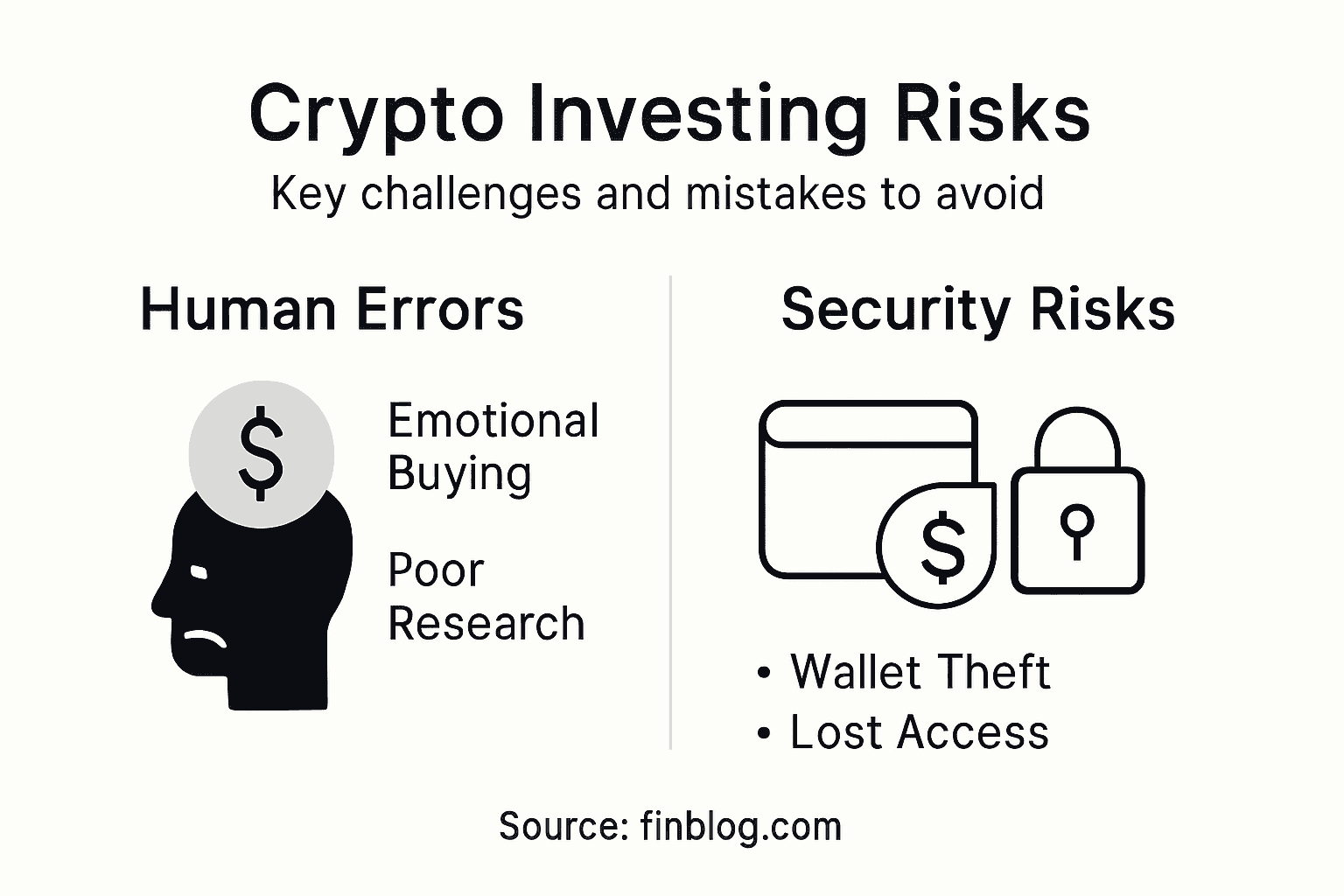
Effective risk mitigation requires a comprehensive approach that combines technological savvy, financial prudence, and psychological resilience. This means implementing robust security measures like using hardware wallets, enabling two-factor authentication, and maintaining detailed transaction records.
To aid your understanding, here’s a summary of critical risks faced by cryptocurrency investors:
| Risk Category | Example Scenario | Why It Matters |
|---|---|---|
| Market Volatility | Sudden 30% drop overnight | Can lead to substantial financial loss |
| Regulatory Uncertainty | New legislation bans certain tokens | Changes may restrict trading |
| Security Threats | Exchange hacking or wallet theft | Loss of funds may be irreversible |
| Liquidity Issues | Difficulty cashing out | Hard to convert to fiat quickly |
| Technological Failure | Blockchain network outage | Transactions delayed or blocked |
Pro Tip: Always allocate no more than 5% of your total investment portfolio to cryptocurrency to maintain a balanced and responsible investment strategy.
Take Control of Your Cryptocurrency Journey Today
Navigating the world of cryptocurrency can feel overwhelming with terms like blockchain technology, digital asset types, and regulatory risks. This article highlights key challenges including market volatility, security threats, and complex tax requirements. If you want to avoid common investing mistakes and build wealth steadily in this digital era, understanding these concepts is just the first step.
At finblog.com, we specialize in guiding investors through these complexities. Our expert insights and tailored advice help you develop effective risk management strategies and stay ahead of evolving regulations. Don’t wait until uncertainty or market swings threaten your investments. Visit finblog.com now to access resources designed to empower you with knowledge and confidence for a safer cryptocurrency experience.
Frequently Asked Questions
What is cryptocurrency?
Cryptocurrency is a decentralized digital currency that uses blockchain technology to facilitate secure, peer-to-peer transactions without the need for traditional banking systems.
What are the primary types of digital assets?
Digital assets are categorized into fungible and non-fungible types. Fungible assets, like cryptocurrencies (e.g., Bitcoin), are interchangeable, while non-fungible tokens (NFTs) represent unique digital items.
What is blockchain technology and how does it work with cryptocurrencies?
Blockchain technology is a cryptographically secured, distributed ledger that records transactions transparently and immutably, eliminating the need for central intermediaries. It enables independent verification and ensures transaction integrity.
What risks should I consider when investing in cryptocurrencies?
Investing in cryptocurrencies involves several risks, including market volatility, security vulnerabilities, regulatory uncertainty, technological risks, and liquidity challenges. It’s crucial to implement risk management strategies and conduct thorough research before investing.